人才培养

Search documents
陈光明,一把捐了1.3亿!最新发声
Zhong Guo Ji Jin Bao· 2026-01-17 03:55
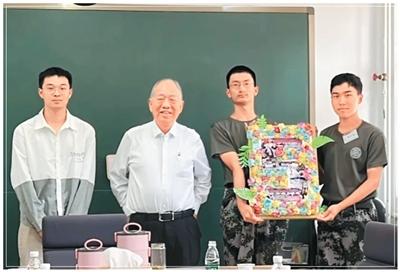
Core Viewpoint - Chen Guangming, founder of Ruifeng Fund, donated 130 million yuan to Shanghai Jiao Tong University, supporting medical assistance, scientific research innovation, and talent cultivation as a way to give back to his alma mater [1][4]. Group 1: Donation Details - The donation of 130 million yuan is aimed at supporting the "Ruifeng Youth Science Award" and is intended to facilitate young researchers, medical assistance, business innovation, and departmental development [4]. - Since 2015, Chen Guangming has donated nearly 200 million yuan to Shanghai Jiao Tong University, contributing to talent development and academic construction [6][7]. Group 2: Impact and Recognition - The "Ruifeng Science Award" and "Ruifeng Youth Science Award" have been well-received, with numerous outstanding scientists and young scholars recognized for their contributions to original research [7]. - The "Ruifeng Science Award" has been held for three consecutive years since its establishment in 2022, covering five major fields including mathematics, engineering, and life sciences, with 13 distinguished scientists awarded to date [7]. Group 3: Broader Context of Donations - Other investors, such as Duan Yongping and Xie Huanyu, have also made significant donations to their alma maters, supporting talent cultivation and innovative research [2][9]. - Duan Yongping has made multiple donations exceeding 1 billion yuan to various educational institutions, including a recent 220 million yuan donation to Beijing Normal University for the development of interdisciplinary studies [9].

山东能源新巨龙公司:人才“活水”奔涌未来
Qi Lu Wan Bao· 2026-01-14 03:13
Core Insights - The company emphasizes the importance of talent as the core element for sustainable development and long-term success, implementing the "31789" talent project to cultivate young technical talents [1] Group 1: Talent Development Strategy - The company focuses on a "theory + practice" growth path for new graduates, allowing them to work in frontline positions for 1-3 years to transform academic knowledge into practical skills [2] - A dynamic assessment mechanism is in place, where monthly evaluations by leadership and mentors help adjust training plans based on feedback, leading to significant career advancement for graduates [2] Group 2: Communication and Support - The company has established a two-way communication system to address the needs of young talents, collecting 46 suggestions related to career development and training through various channels [3] - Quarterly activities and regular meetings with leadership ensure that the concerns of young employees are heard and addressed, achieving a problem resolution rate of over 95% [3] Group 3: Empowerment and Growth - An innovative dual-mentor system is implemented, pairing experienced professionals as business mentors and capable leaders as growth mentors to guide young talents [4] - The company has created a competitive environment for promotions, with 70 young graduates promoted to middle management roles, reflecting a commitment to talent development and retention [4][5]
海底捞(06862)进行董事会结构调整,持续夯实人才梯队与组织基础
智通财经网· 2026-01-13 10:35
Core Viewpoint - Haidilao is undergoing significant management changes, including the resignation of key executives and the appointment of new directors to enhance its strategic direction and operational efficiency [1][2]. Group 1: Management Changes - Mr. Gou Yiqun resigns as Executive Director and CEO effective January 13, 2026, but will continue to play a crucial role in promoting management process automation and operational upgrades within the group [1]. - Ms. Song Qing and Ms. Gao Jie also resign from their executive roles, with Ms. Song continuing as the head of the Product Committee [1]. - New executive directors, including Ms. Li Nana, Ms. Zhu Yinhua, Ms. Jiao Defeng, and Ms. Zhu Xuanyi, have been appointed to support the company's innovation and long-term development, effective January 13, 2026 [1]. Group 2: Board Composition and Diversity - Mr. Zhang Yong, the Chairman and Executive Director, is appointed as the new CEO effective January 13, 2026, while Ms. Li Nana joins the Nomination Committee [2]. - The new directors have extensive experience within Haidilao, coming from various operational and strategic backgrounds, indicating a focus on internal talent development [2]. - The board's composition is becoming more diverse in terms of gender and age, which is expected to bring new perspectives and enhance governance standards [2]. Group 3: Market Outlook - Citigroup has raised Haidilao's 2025 sales forecast by 2% due to growth in its delivery business and better-than-expected contributions from new ventures, increasing the target price from HKD 18.5 to HKD 19.7 while maintaining a "Buy" rating [3]. - Dongwu Securities also maintains a "Buy" rating, highlighting Haidilao's strong brand presence in the hot pot sector and its ability to optimize store operations and develop new brand matrices despite industry pressures [3].

凝聚共识谋发展 谱写期货服务产业新篇章
Qi Huo Ri Bao Wang· 2026-01-13 01:04
Core Viewpoint - The 2026 Industry Service Alliance Conference in Zhengzhou focused on enhancing the futures industry's service to the real economy, addressing challenges in differentiation, digital transformation, compliance, and talent cultivation [1] Group 1: Service to the Real Economy - The futures market's core mission is to serve the real economy, but challenges such as cognitive differences, insufficient tools, and a lack of professional talent hinder effective service [2] - A multi-layered risk management service system is needed, requiring collaboration among regulatory bodies, exchanges, futures companies, and real enterprises [2] - Large state-owned enterprises prioritize compliance and precision in service, with training and simulations improving understanding of hedging in industries like steel [2] Group 2: Differentiation and Development - Differentiation is crucial for futures companies to overcome competition and achieve high-quality development [3] - Futures companies should focus on their backgrounds: industry-focused firms should deepen service in the supply chain, while those with brokerage backgrounds should integrate investment research with AI [3] - The asset management business needs to overcome challenges in product management, fundraising, and research support to avoid homogenization [3] Group 3: Digital Transformation - Digital transformation is essential for enhancing service efficiency, with AI and big data as key drivers [5] - Companies are developing intelligent systems based on AI to improve efficiency without replacing human roles [6] - Regulatory clarity on financial technology is necessary to support innovation while ensuring risk control [6] Group 4: Talent Support - Talent shortages are a significant barrier to the futures industry's development, necessitating partnerships between companies and educational institutions to enhance talent supply [8] - A scientific incentive system is recommended to retain talent and enhance their sense of belonging [8] - Practical empowerment through industry research is essential for young researchers to develop their professional skills [9] Group 5: Compliance and Ecosystem Building - The future of compliance in the securities and futures industry will shift towards a dual accountability model for companies and individuals [7] - Building a diverse cooperation ecosystem involving banks, insurance, and private equity is vital for long-term development [7] - The industry should focus on customer needs to create a service ecosystem that enhances financial literacy and market understanding [7] Group 6: Summary and Future Directions - The conference highlighted the importance of serving the real economy, with a focus on optimizing tools, addressing funding constraints, and enhancing talent supply [10] - Differentiation and asset management transformation are key paths for futures companies, with knowledge-based services emerging as growth points [10] - The Industry Service Alliance aims to foster collaboration across institutions and fields to support the futures industry's long-term development [10]
擎科技大旗 聚创新伟力 蓄发展动能
Xin Lang Cai Jing· 2026-01-11 21:21
Core Viewpoint - The article emphasizes the importance of technology and talent in driving innovation and development in Jiangsu Province, highlighting the achievements and initiatives taken by the Jiangsu Provincial Association for Science and Technology (省科协) during the "14th Five-Year Plan" period to foster a strong technological ecosystem and support over 8.5 million science and technology workers in the region [1][6]. Talent Development - The Jiangsu Provincial Association for Science and Technology has focused on building a talent ecosystem, establishing a framework for high-end talent leadership, youth talent cultivation, and reserve talent development, thereby creating a broad platform for over 8.5 million science and technology workers [1][3]. - Over the past five years, 242 candidates were nominated for the Chinese Academy of Sciences and the Chinese Academy of Engineering, with 30 being elected as academicians, placing Jiangsu third nationally [2]. - A total of 3,018 young talents have been supported to grow from "newcomers" to "backbones" in their fields, with a 100% selection rate for 260 doctoral students from 16 "Double First-Class" universities in a special talent program [3]. Innovation and Industry Development - The province has established 876 innovation platforms to empower industrial development, including 185 academicians' innovation centers and 129 provincial-level technology small courtyards, facilitating the integration of technology and industry [4][5]. - Jiangsu has hosted 102 international academic conferences and over 5,000 provincial-level academic activities, fostering a rich academic exchange ecosystem that supports industrial upgrades [4]. Science Popularization - Jiangsu has achieved a scientific literacy rate of 17.15%, ranking first nationally for nine consecutive years, with 19 counties recognized as national science popularization demonstration counties [6][7]. - The province has established numerous science education bases and launched 110 science research study routes, integrating local cultural characteristics with scientific content [6]. Future Outlook - Looking ahead to the "15th Five-Year Plan," the Jiangsu Provincial Association for Science and Technology aims to continue leading over 8.5 million science and technology workers, driving technological advancements and contributing to the modernization of Jiangsu [7].
《追光》新书发布 致敬“光纤之父”高锟
Xin Lang Cai Jing· 2026-01-11 01:43
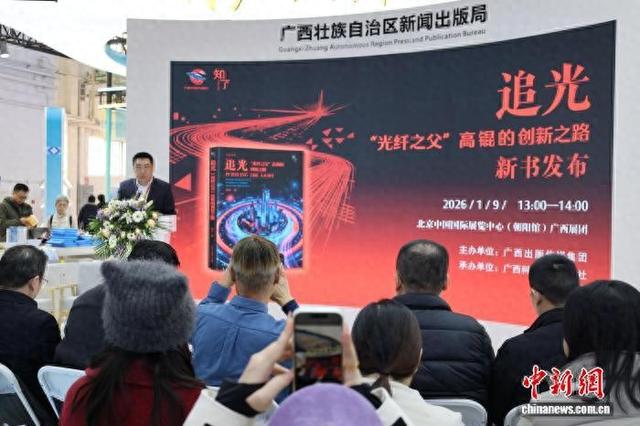
Core Viewpoint - The book "Chasing Light: The Innovative Journey of the 'Father of Fiber Optics' Gao Kun" was launched, highlighting Gao Kun's contributions to scientific research and innovation, as well as his multifaceted life [1][3]. Group 1: Book Overview - The book is a new work under the "Zhi Liao" brand by Guangxi Science and Technology Publishing House, paying tribute to Gao Kun's scientific achievements and providing a deep analysis of his innovative journey and thoughts on technology management [3]. - The author, Gao Liang, discussed the book's content, academic value, and innovative significance, emphasizing its systematic review of Gao Kun's research, management, and educational practices, along with strategic consulting suggestions for China's technological development [3][5]. Group 2: Expert Insights - Professor Wang Daming from the University of Chinese Academy of Sciences highlighted that the book allows readers to trace Gao Kun's research journey and understand the innovative logic and humanistic connotations behind technological breakthroughs [5]. - Liu Bing, a member of the Chinese Association of Science Writers, noted that the book presents the internal logic of technological development and serves as an important reference for contemporary Chinese technological innovation and talent cultivation [5]. - Huang Minxian, the executive deputy editor of Guangxi Science and Technology Publishing House, summarized that the book presents Gao Kun as both an ordinary researcher and an outstanding innovator, providing public insights into innovation and human resonance [5].
沈阳医学院附属口腔医院正式揭牌
Xin Lang Cai Jing· 2026-01-08 22:05
Core Viewpoint - The establishment of the Shenyang Medical College Affiliated Dental Hospital marks a significant step in enhancing the quality of healthcare services and education in Shenyang, with a focus on dental medicine [1] Group 1: Hospital Development - The Shenyang Dental Hospital was officially designated as an affiliated hospital of Shenyang Medical College in March 2024, reflecting the government's commitment to advancing healthcare [1] - The hospital's establishment is part of a broader initiative to integrate high-quality resources and create a new high ground for specialized medical services in Shenyang [1] Group 2: Educational Advancements - The establishment of the dental hospital has facilitated the approval of a master's program in dental medicine at Shenyang Medical College, which is crucial for the institution's goal of becoming a medical university [1] - The college has successfully passed the Ministry of Education's evaluation for undergraduate education, laying a solid foundation for future accreditation in dental medicine [1] Group 3: Future Plans - The college plans to leverage its technological innovation and clinical resources to enhance the integration of dental education and clinical practice, aiming to elevate the development of specialized disciplines and talent cultivation [1]
构筑人才生态,引领健康未来
Xin Lang Cai Jing· 2026-01-07 19:17
Group 1 - The company prioritizes building harmonious labor relations as a core aspect of its development strategy, integrating "employee value leadership" into its "comprehensive value leadership" approach [1] - The establishment of the "Digital Application Capability Development Center" aims to enhance future competitiveness in the global health food industry and develop digital talent [1] - The company implements various programs such as the "AI Super Capability Exploration Plan" to foster an innovative atmosphere and cultivate employees' data thinking and decision-making skills [1] Group 2 - The organization emphasizes respect as a core value, creating an environment that fosters recognition and belonging among employees [1] - The "Spring Rain Plan" has been implemented for 14 consecutive years, providing comprehensive care for employees at significant life moments [1] - The company has developed a health care system focused on prevention and comprehensive coverage, continuously upgrading health check services and offering a free psychological support platform called "Yixin Care" [2]

深耕乡村沃土 广聚振兴人才
Xin Lang Cai Jing· 2026-01-05 18:44
Core Viewpoint - The article highlights the efforts of Bohang Township in Huangyuan County, Xining City, to enhance local talent development and support the construction of a livable environment through various initiatives and training programs [1] Group 1: Talent Development Initiatives - Since February 2024, Bohang Township has adhered to the principle of party management of talent, focusing on "cultivating and gathering talent" to provide talent assurance and intellectual support for local development [1] - As of January 4, the township has reported 5 local talents under the county-level "Dan City Talent" program and established 1 city-level intangible cultural heritage workshop [1] Group 2: Skills Training and Community Engagement - The township organized 4 training sessions in skills such as forklift operation, maternity care, electric welding, and farmer entrepreneurship, benefiting 163 local residents [1] - Experts and industry leaders were invited to discuss rural tourism development, leveraging local tourism resources and promoting regional specialties like the "Ten Bowls of Huangyuan" and other traditional foods [1] Group 3: Economic Development and Employment - A new model for intangible cultural heritage was created, allowing over 30 local operators and culinary experts to compete, providing a platform for skill exchange and enhancing the regional food brand [1] - Local talents have played a significant role in community development, with initiatives like the establishment of a 150 square meter workshop in Nanchai Village, which has created jobs for 7 residents, increasing their monthly income by 3,000 yuan [1]
为学术交流“拆围墙”(走近科学大咖⑧)
Ren Min Ri Bao Hai Wai Ban· 2026-01-04 09:17
Core Insights - The article highlights the significant contributions of Shing-Tung Yau, a prominent mathematician, in fostering academic talent and promoting mathematical research in China, particularly through the establishment of various research institutions and initiatives aimed at bridging different fields of mathematics [4][10][18]. Group 1: Academic Contributions - Shing-Tung Yau is recognized as the first Chinese recipient of the Fields Medal, often referred to as the Nobel Prize of Mathematics, and has dedicated over 40 years to mathematical research and talent cultivation [8][10]. - The Shanghai Mathematics and Interdisciplinary Research Institute, founded by Yau, aims to create an open academic environment that encourages collaboration among scholars from various mathematical disciplines [10][12]. - As of October 2025, the institute has hired approximately 100 researchers and successfully hosted the World Alliance of Chinese Mathematicians conferences in 2023 and 2024 [10]. Group 2: Educational Philosophy - Yau emphasizes the importance of nurturing young talent in mathematics, stating that the vitality of research lies in engaging with younger generations [10][12]. - He has directly supervised over 70 doctoral students and an equal number of postdoctoral researchers, many of whom have become key figures in the mathematics community [12][13]. - Yau advocates for a holistic educational approach that integrates humanities with mathematics, believing that cultural and philosophical insights are essential for scientific inquiry [15][16]. Group 3: Future Aspirations - Yau envisions that within the next decade, the institute will cultivate 20 world-class mathematicians and 30 to 40 young mathematicians at the forefront of international academia [10][12]. - He aims to host the International Congress of Mathematicians in China by 2030, aspiring to elevate the global recognition of Chinese mathematicians [18]. - Yau believes that the current era of mathematics is rich and diverse, and he encourages a focus on fundamental research, particularly in the context of artificial intelligence, which he views as an extension of mathematical principles [18].