
关税成本

Search documents
成本冲击 跨国车企遭遇业绩压力
Zhong Guo Zheng Quan Bao· 2025-08-14 20:17
Core Insights - Major international automakers are facing significant profit declines in the first half of 2025, with only Toyota, Volkswagen, and Hyundai expected to exceed $5 billion in net profit [1] - Several automakers, including Stellantis, Nissan, Renault, Ford, and Volvo, reported losses in the second quarter or first half of the year [1] Group 1: Financial Performance - Volkswagen Group's revenue for the first half of 2025 was €158.4 billion, remaining stable year-on-year, but operating profit fell by approximately 33% to €6.7 billion, with net profit down over 38% to €4.477 billion [2] - Mercedes-Benz reported second-quarter revenue of €33.153 billion, a decline of 9.8% from €36.743 billion the previous year, with net profit dropping 68.7% to €0.957 billion [2] - BMW's revenue decreased by 8% to €67.685 billion, with net profit down 29% to €4.015 billion, although the company maintained its full-year financial outlook [3] Group 2: Impact of Tariffs and Costs - The increase in U.S. tariffs on electric vehicles and components has significantly impacted Volkswagen's profits, with an estimated loss of €1.3 billion due to tariff adjustments [2][4] - Ford reported tariff costs of $800 million in the second quarter, while General Motors faced $1.1 billion in tariff expenses [4] - Tesla indicated that tariffs have added $200 million in costs, with high tariffs on raw materials like steel and aluminum further increasing production costs for U.S. automakers [5]


John Deere forecasts $600 million in tariff impacts this year
CNBC· 2025-08-14 16:30
Core Viewpoint - John Deere is facing significant financial challenges due to rising tariff costs, which are projected to reach $600 million for fiscal 2025, impacting net income and sales performance [1][3]. Financial Performance - In the fiscal third quarter, John Deere reported a net income of $1.29 billion, a decrease of 26% from $1.73 billion in the same period last year [3]. - Total net sales for the quarter were $12.02 billion, down 9% from $13.15 billion year-over-year [3]. - Earnings per share were reported at $4.75, exceeding expectations of $4.63 [5]. - Revenue for the quarter was $10.36 billion, slightly above the expected $10.31 billion [5]. Tariff Impact - The company incurred approximately $200 million in tariff costs during the third quarter, bringing the year-to-date total to around $300 million [3]. - The forecast for the pre-tax impact of tariffs in fiscal 2025 has been adjusted to nearly $600 million [3]. Outlook - John Deere has revised its net income outlook for the fiscal year to a range of $4.75 billion to $5.25 billion, down from a previous estimate of $4.75 billion to $5.5 billion [4]. - CEO John May emphasized the company's commitment to addressing current customer needs while preparing for future growth despite near-term uncertainties [4].



报告称“美国消费者将承担关税成本”,特朗普“开炮”高盛及其CEO
Huan Qiu Shi Bao· 2025-08-13 22:45
Group 1 - Goldman Sachs released a report indicating that U.S. consumers bore 22% of the tariff costs from April to June 2023, and this figure is projected to rise to 67% by October if current tariff policies remain unchanged [1][2] - The report contradicts President Trump's assertion that other countries bear the brunt of the tariffs, leading to a public dispute between Trump and Goldman Sachs CEO David Solomon [1] - Other financial institutions have echoed concerns about rising prices due to tariffs, with the U.S. Consumer Price Index increasing by 0.2% in July and an annual inflation rate of 2.7% reported [2] Group 2 - Goldman Sachs forecasts that the inflation rate in the U.S. could reach 3.2% by the end of the year, while it would have been 2.4% without the impact of tariffs [2] - Oxford Economics predicts an even higher inflation rate of 3.8% by year-end, highlighting the broader economic implications of the current tariff policies [2]

特朗普炮轰高盛CEO“专注做DJ”
Di Yi Cai Jing Zi Xun· 2025-08-13 00:23
2025.08.13 本文字数:915,阅读时长大约1.5分钟 作者 |第一财经 胡弋杰 特朗普称,关税为美国带来数万亿美元收入,并未引发通胀或对经济造成其他损害,"主要是由企业和 政府——其中很多是外国政府——在买单"。他批评高盛未能承认这一事实,认为该行早前关于市场反 应和关税效应的判断"完全错误"。 当地时间8月12日,美国劳工统计局公布的数据显示,7月消费者价格指数(CPI)环比上涨0.2%,符合 预期,较6月的0.3%有所放缓;同比涨幅2.7%,与上月持平。剔除食品与能源的核心CPI环比升0.3%, 创1月以来最大涨幅,同比升至3.1%,高于6月的2.9%。 因7月通胀数据强化投资者对美联储下月降息的押注,标普500指数和纳指双双创下收盘纪录新高。 高盛首席经济学家简·哈祖斯(Jan Hatzius)及其团队近期发布的报告估算,截至6月,美国企业承担了 64%的关税成本,消费者承担了22%的关税,而外国出口商通过降低出口价格,承担了14%的关税。高 盛警告,这些数字将发生显著变化,到10月,美国消费者将承担三分之二的成本增长,而外国企业为 25%,美国公司为8%。 当地时间8月12日,美国总统特朗普 ...

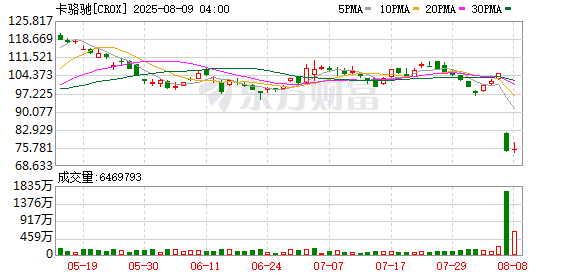
一年增加超六亿元关税成本,美国“洞洞鞋”Crocs股价暴跌三成
Di Yi Cai Jing· 2025-08-11 06:44
Group 1: Impact of US Tariffs on Domestic Companies - The US tariff policy is negatively affecting the profitability of domestic retail companies, with Crocs expecting a revenue decline in Q3 despite analyst predictions of growth [2] - Crocs anticipates an additional cost of $40 million due to tariffs in the second half of the year, potentially reaching $90 million for the entire year, equivalent to approximately 647 million RMB [2] - Following this news, Crocs' stock price plummeted nearly 30%, marking its largest single-day drop in 14 years [2] Group 2: Effects on Other Brands - Deckers, which owns brands like UGG and Hoka, is also facing tariff pressures, with US sales growth slowing from approximately 11% to 2.8% [3] - Deckers has chosen to absorb some of the tariff costs rather than passing them entirely to consumers, which may stabilize market share but compress profit margins [3][4] - Puma's stock fell 18.4% after it downgraded its 2025 fiscal year guidance, citing the new US tariffs as a significant factor leading to an expected gross profit loss of approximately €80 million [6] - Adidas anticipates an additional cost of up to €200 million (approximately 157 million RMB) due to tariffs in the remaining part of the year, with uncertainty about the impact on consumer demand [7] - Companies like Nike and Uniqlo's parent company Fast Retailing are considering price increases in response to tariff impacts, indicating a trend among brands to adjust pricing strategies [7]

关税推高成本 卡特彼勒(CAT.US)Q2利润不及预期
智通财经网· 2025-08-05 12:23
Core Insights - Caterpillar reported lower-than-expected Q2 profits due to tariff costs and slight declines in product prices affecting profit margins on its iconic yellow excavators and bulldozers [1] - The company's Q2 revenue was $16.6 billion, a 1% year-over-year decline, but better than market expectations; adjusted earnings per share were $4.72, down from $5.99 a year ago and below the market forecast of $4.88 [1] - U.S. trade policies have had a sustained impact on the industries served by Caterpillar, with tariffs increasing production costs and harming profits, despite relatively stable sales [1] - The net impact of tariffs in Q2 reached the upper limit of the company's previously disclosed estimate of $250 million to $350 million [1] - Caterpillar's performance is viewed as a barometer for global economic health, with declines in sales from its construction and resource segments, while the energy and transportation segments saw growth [1] - The company anticipates facing approximately $1.3 billion to $1.5 billion in net additional tariff costs this year, with up to $500 million in tariff costs expected in the current quarter [1] - Considering the impact of tariffs, Caterpillar currently expects its full-year adjusted operating profit margin to be in the lower half of its annual guidance range [1] Business Outlook - Caterpillar's CEO Joe Creed stated that strong order volumes and stable demand across business segments are supported by infrastructure spending and growing energy demand [2] - As of the report, Caterpillar's stock was up 0.6% in pre-market trading and has increased by 21% year-to-date [3]

烈酒巨头帝亚吉欧(DEO.US)2025财年业绩超预期 预计2026财年有机销售增长1.7% 拟进一步削减成本
Zhi Tong Cai Jing· 2025-08-05 08:17
Group 1 - Diageo reported preliminary results for the fiscal year 2025, with sales of $20.245 billion, slightly down 0.1% year-on-year, but better than the market expectation of $20 billion [1] - Organic sales grew by 1.7% year-on-year, surpassing the analyst consensus of 1.4% [1] - Operating profit fell by 27.8% to $4.335 billion, with an operating margin decline of 819 basis points to 21.4% [1] Group 2 - Diageo expects organic sales growth for fiscal year 2026 to be similar to that of fiscal year 2025, with operating profit anticipated to achieve mid-single-digit organic growth [1] - The company faces economic uncertainty and consumer inflation concerns due to tariffs imposed by former President Trump, with annual tariff costs now estimated at $200 million, up from a previous estimate of $150 million [1] - Diageo's interim CEO, Nik Jhangiani, announced an increase in the cost-saving target from $500 million to $625 million over the next three years [1] Group 3 - Nik Jhangiani took over as interim CEO after the departure of Debra Crew and indicated that the board may decide on a new CEO by the end of October [2] - Despite a challenging consumer environment, including preferences for non-alcoholic beverages and ready-to-drink cocktails, consumers, including Gen Z, continue to spend [2] - Analyst Ed Mundy from Jefferies noted that Diageo's sales growth target for fiscal year 2026 is in line with market expectations, and the company has maintained or grown market share in 65% of monitored markets, including the U.S. [2]

苹果业绩超预期:硬件稳健增长,AI还在追赶
2 1 Shi Ji Jing Ji Bao Dao· 2025-08-01 12:48
Financial Performance - In Q2 of FY2025, the company reported total revenue of $94.04 billion, a 10% year-over-year increase, marking the largest quarterly revenue growth since December 2021 [1][3] - Net profit for the same period was $23.43 billion, reflecting a 9% year-over-year growth [1] - Service revenue reached a record $27.42 billion, up from $24.21 billion a year ago, indicating a 13.2% increase [4][5] Market Performance - The Greater China region showed a revenue of $15.37 billion, a 4.4% increase, reversing previous declines of 2% and 11% in the prior two quarters [3] - iPhone revenue was $44.58 billion, exceeding analyst expectations of $40.22 billion, and grew 13.5% from $39.3 billion year-over-year [3] - Mac revenue reached $8.05 billion, surpassing expectations of $7.26 billion, and grew nearly 15% from $7.01 billion year-over-year [3] Challenges in Product Lines - iPad revenue was $6.58 billion, below expectations of $7.24 billion, and down 8% from $7.16 billion year-over-year [4] - Wearables, home, and accessories revenue was $7.4 billion, also below expectations of $7.82 billion, and down 8.64% from $8.1 billion year-over-year [4] AI Strategy and Investment - The company is significantly increasing its investment in AI, viewing it as one of the most profound technologies of the generation [2][6] - In 2025, the company acquired approximately seven small tech firms to accelerate its AI roadmap, although the financial details were not disclosed [6] - Capital expenditure for Q2 was $3.46 billion, up from $2.15 billion year-over-year, primarily driven by AI-related investments [6] Competitive Positioning - The company is perceived to be lagging behind competitors like Google and Microsoft in AI commercialization, with some analysts suggesting a delay of over two years in generative AI technology [2][6] - The company’s AI strategy emphasizes privacy and on-device computing, contrasting with the cloud-centric approaches of its competitors [8] Talent Acquisition and Retention - The company has faced challenges in retaining top AI talent, with key personnel leaving for competitors like Meta [7] - The company’s CFO indicated that while capital expenditures are expected to increase, they will not grow exponentially, suggesting a cautious approach to AI investment [7]

库克:苹果第 3 财季额外承担 8 亿美元关税成本
Sou Hu Cai Jing· 2025-08-01 00:54
自今年 4 月美国调整关税政策以来,有各种小道消息称苹果公司为应对额外成本,会提高 iPhone 产品售价,顶配机型一度传言会飙升到 2300 美元。 库克在电话会议中表示,消费者担忧关税可能导致的产品价格大幅上涨,选择在关税实施前抢购,这一情绪推动了 2025 财年第 3 财季苹果设备的销售增 长。 IT之家 8 月 1 日消息,科技媒体 MacRumors 今天(8 月 1 日)发布博文,报道称在 2025 财年第 3 财季(截至 6 月 28 日)财报电话会议上,苹果公司首席 执行官蒂姆・库克(Tim Cook)回应称,大约有 10% 的销售增长,可以归因于客户为规避关税而提前购买产品。 库克还表示第 3 财季苹果公司承担了 8 亿美元(IT之家注:现汇率约合 57.62 亿元人民币)的关税额外成本,如果现有关税保持不变,且不再新增关税,预 计第 4 财季中,苹果将面临 11 亿美元(现汇率约合 79.23 亿元人民币)的关税费用。 ...

苹果公司两个季度关税成本约为19亿美元
news flash· 2025-07-31 21:24
金十数据8月1日讯,苹果(AAPL.O)CEO库克:6月当季,公司因关税问题承担了约8亿美元的成本。预 计在9月当季,关税的影响将使成本增加约11亿美元。 苹果公司两个季度关税成本约为19亿美元 ...