
制造业高端化

Search documents
1至6月全国规模以上工业企业营收保持增长 企业利润降幅收窄
Jin Rong Shi Bao· 2025-07-28 02:31
Core Insights - The overall profit of industrial enterprises in China decreased by 1.8% year-on-year in the first half of the year, totaling 34,365 billion yuan, while revenue increased by 2.5% to 667,800 billion yuan [1] - In June, profits for industrial enterprises showed a smaller decline of 4.3% year-on-year, an improvement from May's decline of 4.8 percentage points, particularly in the manufacturing sector where profits turned from a 4.1% decline in May to a 1.4% increase [1] - The revenue growth of industrial enterprises in June was steady at 1.0%, maintaining the same growth rate as in May, which supports the recovery of profits [1] Industry Performance - The equipment manufacturing sector experienced rapid growth in both revenue and profits, with June revenue increasing by 7.0% year-on-year and profits shifting from a 2.9% decline in May to a 9.6% increase, contributing 3.8 percentage points to the overall profit growth of industrial enterprises [2] - Within the equipment manufacturing sector, the automotive industry saw a remarkable profit increase of 96.8%, driven by promotional activities and investment returns from key enterprises [2] - High-end, intelligent, and green manufacturing sectors reported significant profit growth, with electronic materials manufacturing, aircraft manufacturing, and marine engineering equipment manufacturing seeing year-on-year profit increases of 68.1%, 19.0%, and 17.8% respectively [2] Consumer Goods and Related Industries - The consumer goods sector, particularly in smart and household appliances, benefited from policies encouraging upgrades, with profits in smart drones, computer manufacturing, and air conditioning manufacturing increasing by 160.0%, 97.2%, and 21.0% respectively [3] - Related industries such as optoelectronic devices and computer components also saw profit increases of 29.6% and 16.9% year-on-year [3] Financial Indicators - As of the end of June, accounts receivable for industrial enterprises reached 26.69 trillion yuan, approaching the previous year's high, although the year-on-year growth rate has been declining for four consecutive months since March [3] - The profit growth rate for industrial enterprises has shown negative growth for two consecutive months, influenced by external shocks, slow clearance of outdated capacity, and persistent negative growth in the Producer Price Index (PPI) [3] Future Outlook - Looking ahead to the third quarter, it is anticipated that the overall efficiency of industrial enterprises may improve due to the progress in US-China trade negotiations and the implementation of domestic "anti-involution" policies, alongside a rebound in prices of commodities like coking coal and steel [4]
6月份规模以上工业企业营业收入同比增长1.0% 装备制造业营收、利润快速增长
Yang Guang Wang· 2025-07-28 01:27
Group 1 - In June, the revenue of industrial enterprises above designated size increased by 1.0% year-on-year, with a total profit of 715.58 billion yuan [1] - From January to June, the cumulative revenue growth of industrial enterprises was 2.5%, indicating a favorable condition for profit recovery [1] - The equipment manufacturing industry showed significant growth, with revenue increasing by 7.0% year-on-year in June, accelerating by 0.3 percentage points compared to May [1] Group 2 - In the equipment manufacturing sector, four out of eight industries reported profit growth, with the automotive sector experiencing a remarkable profit increase of 96.8% due to promotional activities and investment returns [1] - High-end, intelligent, and green manufacturing sectors contributed to stable profit growth, with profits in electronic special materials manufacturing, aircraft manufacturing, and marine engineering equipment manufacturing increasing by 68.1%, 19.0%, and 17.8% respectively [1] - The policy of replacing old consumer goods with new ones has positively impacted industries such as smart drones, computer manufacturing, air conditioning, and ventilation equipment, with profit growth rates of 160.0%, 97.2%, 21.0%, and 9.7% respectively [2]
六月份规上工业企业利润降幅收窄 装备制造业支撑作用突出
Jing Ji Ri Bao· 2025-07-27 21:52
Group 1 - In June, the total profit of industrial enterprises above designated size reached 715.58 billion yuan, a year-on-year decrease of 4.3%, with the decline narrowing by 4.8 percentage points compared to May. The manufacturing sector showed significant improvement, with profits turning from a 4.1% decline in May to a 1.4% increase in June [1] - For the first six months, the operating income of industrial enterprises above designated size grew by 2.5%, while profits decreased by 1.8% [1] - The equipment manufacturing industry experienced rapid growth in both revenue and profit, with June revenue increasing by 7.0% year-on-year, accelerating by 0.3 percentage points from May. Profits shifted from a 2.9% decline in May to a 9.6% increase in June, contributing 3.8 percentage points to the overall profit growth of industrial enterprises [1] Group 2 - In June, industries related to high-end, intelligent, and green manufacturing saw rapid profit growth, providing stable support for high-quality industrial development. Profits in high-end equipment manufacturing sectors such as electronic special materials, aircraft manufacturing, and marine engineering equipment manufacturing increased by 68.1%, 19.0%, and 17.8% year-on-year, respectively [2] - The production of intelligent and automated products accelerated, leading to profit increases in related sectors, with profits in smart consumer equipment manufacturing and measuring instruments rising by 40.9% and 12.5%, respectively [2] - The formation of green production and lifestyle accelerated, positively impacting profits in sectors such as lithium-ion battery manufacturing, biomass energy generation, and environmental monitoring instruments, which saw profit increases of 72.8%, 24.5%, and 22.2%, respectively [2]
6月中国规上工业企业利润同比降幅收窄
Zhong Guo Xin Wen Wang· 2025-07-27 05:05
Group 1 - In June, profits of China's industrial enterprises above designated size decreased by 4.3% year-on-year, a reduction in decline by 4.8 percentage points compared to May [1] - The manufacturing sector showed significant improvement, with profits shifting from a 4.1% decline in May to a 1.4% increase in June [1] - Cumulatively, from January to June, profits of industrial enterprises above designated size fell by 1.8% year-on-year [1] Group 2 - In June, the operating income of industrial enterprises increased by 1.0% year-on-year, maintaining the same growth rate as in May, which supports profit recovery [1] - The equipment manufacturing sector's operating income grew by 7.0% year-on-year, accelerating by 0.3 percentage points from May, with profits turning from a 2.9% decline in May to a 9.6% increase in June [1] - The automotive industry saw a remarkable profit increase of 96.8% due to promotional activities and investment returns from key enterprises [1] Group 3 - Profits in high-end, intelligent, and green manufacturing sectors grew rapidly in June, with electronic special materials manufacturing, aircraft manufacturing, and marine engineering equipment manufacturing seeing profit increases of 68.1%, 19.0%, and 17.8% respectively [2] - The lithium-ion battery manufacturing and biomass energy generation sectors reported profit increases of 72.8% and 24.5% respectively [2] - The smart unmanned aerial vehicle manufacturing and computer assembly manufacturing sectors experienced profit growth of 160.0% and 97.2% respectively, driven by the effectiveness of the consumption upgrade policy [2]
6月份制造业利润由降转增
Sou Hu Cai Jing· 2025-07-27 04:14
Group 1 - In June, manufacturing profits shifted from a decline of 4.1% in May to a growth of 1.4% [1] - The total profit of industrial enterprises above designated size in June reached 715.58 billion yuan, a year-on-year decrease of 4.3%, with the decline narrowing by 4.8 percentage points compared to May [1] - The equipment manufacturing industry showed rapid growth in revenue and profits, with June revenue increasing by 7.0% year-on-year and profits turning from a decline of 2.9% in May to a growth of 9.6%, contributing 3.8 percentage points to the overall industrial profit growth [1] Group 2 - The "Two New" policy has expanded its support categories and subsidy scope, leading to significant profit improvements in related industries [2] - In June, profits in the medical instrument and equipment manufacturing, printing and pharmaceutical daily chemical production equipment manufacturing, and general parts manufacturing industries grew by 12.1%, 10.5%, and 9.5% year-on-year, respectively [2] - The old-for-new policy for consumer goods such as electronics and home appliances continued to show effects, with profits in smart drones, computer manufacturing, home air conditioners, and ventilation equipment manufacturing increasing by 160.0%, 97.2%, 21.0%, and 9.7% respectively [2]
国家统计局:6月份规模以上工业企业利润同比降幅较5月份有所收窄 以装备工业为代表的新动能行业利润增长较快
news flash· 2025-07-27 01:37
Core Insights - In June, the decline in profits for large-scale industrial enterprises narrowed compared to May, with new momentum industries like equipment manufacturing showing rapid profit growth [1] Group 1: Industrial Performance - In June, large-scale industrial enterprises achieved a total profit of 715.58 billion yuan, a year-on-year decline of 4.3%, which is a narrowing of 4.8 percentage points from May [1] - The revenue of large-scale industrial enterprises grew by 1.0% year-on-year in June, maintaining the same growth rate as in May, which supports the recovery of corporate profits [1] - Cumulatively, from January to June, the revenue of large-scale industrial enterprises increased by 2.5%, while profits decreased by 1.8% [1] Group 2: Equipment Manufacturing Sector - In June, the equipment manufacturing sector's revenue grew by 7.0% year-on-year, accelerating by 0.3 percentage points compared to May [2] - Profits in the equipment manufacturing sector shifted from a decline of 2.9% in May to a growth of 9.6% in June, contributing 3.8 percentage points to the overall profit growth of large-scale industrial enterprises [2] - Among the eight industries in equipment manufacturing, four reported profit growth, with the automotive industry experiencing a remarkable profit increase of 96.8% due to promotional activities and investment returns [2] Group 3: High-end, Intelligent, and Green Manufacturing - The high-end, intelligent, and green manufacturing sectors saw rapid profit growth in June, providing stable support for high-quality industrial development [3] - Profits in high-end equipment manufacturing sectors such as electronic materials, aircraft manufacturing, and marine engineering equipment grew by 68.1%, 19.0%, and 17.8% respectively [3] - Profits in intelligent and automated product manufacturing increased significantly, with smart consumer devices and measuring instruments growing by 40.9% and 12.5% respectively [3] Group 4: Policy Impact - The "Two New" policies have shown continuous positive effects, with an expansion in supported categories and subsidies leading to significant profit improvements in related industries [4] - In June, profits in medical equipment manufacturing, printing, and general parts manufacturing grew by 12.1%, 10.5%, and 9.5% respectively [4] - The replacement policies for consumer goods have also been effective, with profits in smart drones and computer manufacturing increasing by 160.0% and 97.2% respectively [4]
21社论丨中国外贸量稳质升,韧性凸显
21世纪经济报道· 2025-07-14 23:56
Core Viewpoint - China's export growth remains resilient, supported by strong performance in emerging markets and stable trade relations with developed economies, despite challenges in labor-intensive product exports and fluctuating commodity prices [1][3][5]. Group 1: Export Performance - In June 2025, China's exports grew by 5.8% year-on-year, with a cumulative growth of 5.9% for the first half of the year [1]. - Key markets contributing to export resilience include Europe, ASEAN, and Africa, with exports to the EU growing by 7.6% year-on-year [1][3]. - Emerging markets, particularly ASEAN, saw double-digit growth in exports, with Vietnam and Thailand experiencing over 20% year-on-year increases [1][3]. Group 2: Import Dynamics - Imports in June 2025 recorded a slight year-on-year increase of 1.1%, while the cumulative import decline for the first half was 3.9% [1]. - The decline in imports is attributed to falling commodity prices and weak domestic manufacturing sentiment, with major commodities like soybeans and iron ore seeing price drops [2]. Group 3: Trade Structure and Diversification - The share of emerging markets in China's exports is increasing, with the U.S. share dropping to around 12%, while ASEAN and Latin America account for 17.8% and 7.8% respectively [3][4]. - China's trade diversification is further supported by initiatives like the Belt and Road Initiative and RCEP, enhancing trade relations with new partners [4]. Group 4: Export Product Composition - High-value products such as semiconductors, transportation equipment, and machinery are driving export growth, while labor-intensive products face pressure due to U.S. tariff policies [2][5]. - The export structure is shifting towards high-end manufacturing, with significant growth in integrated circuits (24.2% year-on-year) and machinery [2][4]. Group 5: Future Outlook - The combination of stable demand from emerging markets and strong bilateral trade relations with the EU is expected to bolster China's export resilience amid global trade uncertainties [5]. - The ongoing transformation of China's manufacturing sector towards high-end, intelligent, and green production is anticipated to enhance international competitiveness in exports [5].


中国外贸量稳质升,韧性凸显
2 1 Shi Ji Jing Ji Bao Dao· 2025-07-14 22:32
Group 1 - China's exports in June recorded a year-on-year growth of 5.8%, with a cumulative growth of 5.9% in the first half of the year, supported by "rush exports" and "rush transshipments" from foreign trade enterprises [1] - Imports in June showed a slight year-on-year increase of 1.1%, while the cumulative import for the first half of the year decreased by 3.9%, primarily due to falling prices of bulk commodities and weak domestic manufacturing [1] - Key markets for China's exports include Europe, ASEAN, and Africa, with exports to the EU growing at a rate of 7.6% year-on-year in June [1][3] Group 2 - The export performance of sectors such as automobiles, semiconductor supply chains, transportation equipment, and machinery remains strong, while labor-intensive products face pressure [2] - Shipbuilding exports have shown high growth, achieving a 23.6% increase in June 2025, despite a high base in 2024 [2] - The import of bulk commodities has been a major drag, with most major imports, except for copper ore, experiencing a year-on-year price decline [2] Group 3 - The diversification of China's trade patterns is advancing, with emerging markets increasingly contributing to China's export share, while the share of exports to the US has decreased to around 12% [3] - ASEAN has become China's largest trading partner, with its share of exports rising to 17.8%, reflecting strengthened economic ties [3] - China's position in the EU import structure has remained stable, with its share around 21% since 2022, indicating stable bilateral trade relations [3] Group 4 - The structure of China's export goods is optimizing, with increasing competitiveness in high-end manufacturing products, which is expected to enhance export resilience [4] - The export share of high-end manufacturing goods, such as transportation equipment, is on the rise, while the share of textiles and miscellaneous products is declining [4] - Factors such as steady demand from emerging markets and stable trade relations with the EU are crucial for supporting China's export resilience amid global trade uncertainties [4]
长三角5月“成绩单”:上海社零累计负增长一年后首转正,安徽工业领跑
2 1 Shi Ji Jing Ji Bao Dao· 2025-06-24 10:06
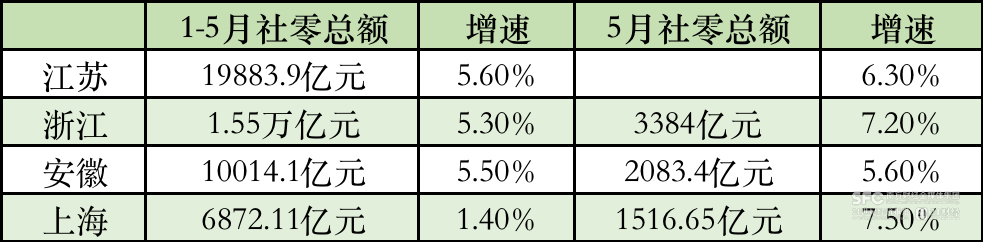
Economic Performance in the Yangtze River Delta - The fixed asset investment in Shanghai, Zhejiang, and Anhui showed positive year-on-year growth from January to May, although Jiangsu's investment decreased by 1.4% due to a decline in real estate development investment [1][8] - In terms of industrial performance, Anhui led the Yangtze River Delta with the highest growth rate in industrial added value in May, driven by the high-end and digital transformation of manufacturing [1][10] - The retail sales of consumer goods in Jiangsu, Zhejiang, and Anhui all grew by over 5% from January to May, while Shanghai's retail sales only increased by 1.4%, primarily due to a decline in restaurant income [1][2][3] Fixed Asset Investment - Shanghai's fixed asset investment grew by 6.2%, while Zhejiang and Anhui saw increases of 1.9% and 0.2%, respectively [6][7] - Jiangsu's fixed asset investment decline was mainly attributed to a 15.3% drop in real estate development investment, despite an 8.7% increase in infrastructure investment [8][7] Industrial Growth - The industrial added value for large-scale industries in Anhui, Jiangsu, and Zhejiang grew by 8.4%, 7.7%, and 7.6%, respectively, with Shanghai's industrial output increasing by 4.8% [9][10] - High-tech manufacturing significantly contributed to Anhui's industrial growth, with a 29.3% increase in May, accounting for 17.6% of the province's industrial added value [10] Consumer Market Dynamics - The consumer market in Jiangsu benefited from the "old-for-new" policy, with significant growth in retail sales of home appliances and other categories [5] - Shanghai's retail sales saw a turnaround in cumulative growth for the first time in a year, indicating a potential recovery in consumer spending [4][3]
21评论丨两大因素支撑我国出口韧性
2 1 Shi Ji Jing Ji Bao Dao· 2025-06-09 17:37
Core Insights - In May 2025, China's exports showed resilience with a year-on-year growth of 4.8% in USD terms, while imports declined by 3.4%, resulting in a trade surplus of $103.22 billion [1] - The trade dynamics indicate a shift towards emerging markets, with ASEAN and Latin America becoming key partners, while exports to the US saw a significant decline of 34.5% year-on-year in May [1][4] - The export structure is improving, with high-end manufacturing products gaining competitiveness, particularly in the semiconductor and transportation equipment sectors [5][6] Trade Performance - Exports to Europe and ASEAN markets were strong, with the EU seeing a 12.0% year-on-year increase and ASEAN exports growing by 14.8%, particularly to Vietnam and Thailand [1][4] - The shipbuilding industry experienced a notable growth of 43.7% in May 2025, supported by global demand and enhanced competitiveness [2] - Labor-intensive products faced pressure, with declines in categories such as bags, textiles, and toys due to the impact of US tariffs [2] Import Dynamics - Domestic manufacturing remains weak, with a marginal improvement in May 2025 due to US-China trade negotiations, but still below the growth line [3] - Imports of semiconductors and machinery increased by 6%, with significant growth in integrated circuits (33.4%) and data processing equipment [3] - Major bulk commodity imports like soybeans increased by 22.5%, while others like iron ore and crude oil saw declines exceeding 10% [3] Trade Diversification - The share of emerging markets in China's exports is rising, with the US share dropping from 14.7% in 2024 to 12% in the first five months of 2025, while ASEAN's share increased to 17.8% [4] - China's trade relationships with ASEAN are strengthening, supported by initiatives like the Belt and Road Initiative and RCEP [4] Future Outlook - The overall export resilience is expected to be supported by emerging market demand and stable relations with the EU, despite ongoing uncertainties from US tariff policies [6] - The high-end manufacturing sector's transformation is anticipated to enhance international competitiveness, with an expected export growth rate of 2% to 3% for the year [6]