
大数据杀熟

Search documents
官方都忍不了......
Xin Lang Cai Jing· 2025-11-12 00:25
Core Viewpoint - The article discusses the increasing complexity and hidden costs associated with purchasing airline tickets and hotel bookings on major platforms, highlighting the prevalence of consumer traps and the challenges of regulation in the industry [2][3][6]. Group 1: Consumer Traps - Consumers face numerous hidden fees and additional charges when booking flights, often disguised as "low-price" options that include bundled services [3][5]. - The practice of "big data price discrimination" and "automatic price adjustment" in hotel bookings further complicates the consumer experience, leading to unfair pricing strategies [6][7]. Group 2: Regulatory Challenges - Regulatory oversight is difficult as platforms often label their tactics as marketing or product innovation, making it hard to enforce rules [9][10]. - The hidden nature of many pricing strategies makes it challenging for consumers to identify and contest unfair practices [10][14]. Group 3: Economic Incentives - Companies like Ctrip reported significant profits, with a net profit of 17.2 billion and a growth rate exceeding 20%, indicating that the financial benefits of these practices outweigh potential penalties [15][16]. - The low cost of violating regulations encourages platforms to continue employing deceptive practices, as the potential gains are substantial compared to the risks [17][19]. Group 4: Market Dynamics - The article highlights a "bad money drives out good" effect, where honest pricing strategies lead to a loss of competitive edge, perpetuating a cycle of deceptive practices across the industry [19][20]. - In monopolistic or oligopolistic markets, these practices become institutionalized, making it harder for smaller platforms to compete without adopting similar tactics [21][22]. Group 5: Potential Solutions - The article suggests that stronger regulatory measures, increased penalties for violations, and the promotion of fair competition could help address these issues [23][24]. - Encouraging ethical practices among industry giants is also proposed as a necessary step to break the cycle of negative competition [25][26].



“双11”购物,消费者成了“精算师”
Xin Hua Wang· 2025-11-09 23:50
Core Insights - The "Double 11" shopping festival has transformed from a consumer benefit event into a complex pricing maze, leading to consumer confusion and frustration [1][2][3] Pricing Issues - Consumers are experiencing price fluctuations where promotional prices are often higher than regular prices, leading to a perception of deceptive practices [2][3] - Instances of price increases before promotional events have been reported, with consumers noting that prices can rise significantly just before the sales begin [3][5] - Complaints regarding price protection policies have surged, with many consumers finding that their purchases do not qualify for the promised lowest price guarantees [4] Consumer Experiences - Many consumers have reported dramatic price changes within short time frames, leading to confusion about the actual cost of products [3][5] - The phenomenon of "price discrimination" based on user accounts has been observed, where different users see different prices for the same product [7] - The complexity of discount mechanisms and coupon systems has left consumers feeling overwhelmed and exhausted, as they struggle to navigate the various offers [8][9] Promotional Mechanisms - The traditional "deposit + final payment" model has lost its appeal, with consumers questioning its effectiveness when final prices exceed initial estimates [9] - The issuance of coupons has become increasingly complicated, with many consumers finding it difficult to apply them effectively due to restrictive conditions [9]
红海变火海!互联网大厂为何扎堆涌入酒旅赛道?
Xi Niu Cai Jing· 2025-10-18 05:46
Core Insights - The competition in the hotel and travel industry has intensified as major internet companies increasingly focus on this sector, with notable entries from JD.com, Alibaba, and Douyin [2][3][4][6]. Group 1: Major Players' Strategies - JD.com has announced its entry into the hotel and travel business, aiming to reduce costs to one-third of the current levels and offering a three-year zero-commission policy for hotel operators [4][6]. - Alibaba has integrated its platforms, Ele.me and Fliggy, into its China e-commerce group, while also launching the "Gaode Street Ranking" to leverage user behavior data [6][14]. - Douyin has introduced the "Heartfelt Hotel Ranking" and a zero-commission policy for offline payments, targeting specific consumer needs with tailored offerings [6][14]. Group 2: Market Dynamics - The e-commerce sector is facing saturation, prompting major companies to seek new growth avenues, with the hotel and travel industry presenting a lucrative opportunity due to its high profit margins [7][8]. - The tourism market is recovering, with domestic travel expected to reach 5.62 billion trips in 2024, a 14.8% increase year-on-year, and total spending projected at 5.8 trillion yuan, up 17.1% [8]. Group 3: Consumer Pain Points - Traditional OTA platforms have faced significant consumer complaints, particularly regarding issues like "data killing familiarity," refund difficulties, and poor after-sales service [10][13]. - The entry of major players like JD.com and Douyin may pressure traditional OTAs to address these consumer grievances and improve service quality [13][16]. Group 4: Competitive Landscape - Major companies are not engaging in homogeneous competition but are leveraging their unique strengths in areas such as traffic, supply chain, and data to capture market share [14][15]. - JD.com focuses on supply chain efficiencies to lower hotel costs, while Alibaba aims to create a seamless consumer experience across its platforms [15][16]. Group 5: Challenges Ahead - Despite the advantages of new entrants, established OTAs like Ctrip and Meituan have deep-rooted partnerships with hotels, making it challenging for newcomers to gain market share [16][17]. - The complexity of travel product services, including customer support for cancellations and changes, poses a significant challenge for new players [16][17].



多方合力优化旅游消费环境
Zheng Quan Ri Bao· 2025-09-16 16:06
Group 1 - The State Council issued a notice to strengthen comprehensive regulation of the tourism market, addressing new characteristics and issues in the current tourism landscape [1][2] - The notice clarifies the responsibilities of various departments, emphasizing a collaborative approach to enhance regulatory effectiveness [1][2] - The cultural and tourism department is tasked with daily coordination and supervision of tourism service quality, while other departments manage specific sectors like aviation and high-risk sports [2] Group 2 - The notice promotes the principle of "tourist-centered, sincere service" among tourism operators, urging them to comply with regulations and improve service quality [2] - It emphasizes the importance of protecting consumer rights against practices like "big data price discrimination" and encourages fair competition among online tourism platforms [2][3] - Industry organizations are encouraged to participate in rights protection and quality improvement, fostering self-regulation and ethical business practices [3] Group 3 - The notice is seen as a timely measure to clarify responsibilities and enhance regulatory oversight ahead of the upcoming tourism peak season [3] - Strengthening overall tourism market regulation is expected to contribute to a more trustworthy and orderly tourism environment, supporting China's transition from a "tourism giant" to a "tourism power" [3]
资讯早间报-20250916
Guan Tong Qi Huo· 2025-09-16 01:55
Report Industry Investment Rating No relevant content provided. Core Viewpoints The report presents a comprehensive overview of the overnight market trends, important news, and financial market conditions across various sectors including commodities, stocks, bonds, and foreign exchange. It also highlights significant events such as geopolitical tensions, economic data releases, and corporate announcements that may impact the markets. Summary by Category Overnight Market Trends - International precious metal futures generally closed higher, with COMEX gold futures up 0.90% at $3,719.50 per ounce and COMEX silver futures up 0.84% at $43.19 per ounce [3]. - International oil prices edged up, with the U.S. oil main contract up 0.94% at $63.28 per barrel and Brent crude up 0.69% at $67.45 per barrel [3]. - Most London base metals closed higher, with LME copper up 1.21% at $10,189 per ton, hitting a 15 - month high [3]. - Domestic futures contracts mostly rose, with coking coal up over 5%, coke and glass up over 4%, and soda ash up over 3% [4]. Important News Macroeconomic News - China's real - estate market is moving towards stabilization, with narrowing year - on - year declines in property sales and prices [7]. - Hamas has suspended cease - fire and hostage - exchange talks with Israel [7]. - China opposes U.S. economic coercion and trade restrictions [7]. - Sino - U.S. economic and trade talks are ongoing [8]. - The Shanghai Export Containerized Freight Index (European route) dropped 8.1% [8]. - The U.S. is opening a tariff "inclusion window" for steel and aluminum derivatives [11]. Energy and Chemical Futures - As of September 15, the commercial inventory of pure benzene in Jiangsu ports decreased by 6.94% month - on - month [12]. - The EU is considering sanctions on Indian companies involved in Russian oil trade [13]. - Ukraine's drone attack on Russia's Primorsk port has ended, and the port has resumed operations [14]. Metal Futures - Xinjiang's latest alumina spot tender was 10,000 tons at a price of 3,220 - 3,230 yuan per ton [16]. - Gold prices have soared 39% this year [18]. - Two smelters in Guangxi and Jiangxi will suspend domestic silver supply this week [19]. - Some lead smelters in the north may start winter stockpiling earlier [19]. Black - series Futures - China's August steel production data showed mixed trends, with crude steel down 0.7% year - on - year, pig iron up 1.0%, and steel up 9.7% [21]. - From January to August, real - estate development investment decreased by 12.9% year - on - year [21]. - Two coal mines in Shanxi and Linfen have suspended production [21][22]. - Global iron ore shipments increased from September 8 - 14 [24]. - Some steel mills in Hebei lowered their coke purchase prices [24]. Agricultural Futures - As of September 12, the weekly soybean crushing volume of domestic oil mills increased [27]. - Canada's rapeseed exports decreased in the week ending September 7 [27]. - Malaysia's Sabah state was hit by landslides and floods [27]. - As of September 12, the national commercial inventory of soybean oil decreased slightly, while palm oil increased [29]. - Malaysia's palm oil exports from September 1 - 15 increased by 2.6% [30]. - India's vegetable oil imports increased in August [30]. - As of September 15, the national inventory of imported soybeans at ports increased [31]. - U.S. soybean and corn export inspection volumes increased in the week ending September 11 [31]. - In August, the U.S. soybean crush volume and豆油 inventory showed specific changes [31]. - As of September 14, the U.S. soybean's good - to - excellent rate, harvest rate, and leaf - fall rate were reported [32]. Financial Market Stock Market - A - shares showed a divergent trend on Monday, with the Shanghai Composite Index down 0.26% and the Shenzhen Component Index up 0.63% [35]. - The Hong Kong Hang Seng Index rose 0.22%, and the Hang Seng Tech Index rose 0.91% [35]. - Hesai Technology's global share offering had high subscription rates [35]. - BeBeBus's parent company launched an IPO [35]. - U.S. stocks closed higher, with the S&P 500 and Nasdaq hitting new highs [45]. - Google's market value exceeded $3 trillion [45]. - The South Korean Composite Index hit a new high [46]. - Tesla's CEO Elon Musk bought over 2.5 million shares of Tesla [48]. Bond Market - China's bond yields showed mixed trends, and treasury bond futures closed higher [51]. - U.S. bond yields fell across the board [52]. Foreign Exchange Market - The on - shore RMB against the U.S. dollar depreciated slightly on Monday [53]. - The U.S. dollar index fell 0.26% [53]. Events Schedule - The U.S. Senate will vote on the nomination of a Fed governor at 08:00 [56]. - China's central bank has 247 billion yuan of reverse repurchases maturing at 09:20 [56]. - There are several press conferences and important events scheduled throughout the day [56].
国办发文提级旅游市场综合监管 剑指“大数据杀熟”、捆绑销售等乱象
Bei Jing Shang Bao· 2025-09-16 01:12
Core Viewpoint - The State Council of China issued a notification on September 15 to strengthen comprehensive regulation of the tourism market, aiming to address issues disrupting market order and protecting tourists' rights, thereby promoting high-quality development in the tourism industry [1][2]. Group 1: Regulatory Responsibilities - The notification emphasizes the need for clear responsibilities among relevant departments, following principles of local management, inter-departmental collaboration, and joint efforts to enhance regulatory effectiveness [1][2]. - The cultural and tourism department is tasked with daily coordination and supervision of tourism service quality, while the police department is responsible for maintaining order at tourist sites and addressing illegal activities such as ticket scalping [2][3]. Group 2: Protection of Tourists' Rights - The notification addresses the issue of "big data killing familiarity," where different prices are shown for the same service based on user accounts, and mandates that online travel platforms protect personal information and refrain from misleading practices [3][4]. - It encourages tourism operators to adopt a customer-centric approach, improve service quality, and ensure compliance with legal standards to safeguard tourists' rights [3][5]. Group 3: Enhanced Regulatory Mechanisms - The notification calls for improved regulatory checks and law enforcement collaboration, including online inspections and surprise checks to ensure compliance across departments [4][5]. - It highlights the importance of ongoing monitoring of popular tourist routes and activities, particularly during peak seasons, to identify and address violations effectively [5].
【8点见】诈骗新套路!收到这种“银行卡”请立即剪碎
Yang Shi Wang· 2025-09-16 00:10
Group 1 - The Chinese Ministry of Commerce has reached a basic framework consensus with the U.S. to address the TikTok issue through cooperation, reduce investment barriers, and promote economic and trade cooperation [1] - The State Administration for Market Regulation has decided to conduct further investigations into NVIDIA for violating antitrust laws [1][1] - The 2025 list of China's top 500 enterprises has been released, with total operating revenue reaching 110.15 trillion yuan [1] Group 2 - The National Railway is expected to send 219 million passengers during the National Day and Mid-Autumn Festival holidays [1] - The box office revenue for the summer season in 2025 has increased by 3.9% year-on-year [1]


国办点名旅游市场“大数据杀熟”
Bei Jing Shang Bao· 2025-09-15 23:00
Core Viewpoint - The State Council issued a notification on September 15 to strengthen comprehensive regulation of the tourism market, aiming to address issues disrupting market order and protecting tourists' rights, thereby promoting high-quality development in the tourism industry [1] Group 1: Regulatory Responsibilities - The notification emphasizes the need to clarify the responsibilities of various departments in tourism market regulation, adhering to principles of local management, inter-departmental collaboration, and shared responsibilities [1] - The cultural and tourism department is tasked with daily coordination and supervision of tourism service quality, while the police department is responsible for maintaining order at tourist sites and addressing illegal ticket sales [2] Group 2: Protection of Tourists' Rights - The notification addresses the issue of "big data killing familiarity," where different prices are shown for the same service based on user accounts, and emphasizes the need for online travel platforms to protect personal information and avoid misleading practices [3] - It encourages tourism operators to adopt a customer-centric approach, improve service quality, and ensure compliance with legal standards to safeguard tourists' rights [3] Group 3: Regulatory Mechanisms - The notification calls for enhanced regulatory checks and law enforcement collaboration among departments, including online inspections and surprise checks to ensure compliance [4] - It highlights the importance of addressing multi-departmental issues promptly and coordinating investigations to uphold market order [4] Group 4: Seasonal Regulatory Focus - The notification acknowledges that illegal activities tend to increase during peak tourist seasons, and emphasizes the importance of ongoing regulatory efforts to identify and address market issues [5]
剑指“大数据杀熟”、捆绑销售等乱象,国办发文提级旅游市场综合监管
Bei Jing Shang Bao· 2025-09-15 13:22
Core Viewpoint - The State Council issued a notice on September 15 to strengthen comprehensive regulation of the tourism market, aiming to address issues disrupting market order and protecting tourist rights, thereby promoting high-quality development in the tourism industry [1] Group 1: Regulatory Responsibilities - The notice emphasizes the need to clarify the responsibilities of various departments in tourism market regulation, adhering to principles of local management, departmental collaboration, and shared responsibilities [3] - The cultural and tourism department is tasked with daily coordination and supervision of tourism service quality, as well as handling violations of tourism laws [3] - The public security department is responsible for maintaining order in tourist areas and addressing illegal activities such as ticket scalping and fraud [4] Group 2: Protection of Tourist Rights - The notice highlights the issue of "big data killing familiarity," where different prices are shown for the same service based on user accounts, and calls for online travel platforms to protect personal information and prevent unfair practices [5][6] - It encourages tourism operators to adopt a customer-centric approach, improve service quality, and ensure the safety and legal rights of tourists [5][6] Group 3: Regulatory Mechanisms - The notice proposes enhancing regulatory checks and law enforcement collaboration among departments through online inspections and surprise checks [6] - It aims to establish a framework for cross-departmental and cross-regional joint inspections to address issues that span multiple regulatory responsibilities [6] Group 4: Focus Areas for Future Regulation - The Ministry of Culture and Tourism plans to conduct ongoing inspections, particularly targeting popular tourist routes and areas to identify and report issues such as forced shopping and tour guide misconduct [7] - The notice outlines a clear direction for future regulatory efforts, especially during peak tourist seasons, to maintain market order and protect consumer rights [7]
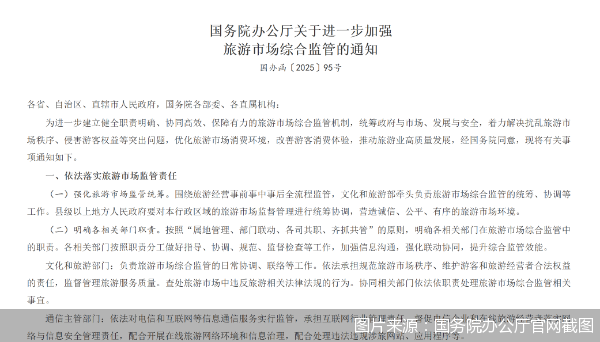
国办:督促在线旅游平台与旅游经营者加强个人信息保护
Bei Jing Shang Bao· 2025-09-15 10:12
Core Viewpoint - The State Council's notice aims to strengthen comprehensive regulation of the tourism market, focusing on protecting consumer rights and promoting healthy competition among online travel platforms [1] Group 1: Consumer Protection - Online travel platforms and operators are urged to enhance personal information protection and refrain from practices such as "big data killing familiarity," false advertising, and bundled sales that harm tourist rights [1] - The notice emphasizes the need for shopping venues and tourist attractions to ensure price and quality alignment, and to consciously resist commercial bribery [1] Group 2: Market Regulation - The notice promotes healthy competition among online travel platforms and aims to legally safeguard the rights of operators within these platforms [1] - It stresses the importance of holding tourist charter companies accountable for safety production responsibilities [1]