
实体经济

Search documents
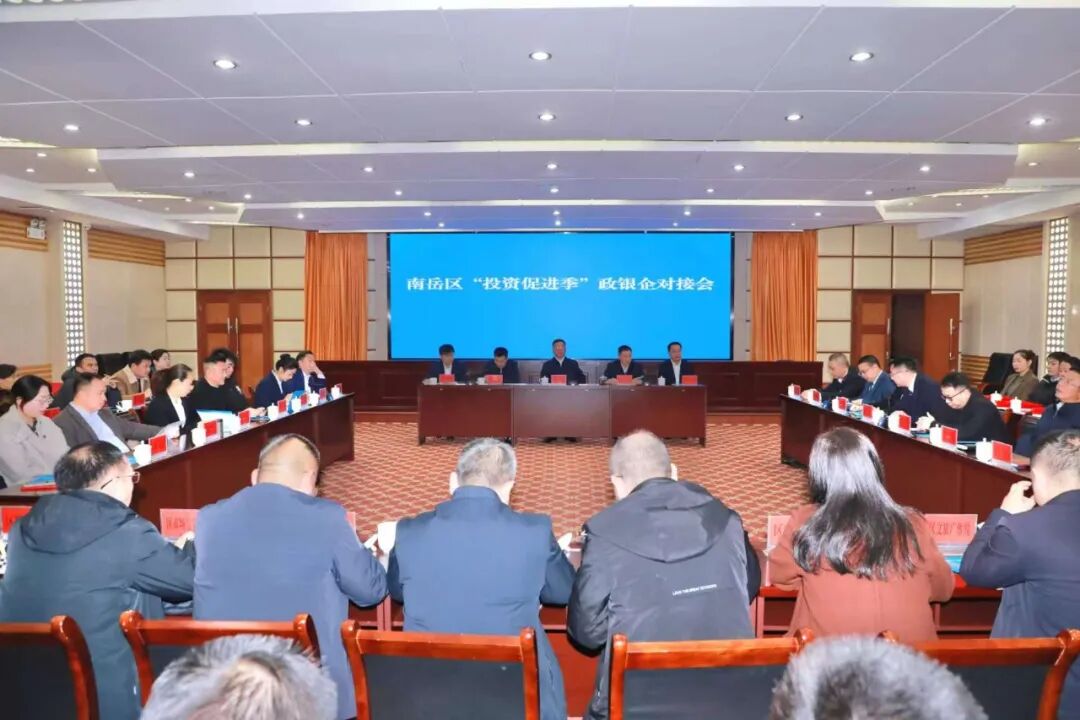
【衡阳动态】南岳区举办“投资促进季”政银企对接会,让更多金融“活水”浇灌实体经济
Xin Lang Cai Jing· 2026-02-04 12:20
Core Viewpoint - The South Yue District government and local banks are collaborating to enhance financial support for enterprises, aiming to foster economic development and project implementation in the region [1][6]. Group 1: Financial Collaboration - Over 80 representatives from the South Yue District government, banks, and enterprises gathered to discuss cooperation and development [1][6]. - Eight local banks signed agreements with eight enterprises, totaling 1.047 billion yuan, and established cooperation intentions with 23 enterprises, granting a total credit of 24.676 billion yuan [3][8]. Group 2: Economic Development Goals - The South Yue District government emphasizes the importance of a structured communication mechanism between government, banks, and enterprises to facilitate financial support and project success [3][8]. - The government aims to enhance service awareness and act as a liaison, coordinator, and service provider in the collaboration between financial institutions and enterprises [5][10].

2025年历下区GDP为2712亿元,同比增长5.6%
Qi Lu Wan Bao· 2026-02-04 11:31
Economic Performance - The district's GDP reached 271.2 billion yuan, with a year-on-year growth of 5.6% [1] - General public budget revenue was 17.38 billion yuan, with tax revenue of 15.99 billion yuan, reflecting a growth of 1.5% [1] - The tax revenue accounted for 92% of the total budget, indicating strong fiscal health [1] Development Goals - The district aims to establish a new urban development pattern characterized by "three zones coordination, north-south synergy, multi-park blooming, and simultaneous quantity and quality improvement" [2] - The focus will be on creating a headquarters economy cluster, targeting modern finance and high-end commerce for attracting quality headquarters enterprises [2] - The district plans to enhance its financial sector by attracting national and regional financial institutions, aiming to build a comprehensive financial ecosystem [2] Industry Focus - The district is set to develop a smart industry leading area, expanding the AI computing center and promoting the integration of digital and real economies [2] - Cultural and tourism integration will be emphasized, leveraging historical and natural resources to enhance the attractiveness of the tourism sector [3] - High-end consumption areas will be developed, focusing on upgrading commercial districts and expanding quality goods and services [3] Quality of Life - The district aims to improve urban living conditions through city renewal, fine management, and functional enhancements [3] - Initiatives will be taken to support community childcare, education, youth entrepreneurship, and multi-level elderly care services [3]
实干践承诺 奋进新征程
Xin Lang Cai Jing· 2026-02-04 09:12
Core Viewpoint - The report emphasizes the commitment of Zhangqiu District to high-quality development through the "Project Empowerment Year," aiming for a GDP growth of approximately 5.3% by 2026 while focusing on four key positioning areas: "Qilu Technology Innovation Manufacturing High Ground," "Longshan Spring Cultural Tourism City," "Jinan School-City Collaborative Integration Demonstration Zone," and "Modernized Strong District in Jinan Metropolitan Area" [2][3][4]. Economic Growth Targets - The main expected economic development targets for 2026 include a GDP growth of around 5.3%, a general public budget revenue increase of 3%, and an industrial added value growth of 7.5% [4]. - The social retail sales of consumer goods are projected to grow by 3.5%, with urban residents' per capita disposable income growth synchronized with economic growth, while rural residents' income growth is expected to exceed that of urban residents [4]. Investment and Consumption Strategies - The report highlights the importance of expanding domestic demand and enhancing economic recovery through initiatives like promoting large consumer goods replacement and expanding urban and rural consumption markets [5]. - Investment structure optimization is emphasized, with a focus on industrial investment, high-tech investment, and new investment, aiming to increase the share of private investment by 4 percentage points [5]. Industrial Development and Upgrading - Zhangqiu District aims to strengthen the real economy by promoting key projects in the main industrial chain, including new energy and intelligent manufacturing [6]. - The district plans to enhance the digital economy and logistics industries, with a target of reaching 210 service enterprises and a revenue of over 11.5 billion yuan in the service sector [6]. Innovation and Talent Development - The report stresses the creation of an innovation and entrepreneurship ecosystem, focusing on the construction of innovation clusters around universities and the establishment of new research platforms [7]. - It aims to cultivate a talent pool by introducing and training over 15 high-level talents and incubating more than 10 quality talent projects [7]. Rural Revitalization Initiatives - Rural revitalization is prioritized, with plans to create high-standard farmland and develop modern facility agriculture, aiming for stable production capacities in various agricultural sectors [8]. - The district also plans to enhance rural living conditions and increase farmers' income through asset utilization reforms and training programs [8]. Urban Development and Public Services - The report outlines urban governance and ecological protection efforts, including infrastructure projects and environmental management to improve living standards [9]. - It emphasizes the importance of social security and public service equalization, with initiatives to enhance education and healthcare services [10].
信长星参加无锡代表团审议时强调聚力聚焦 狠抓落实 着力推动“十五五”高质量可持续的发展
Xin Hua Ri Bao· 2026-02-04 00:29
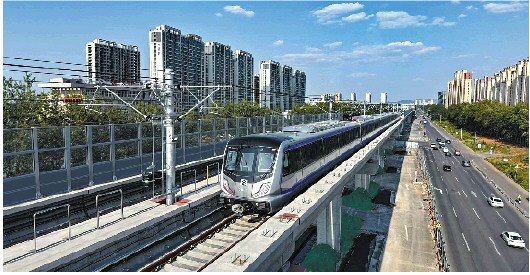
Group 1 - The core viewpoint emphasizes the importance of high-quality and sustainable development in Wuxi, aligning with the directives from the central government and the provincial leadership [1][2] - The government work report highlights the need to focus on emerging industries, support specialized and innovative enterprises, and enhance the technology finance service system [1][2] - There is a commitment to improving the ecological environment of the Taihu Lake area through comprehensive governance and pollution control measures [2] Group 2 - The focus for the next five years includes optimizing the industrial system, maintaining a reasonable proportion of manufacturing, and leveraging the Shanghai (Yangtze River Delta) international technology innovation center [2] - The government aims to enhance residents' income and improve living standards while addressing urgent social issues to meet the public's expectations for a better life [2][3] - There is a call for all levels of government officials to adopt a correct view of performance, emphasizing practical results that benefit the people [3]
高质量发展数字人民币 助力金融强国建设
Xin Lang Cai Jing· 2026-02-03 19:47
Core Viewpoint - The development of digital RMB is positioned as a crucial component in enhancing the central banking system and constructing a robust monetary policy framework, aiming to establish a financial powerhouse in China [1] Group 1: Digital RMB Development - The digital RMB has been recognized as an essential financial infrastructure in the digital economy era, with its development being a strategic initiative for deepening financial supply-side structural reforms and maintaining national financial security [1] - The People's Bank of China plans to implement a new generation of digital RMB management and service systems by January 1, 2026, marking the upgrade from version 1.0 (digital cash) to version 2.0 (digital deposit currency) [1] Group 2: Monetary Policy Effectiveness - The comprehensive promotion of digital RMB is expected to significantly enhance the precision and transmission efficiency of monetary policy, providing robust monetary tools for building a financial powerhouse [2] - Digital RMB's programmable features allow for targeted fund allocation, ensuring that credit flows to key sectors such as technological innovation and green manufacturing, thus addressing structural challenges in traditional monetary policy [2] Group 3: Financial Security - In the context of rising geopolitical risks, digital RMB plays a strategic role in maintaining national financial security, with its infrastructure and core data fully controlled by the state [3] - Digital RMB aims to reconstruct the cross-border payment and settlement system, enhancing the international competitiveness of the RMB by lowering costs and barriers for cross-border transactions [3] Group 4: Financial Inclusion - Digital RMB is designed to lower the barriers to accessing financial services, improving coverage and quality, particularly benefiting small and micro businesses by saving transaction costs [5] - The offline payment capability of digital RMB ensures basic payment needs are met even in areas with poor network signals, thus bridging the "digital divide" in financial services [5] Group 5: Empowering the Real Economy - Digital RMB is viewed as a vital financial innovation tool for promoting the integration of digital and real economies, enhancing the efficiency of supply chain finance and industry collaboration [6] - The low-cost settlement mechanism of digital RMB is expected to alleviate funding bottlenecks for enterprises, thereby supporting their operational needs [6] Group 6: Social Governance Innovation - Digital RMB offers unique advantages in government public service payments, enhancing transparency, security, and convenience for vulnerable groups [7] - The "controllable anonymity" feature of digital RMB protects user privacy while allowing the state to monitor for serious crimes, thus improving governance efficiency [7] Group 7: Strategic Value Recognition - Recognizing the strategic value of digital RMB, the implementation of the action plan is seen as an opportunity to innovate steadily, improve the ecosystem, and expand application scenarios, contributing to the construction of a financial powerhouse and providing a reference for global digital currency development [8]

总投资超330亿元!广东惠州一季度拟开工65宗重点项目
Zhong Guo Jing Ji Wang· 2026-02-03 09:16
Group 1 - The core viewpoint of the articles highlights the rapid construction and investment in key projects in Huizhou, with a total investment exceeding 33 billion yuan and an annual planned investment of over 12 billion yuan for 2026 [1][2] - Huizhou has 65 key construction projects scheduled to commence in the first quarter of 2026, focusing on expanding effective investment and supporting the development of the real economy [1] - Shenghong Technology's industrial park is a significant project, with several new factories under construction, aiming for partial completion before the Spring Festival [1] Group 2 - Huizhou is enhancing its service mechanisms by implementing a "credit fast review" commitment system and expanding the scope of acceptance for project applications [2] - The city is committed to ensuring that over 70% of new industrial land is allocated to industrial parks each year, while also seeking various funding supports [2] - Huizhou is strengthening the supply stability of key construction materials like cement and sand through dynamic price monitoring and a diversified market structure [2]

以有力监督推动巩固壮大实体经济根基
Zhong Yang Ji Wei Guo Jia Jian Wei Wang Zhan· 2026-02-03 00:07
Core Viewpoint - The construction of a modern industrial system and the consolidation of the real economy are prioritized as strategic tasks during the "14th Five-Year Plan" period, emphasizing the importance of political supervision to ensure effective implementation of these goals [5][17]. Group 1: Modern Industrial System Construction - The modern industrial system is deemed essential for economic modernization and is positioned as the material and technical foundation for a modern socialist country [8][17]. - The "14th Five-Year Plan" emphasizes the need to focus on the real economy, with a commitment to intelligent, green, and integrated development [8][17]. - The construction of a modern industrial system is linked to achieving strategic advantages in future development and international competition [6][17]. Group 2: Political Supervision and Support - Political supervision is highlighted as a primary responsibility of the disciplinary inspection and supervision agencies to ensure the implementation of major decisions regarding the construction of the modern industrial system [5][9]. - The central disciplinary inspection and supervision agencies are actively engaging in monitoring and evaluating the implementation of policies related to traditional and emerging industries [9][10]. - Local disciplinary bodies are focusing on specific industries, such as steel and artificial intelligence, to enhance political supervision and ensure compliance with national directives [12][13]. Group 3: Industry Development and Innovation - The manufacturing sector has maintained its position as the world's largest for 16 consecutive years, with significant advancements in high-end equipment, green energy, and intelligent manufacturing [7]. - By 2025, the value added of equipment manufacturing and high-tech manufacturing is expected to reach 36.8% and 17.1% of the total industrial value added, respectively [7]. - The integration of technology and industry is being prioritized to foster innovation and support the development of new production capacities [6][9]. Group 4: Challenges and Strategic Considerations - The construction of a modern industrial system faces various challenges, including the need for a balanced approach between traditional and emerging industries [17][18]. - There is a call for a strategic focus on both new and old industries, recognizing the importance of traditional sectors while promoting new technologies [17][18]. - The need for a dynamic balance in industrial structure is emphasized to prevent hollowing out of the manufacturing sector while optimizing its composition [17][18].


新思想引领新征程丨优化提升传统产业 巩固壮大实体经济根基
Yang Guang Wang· 2026-02-02 04:59
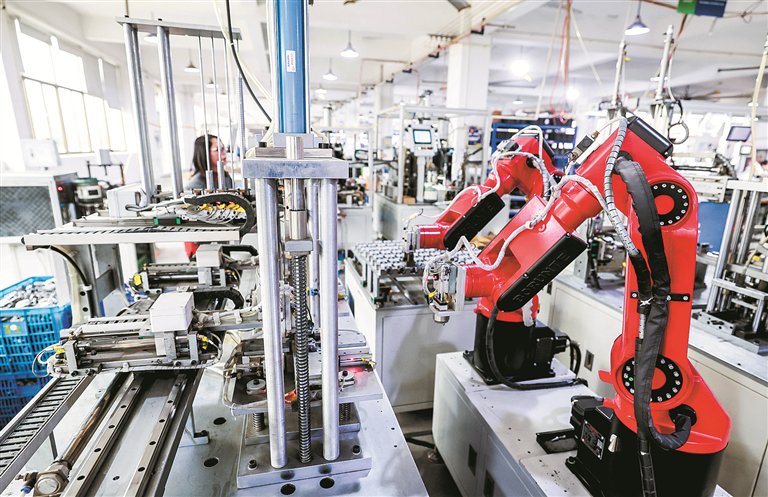
Group 1 - Traditional manufacturing is a crucial part of the real economy, and there is a strong emphasis on leveraging market demand and technological innovation to revitalize traditional industries [1][2] - Regions and departments are encouraged to adopt high-end, intelligent, green, and integrated approaches to enhance traditional industries, effectively stimulating new momentum and vitality [1][2] - The production line at Benxi Steel's cold-rolled plant is noted for its capability to produce steel plates that are only as thick as a bank card but can withstand a pressure of 480 tons, showcasing advancements in material strength and toughness [1] Group 2 - The delivery of the LNG carrier "Tianshan," which utilizes the latest dual-fuel low-speed propulsion system, highlights the integration of digital construction technologies that have reduced the construction cycle from 21 months to 16-17 months [2] - The AI "Safety Brain" developed by a fossil energy equipment manufacturing company in Lanzhou has significantly shortened the hazard inspection cycle from 2-3 months to 2 weeks, enhancing safety management [3] - Over 35,000 basic-level and more than 8,200 advanced-level intelligent factories have been established in China, indicating a robust push towards digital transformation in manufacturing [3] Group 3 - The green transformation of traditional industries is advancing, with significant reductions in energy consumption per unit of added value expected in major energy-consuming sectors by 2025 [3] - A coal-to-nylon transformation in an energy chemical enterprise illustrates the shift of coal from a fuel to a core material in high-end manufacturing, revitalizing traditional industries [3] - The deep integration of the digital economy with traditional industries is injecting new growth vitality, with a focus on optimizing and enhancing traditional sectors during the 14th Five-Year Plan [3]
“开票经济”,为何要严查?
Sou Hu Cai Jing· 2026-02-01 10:24
Core Viewpoint - The national tax work conference held on January 28, 2026, emphasized the need to address issues related to "invoice economy" and illegal tax-related practices to maintain a sound economic tax order and better serve the construction of a unified national market [1] Group 1: Understanding "Invoice Economy" - "Invoice economy" refers to a situation where local governments attract shell companies that lack real operations by offering financial incentives, creating a false economic prosperity through digital manipulation [2] - This model leads to fiscal circularity and tax revenue loss, as local governments may return excessive portions of tax revenue to attract these shell companies, resulting in a cycle where legitimate businesses suffer while the state loses tax revenue [2] - The practice undermines fair market competition, as compliant businesses bear the full tax burden while shell companies gain undue advantages through illegal financial returns, leading to a scenario where "bad money drives out good" [2] Group 2: Risks and Consequences of "Invoice Economy" - "Invoice economy" provides opportunities for criminal activities, where gangs register shell companies to fraudulently claim financial subsidies and tax returns, creating a black market chain of "registration - invoicing - virtual issuance - collection" [3] - This approach does not generate real industries, jobs, or high-quality development, as inflated GDP and fiscal data misrepresent the actual economic situation, potentially misleading macroeconomic decisions and causing neglect of core issues like industrial cultivation and public welfare [3] - To foster genuine economic growth, it is essential to shift the focus from mere numerical achievements to real tax contributions, job creation, and industrial development, while enhancing regulatory frameworks to monitor and penalize illegal financial practices [3]
人行辽宁省分行:多渠道为实体经济提供“真金白银”
Xin Hua Cai Jing· 2026-01-31 01:49
Core Viewpoint - The People's Bank of China Liaoning Branch is committed to implementing a moderately loose monetary policy to support the real economy and promote high-quality development, effectively utilizing various monetary policy tools to provide substantial financial support to the economy and reduce overall financing costs. Group 1: Financing Growth - The People's Bank of China Liaoning Branch has guided financial institutions to meet the effective financing needs of the real economy, resulting in an increase of 121.9 billion RMB in new loans in 2025, with a year-on-year growth of 2.35% in loan balance [1] - Among the new loans, six major state-owned banks contributed 102.2 billion RMB, with a year-on-year growth of 4.2%, while joint-stock banks added 4.53 billion RMB, which is an increase of 31.1 billion RMB compared to the previous year [1] Group 2: Credit Structure Optimization - The People's Bank of China Liaoning Branch has utilized various structural monetary policy tools to guide funds towards key areas and weak links, deploying approximately 77 billion RMB in central bank funds through tools like re-loans for technological innovation and consumer services, which has stimulated financial institutions to issue around 370 billion RMB in various loans [2] - Future plans include establishing special quotas such as "Le Gou Loan" and "Silver Hair Loan" to support loans for consumer services and the elderly care industry, ensuring comprehensive coverage of re-loans for agriculture and small enterprises in key areas [2] Group 3: Sustainable Interest Rate Environment - The People's Bank of China Liaoning Branch aims to optimize the interest rate environment as a crucial part of improving the business environment, continuously guiding a steady decline in overall financing costs and strengthening the supervision of interest rate policies to maintain market competition [2] - In December, the interest rates for newly issued corporate loans and inclusive micro-loans decreased by 248 basis points and 271 basis points, respectively, compared to the end of 2020, demonstrating significant effectiveness in reducing financial burdens on the real economy [2]