
数字货币

Search documents
美股周五收盘点评:数字货币见底反弹,股市关注财报数据
Xin Lang Cai Jing· 2026-02-06 22:00
来源:宏观对冲陈凯丰Kevin - 欧洲:周四股市回调后,市场趋于稳定,欧洲股市午盘小幅上涨,本周整体略有上涨。德国出口数据 好于预期,但疲软的工业生产数据凸显了经济增长的脆弱性,而欧洲央行专业预测人士调查显示通胀保 持稳定,尽管一些领先指标发出了一些预警信号。正如预期,欧洲央行昨日连续第五次会议维持利率政 策不变,政策展望强调了持续的贸易不确定性和地缘政治紧张局势。 特别声明:以上内容仅代表作者本人的观点或立场,不代表新浪财经头条的观点或立场。如因作品内 容、版权或其他问题需要与新浪财经头条联系的,请于上述内容发布后的30天内进行。 - 亚太地区:周五亚洲股市普遍下跌,大中华区和澳大利亚的跌幅超过了日本的涨幅。区域交易主要受 科技股波动的影响,韩国半导体股票再次遭到抛售,恒生科技指数徘徊在熊市边缘。从宏观角度来看, 我们认为政策信号对股市没有提供任何直接的指引。例如,澳大利亚央行和日本央行隔夜的评论重申了 货币政策的谨慎和渐进性,日本家庭消费数据令人失望,印度央行维持利率不变。 ...
【UNforex知识课堂】黄金是被困在笼子里的货币之王
Sou Hu Cai Jing· 2026-02-06 11:24
避险属性: 在经济危机、战争或通胀时期,黄金被视为最可靠的避险资产。 例如,2008年金融危机和2020年新冠疫情初期,黄金价格大幅上涨。 央行储备: 各国央行将黄金作为外汇储备的重要组成部分,用于稳定货币和经济。 UNforex知识分享:"黄金是被困在笼子里的货币之王"这一说法形象地描述了黄金在现代金融体系中的 地位和困境。当下,黄金在投资、央行储备和避险领域仍具有重要地位,但其货币属性受到现代货币体 系和数字货币的挑战。未来,黄金的命运将取决于全球经济、货币政策和数字货币的发展趋势。以下是 对这一观点的详细分析: 历史地位: 黄金在历史上长期作为货币使用,尤其是在金本位制下,黄金是货币价值的锚定物。 黄金具有稀缺性、耐久性和全球通用性,被视为"硬通货"和财富的象征。 比特币等加密货币被视为"数字黄金",可能对黄金的避险地位构成挑战。 脱离金本位制: 1971年,美国宣布美元与黄金脱钩,金本位制终结,黄金的货币属性被削弱。 现代货币体系以信用货币(如美元、欧元)为基础,黄金不再是直接交易媒介。 价格受控: 黄金价格受美元走势、美联储政策和市场情绪的影响,失去了独立定价的能力。 例如,美元走强时,黄金价格往往 ...
人民币最大面额才100元,为何不发行500元和1000元?原来大有讲究
Sou Hu Cai Jing· 2026-02-06 09:26
Core Viewpoint - The issuance of high-denomination currency in different countries is closely related to their historical evolution and economic conditions, with China maintaining a maximum denomination of 100 yuan due to its unique economic environment and consumer behavior [1][11][20]. Group 1: Historical Context - Japan's largest denomination was initially 100 yen during its economic recovery in the early 20th century, reflecting a stable economic development [3]. - After World War II, Japan faced severe inflation and increased its maximum currency denomination to 1,000 yen to address economic collapse [5]. - As Japan's economy recovered and entered a growth phase in the 1950s, it issued higher denominations of 5,000 and 10,000 yen to meet currency circulation needs [7]. Group 2: Economic Conditions and Currency Issuance - Countries experiencing economic weakness and severe inflation, like Zimbabwe, often resort to issuing high-denomination currency [9]. - In contrast, countries with strong economies, such as the United States and China, do not issue high-denomination currency due to effective inflation control [11]. Group 3: Consumer Behavior and Payment Trends - In China, the maximum denomination of 100 yuan aligns with everyday consumer needs, as most transactions do not require large amounts of cash [13]. - The rise of mobile payments has reduced the necessity for cash, making transactions more convenient and less reliant on high-denomination currency [14]. Group 4: Security Concerns - High-denomination currency poses security risks during large transactions, while electronic payments provide safer transaction records [16]. - The potential for counterfeiting increases with high-denomination currency, as the cost of producing counterfeit bills is relatively low [18]. Group 5: Future Outlook - Given China's current economic situation and technological advancements, the issuance of high-denomination currency is deemed unnecessary, with a shift towards electronic payments and digital currency expected to enhance efficiency and security in the monetary system [20].

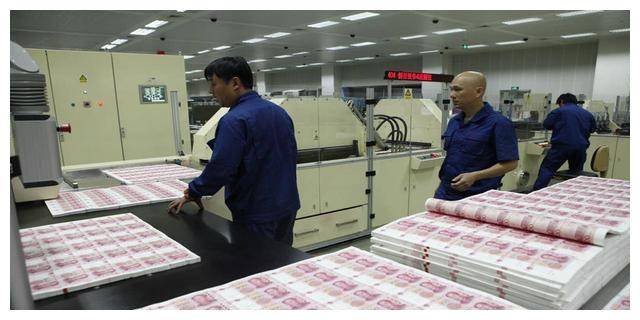
加密货币市值蒸发2万亿美元,比特币大跳水一度跌破60000美元
21世纪经济报道· 2026-02-06 07:56
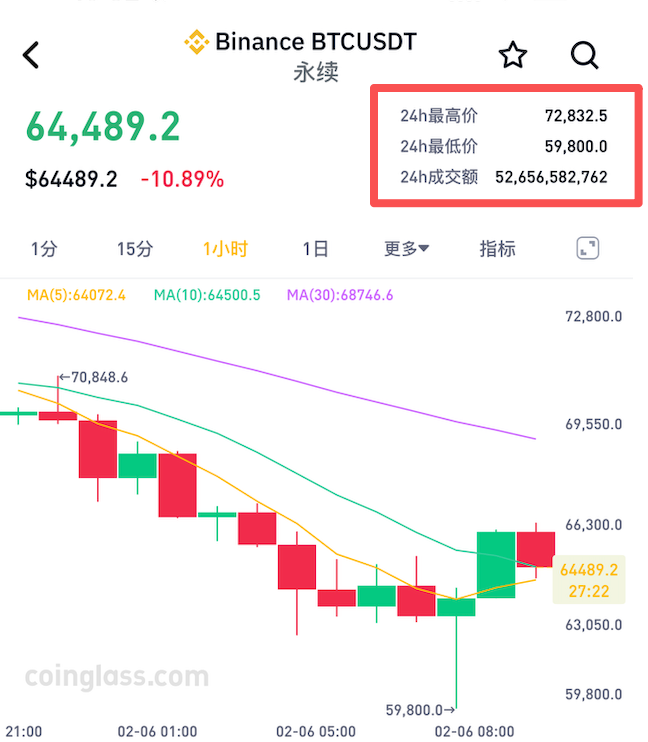
Core Viewpoint - The article discusses the significant volatility in Bitcoin prices, highlighting a sharp decline and the factors contributing to this market behavior [1][5][11]. Price Movement - On February 6, Bitcoin experienced a drastic drop, reaching a low of $60,000 before rebounding to around $66,000, marking a decline of over 6% from the previous trading day [1]. - Over the past 12 months, Bitcoin started at approximately $96,000, peaked at $125,000 in early October, and has since fallen to around $64,000, nearly halving its market value since the peak [4]. Market Dynamics - The total market capitalization of cryptocurrencies has plummeted from $4.4 trillion in early October 2025 to over $2 trillion, indicating a significant loss in value [2]. - The recent downturn has led to massive liquidations, with Bitcoin accounting for a substantial portion of the total $2.584 billion liquidated in the last 24 hours [6][7]. Investor Behavior - The article notes that Bitcoin's price movements are closely correlated with the Nasdaq index, suggesting that its investors often have a technology background [5]. - Concerns over potential shifts in monetary policy, particularly regarding the nomination of Kevin Walsh as Fed Chair, have heightened investor anxiety, contributing to the market's volatility [11]. Broader Market Impact - Other major cryptocurrencies, including Ethereum and Dogecoin, have also faced declines exceeding 6%, reflecting a broader market trend [9].

比特币较去年高点腰斩!跌至64000美元 59万人爆仓
2 1 Shi Ji Jing Ji Bao Dao· 2026-02-06 05:01
Group 1 - Bitcoin price experienced a significant drop on February 6, reaching a low of $59,800 before rebounding to around $64,000, still down over 10% from the previous trading day [1] - The price volatility within 24 hours showed a range of $17,000, indicating a highly unstable market environment [1] - Over the past 12 months, Bitcoin started at approximately $96,000, peaked at $126,000 in October, and has since seen a decline to around $64,000, nearly halving its market value from the October high [4] Group 2 - The recent price fluctuations are attributed to Bitcoin's correlation with the Nasdaq index rather than traditional assets like gold, suggesting it is viewed as a technology asset [5] - A significant amount of liquidations occurred, with $1.42 billion in liquidations reported in the past 24 hours, including $1.2 billion in long positions and $220 million in short positions [5][8] - The overall market saw over 590,000 liquidations, totaling $2.705 billion, with Bitcoin accounting for 52.5% of this amount [8] Group 3 - The market downturn is linked to multiple factors, including concentrated leverage unwinding and increased selling pressure, alongside investor concerns regarding potential shifts in monetary policy [11] - Recent news regarding the nomination of Kevin Walsh as the Federal Reserve Chair has raised fears of a hawkish stance that could negatively impact the cryptocurrency market [11]
港股午评:恒指跌1.13%、科指跌0.47%,大金融股低迷,锂电池逆势上扬 ,茶饮及新能源车股走强、蔚来汽车涨超7%
Jin Rong Jie· 2026-02-06 04:11
Market Overview - The Hong Kong stock market experienced a significant decline, with the Hang Seng Index dropping 1.13% to 26,580.94 points, the Hang Seng Tech Index down 0.47% to 5,380.72 points, and the National Enterprises Index falling 0.52% to 9,045.82 points, indicating a weak overall performance and noticeable market divergence [1][2]. Sector Performance - Major technology stocks faced substantial pressure, with Alibaba down 2.57%, JD Group down 2.21%, and Tencent Holdings down 0.9%, contributing significantly to the index decline. Analysts attribute this adjustment to intensified market competition and regulatory changes, leading to evident capital outflows [2]. - Gold stocks plummeted due to a sharp drop in gold and silver prices, with companies like Zhaojin Mining and Zijin Mining experiencing declines. The decrease in demand for gold as a safe haven and the rebound of the US dollar index pressured gold prices [3]. - Digital currency and AI application stocks also performed poorly, affected by increased market volatility and regulatory uncertainties. Despite the promising outlook for AI applications, the sector is still in its early development stages, facing challenges in commercialization [4]. Active Sectors - Chinese medicine stocks showed strong performance due to favorable government policies supporting traditional Chinese medicine, with companies like Tongrentang Technology and China Traditional Chinese Medicine seeing significant gains [5]. - The paper industry and new consumption concept stocks were active, benefiting from stable raw material prices and improved supply-demand dynamics, attracting investor interest [6]. Corporate Developments - Meituan announced plans to acquire all shares of fresh food e-commerce platform Dingdong Maicai for $717 million, aiming to expand its presence in the fresh food sector and enhance market share [7]. - NIO projected its first quarterly profit, estimating adjusted operating profits between 700 million to 1.2 billion yuan for Q4 2025, a significant reduction in losses compared to the previous year, driven by increased sales and cost-cutting measures [8][9]. - Several companies reported positive earnings forecasts, including Tongda Group, which expects a profit of 115 to 125 million HKD for the fiscal year 2025, and Caike New Energy, which anticipates a revenue of 507 million yuan, reflecting year-on-year increases [10][11]. Institutional Insights - Analysts from Hang Seng Qianhai suggest that while short-term volatility and liquidity shocks may persist, the market's valuation attractiveness is gradually becoming evident, with potential for upward movement in the medium term [12]. - Guosen Securities remains optimistic about the Hong Kong market's future, despite potential risks from rising oil prices and long-term bond yields, emphasizing the resilience of corporate earnings [13]. - Guoyuan International highlights the potential for short-term fluctuations but maintains a positive long-term outlook for the Hong Kong market, citing strong capital resilience [14].

“这次大家也在怀疑,会不会是庞氏骗局?”
Guan Cha Zhe Wang· 2026-02-05 16:05
Core Insights - The recent surge in gold prices is attributed to evolving geopolitical conditions, with gold reaching unprecedented levels of $5,500 per ounce, a historical first [1] - Historical patterns show that significant increases in gold prices have occurred during times of monetary system instability, such as the collapse of the Bretton Woods system in 1973 and the U.S. debt crisis in the 1980s [1] - Current concerns regarding the U.S. national debt, which stands at $39 trillion, have led to speculation about the stability of the financial system, prompting further interest in gold as a safe-haven asset [1] Summary by Categories Gold Price Trends - Gold has been on a continuous upward trajectory for the past two years, with a notable increase in value [1] - The annualized return on gold over the past 50 years is approximately 7% to 8%, with slight variations between U.S. dollar and Chinese yuan valuations [1] Economic Context - The rapid issuance of fiat currencies, exceeding 10%, has created a demand for stable assets, leading investors to turn to gold [1] - The current market sentiment reflects a diversified approach among investors, who are seeking to hold fiat currencies, digital currencies, and gold simultaneously, indicating a potential bubble in gold prices [2]