柔性制造

Search documents
国务院常务会议提出“增强供需适配性”,提振消费释放新信号
Xin Jing Bao· 2025-11-19 10:58
Core Insights - The State Council's recent meeting emphasized enhancing the adaptability of supply and demand to stimulate consumption, signaling a strategic shift towards innovation and technology integration in key industries [1][2][3] Group 1: Supply and Demand Adaptability - The concept of supply and demand adaptability aims to improve the match between supply and demand, addressing issues of excess low-end supply and insufficient high-quality supply, thereby facilitating economic circulation and unlocking consumption potential [2][3] - The meeting outlined key paths to solve supply-demand adaptability, including accelerating the application of new technologies and models, focusing on developing new products and value-added services in key industries, and expanding new consumption increments [1][3] Group 2: Consumer Trends and Market Dynamics - There is a notable shift in consumer behavior from quantity to quality, with increasing demand for diversified, personalized, and high-quality products, indicating a need for industry and consumption upgrades to create a virtuous cycle between supply and demand [2][4] - The meeting highlighted the importance of fostering new consumption scenarios and business models, enhancing consumer financial products and services, and creating a favorable consumption environment [3][4] Group 3: Policy and Structural Reforms - The government is implementing policies to boost consumption, including promoting income growth and reducing burdens on residents, which are expected to enhance consumer confidence and spending [4][5] - Experts suggest that the potential of a large-scale market as a "demand engine" relies on effectively addressing the issue of "income-supported consumption demand," advocating for reforms in income distribution to strengthen the middle-income group [5]
增强供需适配 柔性制造发展提速
Zheng Quan Ri Bao· 2025-11-18 16:08
Core Viewpoint - The State Council meeting emphasizes enhancing supply-demand adaptability as an effective measure to unleash consumption potential and facilitate economic circulation [1] Group 1: Flexible Manufacturing - Flexible manufacturing is identified as a future direction for manufacturing enterprises to achieve personalized customization in response to increasingly diverse market demands [1][2] - The construction of flexible manufacturing plants in China has transitioned from conceptual exploration to large-scale practical implementation, driven by national strategy and market demand [1][2] - Flexible manufacturing can effectively address the mismatch between supply and demand in traditional mass production, thereby releasing domestic demand potential and creating new demand through high-quality supply [2] Group 2: Market Potential and Growth - The market size of flexible manufacturing was approximately 62 billion yuan in 2020, with expectations to reach 130 billion yuan by 2025, indicating significant growth potential [2] - The penetration of flexible manufacturing is expanding from the automotive and home appliance sectors to include clothing, food, and other industries, with the automotive sector already accounting for 35% of flexible production lines [2] Group 3: Policy Support and Technological Integration - Policies such as the "Implementation Plan for Digital Transformation in Light Industry" aim to enhance flexible production capabilities by promoting the application of smart technologies in various industries [3] - The integration of new information technologies, such as industrial internet platforms and AI, is deepening, providing strong support for rapid production changes and personalized scheduling in flexible manufacturing [3][5] Group 4: Future Trends and Workforce Development - The demand for flexible manufacturing is increasing due to industrial upgrades, which also provide application scenarios for advanced technologies like embodied intelligent robots [4] - The implementation of technologies like digital twins, AI scheduling, and 5G edge computing is expected to drive the development of upstream and downstream industries, creating new job roles in data analysis and algorithm engineering [5] - Strengthening the "digital foundation" and breaking down data barriers across enterprises and industries are essential for the development of flexible manufacturing plants [5]
国务院勾勒未来消费蓝图 AI赋能、柔性制造,下一件商品或许将“为你而生”
Mei Ri Jing Ji Xin Wen· 2025-11-16 13:43
Group 1 - The State Council, led by Premier Li Qiang, is focusing on the implementation of the "Two Major" initiatives, which include national strategic implementation and key area security capability construction [1][2] - The "Two Major" initiatives are to be integrated into the overall planning of the 14th Five-Year Plan, emphasizing strategic, forward-looking, and holistic requirements [2][3] - The initiatives aim to enhance project review processes, prioritize innovation and intangible asset investments, and promote the development of new productive forces [2][3] Group 2 - The "Two Major" initiatives are expected to drive economic growth through government and enterprise investments while integrating new technologies to promote high-quality economic development [3][4] - Key strategies for advancing the "Two Major" initiatives include strengthening coordination among departments, focusing on both hard and soft infrastructure, and addressing gaps in key areas such as technology innovation [4] - Enhancing supply-demand adaptability is seen as a crucial measure to unleash consumption potential and facilitate economic circulation [5] Group 3 - The meeting emphasized the importance of consumer demand in driving economic growth, identifying two main issues: insufficient purchasing power among the general population and a lack of quality consumption projects for wealthier consumers [5] - The government aims to support the expansion of high-quality consumer goods and accelerate the updating of safety, performance, and green standards [5] - The meeting also discussed the establishment of a coordinated mechanism for education and talent development to meet national strategic needs [6] Group 4 - The meeting approved the draft amendment to the Trademark Law, aiming to strengthen trademark management and protection to promote economic and social development [7]
拓斯达单季营收增逾17%拟赴港IPO 逐步“卸包袱”进军人形机器人赛道
Chang Jiang Shang Bao· 2025-11-13 23:57
Core Viewpoint - TuoSiDa is undergoing a strategic transformation focusing on product enhancement and project contraction, leading to improved performance and plans for an H-share listing in Hong Kong [1][2]. Financial Performance - In the first three quarters of 2025, TuoSiDa achieved revenue of 1.688 billion yuan, a year-on-year decline of 24.49%, while net profit attributable to shareholders reached 49.34 million yuan, an increase of 446.74% [1][6]. - The third quarter saw revenue of 602 million yuan, a year-on-year increase of 17.58%, and net profit of 20.60 million yuan, up 176.93% [1][6]. - For the first half of 2025, revenue was 1.086 billion yuan, down 36.98%, with net profit decreasing by 19.75% [6]. Business Strategy - TuoSiDa is actively adjusting its business structure by reducing the scale of its project-based operations, particularly in the smart energy and environmental management systems sector, which is expected to see a revenue decline of over 50% in 2024 [4][5]. - The company aims to enhance its product lines, including industrial robots, CNC machine tools, and injection molding machines, while decreasing the proportion of project-based business [5][6]. Product Development - On September 12, TuoSiDa launched its first humanoid robot, "Xiao Tuo," targeting the injection molding sector and marking its entry into the humanoid robot market [1][8]. - The company is deepening its "AI + manufacturing" strategy to explore new market opportunities in flexible manufacturing [8]. Business Segments - In the first three quarters of 2025, the industrial robot and automation application systems segment generated revenue of 545 million yuan, a year-on-year increase of 2.34% [7]. - The injection molding machine and related equipment segment achieved revenue of 348 million yuan, maintaining stability with a gross margin increase of 8.55 percentage points [7]. - The CNC machine tool segment reported revenue of 226 million yuan, a growth of 44.29%, although the gross margin decreased by 4 percentage points due to changes in product mix [7].

智元机器人真机强化学习落地;云深处科技更名“股份有限公司”|数智早参
Mei Ri Jing Ji Xin Wen· 2025-11-03 23:16
Group 1 - The core viewpoint of the news is that advancements in technology, such as real machine reinforcement learning and the transition of companies to joint-stock structures, are driving the evolution of the robotics industry and related materials [1][2][3] Group 2 - ZhiYuan Robotics has successfully implemented its real machine reinforcement learning technology in collaboration with Longqi Technology, marking a significant step from academic research to industrial application, enhancing flexible manufacturing efficiency and adaptability [1] - The name change of YunShenChu Technology from a limited liability company to a joint-stock company indicates a strategic shift towards capital operations, potentially paving the way for attracting strategic investors or preparing for an IPO [2] - Northern Rare Earth has identified humanoid robots as a new driving force for the demand for rare earth magnetic materials, highlighting the critical relationship between humanoid robotics and the supply chain of high-performance rare earth materials [3]


“平台+服装产业”双向赋能 解码“柔性制造”里的“数智化”
Hang Zhou Ri Bao· 2025-10-31 05:48
Group 1 - The core concept of the news highlights the innovative model of the fashion industry in Yishan Town, which integrates digital innovation and flexible manufacturing to respond to market changes [1] - Yishan Town has established a comprehensive fashion ecosystem that includes design, sampling, production, and sales, attracting nearly 3,700 enterprises and over 8,000 designers and pattern makers [1] - In the first half of this year, the online retail sales of the clothing industry in Hangzhou reached 30.738 billion yuan, representing a year-on-year growth of 15% [1] Group 2 - The "live streaming + brand" revolution in Hangzhou is driving a transformation in the clothing industry, with over 500 cross-border e-commerce companies and a transaction volume of 5.26 billion yuan, up 21.85% year-on-year [2] - The industry aims to transition from being a "traffic highland" to a "quality peak," emphasizing the importance of dual empowerment through platforms and industries for the future of Hangzhou's women's clothing [2]
黑湖科技:柔性颠覆万亿制造
2 1 Shi Ji Jing Ji Bao Dao· 2025-10-30 12:35
Core Insights - The article highlights the emergence of Heihu Technology, founded by the young entrepreneur Zhou Yuxiang, as a significant player in China's industrial automation and SaaS market, catering to a diverse range of industries from beverage to household appliances [1][2][10] - Heihu Technology's strategy focuses on serving small and micro enterprises, which are abundant in China, by providing lightweight and convenient digital solutions, thus addressing a gap left by traditional industrial software [4][5][6] Industry Overview - The industrial software market in China, particularly in the SaaS/MES sector, remains relatively limited compared to global giants like Siemens, Dassault Systems, and Rockwell, which dominate the market due to their established technology and ecosystem [3][6] - The Chinese manufacturing landscape is characterized by a vast number of small workshops and enterprises, making it distinct from other countries where large corporations dominate [4][6] Company Strategy - Heihu Technology's approach is likened to a "guerrilla warfare" strategy, penetrating the intricate network of China's manufacturing sector by offering solutions tailored for small factories, which traditional software has often overlooked [5][6] - The company has successfully integrated its "Heihu Small Work Order" system, which facilitates progress tracking and payroll for small enterprises, leading to increased collaboration with larger companies that discover their suppliers are already using Heihu's products [5][6] Technological Advancements - Heihu Technology is at the forefront of flexible manufacturing, responding to the growing demand for personalized and rapid production cycles, which traditional manufacturing methods struggle to accommodate [7][9] - The company has invested in advanced technologies such as AI, IoT, and digital twin technology to enhance production efficiency and decision-making processes, significantly reducing the time required for complex tasks [9][10] Market Position - As of 2023, Heihu Technology has captured a 40% market share in China's SaaS/MES sector, with over 30,000 clients, including notable brands like Mixue Ice Cream and AO Smith, which have contributed to its market expansion [10]
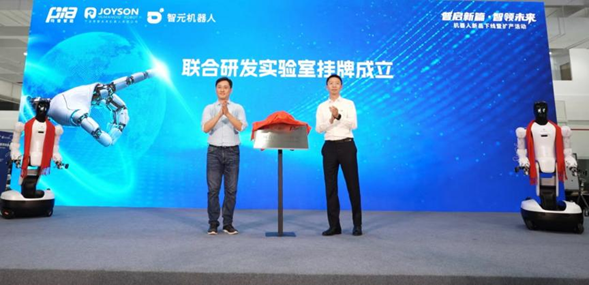
均普智能与智元机器人携手成立联合实验室 攻坚工业AI底层技术
Zheng Quan Shi Bao Wang· 2025-10-29 12:28
Core Viewpoint - The establishment of the "Junpu Intelligent - Zhiyuan Joint R&D Laboratory" aims to advance industrial AI from "perceptual intelligence" to "executive intelligence," focusing on developing a closed-loop ecosystem for toolchain development and scenario validation [1][5]. Group 1: Laboratory Objectives - The laboratory will focus on creating a universal underlying toolchain and algorithm platform for core industrial processes, addressing the complexities of basic actions like "grasping," "assembly," and "movement" [3]. - It aims to build a standardized toolchain that integrates software and hardware, facilitating rapid development and deployment of upper-layer applications [3]. Group 2: Data Acquisition and Model Training - The laboratory has established a complete closed-loop system for "scene building - data collection - model training - tool development" to tackle the challenge of acquiring high-quality industrial private data [3]. - Junpu Intelligent is actively building a physical data collection center to gather essential data for model training from real and simulated industrial environments [3]. Group 3: Strategic Collaboration - The collaboration between Zhiyuan Robotics and Junpu Intelligent combines Zhiyuan's expertise in AI large models with Junpu's 50 years of experience in intelligent manufacturing, creating a strategic synergy [5]. - The laboratory will focus on developing a universal toolchain for AI models, enabling quick training, adaptation, and deployment in new scenarios [5]. Group 4: Innovation and Flexibility - The laboratory's approach aims to overcome the limitations of traditional industrial automation, which has been constrained by insufficient flexible manufacturing capabilities and low hardware reuse rates [5]. - Future intelligent devices equipped with the laboratory's technological achievements will be able to adapt quickly to new tasks, significantly improving equipment utilization and reducing debugging cycles [5]. Group 5: Sustainable Development - The innovation center will serve as an open platform, continuously providing real industrial demands and data to the laboratory [5]. - The tools and data platforms developed by the laboratory will be made available to customers and partners, promoting self-extraction of data and model utilization, ultimately creating a sustainable closed-loop from technology development to commercial application [5].


解码“柔性制造”里的“数智化”
Hang Zhou Ri Bao· 2025-10-29 02:59
Group 1 - The core concept of the news highlights the innovative model of the fashion industry in Yishan Town, which integrates digital innovation and flexible manufacturing to respond to market changes [1] - Yishan Town has established a comprehensive fashion ecosystem that includes design, sampling, production, and sales, attracting nearly 3,700 enterprises and over 8,000 designers and pattern makers [1] - In the first half of this year, the online retail sales of the clothing industry in Hangzhou reached 30.738 billion yuan, representing a year-on-year growth of 15% [1] Group 2 - The news also discusses a "live streaming + brand" revolution in Hangzhou, driven by leading MCN organizations, which is fostering the development of designer and influencer brands [2] - There are over 500 cross-border e-commerce companies in Hangzhou, with a cross-border clothing transaction volume of 5.26 billion yuan, showing a year-on-year increase of 21.85% [2] - The industry aims to transition from being a "traffic highland" to a "quality peak," emphasizing the importance of dual empowerment through platforms and industries for the future of Hangzhou's women's clothing sector [2]
多省市前三季度GDP增长亮眼 机器人“立功”
财联社· 2025-10-25 07:01
Core Insights - The article highlights the robust growth of the robotics market in China, particularly in cities like Beijing, Shanghai, and Hangzhou, driven by increasing demand for automation in traditional industries [4][5][6] - The integration of artificial intelligence (AI) into manufacturing processes is accelerating, enhancing productivity and quality across various sectors [9][10][11] Economic Performance - Zhejiang Province reported a GDP of 68,495 billion yuan in the first three quarters, with a year-on-year growth of 5.7%. Key products like industrial robots and lithium-ion batteries saw significant production increases of 65.6% and 52.5%, respectively [5] - Hangzhou's industrial robot production surged by 97.9%, while Ningbo's investment in AI and robotics grew by 9.3%, outpacing overall investment growth [6] Robotics Market Growth - The demand for industrial robots remains strong, with JD Logistics announcing plans to purchase 3 million robots, 1 million unmanned vehicles, and 100,000 drones over the next five years [4] - In Shanghai, exports of high-end manufacturing products, including industrial robots, grew by 41.6% in the first three quarters [6] AI Integration in Manufacturing - The AI manufacturing sector in Shanghai experienced a year-on-year growth of 12.8%, significantly higher than the previous year's 3.2%, indicating its role as a key driver of GDP growth [9] - Companies like Hikvision and Midea are actively applying AI and robotics in production, enhancing efficiency and quality control [10] Challenges and Future Outlook - Experts note that while AI integration in manufacturing is a trend, challenges remain, including the need for cost-effective solutions and the development of diverse application scenarios [11] - The focus on quality improvement rather than just capacity expansion is emphasized, with AI technologies enabling more flexible and customized manufacturing processes [11]