财政宏观调控

Search documents
国家财政实力持续增强(锐财经)
Ren Min Ri Bao· 2025-09-12 19:48
Core Viewpoint - The "14th Five-Year Plan" period has seen significant enhancements in national fiscal strength and efficiency, highlighting the role of finance as a fundamental pillar of national governance [1] Fiscal Strength and Revenue Growth - During the "14th Five-Year Plan," national public budget revenue is expected to reach 106 trillion yuan, an increase of 17 trillion yuan or approximately 19% compared to the "13th Five-Year Plan" [2] - Local fiscal strength has steadily grown, with 16 provinces projected to have fiscal revenue growth of over 20% compared to 2020, and 7 provinces exceeding 500 billion yuan, including 2 provinces surpassing 1 trillion yuan [2] Expenditure and Structural Optimization - National public budget expenditure is projected to exceed 136 trillion yuan over five years, an increase of 26 trillion yuan or 24% compared to the "13th Five-Year Plan" [2] - The expenditure structure has been optimized, with more funds directed towards major development and livelihood projects [2] Macroeconomic Regulation - Fiscal macro-control has become more proactive, enhancing adaptability to economic conditions, and has played a crucial role in supporting stable and healthy economic development [3] - The government has implemented counter-cyclical adjustments to smooth short-term fluctuations, with a package of policies introduced in late 2022 to stabilize the economy [3] Social Welfare and Public Services - Total fiscal investment in the livelihood sector during the "14th Five-Year Plan" is nearly 100 trillion yuan, with over 70% of national public budget expenditure allocated to this area [4] - Key social expenditures include 20.5 trillion yuan for education, 19.6 trillion yuan for social security and employment, and 10.6 trillion yuan for health care [4] Education and Healthcare Initiatives - All compulsory education students in urban and rural areas are exempt from miscellaneous fees and receive free textbooks, benefiting approximately 20 million economically disadvantaged students [5] - The government has allocated over 800 billion yuan to support clinical specialty and regional healthcare capacity building [5] Demand Expansion Strategies - The Ministry of Finance has implemented a series of policies to expand domestic demand, including employment subsidies totaling 318.6 billion yuan, a 29% increase from the "13th Five-Year Plan" [7] - The government has invested approximately 420 billion yuan in consumer goods replacement programs, driving sales exceeding 2.9 trillion yuan [7] Infrastructure Investment - Over the past five years, 19.4 trillion yuan in local government special bonds have been allocated to support 150,000 construction projects, alongside 3.33 trillion yuan for central budget investments in infrastructure [8] - The Ministry of Finance aims to stimulate effective investment and consumption through innovative fiscal and tax policy tools, tapping into the vast potential of domestic demand [8]
财政部:财政政策始终留有后手 未来政策发力空间依然充足
Zheng Quan Shi Bao· 2025-09-12 18:58
Core Insights - The fiscal strength of the country has significantly increased since the "14th Five-Year Plan," with a notable enhancement in the structure of fiscal expenditures and proactive macroeconomic regulation [1][2] - The total public budget revenue is expected to reach 106 trillion yuan, an increase of 17 trillion yuan or approximately 19% compared to the "13th Five-Year Plan" [1] - The total public budget expenditure is projected to exceed 136 trillion yuan, marking an increase of 26 trillion yuan or 24% compared to the previous five-year period [1] Fiscal Policy and Economic Growth - Fiscal policy has shifted from active to more proactive, becoming a crucial support for stable economic growth, with an average growth rate of 5.5% over the past four years [2] - The deficit ratio has increased from 2.7% to 3.8%, with a further rise to 4% this year, and new local government special bond quotas amounting to 19.4 trillion yuan have been arranged [2] - Over 10 trillion yuan in tax reductions and deferred payments have been implemented, expanding fiscal policy space [2] Focus on Domestic Demand - The Ministry of Finance aims to innovate fiscal and tax policy tools to stimulate consumption and expand effective investment, tapping into the potential of domestic demand [3] Social Welfare Investments - More than 70% of the national public budget expenditure is allocated to social welfare, with significant investments in education (20.5 trillion yuan), social security and employment (19.6 trillion yuan), health (10.6 trillion yuan), and housing security (4 trillion yuan) [4] - The central government has arranged nearly 50 trillion yuan in transfer payments to local governments over five years to strengthen financial support [5] Debt Management - The Ministry of Finance has effectively managed existing debt and curbed new debt, leading to a gradual reduction in hidden debt risks [7] - As of the end of August this year, 4 trillion yuan of the newly increased 6 trillion yuan special debt limit has been issued, with an average interest cost reduction of over 2.5 percentage points [8] - The total government debt is projected to be 92.6 trillion yuan by the end of 2024, with a debt-to-GDP ratio of 68.7%, indicating that the overall government debt level is within a reasonable range [8]
高质量完成“十四五”规划|国家财政护航国计民生——国新办发布会聚焦“十四五”时期财政改革发展成效
Xin Hua Wang· 2025-09-12 17:45
Core Insights - The article emphasizes the significant enhancement of national fiscal strength during the "14th Five-Year Plan" period, highlighting its role in supporting national governance and meeting public expectations [1][2]. Fiscal Strength Enhancement - National general public budget revenue is expected to reach 106 trillion yuan, an increase of 17 trillion yuan or approximately 19% compared to the "13th Five-Year Plan" period [2]. - General public budget expenditure is projected to exceed 136 trillion yuan, marking an increase of 26 trillion yuan or 24% compared to the previous period [2]. Focus on Livelihood Investment - Fiscal investment in the livelihood sector has approached 100 trillion yuan, accounting for over 70% of the national general public budget expenditure [3]. - In education, fiscal investment is expected to exceed 25 trillion yuan, representing a growth of around 38% compared to the "13th Five-Year Plan" period, with education funding consistently above 4% of GDP for over a decade [3]. Active Fiscal Macroeconomic Regulation - Fiscal policy has become more proactive and precise, enhancing its adaptability to economic conditions, supporting stable economic development [4]. - National fiscal science and technology expenditure is expected to reach 5.5 trillion yuan, a 34% increase from the "13th Five-Year Plan" period, focusing on basic research and national strategic technology tasks [4]. Tax and Fiscal Reform - The "14th Five-Year Plan" period has seen deepening tax and fiscal reforms to better serve national governance modernization [5][6]. - Key reform focuses include optimizing resource allocation, enhancing efficiency and fairness in tax systems, and improving the incentive mechanisms for high-quality development [7]. Risk Prevention and Management - The fiscal department has prioritized risk prevention in key areas, particularly in local government debt management, with a focus on regular supervision and a legal debt management system [8]. - Central fiscal transfers to local governments are projected to be nearly 50 trillion yuan over five years, ensuring stable local fiscal operations [8].
杨志勇:中国财政政策仍有较大发力空间
2 1 Shi Ji Jing Ji Bao Dao· 2025-09-12 12:56
Core Viewpoint - The Chinese government is implementing a more proactive fiscal policy during the "14th Five-Year Plan" period to stabilize and promote economic growth, with a focus on enhancing the adaptability of fiscal policies to economic conditions [1][2]. Group 1: Fiscal Policy Characteristics - The fiscal macro-control during the "14th Five-Year Plan" has four key characteristics: increased strength, richer tools, more precise implementation, and greater flexibility in timing [3]. - The fiscal policy aims to be stable while maintaining targeted flexibility, adapting to changing external factors and economic conditions [3]. Group 2: Economic Cycle Management - The goal of macroeconomic regulation is to smooth out economic cycles, preventing significant fluctuations that could waste resources and impact social welfare [2]. - Cross-cycle regulation is emphasized to find new growth drivers for medium to long-term development, moving beyond traditional short-term adjustments [2]. Group 3: Coordination of Policies - Effective fiscal macro-control requires the coordination of fiscal and monetary policies, with recent measures such as the issuance of 500 billion yuan in special bonds to stimulate credit lending by approximately 6 trillion yuan [4]. - The fiscal deficit rate has increased from 2.7% to 4%, providing more room for fiscal policy [4]. Group 4: Future Fiscal Space - There is significant potential for fiscal policy to exert influence, supported by the long-term positive trend of the Chinese economy and the advantages of a large market [5]. - The ability to utilize fiscal policy effectively is expected to improve, with a more sophisticated toolbox and enhanced macro-control capabilities [5][6].
“十四五”时期国家财政实力持续增强、效能不断提升
Xin Hua She· 2025-09-12 12:56
Group 1 - The core viewpoint is that during the "14th Five-Year Plan" period, the national fiscal strength has significantly increased, enhancing its role as a foundation and important pillar of national governance [1] - The general public budget revenue is expected to reach 106 trillion yuan, an increase of 17 trillion yuan or approximately 19% compared to the "13th Five-Year Plan" period [1] - Local fiscal strength is steadily growing, with 16 provinces expected to see fiscal revenue growth of over 20% compared to 2020, and 7 provinces exceeding 500 billion yuan, including 2 provinces surpassing 1 trillion yuan [1] Group 2 - The general public budget expenditure is projected to exceed 136 trillion yuan, an increase of 26 trillion yuan or 24% compared to the "13th Five-Year Plan" period [2] - The fiscal policy has maintained a proactive orientation, with an increase in the deficit ratio from 2.7% to 3.8%, and further to 4% this year [2] - The fiscal policy has become more adaptable to economic conditions, enhancing its role in supporting stable and healthy economic development [2]
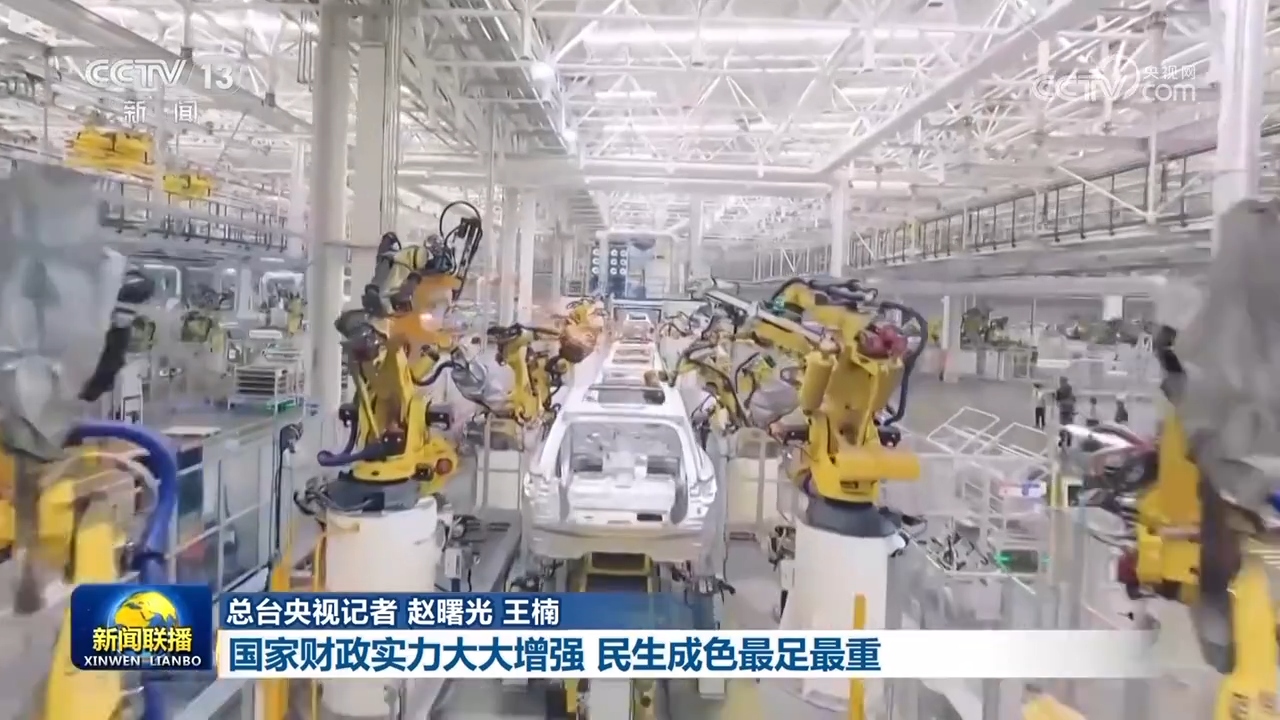
【“十四五”高质量发展答卷】国家财政实力大大增强 民生成色最足最重
Yang Shi Wang· 2025-09-12 12:41
Core Insights - The "14th Five-Year Plan" period has significantly enhanced the country's fiscal strength, with a clearer focus on people's livelihoods [1][3] - National general public budget revenue is expected to reach 106 trillion yuan, an increase of 17 trillion yuan or approximately 19% compared to the "13th Five-Year Plan" period [3] - General public budget expenditure is projected to exceed 136 trillion yuan over five years, an increase of 26 trillion yuan or 24% compared to the previous period, with more funds directed towards major development and livelihood projects [3] Fiscal Policy Measures - The government has arranged for an additional local government special bond quota of 19.4 trillion yuan [5] - New tax reductions, fee cuts, and deferred tax payments are expected to exceed 10 trillion yuan [5] - Fiscal policies are increasingly focused on counter-cyclical adjustments to support the development of new productive forces and promote qualitative and reasonable economic growth [5]

南财快评|杨志勇:中国财政政策仍有较大发力空间
2 1 Shi Ji Jing Ji Bao Dao· 2025-09-12 11:35
Core Viewpoint - The Chinese government is implementing a more proactive fiscal policy during the "14th Five-Year Plan" period to stabilize and promote economic growth, with a focus on enhancing the adaptability of fiscal policies to economic conditions [1][2][3]. Group 1: Fiscal Policy Characteristics - The fiscal macro-control during the "14th Five-Year Plan" has four key characteristics: increased strength, richer tools, more precise implementation, and greater flexibility in timing [3]. - The fiscal policy has shifted from being merely proactive to being more actively engaged, which is crucial for supporting stable and healthy economic development [1][3]. Group 2: Economic Cycle Management - The goal of macroeconomic regulation is to smooth out economic cycles, preventing significant fluctuations that could waste resources and impact social welfare [2]. - Cross-cycle regulation is increasingly important for finding new growth drivers for medium- to long-term development, especially in the context of China's evolving economic landscape [2]. Group 3: Coordination of Policies - Effective fiscal macro-control requires the coordination of fiscal and monetary policies, which enhances the overall effectiveness of macroeconomic governance [4]. - The issuance of 500 billion yuan in special government bonds is an example of fiscal and monetary policy collaboration, expected to leverage approximately 6 trillion yuan in credit [4]. Group 4: Fiscal Space and Debt Management - China's fiscal policy still has significant room for maneuver, with the fiscal deficit rate increasing from 2.7% to 4% during the "14th Five-Year Plan," allowing for greater fiscal policy space [4]. - The government debt ratio in China is projected to be 68.7% by the end of 2024, significantly lower than the G20 average of 118.2% and the G7 average of 123.2%, indicating potential for further fiscal expansion [4]. Group 5: Long-term Economic Outlook - The long-term positive trend of the Chinese economy remains intact, supported by a vast market, which is expected to lead to increased fiscal revenues and enhanced fiscal strength [5]. - The ability to utilize fiscal policy effectively is improving, with a growing toolbox for macro-control, indicating a more forward-looking and targeted approach to fiscal policy [5][6].
财政部:财政宏观调控实现很多新的突破
Sou Hu Cai Jing· 2025-09-12 10:45
今天下午,国务院新闻办公室举行"高质量完成'十四五'规划"系列主题新闻发布会。 财政部部长蓝佛安介绍,财政政策作为宏观调控主要手段,具有扩大总需求和定向调结构的双重优势。"十四五"时期,财政宏观调控实现了很 多新的突破。 财政部部长蓝佛安介绍,在这一过程中,对财政宏观调控的规律性认识也在逐步深化。 "十四五"以来,财政政策始终保持积极取向,成为推动经济平稳健康发展的重要力量。 力度上更加给力。"十四五"以来,赤字率从2.7%提高到3.8%,今年进一步提高到4%;安排新增地方政府专项债券额度19.4万亿元;新增减税 降费及退税缓税缓费超10万亿元,财政政策空间进一步打开。 财政政策工具更加丰富。综合运用政府债券、税收、财政贴息、专项资金等工具,强化与其他宏观政策协同,放大政策乘数效应。比如,创造 性发行使用超长期特别国债,用于"两重""两新",支持全方位扩大内需。 财政政策聚焦畅通经济循环,发力上更加精准。比如,一次性安排6万亿元债务限额置换存量隐性债务,帮助地方极大减轻偿债压力,腾出财 力用于保民生、促发展。 财政政策出台时机更加灵活。抓住时间窗口,确保早落地、早见效。 再比如,加强财政与货币等政策协同,形成 ...
财政“十四五”成绩单:民生投入近100万亿元!
Zheng Quan Ri Bao Wang· 2025-09-12 10:16
Core Viewpoint - The Chinese government has made significant progress in fiscal reform and development during the "14th Five-Year Plan" period, enhancing national fiscal strength and effectiveness, which supports the long-term stability of the party and the nation, as well as meeting the people's expectations for a better life [1] Fiscal Strength - The national general public budget revenue is expected to reach 106 trillion yuan during the "14th Five-Year Plan," an increase of 17 trillion yuan or approximately 19% compared to the "13th Five-Year Plan" [2] - Local fiscal strength is steadily growing, with 16 provinces projected to have fiscal revenue growth of over 20% compared to 2020, and 7 provinces exceeding 500 billion yuan, including 2 provinces surpassing 1 trillion yuan [2] - The general public budget expenditure is expected to exceed 136 trillion yuan over five years, an increase of 26 trillion yuan or 24% compared to the "13th Five-Year Plan," with a focus on optimizing the structure of expenditures [2] Social Welfare Orientation - The budget for social welfare is substantial, with 20.5 trillion yuan allocated for education, 19.6 trillion yuan for social security and employment, 10.6 trillion yuan for health care, and 4 trillion yuan for housing security, totaling nearly 100 trillion yuan in social welfare investments [2] - In response to public concerns, the government has allocated 100 billion yuan for childcare subsidies and 200 billion yuan for gradually implementing free preschool education [2] Fiscal Policy Characteristics - Fiscal policy has maintained a proactive stance, effectively responding to short-term economic fluctuations while focusing on long-term modernization goals [3] - Key characteristics of the fiscal policy include increased strength, a richer set of tools, more precise targeting, and greater flexibility in timing [3] Future Considerations - The fiscal department plans to maintain policy continuity and stability while enhancing flexibility and foresight, preparing for future economic challenges [4] - The long-term positive trend of the economy remains unchanged, providing a solid foundation for fiscal operations [3]
蓝佛安发声,财政政策始终留有后手
财联社· 2025-09-12 09:15
Core Viewpoint - The article discusses the achievements and future plans of China's fiscal policy during the "14th Five-Year Plan" period, emphasizing the importance of balancing risk prevention and economic development while ensuring fiscal policy remains flexible and proactive [2][3]. Fiscal Policy and Debt Management - The Ministry of Finance will continue to maintain the continuity and stability of fiscal policies while enhancing flexibility and foresight, preparing policies in advance to support high-quality economic development [3]. - The government will implement a debt management mechanism that aligns with high-quality development, focusing on reducing existing hidden debts, managing new debt limits, and improving the efficiency of bond usage [4]. - A total of 19.4 trillion yuan of local government special bonds have been arranged over five years to support 150,000 construction projects, alongside 3.3 trillion yuan in central budget investments for infrastructure [6]. Economic Stimulus and Consumption - The issuance of 5 trillion yuan in special government bonds this year aims to inject capital into large commercial banks, potentially stimulating around 6 trillion yuan in credit [7]. - Fiscal policies have successfully stimulated consumption, with approximately 420 billion yuan allocated to support the replacement of old consumer goods, resulting in over 2.9 trillion yuan in sales [11]. - The rural retail sales of consumer goods have increased by 24% since the beginning of the "14th Five-Year Plan," driven by targeted fiscal measures [11]. Debt and Risk Management - As of the end of 2024, the total government debt is projected to be 92.6 trillion yuan, with a debt-to-GDP ratio of 68.7%, indicating that the debt level is within a reasonable range and manageable [9]. - Over 60% of financing platforms have exited by mid-2025, indicating significant progress in reducing hidden debts [10]. - The average interest cost of debt has decreased by over 2.5 percentage points after debt swaps, saving more than 450 billion yuan in interest expenses [12].