贵金属价格波动

Search documents
现货黄金短线跳水逼近4967美元,现货白银回落至89美元一线
Jin Rong Jie· 2026-02-04 15:17
现货 黄金短线从5037美元附近跳水,逼近4967美元,日内整体涨幅迅速收窄至0.5%。现货 白银回落至 89美元一线,目前涨4.6%,美股盘前还曾涨至92.2美元。 ...
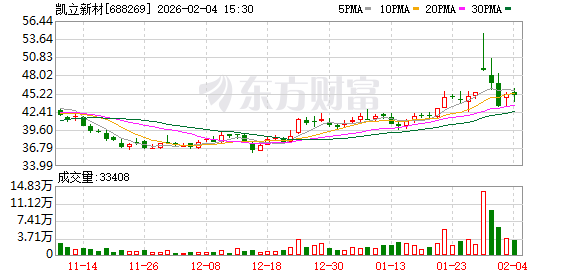
凯立新材:贵金属价格波动主要是对销售业务的收入及利润率产生影响
Zheng Quan Ri Bao· 2026-02-04 12:43
Core Viewpoint - The fluctuation in precious metal prices significantly impacts the revenue and profit margins of the company, particularly in its sales of precious metal catalysts [2] Group 1: Company Insights - The company considers various factors such as precious metal costs, labor, auxiliary materials, and reasonable profit margins when pricing its precious metal catalysts [2] - The cost of precious metals is calculated based on the quantity of precious metals in the catalyst products multiplied by the unit price of the precious metals [2] - The average unit price of precious metals is determined based on the average price on the China Metal Information Network at the time of contract signing, indicating that rising precious metal prices will lead to increased product pricing and subsequently drive revenue growth for the company [2]


银价波动部分人坚守“信念” 伦敦银现负背离
Jin Tou Wang· 2026-02-04 06:57
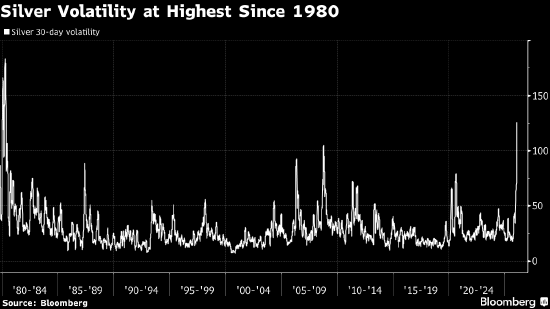
Group 1 - The core viewpoint is that volatility in the gold and silver markets will remain high following a significant drop from historical highs, with silver experiencing its most severe market turbulence since 1980 [1] - Bank of America predicts that while volatility will remain elevated, it will not be as extreme as in recent days unless a speculative bubble is reignited [1] - A retired IT technician turned day trader is currently bullish on gold and bearish on silver, but is considering buying a silver ETF due to perceived undervaluation [1][2] Group 2 - The fundamental shortage of silver has not disappeared, although gold has become overheated in recent days according to market observations [2] - A wealth management advisor suggests that maintaining a balanced portfolio makes it a good time to invest in precious metals [2] - Recent trading analysis indicates that silver prices are attempting to retest a previously broken bullish trend line, with ongoing resistance limiting the current rebound [3]
贵金属行情巨幅波动的逻辑、影响与应对策略
Sou Hu Cai Jing· 2026-02-04 03:19
Group 1: Key Drivers of Volatility in Precious Metals - The sharp fluctuations in the precious metals market in early 2026 are driven by a combination of short-term policy shocks, mid-term supply-demand restructuring, and long-term monetary system changes [1] - Short-term triggers include concerns over policy shifts following the nomination of Kevin Warsh as the new Fed Chair, leading to a rebound in the dollar index and suppressing precious metal valuations [1] - Increased margin requirements by the Chicago Mercantile Exchange (CME) for gold and silver have exacerbated market volatility, forcing high-leverage long positions to liquidate [1] Group 2: Mid-term Structural Contradictions - The industrial demand for precious metals, particularly silver, is experiencing explosive growth due to the deepening of the renewable energy revolution, with silver demand for photovoltaic applications reaching 55% [2] - In contrast, mineral supply growth remains constrained, with South African platinum group metal production down 5% and Russian palladium export quotas reduced by 18.75% [2] - The tightening supply situation has led to a significant reduction in inventories, with LBMA gold stocks falling to 7,200 tons, covering less than 30 days of consumption [2] Group 3: Long-term Underlying Logic - The acceleration of de-dollarization is a core logic supporting the long-term value of precious metals, with global central bank gold reserves expected to rise to 15.1% by 2025 [2] - The deepening debt crisis in the U.S., with federal debt to GDP surpassing 126%, is driving demand for precious metals as a "ultimate trust anchor" [2] - Geopolitical tensions, such as the ongoing Russia-Ukraine conflict and escalating Middle East issues, are normalizing safe-haven demand, contributing 35% to gold price volatility in 2025 [3] Group 4: Characteristics of Precious Metal Volatility - Current market volatility in precious metals shows a high leverage characteristic, with silver futures leverage exceeding 20 times, making price fluctuations more sensitive compared to gold [4] - The sensitivity of the market to events is increasing, with significant impacts from Fed policy meetings and geopolitical conflicts, leading to daily volatility rates exceeding 15% in January 2026 [5] Group 5: Future Trends in Precious Metals - In the short term (Q2-Q3 2026), the precious metals market is expected to enter a phase of consolidation, with gold needing to break through $4,600 per ounce to confirm a trend reversal [6] - In the mid-term (Q4 2026-2027), a structural bull market is anticipated, supported by rigid supply-demand dynamics, with global central bank gold purchases expected to remain above 800 tons annually [8] - UBS forecasts gold prices to reach $6,350 per ounce and silver prices to potentially exceed $150 per ounce by 2027, although potential risks from technological advancements in hydrogen catalysts and photovoltaic materials could impact demand [8] Group 6: Investor Strategies - The core asset allocation strategy suggests positioning gold as a "ballast" in portfolios (5%-10%) and silver as a "satellite" position (3%-5%) [9] - Investors are advised to establish a "gold + oil" hedging strategy to mitigate geopolitical risks and utilize "silver-copper" spread trading to capture industrial demand elasticity [10] - Conservative investors should prioritize gold ETFs and physical gold to avoid leverage risks, while aggressive investors may consider gold mining stocks and silver futures with stop-loss measures [11]
美国银行:价格暴跌后金银的波动性仍将持续
Xin Lang Cai Jing· 2026-02-03 18:58
Core Viewpoint - The market for gold and silver remains highly volatile following a significant drop from historical highs, with gold experiencing its highest volatility since the 2008 financial crisis and silver facing its most severe market turmoil since 1980 [1][6]. Group 1: Market Volatility - Gold's volatility has reached its highest point since the peak of the 2008 financial crisis [6]. - The silver market has experienced the most intense market fluctuations since 1980 [6]. - Recent price surges in precious metals were driven by speculation, geopolitical concerns, and uncertainties regarding the independence of the Federal Reserve [6]. Group 2: Recent Market Movements - Last week, gold faced its largest drop in over a decade, while silver recorded its largest single-day decline [1][6]. - Following the recent downturn, there has been a rebound in gold and silver prices due to buying interest in the market [9]. - The recent volatility is expected to remain above historical levels, although it may not reach the extremes seen in the past few days unless a new speculative bubble emerges [3][8]. Group 3: Investment Sentiment - The investment theme for gold is considered stronger and more sustainable in the long term [9]. - Price increases and market volatility may affect position sizes, but overall investor interest is expected to remain intact [9].
国际银价持续走高
Di Yi Cai Jing Zi Xun· 2026-02-03 08:52
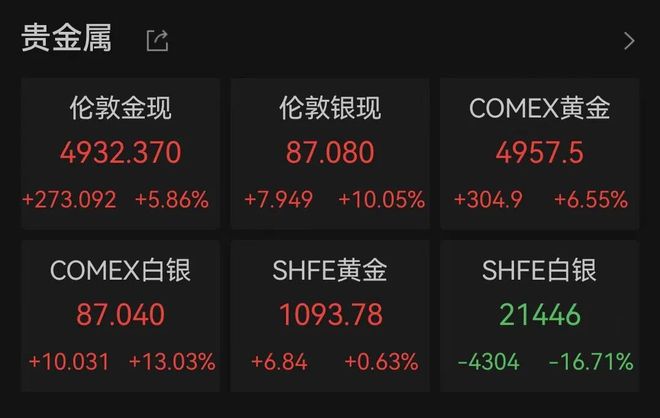
Group 1 - COMEX silver increased by over 13% on February 3, with spot silver rising more than 10%, reaching $87.03 per ounce [1] - London silver spot price was reported at $87.080, reflecting a gain of 10.05% [2] - COMEX silver price was noted at $87.040, showing an increase of 13.03% [2]
国投瑞银白银LOF净值跌31.5%,公司回应
Sou Hu Cai Jing· 2026-02-03 02:42
值得关注的是,受估值调整影响,国投白银LOF二级市场交易价格与基金份额净值之间出现巨大偏离。 Wind数据显示,2月2日,该基金复牌后一字跌停,收盘价锁定在4.722元。按最新净值2.2494元计算, 目前二级市场价格溢价率高达109.92%。 国投瑞银白银期货LOF主要投资于上期所白银期货合约。2025年基金四季报显示,截至2025年底,该基 金持有沪白银2608、沪白银2606、沪白银2604、沪白银2602和沪白银2610等多个合约。 图片来源:智通财经 近期,白银价格大幅度下挫。2月2日,国投瑞银白银LOF晚间更新的净值显示,其单位净值从前一日的 3.2838元骤降至2.2494元,单日跌幅高达31.5%,创公募基金单日下跌历史纪录。 国投瑞银基金管理有限公司当晚发布公告,解释此次净值大幅波动系因调整基金估值方法所致。 根据国投瑞银发布的说明,此次估值调整的核心原因直指近期国际白银市场的极端波动。公告指出,在 正常市况下,基金净值依循行业惯例,采用上海期货交易所白银期货合约的当日结算价进行估算。但国 内期货市场设有±17%的涨跌停板限制。 国投瑞银基金在公告中特别提示投资者关注二级市场交易价格溢价风险 ...

美股三大指数集体上涨,白银期货由跌转涨
Zhong Guo Zheng Quan Bao· 2026-02-02 23:24
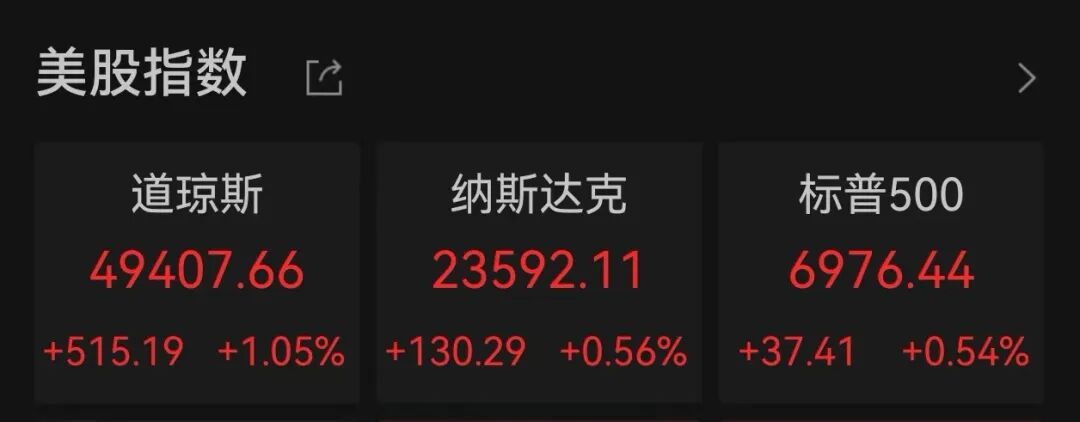
Market Performance - On February 2, US stock indices collectively rose, with the Dow Jones, Nasdaq, and S&P 500 increasing by 1.05%, 0.56%, and 0.54% respectively [2] - Storage concept stocks surged, with SanDisk rising over 15% to a closing price of $665.24 per share, marking a new high [4] Commodity Market - In the commodity market, gold and silver prices continued to decline, but the drop was less severe than the previous day, with silver futures prices turning positive [7] - As of February 3, COMEX gold futures and London gold spot prices fell by 1.05% and 4.75% respectively, while COMEX silver futures rose by 1.2% [8][9] Industry Insights - Analysts from China Galaxy Securities indicated that the recent drop in gold and silver prices was due to changes in market sentiment and profit-taking, suggesting a phase of adjustment after a period of market overheating [9] - The short-term outlook for gold prices suggests increased volatility, with a potential for technical corrections, but the long-term bullish logic remains intact [10]
金银价格巨震,多家银行出手
Zhong Guo Zheng Quan Bao - Zhong Zheng Wang· 2026-02-02 15:20
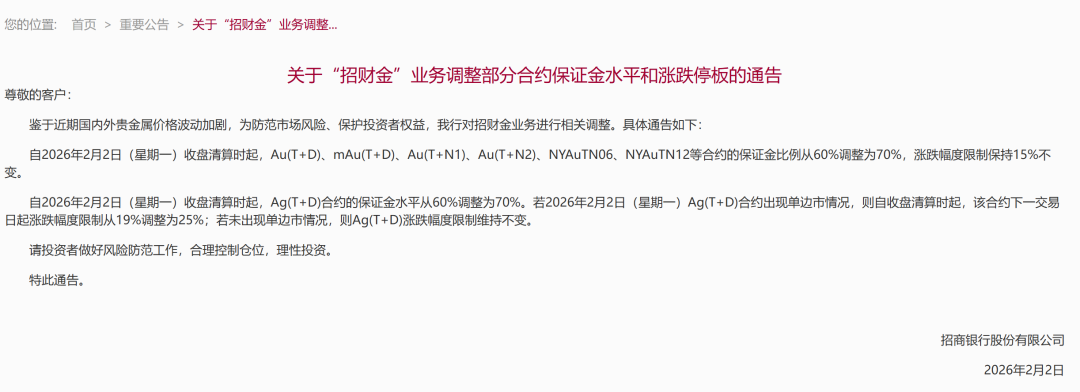
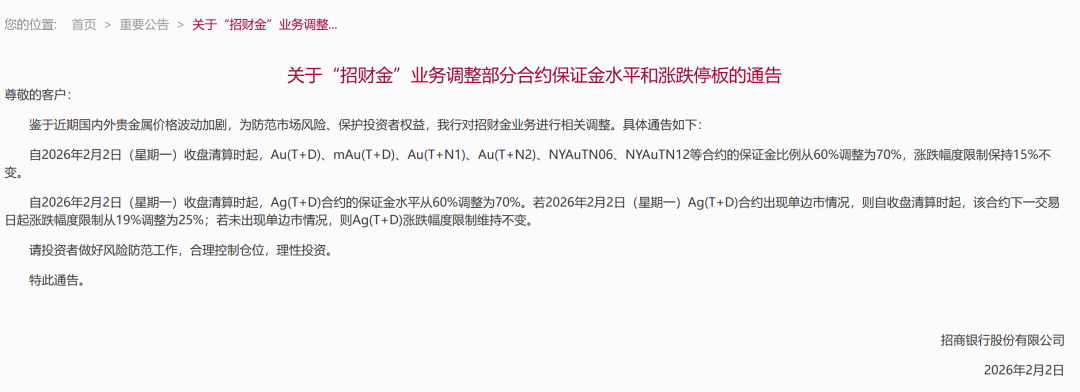
Core Viewpoint - Recent adjustments by major banks in China, including China Agricultural Bank, China Merchants Bank, and Bank of China, are aimed at mitigating risks associated with significant fluctuations in precious metal prices, emphasizing the need for investors to manage their positions and invest rationally [1][2][5]. Group 1: Bank Adjustments - China Merchants Bank announced an increase in margin requirements for various gold contracts from 60% to 70% due to heightened volatility in precious metal prices, while maintaining a 15% limit on price fluctuations [1]. - Bank of China adjusted the margin for silver deferred contracts from 50.80% to 66.04% and increased the fluctuation limit from 19% to 25% if a unilateral market condition occurs [5]. - Agricultural Bank of China also indicated adjustments to the fluctuation limits for silver contracts, aligning with the Shanghai Gold Exchange's risk management guidelines [7]. Group 2: Market Implications - Industry experts suggest that these measures are intended to tighten risk controls, reduce trading leverage, and increase capital costs for investors, thereby curbing speculative behavior in the market [2][7]. - The adjustments are expected to enhance liquidity during extreme market conditions and reduce the probability of defaults, with other banks likely to follow suit in implementing similar risk management strategies [7]. - Banks are advising investors to carefully assess their risk tolerance and financial situation, urging a rational investment approach and close monitoring of market conditions to mitigate potential losses from price volatility [9][10].



金银价格巨震 多家银行出手
Zhong Guo Zheng Quan Bao· 2026-02-02 15:13
Core Viewpoint - The recent adjustments by several banks in response to significant fluctuations in precious metal prices aim to mitigate market risks and protect investors' interests through increased margin requirements and changes in trading limits [1][2][4][6]. Group 1: Bank Adjustments - China Merchants Bank announced an increase in margin requirements for various gold contracts from 60% to 70% effective February 2, while maintaining a 15% limit on price fluctuations [1]. - The Agricultural Bank of China and other banks are also adjusting their trading parameters for silver contracts, with margin levels rising from 50.80% to 66.04% for certain contracts, depending on market conditions [4][6]. - Postal Savings Bank has issued warnings to investors about the volatility in precious metal prices, urging them to assess their financial situations and manage their investments prudently [10]. Group 2: Market Impact - The adjustments are intended to lower trading leverage for investors, which may help prevent excessive speculation and enhance liquidity during extreme market conditions [2][6]. - If a one-sided market occurs, banks will increase the fluctuation limits for certain contracts, indicating a proactive approach to managing potential market disruptions [4][6]. - The overall trend suggests that other banks are likely to follow suit in implementing similar risk control measures in response to ongoing market volatility [6].