价值投资

Search documents
巴菲特退休
Sou Hu Cai Jing· 2025-12-31 23:40
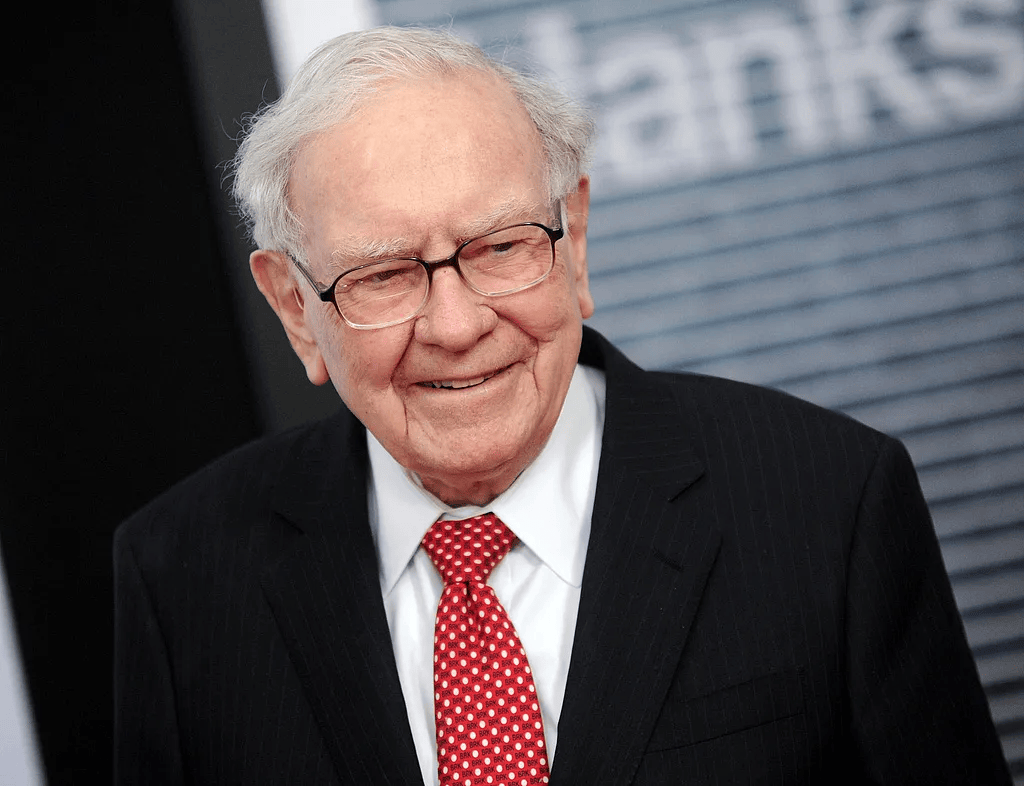
Core Viewpoint - Warren Buffett officially retires as CEO of Berkshire Hathaway on December 31, 2025, after a long tenure, while continuing as chairman of the board and retaining a significant amount of shares [1][3] Group 1: Retirement Announcement - Buffett, aged 95, has been the CEO of Berkshire Hathaway for many years and is a prominent figure in value investing and long-term investment strategies [1] - In his annual Thanksgiving letter to shareholders in November 2025, Buffett announced his decision to step down from the CEO position but will remain as chairman [1] - He expressed that while he feels generally well, he is experiencing increased difficulty with mobility and reading [1] Group 2: Succession and Stock Holdings - Buffett will continue to hold Class A shares of Berkshire Hathaway until investors are satisfied with the performance of his successor, Greg Abel, who is the vice chairman of the company [3] - The announcement included a new charitable donation plan, with Buffett accelerating donations to family-managed foundations [3] - On November 10, 2025, Buffett donated 2.7 million shares of Berkshire Hathaway Class B stock, valued at approximately $1.3 billion, to four family foundations [3]

巴菲特退休
券商中国· 2025-12-31 23:39
据央视新闻消息,当地时间2025年12月31日,著名投资人沃伦·巴菲特正式退休,从知名投资机构伯克希 尔-哈撒韦公司的首席执行官岗位上卸任。 沃伦·巴菲特现年95岁,常年担任伯克希尔-哈撒韦公司的首席执行官。他信奉"价值投资法",是价值投 资、长期投资的代表人物。 来源:央视新闻、长安街知事 责编:汪云鹏 校对:杨立林 百万用户都在看 刚刚,飙涨201%! 2026年新年献词|顺流逆流,守护我们内心的罗盘! 2026,重大利好! 市值腰斩!巴菲特"踩雷",给我们敲响什么警钟? 独家揭秘!新股未上市先套现,中签之前也能买卖! 违法和不良信息举报电话:0755-83514034 邮箱:bwb@stcn.com 券中社 × 券商中国 券 中 社 扫码下载券中社APP 扫码关注券商中国公众号 quanshangcn qzs.stcn.com 舞中 券中社APP 券 商 中 国 是 证 券 市 场 权 威 媒 体 《 证 券 时 报 》 旗 下 新 媒 体 , 券 商 中 国 对 该 平 台 所 刊 载 的 原 创 内 容 享 有 著 作 权 , 未 经 授 权 禁 止 转 载 , 否 则 将 追 究 相 应 法 律 ...
伯克希尔进入阿贝尔时代,巴菲特“交棒”留下哪些财富
Di Yi Cai Jing· 2025-12-31 23:19
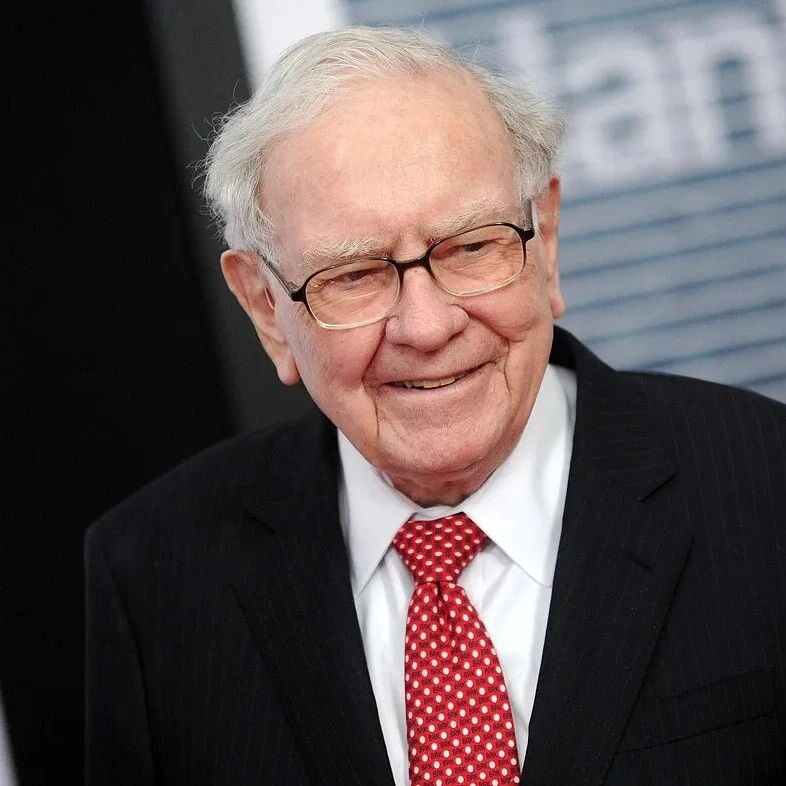
Core Insights - Warren Buffett, the legendary investor, will step down as CEO of Berkshire Hathaway at the end of 2025, with Greg Abel set to take over [2][3] - Buffett has led Berkshire Hathaway since 1965, transforming it from a struggling textile company into a diversified conglomerate with a market value exceeding $1 trillion [3] - Despite his retirement, Buffett will continue to engage with the public through annual Thanksgiving messages, maintaining a presence in the investment community [3] Company Overview - Berkshire Hathaway has evolved into a conglomerate with interests in various sectors, including railroads, energy, manufacturing, and retail [3] - The company achieved a milestone by becoming the first non-tech company in the U.S. to reach a market capitalization of $1 trillion in August 2024 [3] - Buffett's investment strategy focuses on value investing, favoring stocks that are undervalued or have long-term growth potential, with a preference for dividend-paying companies [4] Investment Strategy - Buffett has maintained a cautious stance on the U.S. stock market, having been a net seller of stocks for 12 consecutive quarters, while the company's cash reserves have reached a record $381 billion [4] - The current stock portfolio value stands at $283 billion, indicating a significant cash position compared to investments [4] - Berkshire Hathaway is increasing its investments in Japan, preparing for a new round of yen bond issuance, signaling a commitment to acquiring more shares in Japanese trading companies [5] Leadership Transition - Greg Abel, who has been the Vice Chairman of non-insurance operations, is highly regarded by Buffett, who believes Abel will exceed expectations as the new CEO [4] - Following the announcement of Buffett's retirement, Berkshire's stock price fell over 10%, while the S&P 500 index rose more than 10% during the same period [4] - Buffett has taken measures to reassure investors, including committing to not sell his shares and continuing to serve as Chairman [4] Emotional Discipline in Investing - Buffett emphasizes the importance of emotional control in investment decisions, advocating for a disciplined approach that avoids impulsive reactions to market fluctuations [6][7] - The ability to manage emotions distinguishes successful investors from those who follow market trends without critical analysis [6][7] - Buffett's strategy involves holding cash to wait for favorable investment opportunities, rather than making hasty decisions during market volatility [6][8]
TA们,在2026年能否“峰回路转”?
Shang Hai Zheng Quan Bao· 2025-12-31 15:27
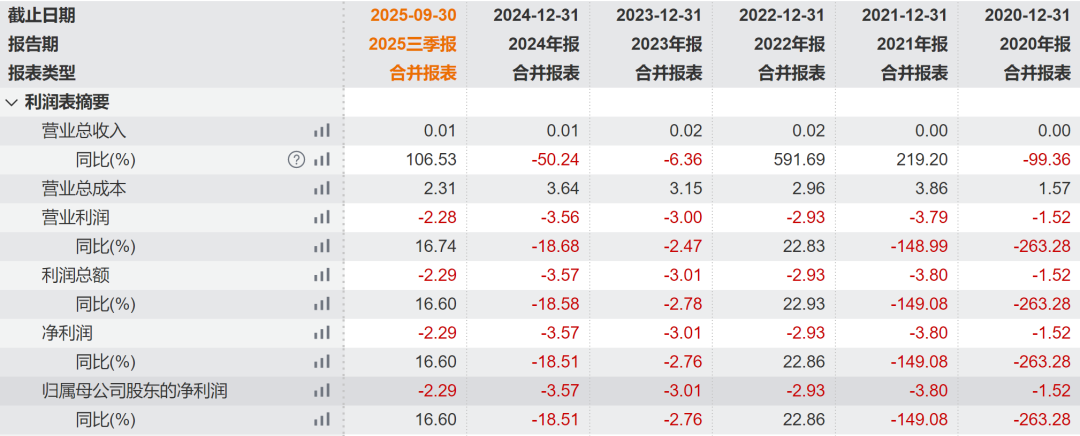
Market Overview - In 2025, the A-share market experienced a structural "small bull" market, with 4,110 out of 5,176 stocks showing positive growth, and 523 stocks rising over 100% [1] - However, 40 stocks fell over 30%, with 7 stocks declining more than 40% [1] Worst Performing Stocks - The largest decline was seen in Shijing Technology, which dropped 50.99% in 2025, primarily due to a significant decrease in completed orders after entering the photovoltaic sector [3] - Kangle Weishi ranked second with a decline of 49.97%, continuing to face losses since 2013, with a net profit loss of 2.29 billion yuan in the first three quarters of 2025 [3][4] - Longda Meishi experienced a 48.11% drop, affected by a prolonged downturn in the pig cycle and intensified competition in the prepared food sector [3] Financial Performance - Kangle Weishi reported a revenue of 1.2763 million yuan in the first three quarters of 2025, a year-on-year increase of 106.53%, but still faced a net profit loss of 2.29 billion yuan [4] - The food and beverage sector saw a 9.69% decline in 2025, marking its fifth consecutive year of losses, with a cumulative drop of over 50% since the peak in 2021 [8][10] Industry Trends - The pharmaceutical and biotechnology sector showed signs of recovery in 2025, with an 11.94% increase, ending a four-year downtrend [10] - The food and beverage sector is expected to benefit from macro policies aimed at boosting domestic demand, with potential recovery in the white liquor and pre-processed food segments [10][11]



美的集团接待20家机构调研,包括睿远基金、华创证券、长江养老保险、银河证券等
Jin Rong Jie· 2025-12-31 13:03
Group 1 - Midea Group disclosed a research reception announcement on December 31, 2025, hosting 20 institutions including Ruifeng Fund and Huachuang Securities [1] - The latest stock price of Midea Group is 78.15 yuan, down 0.70 yuan or 0.89% from the previous trading day, with a total market value of 593.76 billion yuan [1] - Midea Group's rolling P/E ratio is 13.28, ranking 13th in the home appliance industry, which has an average P/E ratio of 30.26 [1] Group 2 - The smart building technology segment showed strong performance, with revenue reaching 28.1 billion yuan in the first three quarters of the year, a year-on-year increase of 25% [1] - The segment has diversified its customer base, including data centers, healthcare, industrial parks, and rail transit, leading in market share for commercial multi-split units and centrifugal units [1] Group 3 - The humanoid robot business is progressing steadily, with the "Mei Luo U" six-arm wheeled humanoid robot recently unveiled, and the "Mei La" series planned for 2026 entry into Midea's offline experience stores [2] - Midea Group was established on April 7, 2000, primarily engaged in general equipment manufacturing [2] - As of September 30, 2025, Midea Group had 308,748 shareholders, an increase of 31,510, with an average holding value of 1.9232 million yuan [2]

YiwealthSMI|11月基金视频号高赞内容升级,深度解读受青睐
Di Yi Cai Jing Zi Xun· 2025-12-31 10:00
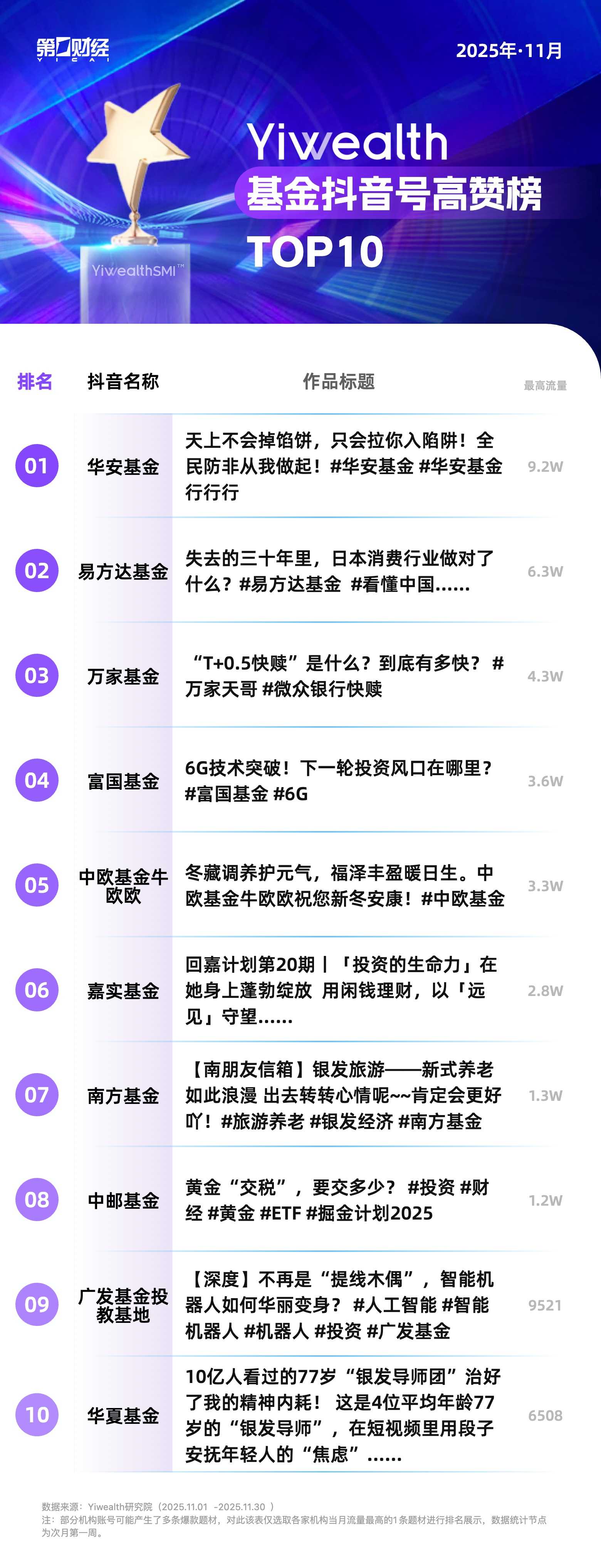
Group 1 - The top three fund companies in November are China Europe Fund, Huaxia Fund, and Fuguo Fund, with several companies like Xingzheng Global Fund and Morgan Fund making it to the top 20 list [1] - Notable educational content on Douyin includes anti-fraud warnings, practical financial knowledge, and industry hot topic analyses, which received significant user engagement [1] - Huaxia Fund's video on financial fraud received nearly 100,000 likes, while E Fund's analysis of Japan's "lost thirty years" garnered 63,000 likes, indicating a trend towards deeper, more professional content [1][6] Group 2 - The November high-view content on fund video accounts shows a trend towards lightweight, engaging formats focusing on industry insights and market outlooks [9] - The high-view live broadcasts on wealth accounts primarily revolve around market hot topics and asset allocation strategies, reflecting a consistent engagement pattern [11] - The public account rankings feature content mainly focused on promotional activities and product advertisements, highlighting a marketing-driven approach [13]
中欧基金:2026第一场对话,我们决定用「价值投资」开场
Xin Lang Cai Jing· 2025-12-31 09:14
炒股就看金麒麟分析师研报,权威,专业,及时,全面,助您挖掘潜力主题机会! 来源:中欧基金 2026年悄然降临,我们习惯在岁末回望总结,也渴望站在又一年的起点找寻新认知。过去一年,市场情 绪高昂,资金热衷成长风格,然而正如每次成长风格占据上风,价值投资是否失效的质疑不绝于耳。也 有人好奇,'价值派'的投资人是如何在喧嚣中捕捉决策的信号? 今天,我们邀请到中欧基金价值组负责人蓝小康,对话《华尔街见闻》常务副总编辑周宏。两人从当下 市场常见的困惑切入:为何二级市场水温与经济水温之间似乎存在着'温差'? 在将近两小时的对谈中,他们很少从短期市场出发,而是把视角放在更宏大的尺度上:中国经济新旧动 能的转换、美元信用的下降、全球共同面对的分配极化难题……蓝小康反复强调着,'先活下来'比短期 获胜更重要,并鲜明地表达了自己的偏好——在所有的价值观中,他最追求'共赢'的价值。 值此辞旧迎新之际,希望这场静下来的对谈,能为大家的投资带来更多思考启发。 聊天的人 蓝小康,中欧基金价值组负责人 周宏,《华尔街见闻》常务副总编辑 时间轴 Part 1:为何'看多'中国? 02:28 市场水温与经济水温之间,为什么存在'温差'? 03 ...
官网变黑白!“顶流”基金经理在深圳病逝!业界悼念
Sou Hu Cai Jing· 2025-12-31 08:47
Core Insights - Wang Zonghe, former deputy general manager of Penghua Fund and renowned fund manager, passed away on December 29 due to illness, with a memorial service scheduled for December 31 [1] - His death has prompted widespread mourning and remembrance within the industry, and Penghua Fund's official website has turned black and white in tribute [1] Group 1: Career Highlights - Wang Zonghe held a master's degree in finance from Renmin University of China and began his career in industry research at China Merchants Fund before joining Penghua Fund in May 2009 [3] - He rose through the ranks from researcher to assistant fund manager, officially becoming a fund manager in December 2010, and was promoted to deputy general manager in January 2021 [3] - Wang managed over 500 billion in assets and set a record for public fund subscription, particularly noted for his successful management of funds like Penghua Consumption Preferred and Penghua Pension Industry, which won multiple awards [3][4] Group 2: Investment Philosophy - Wang's investment philosophy centered on value investing, focusing on leading companies in key industries, famously stating "thirteen years of wind and rain, walking alongside Moutai" [4] - He adhered to strict stock selection criteria based on the standards of Warren Buffett and Charlie Munger, prioritizing companies with high barriers to entry and sustainable ROE while avoiding high-valuation growth stocks [4] - The funds he managed, such as Penghua Consumption Preferred and Penghua Pension Industry, achieved returns of 244.70% and 211.40% respectively, with annualized returns exceeding 10% [4]
收官!新年红包一天十倍!上市首日暴拉1000%!沪指十一连阳完美收官!今年你赚钱了吗?
雪球· 2025-12-31 08:24
Market Overview - The three major indices closed on the last trading day of 2025, with the Shanghai Composite Index up 0.09%, marking an 11-day winning streak and an annual increase of 18.41%. The Shenzhen Component Index fell 0.58% but recorded a 29.87% annual gain, while the ChiNext Index dropped 1.23% but saw a significant annual increase of 49.57%. The STAR 50 Index rose 35.92% and the Beijing Stock Exchange 50 Index increased by 38.8% throughout the year [2]. Sector Performance - On the last trading day, sectors such as commercial aerospace, AI applications, internet, and cultural media saw the highest gains, while sectors like pharmaceutical commerce, batteries, oil, and semiconductors experienced the largest declines [3]. Commercial Aerospace - The commercial aerospace sector continued to rise, with stocks like Tailong Co. achieving five consecutive daily limits, and companies such as Reco Defense and Hongying Intelligent reaching three consecutive daily limits. Other notable stocks included Changjiang Communication, Beidou Star, Urban Development, and Fenghuo Communication, all hitting their daily limits [5][6]. - A meeting held by the Hainan Provincial Aerospace Leadership Group discussed the 2026 launch plans for the Hainan commercial aerospace launch site, emphasizing the importance of the project's successful construction and operation for supporting the nation's aerospace ambitions. The meeting outlined key tasks, including seizing strategic opportunities and enhancing industry status [9]. - Jiangxi Lianchuang Superconducting Technology Co., Ltd. successfully delivered a project related to a "high-power low-temperature refrigeration system and model superconducting magnet," marking a significant achievement in the commercial aerospace electromagnetic launch field [10]. New Stock Listings - The new stock Hengtongguang listed on the Beijing Stock Exchange saw an unprecedented opening surge of 1000%, reaching a maximum intraday increase of 1087.08%, and closing with a remarkable gain of 878.16% at 309.00. The company focuses on the research, manufacturing, and sales of passive optical devices in the optical communication field [11][12]. Investment Sentiment - Investors reflected on their experiences in 2025, with some expressing regret for missing out on the hard technology sector's gains while remaining committed to value investing principles. The sentiment highlighted the importance of patience and long-term holding of quality assets like Kweichow Moutai, despite market volatility [16][18]. - The discussion also included strategies for 2026, with plans to continue holding quality stocks and selectively increasing positions in companies with strong cash flow and dividend capabilities [18].
投资的关键是知道自己擅长什么,又在等待什么︱告别2025
重阳投资· 2025-12-31 07:33
Core Insights - The essence of investing is not about seeking certainty but about managing probabilities in uncertainty [5] - Successful investing is characterized by a long-term, steady performance rather than high-risk gambles [5] - Emotional stability is a crucial quality for successful investors, allowing them to avoid impulsive decisions based on market fluctuations [5] Group 1 - Investment success comes from knowing one's strengths and waiting for the right opportunities rather than following trends [5] - The market is filled with tempting opportunities, but not all are suitable; avoiding traps is essential for long-term success [5] - The art of investing involves both numerical calculations and personal discipline [5] Group 2 - The importance of patience in investing is emphasized, akin to waiting for the right pitch in baseball [10] - Investors should focus on their own capabilities and avoid unnecessary risks, concentrating on consistent performance [17][19] - The ability to endure through market downturns is vital for long-term investment success [22] Group 3 - The concept of "advantage zones" is introduced, where investors must identify their unique strengths and knowledge areas [39][41] - The current AI market resembles the internet bubble of 1998-2000, with many uncertainties about its future impact [44] - Investors should be cautious of market euphoria and avoid making decisions based solely on trends or hype [47] Group 4 - Value investing requires understanding an asset's intrinsic value, which is often difficult for non-cash flow assets like gold [49] - For most individuals, investing in index funds or professionally managed products is recommended over direct stock picking [51][52] - Emotional control is essential; frequent trading based on emotions can lead to poor investment outcomes [56]