扩内需

Search documents
中金:若想持续有效推动通胀回归历史中枢,仍需政策加力
Xin Lang Cai Jing· 2025-08-11 00:00
Core Insights - In July, the "anti-involution" policy led to a reduction in the month-on-month decline of the Producer Price Index (PPI) to -0.2%, driven by key industries controlling volume and raising prices [1] - The Consumer Price Index (CPI) for industrial consumer goods improved due to the release of new funds, the fading of online promotional disturbances, and rising gold prices, resulting in the core CPI increasing for the third consecutive month year-on-year [1] - The current supply-side capacity governance is more market-oriented and rule-based compared to 2016, leading to a milder effect on price increases [1] PPI and CPI Analysis - The year-on-year decline of PPI remains at a two-year low of -3.6%, while the CPI has shifted from an increase to stability [1] - Looking ahead, the fading of tailing factors may lead to improvements in year-on-year PPI and CPI in the fourth quarter, starting from August [1] - To effectively drive inflation back to historical averages, stronger policy measures and a focus on expanding domestic demand are essential [1]
中金:提物价待需求端发力——2025年7月物价数据点评
中金点睛· 2025-08-10 23:55
Core Viewpoint - In July, the "anti-involution" policy led to a narrowing of the PPI month-on-month decline to -0.2%, while the CPI for industrial consumer goods improved, contributing to a third consecutive month of core CPI year-on-year recovery. However, the impact of supply-side capacity management on prices is more moderate compared to 2016, with PPI year-on-year decline remaining at a two-year low of -3.6% and CPI year-on-year turning flat [2][19]. Group 1: CPI Analysis - The CPI year-on-year remained flat at 0.0% in July, primarily dragged down by food items, while core CPI rose to 0.8% [4]. - Food prices decreased by 1.6% year-on-year, with the decline widening by 1.3 percentage points compared to the previous month, contributing a marginal drag of 0.30 percentage points to the overall CPI [8]. - Seasonal supply of fresh vegetables and fruits was abundant, leading to a significant year-on-year decline in their prices, with fresh vegetables down 7.6% and fresh fruits up 2.8% [8][11]. Group 2: PPI Analysis - The PPI month-on-month decline narrowed from -0.4% to -0.2% in July, but the year-on-year decline remained at -3.6%, indicating limited effectiveness of the "anti-involution" measures on price uplift [19]. - Key industries such as coal, steel, and cement have implemented capacity management measures, which have led to a reduction in the month-on-month price declines for these sectors [19]. - International factors continue to pressure export-related prices, while domestic oil and non-ferrous metal prices have seen increases due to external input factors [20]. Group 3: Market Outlook - The "anti-involution" measures have led to a faster increase in futures prices compared to spot prices, indicating market expectations are ahead of actual supply-side adjustments [24]. - Looking ahead, the diminishing drag from tailing factors may lead to improvements in PPI year-on-year in August and CPI year-on-year in the fourth quarter, but sustained inflation recovery will require stronger policy support and a focus on expanding domestic demand [24]. - The current supply-side price uplift is more challenging and softer compared to 2016, with a broader range of industries involved, including upstream raw materials and downstream sectors [24].


消费领域价格呈现积极变化
Jing Ji Ri Bao· 2025-08-10 02:03
Group 1 - The consumer price index (CPI) increased by 0.4% month-on-month in July, reversing a previous decline of 0.1%, while year-on-year it remained flat [1] - The core CPI, excluding food and energy, rose by 0.8% year-on-year, marking the highest increase since March 2024, with significant price increases in gold and platinum jewelry [2] - The producer price index (PPI) decreased by 0.2% month-on-month, but the decline was less than the previous month, indicating a potential stabilization in prices [2] Group 2 - The rise in CPI was primarily driven by increases in service and industrial consumer goods prices, with service prices up 0.6% month-on-month [1][2] - The implementation of consumption-boosting policies has led to a recovery in demand, contributing to the positive changes in prices across various sectors [3] - The recent PPI data suggests improvements in supply-demand relationships and reflects the effectiveness of macroeconomic policies aimed at optimizing industrial structures [3]
李大霄:扩内需加力七月 数据呈积极变化
Xin Lang Zheng Quan· 2025-08-09 23:31
炒股就看金麒麟分析师研报,权威,专业,及时,全面,助您挖掘潜力主题机会! 责任编辑:石秀珍 SF183 ...
核心CPI连续3个月回升——消费领域价格呈现积极变化
Sou Hu Cai Jing· 2025-08-09 22:53
Group 1 - The consumer price index (CPI) increased by 0.4% month-on-month in July, reversing a previous decline of 0.1%, while year-on-year it remained flat [2] - The core CPI, excluding food and energy, rose by 0.8% year-on-year, marking the highest increase since March 2024 [3] - The producer price index (PPI) decreased by 0.2% month-on-month, but the decline was narrower than the previous month, indicating a potential stabilization in prices [2][3] Group 2 - Service prices increased by 0.6% month-on-month, contributing significantly to the CPI rise, while industrial consumer goods prices, excluding energy, also saw a 0.2% increase [2] - The decline in food prices, down 1.6% year-on-year, was a major factor in keeping the year-on-year CPI unchanged [2] - The improvement in supply-demand relationships in certain industries is attributed to ongoing macroeconomic policies and consumer demand initiatives [4] Group 3 - Recent months have shown a stabilization in PPI declines, reflecting effective policy measures and structural adjustments in the industry [5] - The concept of "anti-involution" is expected to be a key focus for policies in the second half of the year, aiming to optimize resource allocation and improve industry efficiency [5] - The sustainability of price recovery remains uncertain and is contingent on effective policy execution and coordination [5]
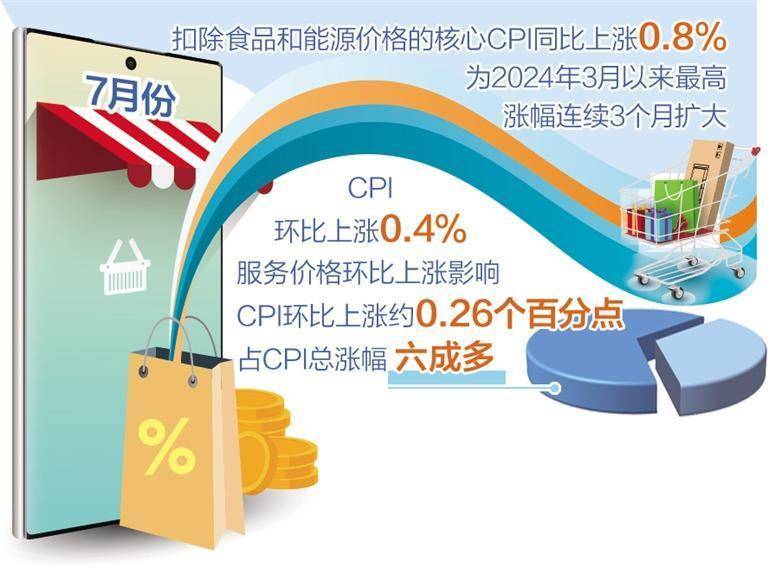
核心CPI连续3个月回升—— 消费领域价格呈现积极变化
Jing Ji Ri Bao· 2025-08-09 21:55
Group 1: Consumer Price Index (CPI) Insights - In July, the Consumer Price Index (CPI) increased by 0.4% month-on-month, reversing a previous decline of 0.1% in June, while year-on-year it remained flat [1] - The core CPI, excluding food and energy, rose by 0.8% year-on-year, marking the highest increase since March 2024, with significant price increases in gold and platinum jewelry at 37.1% and 27.3% respectively [2] - Service prices contributed to the CPI increase, rising by 0.6% month-on-month, accounting for over 60% of the total CPI increase [1][2] Group 2: Producer Price Index (PPI) Trends - The Producer Price Index (PPI) decreased by 0.2% month-on-month, but the decline was narrower by 0.2 percentage points compared to the previous month, indicating a potential stabilization in prices [1][2] - Year-on-year, the PPI fell by 3.6%, consistent with the previous month, reflecting ongoing challenges in certain industries due to seasonal factors and international trade uncertainties [1][2] - Specific sectors such as non-metallic mineral products, black metal smelting, and coal mining experienced price declines, influenced by seasonal weather conditions and reduced demand for electricity [2] Group 3: Economic Policy and Market Dynamics - The ongoing macroeconomic policies are showing positive effects, with improvements in supply-demand relationships across various industries, leading to price increases in some sectors [3] - The implementation of consumption-boosting policies is contributing to a healthier consumer market, with an increase in demand for upgraded consumer goods driving price rises [3] - The concept of "anti-involution" is expected to be a key focus for policies in the second half of the year, aiming to reshape supply-demand structures and enhance overall efficiency in industries facing overcapacity [3]
2025年7月通胀数据点评:PPI同比触底
CMS· 2025-08-09 15:37
Group 1: CPI Analysis - In July 2025, the CPI increased by 0.4% month-on-month and remained flat year-on-year at 0.0% due to significant pressure from food prices[2] - Core CPI, excluding food and energy, rose to 0.8%, the highest in 17 months, indicating effective domestic demand policies[2] - Vegetable prices saw a significant decline due to high base effects from the previous year, while pork prices continued to drop due to weak terminal demand[2] Group 2: PPI Analysis - In July 2025, the PPI decreased by 3.6% year-on-year and by 0.2% month-on-month, marking a continued decline in the mining and raw material processing industries[2] - The coal mining and oil extraction sectors were the largest contributors to the PPI decline, with mining industries showing a year-on-year drop of 14.0%[2] - The report anticipates a slight recovery in PPI in August, projecting a year-on-year rate around -3%, influenced by high base effects from the previous year[2] Group 3: Future Outlook - The report suggests that while CPI may rise above 0 in August, energy prices remain a significant constraint on overall inflation recovery[2] - The ongoing weak demand in the mid and downstream sectors is expected to limit the positive impact of anti-involution policies on PPI[2] - The effectiveness of domestic policies in stimulating demand will be crucial for any significant recovery in PPI throughout the year[2]
【新华解读】宏观政策“组合拳”持续显效 7月份多项物价指标改善
Xin Hua Cai Jing· 2025-08-09 08:49
Group 1 - The Consumer Price Index (CPI) in July increased by 0.4% month-on-month, reversing a 0.1% decline in June, indicating a recovery in domestic demand [2][4] - The core CPI, excluding food and energy, rose by 0.8% year-on-year, marking the highest increase since March 2024, and has expanded for three consecutive months [2][5] - The Producer Price Index (PPI) saw a month-on-month decline of 0.2%, but this was a narrowing of the decline for the first time since March, suggesting stabilization in some industrial sectors [6][7] Group 2 - The rise in CPI was primarily driven by increases in service prices, which rose by 0.6% month-on-month, contributing approximately 0.26 percentage points to the overall CPI increase [4][5] - Key contributors to the service price increase included airfare, tourism, hotel accommodation, and vehicle rental, which saw significant month-on-month increases of 17.9%, 9.1%, 6.9%, and 4.4% respectively [4] - Industrial consumer goods prices also showed improvement, with a month-on-month increase of 0.5%, influenced by policies aimed at boosting consumption [4][6] Group 3 - The government has implemented a series of macroeconomic policies aimed at enhancing consumption capacity and optimizing the consumption environment, with 19 key measures proposed [2][3] - The ongoing efforts to build a unified national market and regulate low-price competition among enterprises are expected to further stabilize prices [3][6] - The PPI's year-on-year decline remained at -3.6%, but the stabilization indicates a potential turning point for industrial prices, aided by policy measures [6][7]
对话邢予青:为什么日本这么重视旅游业
经济观察报· 2025-08-09 07:21
Core Viewpoint - The article emphasizes the importance of developing high-end service industries in China to address income inequality and stimulate domestic demand, highlighting the need for skilled talent to create new consumption opportunities [2][4][9]. Group 1: Demand Expansion - The Chinese economy faces insufficient domestic demand and weak consumption, primarily due to a supply focus on basic needs like food, rather than higher-level consumer demands [5][9]. - According to Maslow's hierarchy of needs, consumers are now seeking more sophisticated services, which require high-skilled talent to meet these new demands [5][6]. - The development of high-end service industries is crucial for creating new employment opportunities and stimulating consumption, which is essential for reversing the current demand shortfall [5][9]. Group 2: Anti-Competition Measures - The article discusses the need to address unreasonable local government industrial policies that contribute to "involution" or excessive competition, suggesting that solutions should be sought within industrial policy frameworks [2][12]. - It highlights the importance of adjusting regulatory policies in various sectors, such as entertainment and tourism, to foster a more conducive environment for high-end service development [6][7]. Group 3: Global Value Chain and Industrial Policy - The article notes that multinational companies are re-evaluating their global value chain distribution to balance risks, which aligns with the trend of Chinese companies expanding overseas [3][18]. - It argues that the focus should shift from merely increasing production capacity to enhancing the value created by industries, emphasizing the need for companies to move up the value chain [22][23]. - The experience of Japan in transitioning from industrial growth to prioritizing service industries is presented as a model for China, illustrating the importance of adapting to changing consumer needs [10][11]. Group 4: Tourism and Service Industry Development - The article points out that Japan's tourism industry has significantly grown due to government policies aimed at increasing foreign visitors, which has also created numerous job opportunities [8][11]. - It contrasts the immediate economic benefits of industrial projects with the long-term, inclusive growth potential of the service sector, advocating for a shift in focus towards developing high-end services [9][10]. Group 5: Regulatory Environment - The article stresses the need for a suitable social atmosphere and regulatory environment to support the growth of high-end service industries, citing issues like high transaction costs in tourism as barriers to attracting foreign visitors [6][7]. - It suggests that regulatory adjustments in certain sectors could enhance service quality and consumer experience, ultimately benefiting the economy [7][12].

新质生产力再造GDP!“长牛已至,股海扬帆”九方金融研究所半年度策略会举办
第一财经· 2025-08-08 08:28
Macro Perspective - The current market is supported by a "dual easing" monetary and fiscal policy, which is the core driver for the slow bull market [2][7] - The macroeconomic fundamentals do not support a "crazy bull" or "fast bull" market, indicating a need for caution [5][6] - The market is expected to experience a "slight fluctuation" in the third quarter, with a significant upward trend starting in the fourth quarter [6][7] Market Strategy - The Shanghai Composite Index is currently in a slow upward trend, with a target of 4000 points by the end of the year and a medium-term target of 4500 points [10][11] - Six major policy areas are identified to support the capital market's positive outlook, including financial policies and corporate governance improvements [11][12] - The market's risk-reward ratio is considered favorable, with pullbacks seen as good opportunities for investment [12] Industry Focus - The focus on expanding domestic demand and countering "involution" is crucial for optimizing the existing economic structure [16][18] - Key future industries, particularly artificial intelligence, are expected to drive significant economic growth, potentially adding another GDP's worth of value over the next decade [16][17] - The "anti-involution" policies are aimed at stabilizing growth in major industries, covering nearly 40% of the A-share market capitalization [18]