
绿色化

Search documents
“中国是全球工商界投资兴业的沃土”(进博会观察)
Ren Min Ri Bao· 2025-11-07 22:00
Group 1: Event Overview - The China International Import Expo (CIIE) serves as a significant platform for global businesses to engage with the Chinese market, showcasing the country's openness and investment potential [2][3][4] - The event features various international exhibitors, highlighting China's role as a fertile ground for global commerce and investment [2][3] Group 2: Market Opportunities - The Ministry of Commerce launched the "Shared Big Market · Export to China" initiative, emphasizing the importance of collaboration and mutual benefits in the global market [3] - General Electric Medical has successfully introduced over 50 precision medical innovations to the Chinese market, indicating strong demand and growth potential in the healthcare sector [3] - Procter & Gamble showcased new products tailored for the Chinese market, reflecting a consumer-centric approach to innovation and sustainable growth [4] Group 3: Investment and Innovation - The CIIE is viewed as a strategic platform for companies like Michelin to deepen their connection with the Chinese market and foster innovation [5] - China is accelerating its green, digital, and intelligent development, with international cooperation being essential for driving innovation [5][6] - The event facilitates significant procurement agreements, such as those by China National Offshore Oil Corporation, focusing on clean and low-carbon supply chains [4][5] Group 4: Global Collaboration - The CIIE promotes free and fair trade, with participants expressing a strong desire for collaboration and shared growth [7] - The event has attracted diverse international exhibitors, showcasing products from various countries and enhancing trade relations [8] - The 10th anniversary of the China-Australia Free Trade Agreement highlights the ongoing commitment to deepening market engagement and brand development in China [8]


东方电气:持续推动产业向高端化、智能化、绿色化方向升级
Zhong Zheng Wang· 2025-11-07 11:25
Core Insights - The event marked the 30th anniversary of Dongfang Electric's listing and aimed to enhance communication with the capital market, showcasing the company's operational achievements and industry layout [1] - Dongfang Electric reported a total operating revenue of 55.522 billion yuan for the first three quarters of 2025, representing a year-on-year increase of 16.03%, and a net profit attributable to shareholders of 2.966 billion yuan, up 13.02% year-on-year [2] Group 1 - The event was attended by over 90 representatives from various institutions, including CITIC Securities, CICC, Citibank, HSBC, UBS, and Bosera Fund, indicating strong interest from the investment community [1] - The management discussed the company's "14th Five-Year Plan," development of new industries, and operational plans, addressing investor concerns [1] - Dongfang Electric emphasizes the importance of investor relations management and aims to improve communication quality and respond to market concerns [1] Group 2 - As a leading global energy equipment enterprise, Dongfang Electric is focused on enhancing its core competitiveness and upgrading its industry towards high-end, intelligent, and green directions [2] - The company is committed to delivering stable operational signals and long-term value to the capital market [1]
中国宝武胡望明:聚焦“新阶段、新战略、新模式”战略部署 持续深化中央企业品牌引领行动
Zhong Zheng Wang· 2025-11-07 11:19
Core Insights - The forum highlighted the achievements of the second batch of the Central Enterprises Brand Leadership Action, with China Baowu and nine other central enterprises recognized for their brand initiatives [1][2] - China Baowu emphasizes technological self-reliance and innovation as the foundation of its brand, positioning itself as a "breaker" in key areas and a "stabilizer" in the modern industrial chain [1][2] Group 1 - China Baowu is recognized for its commitment to technological innovation, focusing on overcoming material and technical challenges [1] - The company aims to provide stable, reliable, and high-quality steel materials to energize various downstream industries [1] - The company has been selected as part of the second batch of the Central Enterprises Brand Leadership Action, following Baosteel's recognition in the first batch [1] Group 2 - China Baowu is driving its brand's future through green and intelligent dual initiatives, aiming to lead the global steel industry's green transformation [2] - The company is committed to becoming a model for green development and a pioneer in smart manufacturing through the integration of steel and AI [2] - The company aspires to achieve satisfaction among shareholders, customers, and employees while being respected by society, embodying the principle of "three satisfactions and one respect" [2] Group 3 - Looking ahead, China Baowu aligns with the development directions of "intelligent, green, and integrated" as outlined in the 20th Central Committee's fourth plenary session [2] - The company plans to focus on "new stage, new strategy, new model" to deepen the brand leadership action among central enterprises [2] - China Baowu aims to establish a modern brand governance system and create world-class product and technology brands [2]

化工行业10月月报:行业发展高端化﹑绿色化-20251107
Hengtai Securities· 2025-11-07 10:46
Investment Rating - The report maintains an "Outperform" rating for the chemical industry [3] Core Views - The macroeconomic data indicates a decline in the PMI to 49.0%, a decrease of 0.8 percentage points from the previous month. The main raw material purchasing price index also decreased by 0.7 percentage points [5][27] - The report highlights the need for the chemical industry to focus on high-end, green, intelligent, and circular development as emphasized in the recent policy recommendations from the Communist Party of China [5][51] - Investment strategies suggest focusing on sectors such as coal chemical, fluorochemical, phosphate and phosphorus chemical, and potassium fertilizer [5][61] Summary by Sections Macroeconomic Data - The October PMI is at 49.0%, down 0.8 percentage points from last month. The main raw material purchasing price index is at 52.5%, down 0.7 percentage points [27] - The PPI for September shows a year-on-year decline of 2.3%, with the decline narrowing by 0.6 percentage points from the previous month [5][27] - Fixed asset investment in the chemical raw materials and chemical products manufacturing sector saw a year-on-year decline of 5.6% in September, widening from the previous month [27] Downstream Industry Performance - In September, the export value of textile yarns and fabrics increased by 6.4% year-on-year, while the export value of household appliances decreased by 9.6% [42] - The production of new energy vehicles decreased by 2.4% year-on-year, while automobile production increased by 3.2% [42] Investment Recommendations - The report suggests focusing on the SW coal chemical, SW fluorochemical, SW phosphate and phosphorus chemical, and SW potassium fertilizer sectors for potential investment opportunities [61][62] - Recommended ETF: Penghua CSI Sub-Sector Chemical Industry Theme ETF (159870.SZ) [62]


珠江股份(600684.SH):未涉及无人驾驶的相关业务
Ge Long Hui· 2025-11-07 08:40
Core Viewpoint - The company, Zhujiang Co., Ltd. (600684.SH), clarified that it is not involved in any autonomous driving-related business, but it is committed to transforming its traditional property services towards digitalization, greening, and intelligence enhancement [1] Group 1 - The company is not engaged in autonomous driving [1] - The company aims to promote the transformation of traditional property services [1] - The focus of the transformation includes digitalization, green initiatives, and intelligent enhancements [1]

第二十二届中国住博会开幕
Xin Hua She· 2025-11-07 06:30
Core Insights - The 22nd China International Housing Industry and Building Industrialization Products and Equipment Expo opened on November 6 in Beijing, focusing on "shared innovation, building the future, and creating a new ecosystem for open cooperation in the industry" [1][2] - The expo showcases the latest technologies and products in the housing and urban construction sector, promoting the application of technological innovations and leading the transformation and upgrading of the industry [1][2] Summary by Categories Event Overview - The expo features over 200 industry enterprises from both domestic and international markets, covering an exhibition area of 17,000 square meters [1] - The event includes specialized exhibition areas such as model houses, digital homes and smart living, new building industrialization, prefabricated decoration, low-carbon and zero-carbon buildings, and China-Central Asia cooperation [1] Technological Focus - Key technologies and products on display include domestic Building Information Modeling (BIM) core platforms, digital twin collaborative tools, high-performance building materials, construction robots, and urban drainage emergency equipment [1] Industry Impact - The expo aims to showcase technological innovations in the housing and urban construction sector, fostering an open collaborative industrial ecosystem and injecting innovative momentum into the high-quality development of urban and rural construction [2]
直击进博会|太古中国区主席蒋意达:进博会既是展示的窗口 更是链接伙伴、共创价值的平台
Zhong Guo Jing Ying Bao· 2025-11-06 23:53
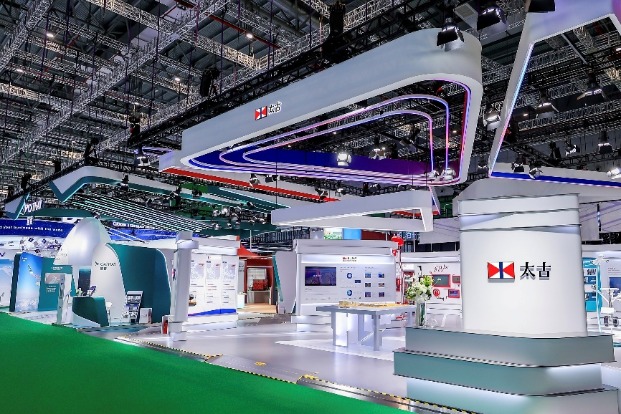
Core Viewpoint - The participation of Swire Group at the China International Import Expo (CIIE) emphasizes its long-term commitment to the Chinese market through innovative practices and contributions to high-quality and sustainable development [1][4]. Group 1: Exhibition Highlights - Swire Group showcased its subsidiaries, including Swire Properties, Swire Coca-Cola, Cathay Pacific, Swire Marine, and the Port Machinery Group, under the theme "Lean and Innovative" [1]. - The exhibition featured a 400-square-meter interactive booth utilizing digital multimedia technology to illustrate the vitality of "new consumption" [3]. - Visitors experienced immersive interactions, such as a VR experience of Cathay Pacific's cabin space and a model of the Xi'an Taikoo Li project, highlighting the integration of historical culture and modern commerce [3]. Group 2: Innovation and Sustainability - The booth demonstrated Swire's exploration in digitalization, intelligence, and green transformation, showcasing applications of robotics and AI in aircraft maintenance [3]. - Swire Marine introduced its low-carbon solutions and logistics capabilities connecting China with Pacific island nations and Belt and Road markets [3]. - The exhibition presented various case studies reflecting Swire's commitment to sustainable development and the green transformation of industries [3]. Group 3: Future Commitment - Swire Group aims to combine its century-old craftsmanship with excellent operational principles, focusing on new opportunities in digitalization, intelligence, and green development [4]. - The company positions itself as a witness, participant, and beneficiary of China's modernization, contributing to high-quality development and sustainable future [4].

本钢板材推动可持续发展战略转型
Zheng Quan Ri Bao· 2025-11-06 15:45
Core Viewpoint - The company aims to transform its strategy towards sustainable development by focusing on high-end, intelligent, and green production, while optimizing asset allocation to reduce costs and improve efficiency [1][4]. Group 1: Financial Performance - In the first three quarters of 2025, the company reported operating revenue of 35.201 billion yuan, a year-on-year decrease of 12.47% [2]. - The net profit attributable to shareholders was -2.216 billion yuan, with a single-quarter loss exceeding 800 million yuan in the third quarter [2]. - The company has seen a 30.60% reduction in net loss year-on-year, with the third quarter showing a more than 50% reduction in loss compared to the same period last year [3]. Group 2: Industry Challenges - The steel industry is currently facing a situation characterized by high production, high costs, high inventory, low demand, low prices, and low efficiency [2]. - The company, located in Northeast China, experiences higher logistics costs than the industry average, which affects its ability to withstand market downturns [2]. Group 3: Strategic Initiatives - The company is transitioning from a production-oriented model to a management-oriented model to better respond to market challenges [3]. - Initiatives include increasing R&D and production of differentiated products, reducing procurement costs, exploring regional cooperation for sales, and enhancing operational efficiency through intelligent production processes [2][3]. Group 4: Technological Advancements - The company is investing in advanced equipment and technology, focusing on high-end, intelligent, and green production to upgrade its steel business [3][4]. - It has established a premium steel base with over 60 varieties and more than 7,500 specifications, with high value-added and high-tech products accounting for over 80% of its output [3]. Group 5: Future Opportunities - The company is positioned to benefit from green development initiatives, including ecological electric furnaces, which may enhance its brand image and market competitiveness [4]. - The company has four factories recognized as excellent intelligent factories, indicating a strong foundation for smart manufacturing [4].

中国宝武胡望明:聚焦“新阶段、新战略、新模式” 构建现代化品牌治理新体系
Zheng Quan Shi Bao Wang· 2025-11-06 10:44
Core Insights - The forum highlighted the second batch of achievements in the Central Enterprise Brand Leading Action, with China Baowu and nine other central enterprises recognized for their brand initiatives [1][2] - China Baowu's chairman emphasized the importance of brand value, stating that a world-class enterprise should not only be large but also strong, serving as a key executor of national strategies and a leader in industry progress [1][2] Group 1 - China Baowu is focusing on technological self-reliance to strengthen its brand foundation, addressing critical material and technology challenges [1] - The company has successfully replaced imported materials with high-precision products, supporting major national projects such as advanced aerospace engines and large-scale hydropower stations [1] - Over 100 products have achieved global firsts, showcasing the company's innovation capabilities [1] Group 2 - The brand's value is rooted in its commitment to the mission of building a strong steel nation, which serves as a foundation of trust [2] - China Baowu aims to reshape its brand future through green and intelligent dual-driven strategies, leading the global steel industry's green transformation [2] - The company is committed to integrating AI with steel production, promoting smart manufacturing and full connectivity in industrial settings [2] Group 3 - Looking ahead, China Baowu plans to focus on the strategic directions of "intelligent, green, and integrated" development as outlined in the 20th National Congress [2] - The company will enhance brand governance and create world-class product and technology benchmarks [2] - China Baowu aims to become a trusted strategic partner for the nation, a preferred collaborator for customers, a proud platform for employees, and a recognized industrial brand globally [2]
2025年中国绝缘体清洗剂行业发展全景分析:随着市场需求的增长,市场规模有望达到19.5亿元,绿色化、可持续化是未来主要发展方向[图]
Chan Ye Xin Xi Wang· 2025-11-06 01:25
Core Insights - The demand for insulation cleaning agents is experiencing explosive growth due to the acceleration of UHV power grid construction, increased penetration of electric vehicles, and upgrades in rail transit equipment [1][2][3] Industry Definition and Function - Insulation cleaning agents are specialized chemical products used for cleaning insulating materials, effectively removing stains, grease, and other impurities to maintain the performance of insulation materials [2][3] - They can be categorized into two types: live insulation cleaning agents and ordinary insulation cleaning agents [2] Industry Development Status - In 2024, China's production of insulation cleaning agents is projected to be 87,000 tons, with a domestic demand of 80,000 tons, including 47,000 tons for live insulation cleaning agents and 33,000 tons for ordinary insulation cleaning agents [1][2] - The market size for insulation cleaning agents in 2024 is estimated at 1.74 billion yuan, with live insulation cleaning agents accounting for 1.22 billion yuan and ordinary insulation cleaning agents for 520 million yuan [3] Industry Chain - The upstream of the insulation cleaning agent industry includes raw materials such as basic chemical raw materials, solvents, surfactants, additives, and packaging materials [3] - The midstream involves the production and manufacturing of insulation cleaning agents, while the downstream applications span various sectors including electronics, electrical equipment, UHV power grids, electric vehicles, rail transit, data centers, aerospace, and medical equipment [3] Competitive Landscape - Major companies in the insulation cleaning agent industry include Shanghai Shenjie Environmental Technology Co., Ltd., Shihua Zhongke Group Co., Ltd., Zhengzhou Lanqing Technology Co., Ltd., Shenzhen Zhongdian Taitong Electric Co., Ltd., and Henan Hengan Electric Power Co., Ltd. [2][3] Industry Development Trends - The insulation cleaning agent industry is expected to expand its application areas due to continuous technological innovation, with increasing precision requirements for cleaning processes driven by advancements in semiconductor technology [6] - The industry is also moving towards greener and more sustainable practices in response to stricter environmental regulations [6]
