创新

Search documents
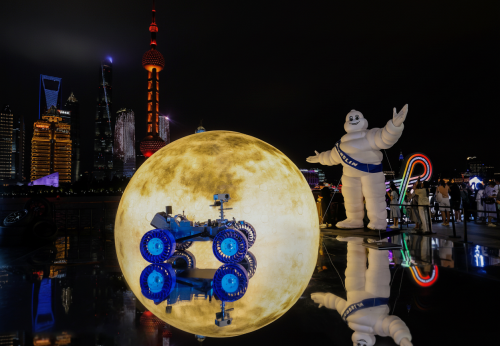
“创新,不止于道路”米其林点亮三城月球艺术装置,展示百年创新探索版图
Sou Hu Wang· 2025-10-05 09:45
Core Viewpoint - Michelin celebrates the Mid-Autumn Festival by showcasing a giant moon art installation in Shanghai, Guangzhou, and Chengdu, emphasizing its commitment to innovation and exploration in various fields [1][2]. Group 1: Innovation and Technology - Michelin has a 136-year history as a leading manufacturer of tires and composite materials, focusing on innovation that extends beyond road applications to sectors like aerospace, low-carbon energy, and healthcare [2][12]. - The company has developed a new tire, the Michelin Hao Yue V, which integrates 17 patents and offers superior wet braking performance, reducing stopping distance by an average of 6 meters after 50,000 kilometers compared to competitors [3][9]. - Michelin's innovative tire technology has been applied to aircraft, with approximately half of the world's commercial planes equipped with Michelin tires, ensuring passenger safety during takeoff and landing [5]. Group 2: Cultural Engagement and Brand Vision - The moon symbolizes reunion and exploration in Chinese culture, and Michelin uses the moon art installation to convey its brand message of "innovation beyond the road" [8][12]. - Michelin's exploration extends to developing airless tires for lunar rovers, capable of withstanding extreme temperatures and conditions on the moon, showcasing the company's commitment to pushing technological boundaries [8][11]. - The company aims to continue its innovative journey by collaborating with Chinese users to create a more sustainable and better future [15]. Group 3: Diverse Applications and Research - Michelin's research and innovation span over 350 professional fields, including aerospace, low-carbon energy, and medical applications, demonstrating its versatility in engineering materials [14]. - The company has developed advanced composite materials for various applications, such as a revolutionary automatic sail system for reducing greenhouse gas emissions in maritime transport and biocompatible materials for medical implants [14].

千乘资本熊伟:重读经典《西方哲学史》 借千年智慧寻商业本质丨大咖荐书
Zheng Quan Shi Bao Wang· 2025-10-04 02:42
Core Insights - The essence of investment success lies in the accurate judgment of profitability, which is fundamentally linked to the depth of understanding [1] - In a rapidly changing world, expanding one's perspective through historical dialogue and reading is essential for enhancing cognitive abilities and recognizing enduring truths [1] Group 1: Importance of Reading - Reading is a common trait among successful individuals across various industries, serving as a tool to observe changes over time and uncover investment value [1] - The recommendation of "A History of Western Philosophy" emphasizes the need for depth of understanding in contrast to the speed of AI advancements [2] Group 2: First Principles and Innovation - The concept of "first principles" from Aristotle remains relevant, urging entrepreneurs and investors to strip away superficial data and focus on fundamental economic truths [2] - Innovation is highlighted as the core driving force for entrepreneurship, with the recognition that innovators often face initial skepticism [2]
卖爆了!小米17系列,销量超100万台!
Zhong Guo Ji Jin Bao· 2025-10-02 03:17
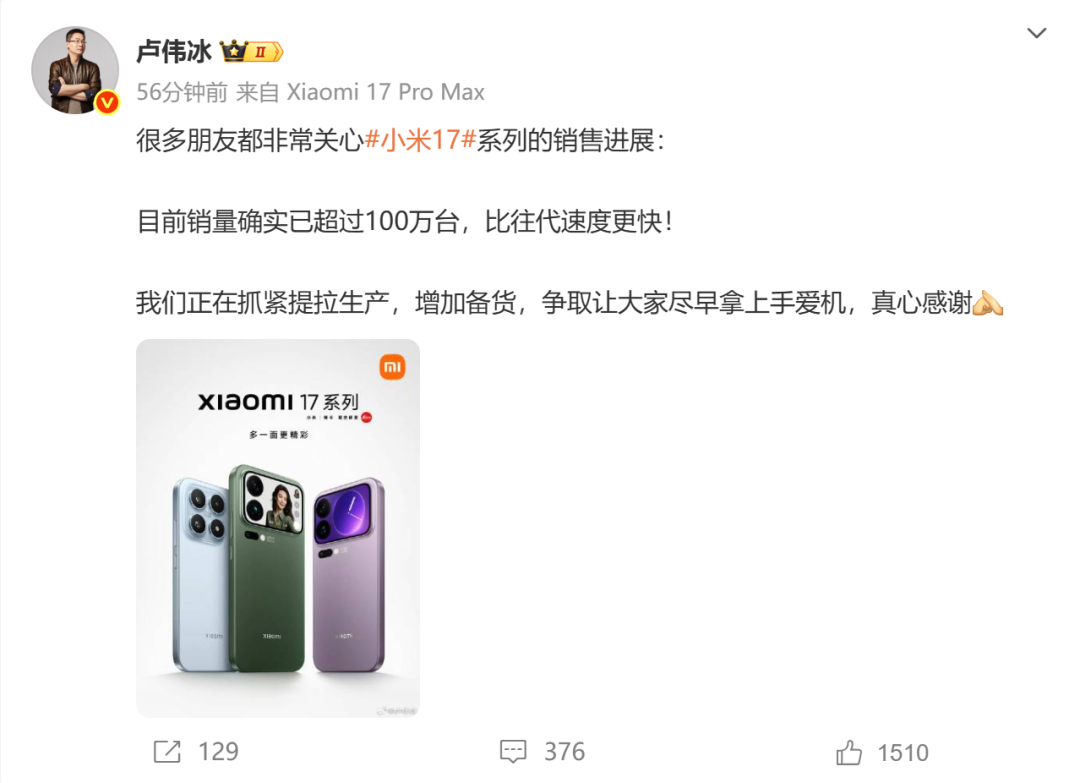
Core Viewpoint - The Xiaomi 17 series has surpassed 1 million units in sales, achieving this milestone faster than previous models, indicating strong market demand and consumer interest [1][3][6]. Sales Performance - The Xiaomi 17 series was officially launched on September 25, with a starting price of 4,499 yuan for the base model and 5,999 yuan for the Pro Max model [8]. - Within just 5 minutes of its release on September 27, the entire Xiaomi 17 series set new records for first-day sales volume and revenue across all price segments of domestic smartphones in 2025 [8]. - The Pro Max model accounted for over 50% of the sales within the Xiaomi 17 series, highlighting its popularity [8]. Market Strategy - Xiaomi is ramping up production and increasing inventory to meet the high demand for the Xiaomi 17 series [3]. - The company aims to compete directly with Apple, particularly in the high-end market segment, and has introduced a 1TB version of the device to enhance its product lineup [9][10]. Competitive Landscape - Despite the strong initial sales, there are concerns regarding a potential 20% reduction in total shipment targets for the Xiaomi 17 series, primarily due to lower-than-expected demand for the standard version and competition from Apple and Huawei [9]. - Analysts suggest that the competitive pressure from the iPhone 17 and Huawei's high-end models could impact Xiaomi's market share [9]. Market Outlook - Market research indicates that Xiaomi's strong specifications and design for the 17 series could help it capture market share in the 4,000 to 6,000 yuan price range, potentially stabilizing profit margins [14]. - Following the positive sales news, Xiaomi's stock price increased by over 3%, reflecting investor confidence in the company's performance [14].
《2025年全球创新指数报告》发布,中国首次跻身全球前十——中国创新向世界展现新图景
Ren Min Ri Bao· 2025-10-01 01:53
Group 1: Global Innovation Index and Rankings - China has improved its ranking to 10th in the 2025 Global Innovation Index, marking its first entry into the top ten and leading among 36 upper-middle-income economies, having risen 25 places since 2013 [1] - In terms of innovation input, China ranks 19th globally, up 4 places from the previous year, while its innovation output ranks 5th, an increase of 2 places [3] Group 2: Investment in R&D - In 2024, China's total R&D expenditure exceeded 3.6 trillion yuan, reflecting an 8.3% increase from the previous year, with a steady rise in R&D investment intensity and rapid growth in basic research funding [2] - China has the largest R&D workforce globally, with 26 of the world's top 100 technology innovation clusters, and over 460,000 high-tech enterprises [2] Group 3: Innovation Output and Intellectual Property - China ranks first globally in several intellectual property metrics, including design patent applications per unit of GDP, utility model patent applications, and trademark applications [2] - The efficiency of technology transfer has significantly improved, with the development cycle for consumer products like drones and mobile cameras reduced from years to months or even weeks [3] Group 4: AI and International Cooperation - China is actively promoting AI technology and has launched initiatives like the "AI+" international cooperation initiative to enhance collaboration and benefit various sectors globally [4][5] - The "Artificial Intelligence Global Governance Action Plan" aims to promote inclusive and equitable development of AI through effective international cooperation [5] Group 5: Advancements in Key Technologies - China is making significant strides in core technologies, particularly in AI, with over 1,500 large models developed, many of which are open-source and competitive with international standards [7] - The biotechnology sector in China is experiencing a structural transformation, with over 1,250 innovative drugs in the R&D phase, meeting advanced global standards [7] Group 6: Recommendations for Enhancing Innovation - Experts suggest breaking down disciplinary boundaries to foster collaboration between natural sciences, engineering, and social sciences, enhancing the integration of technology with social ethics and cultural contexts [9] - Recommendations include strengthening the innovation ecosystem, increasing investment in basic research, and establishing a unified framework for AI technology assessment and governance [10]
多名国际组织代表出席科特迪瓦企业总联合会召开的科2025年私营领域经济论坛
Shang Wu Bu Wang Zhan· 2025-09-30 17:00
Core Insights - The 2025 Private Sector Economic Forum in Côte d'Ivoire focuses on "Economic Sovereignty, Action Time" and is organized by the General Confederation of Enterprises of Côte d'Ivoire (CGECI) [1] - The event is attended by over 2,000 participants, including government officials and representatives from international organizations, highlighting its significance in the region [1] Group 1: Event Overview - The forum is held in Abidjan on September 29 and lasts for two days, featuring discussions on various topics such as financing, industrialization, innovation, energy, agricultural processing, health, natural resources, and human resources [1] - Key attendees include the Prime Minister, Minister of Finance, Minister of Trade and Industry, and notable figures from international financial institutions [1] Group 2: Themes and Topics - The forum aims to address critical issues related to economic sovereignty and the role of the private sector in driving growth and development in Côte d'Ivoire [1] - Sub-forums will focus on specific sectors, indicating a comprehensive approach to tackling economic challenges and opportunities in the region [1]
丽臣实业:表面活性剂的生产、销售为公司核心业务
Zheng Quan Ri Bao Wang· 2025-09-30 08:43
Core Viewpoint - Lichen Industrial (001218) emphasizes its core business in the production and sales of surfactants, highlighting its advantages in brand, customer base, production capacity, and industry chain [1] Group 1 - The company is committed to continuous technological research and innovation, aiming to build a diverse product matrix [1] - The company is actively expanding into related product application fields, with a focus on industrial and electronic sectors as key development directions [1] - In addition to organic growth, the company is closely monitoring high-quality resources in the industry and is prepared to engage in external mergers and acquisitions to accelerate business layout and upgrades [1]
聊城市严厉打击知识产权侵权假冒行为
Qi Lu Wan Bao Wang· 2025-09-30 06:53
Core Viewpoint - The importance of intellectual property (IP) protection is increasingly emphasized as technology and industrial design continue to innovate, with various types of IP protection available for different aspects of innovation [1][2][3] Group 1: Intellectual Property Protection Types - Companies can apply for patent protection for product concepts, new technology solutions, optimization of existing technologies, ID design presentations, and product functionalities [1] - Trademark registration can be pursued for product models and names after design [1] - Special rights for integrated circuit layout designs and software copyright can be utilized during hardware and software development [1] - Copyright registration can protect packaging and decorative designs of enterprises [1] - Trade secrets can safeguard unique technical methods, processes, material compositions, and formulas that are not suitable for patent application [1] Group 2: Strengthening Enforcement and Collaboration - The market supervision department enhances collaboration with courts to ensure the enforcement of IP administrative mediation agreements through judicial confirmation cases [2] - A practice point for government-court collaboration has been established in the Chipping District People's Court to effectively resolve IP disputes [2] - Over 140 cases of patent and trademark infringement have been investigated, with severe violations leading to public disclosure of typical administrative protection cases [2] Group 3: Optimizing Protection Guidance - A special action for IP protection of foreign-funded enterprises has been initiated, establishing a system of IP specialists to provide targeted services to various companies [3] - The establishment of a national overseas IP dispute response guidance center in Liaocheng aims to assist over 40 companies with overseas IP layout, warning information release, and rights protection [3]
用鸿蒙的人,到底图什么?
半佛仙人· 2025-09-30 04:12
Core Viewpoint - Huawei has achieved significant growth with its HarmonyOS, surpassing 20 million devices in less than a year since the public beta of HarmonyOS 5, indicating exponential growth in user adoption and ecosystem development [6][20]. Group 1: User Engagement and Ecosystem - The rapid increase in HarmonyOS users reflects a strong user base that is willing to embrace new technology, which is crucial for the ecosystem's success [6][11]. - Users of HarmonyOS are not just passive consumers; they actively participate in the system's development by providing feedback and suggestions, which are essential for continuous improvement [15][19]. - The unique features and innovations offered by HarmonyOS attract users who are eager to explore new possibilities, differentiating it from other operating systems [12][14]. Group 2: Developer Support and Incentives - Huawei has launched various incentive programs, including cash rewards and exclusive offers, to encourage developers to create applications for HarmonyOS, demonstrating a commitment to building a robust ecosystem [20][22]. - The company has allocated significant financial resources, including a 10 billion yuan investment for AI ecosystem innovation, to support developers and enhance the platform's capabilities [20][22]. - By rewarding both users and developers, Huawei aims to create a sustainable ecosystem that fosters growth and innovation [20][22]. Group 3: Market Strategy and User Retention - Huawei's strategy focuses on exceeding user expectations through continuous product improvement and rapid iteration, which helps retain existing users and attract new ones [23][24]. - The company recognizes that user engagement is critical in a competitive market, and it actively seeks to build a loyal user base that can advocate for the platform [22][23]. - By creating a positive feedback loop where satisfied users promote the system, Huawei aims to establish a self-sustaining growth model for HarmonyOS [22][23].

中国-北欧经贸合作论坛即将召开,电动汽车及电池产业成新热点
Di Yi Cai Jing· 2025-09-29 12:02
Core Points - The China-Nordic Economic and Trade Cooperation Forum will be held in Wuhan, Hubei, marking the first and only long-term mechanism for economic cooperation specifically targeting Nordic countries since its inception in 2018 [1] - Denmark has been invited as the guest country for this year's forum, highlighting the comprehensive strategic partnership between China and Denmark [1] Group 1: Historical Context and Trade Growth - China has a long-standing and robust economic cooperation with Nordic countries, with Sweden, Denmark, and Finland being among the first Western nations to establish diplomatic relations with China [3] - In 2024, trade volume between China and the five Nordic countries reached $53.17 billion, an increase of 8.5% [3] - From January to August 2024, trade volume was $37.96 billion, showing a year-on-year growth of 7.1%, which is more than double the growth rate of trade between China and other European countries during the same period [3] Group 2: Investment Trends - Nordic countries have invested over $15 billion in China, with Sweden and Denmark each contributing more than $5 billion, positioning them among the top European investors [4] - Nordic companies view China's economic prospects favorably and are increasingly integrating into local supply chains across various sectors, including automotive and machinery [4] Group 3: Emerging Sectors - The electric vehicle and battery industries are becoming new focal points for cooperation, with Chinese companies like BYD and NIO successfully entering Nordic markets [5] - Chinese battery manufacturers are also establishing a presence in Nordic countries, with companies like Xingyuan Material setting up European headquarters in Sweden [5] Group 4: Future Cooperation Potential - The cooperation potential between China and Nordic countries can be summarized in three keywords: green, innovation, and quality [6] - Green cooperation is emphasized, with both parties committed to sustainable development and addressing global challenges [6] - Innovation is a cornerstone for Nordic countries, with Sweden, Finland, and Denmark ranking among the top ten in the global innovation index [7] - The demand for high-quality and diverse consumer products in China is rising, with Nordic countries offering advanced technology and premium goods [7]
美国不愿看到的情况出现了!比尔盖茨一语中的?中国不再依赖美芯
Sou Hu Cai Jing· 2025-09-29 05:21
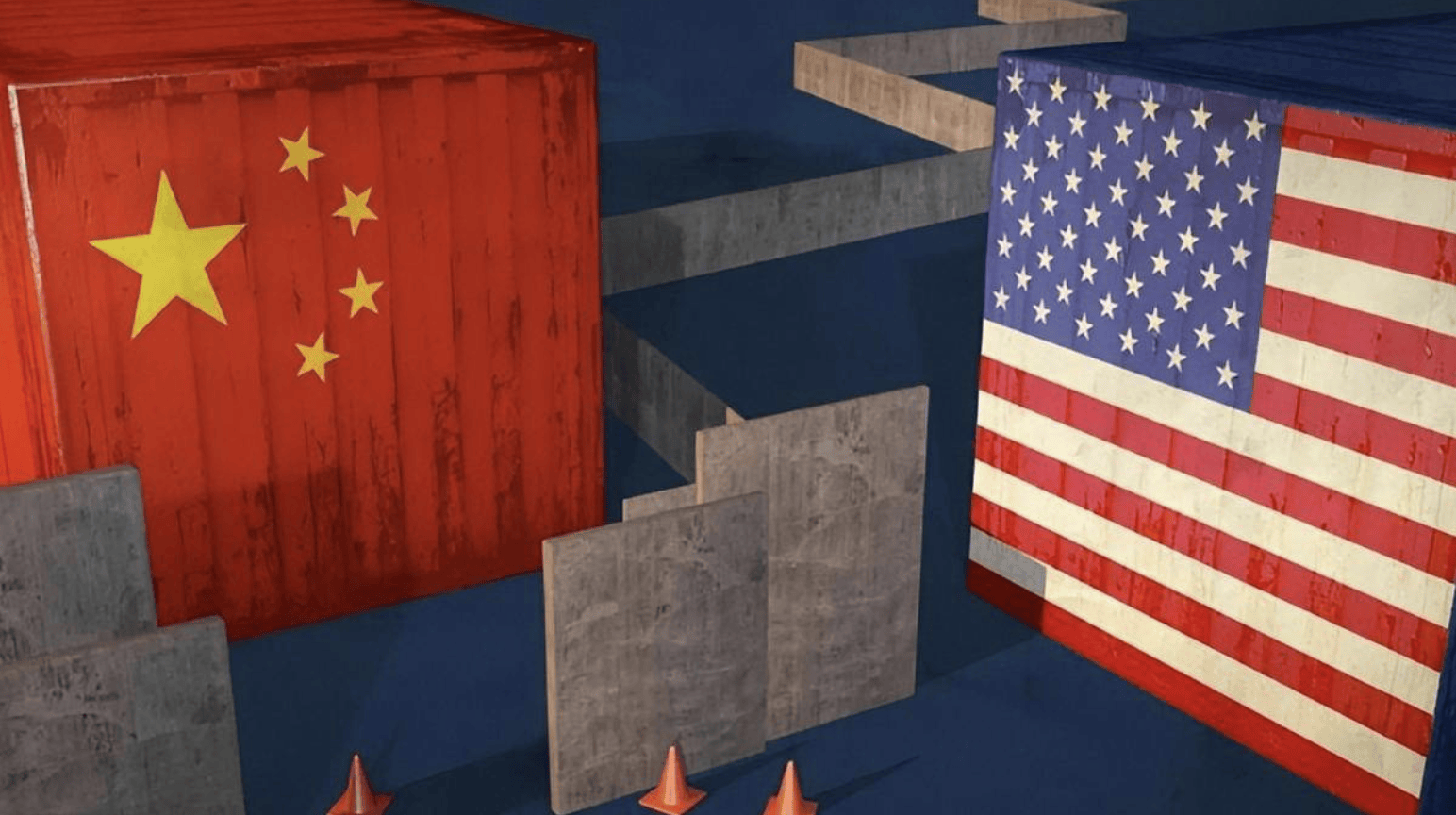
Core Viewpoint - The article discusses the ongoing technological and economic competition between the U.S. and China, particularly focusing on the semiconductor industry, highlighting how U.S. restrictions have inadvertently accelerated China's technological advancements [1][5][12]. Group 1: U.S.-China Semiconductor Competition - The technological rivalry between the U.S. and China began in 2018, centered around semiconductors, which are crucial for national security and various consumer technologies [3]. - U.S. actions, including export restrictions on semiconductor technology, are seen as counterproductive, potentially harming the U.S. semiconductor industry more than benefiting it [5][12]. - The U.S. restrictions have led to a significant increase in China's focus on self-reliance in semiconductor technology, with a reported self-sufficiency rate of nearly 70% in mature chips [10]. Group 2: Impact of U.S. Restrictions - Prominent figures like Bill Gates have warned that U.S. efforts to contain China could backfire, igniting innovation within China's semiconductor sector [5][8]. - Despite initial setbacks from U.S. restrictions, Chinese companies like Huawei have made significant strides in developing their own technologies, including the Kirin chip and Harmony OS [10]. - The market share of U.S. companies in China has declined, with Nvidia reportedly losing 10% of its market share and over $10 billion in revenue due to export restrictions [12]. Group 3: Future Outlook - The article suggests that the current challenges faced by Chinese tech companies will eventually lead to a brighter future, as they continue to innovate and reduce dependency on U.S. technology [12]. - China's advancements in AI and semiconductor technology are closing the gap with U.S. companies, indicating a shift in the global tech landscape [8].