
区域协调发展

Search documents
国家发改委:会同有关方面抓紧起草“十五五”规划《纲要草案》
Di Yi Cai Jing· 2025-10-24 12:34
Core Points - The National Development and Reform Commission (NDRC) held an expanded meeting on October 24 to convey and implement the spirit of the 20th Central Committee's Fourth Plenary Session and General Secretary Xi Jinping's important speech [1][2] - The meeting emphasized the need for the NDRC to take proactive actions to effectively implement major strategic tasks during the 14th Five-Year Plan period, focusing on building a modern industrial system and promoting high-level technological self-reliance [1][2] Group 1 - The NDRC is tasked with implementing key work related to the construction of a strong domestic market and high-level socialist market economy [1] - The meeting called for immediate action to study and implement the spirit of the plenary session and to draft the "14th Five-Year Plan" outline [2] - The NDRC aims to ensure that various plans at all levels align and work towards common goals [2]
权威解读“十五五”,这场发布会透露哪些信号?|宏观经济
清华金融评论· 2025-10-24 11:56
文/ 《清华金融评论》 周茗一 中共中央于1 0月2 4日上午1 0时举行新闻发布会,介绍和解读党的二十届 四中全会精神。会议介绍,此次全会最重要的成果,审议通过了中共中央 关于制定国民经济和社会发展第十五个五年规划的建议》 , "十五五"时 期 , 既 要 乘 势 而 上 , 又 要 迎 难 而 上 , 充 分 发 挥 中 国 特 色 社 会 主 义 制 度 优 势、超大规模市场优势、完整产业体系优势、丰富人才资源优势,把各方 面优势转化为高质量发展的实际效能。 党的二十届四中全会最重要的成果,是审议通过了《建议》。《建议》共15个部分、61条、分为三大板块。第一板块是总论,关于"十五五"时期我国发展环 境的总体判断,主要阐述"十四五"时期我国发展取得的重大成就、抓好"十五五"时期经济社会发展的重大意义和总体要求。第二板块为分论,关于"十五 五"时期经济社会发展的指导方针,分领域部署"十五五"时期的战略任务和重大举措。第三板块 "十五五"时期经济社会发展主要目标,关于主要部署坚持和 加强党中央集中统一领导、推进社会主义民主法治建设等任务。 "十五五"时期,既要乘势而上,又要迎难而上 中央财办分管日常工作的副 ...

二十届四中全会会议点评:聚焦高质量发展与科技自立自强,进一步夯实市场中长期预期
Dongguan Securities· 2025-10-24 09:51
Core Insights - The report emphasizes the importance of high-quality development and technological self-reliance as key themes for the upcoming "Fifteen Five" period, building on the achievements of the "Fourteen Five" period [3][4][5] - The "Fifteen Five" period is characterized by a focus on modernizing the industrial system, enhancing technological independence, and fostering new productive forces [6][7] - The report outlines twelve specific goals for the "Fifteen Five" period, prioritizing the construction of a modern industrial system and the promotion of high-level technological self-reliance [7][8] Summary by Sections Achievements of the "Fourteen Five" Period - The "Fourteen Five" period is recognized for significant achievements in economic recovery and high-quality development, laying a solid foundation for future growth [3][4] - The report highlights the advantages of the socialist system in China and the effective leadership of the central government in navigating complex challenges [4] Goals for the "Fifteen Five" Period - The main goals include accelerating the construction of a modern industrial system, enhancing technological self-reliance, and expanding high-level openness [6][7] - The report emphasizes the need for a qualitative improvement in economic performance and a reasonable growth rate, aiming for decisive progress in modernization by 2035 [6] Economic Policy Direction - The report indicates a shift from merely pursuing economic growth to focusing on quality, efficiency, and innovation as the main drivers of development [12] - It stresses the importance of balancing multiple objectives, including growth stabilization, structural adjustment, and risk prevention [12][11] Market Implications - The report suggests that the focus on institutional innovation and high-quality development will provide clearer long-term policy expectations for the market [13] - It anticipates that sectors such as high-end manufacturing, green energy, and the digital economy will benefit from supportive policies and financial resources [14]
权威解读“十五五” 这场发布会释放重要信息
Yang Shi Xin Wen· 2025-10-24 07:56
Core Points - The key outcome of the 20th Central Committee's Fourth Plenary Session is the approval of the "Suggestions on Formulating the 15th Five-Year Plan for National Economic and Social Development" [1][3] - The "15th Five-Year Plan" outlines significant strategies and tasks for China's economic and social development during this period [4][5] Group 1: Overview of the Suggestions - The Suggestions consist of three main sections: general principles, specific strategies, and tasks for the 15th Five-Year Plan [3][4] - The first section highlights major achievements during the 14th Five-Year Plan and the significance of the upcoming plan [4] - The second section details strategic tasks and major initiatives across various sectors for the 15th Five-Year Plan [4] Group 2: Economic Development Guidelines - The Suggestions propose five guiding principles and two driving forces for economic development, emphasizing high-quality growth and comprehensive governance [4][5] - The plan aims to ensure significant progress towards socialist modernization while addressing both opportunities and challenges in the current international landscape [5][6] Group 3: Agricultural Modernization - The Suggestions prioritize agricultural modernization as a critical area for achieving overall modernization, focusing on rural revitalization and urban-rural integration [7][8] - Emphasis is placed on enhancing agricultural productivity and quality, ensuring food security, and increasing farmers' income [8][9] Group 4: Modern Industrial System - The Suggestions stress the importance of building a modern industrial system, with a focus on upgrading traditional industries and fostering new emerging sectors [11][12] - Key tasks include enhancing the competitiveness of core industries and developing strategic emerging industries such as renewable energy and advanced manufacturing [12][13] Group 5: Domestic Market Expansion - The Suggestions highlight the need to strengthen the domestic market as a strategic foundation for modernization, with a focus on expanding consumption and investment [17][18] - Specific measures include promoting consumer spending, optimizing government investment, and removing market barriers to enhance economic circulation [19][20] Group 6: Regional Development Coordination - The Suggestions outline strategies for promoting coordinated regional development, emphasizing the need for optimized spatial layouts and new urbanization [21][24] - Initiatives include enhancing infrastructure connectivity and fostering collaborative mechanisms among different regions [22][23] Group 7: Technological Self-Reliance - The Suggestions call for accelerating technological self-reliance and innovation, focusing on key areas such as semiconductor technology and high-end manufacturing [26][27] - Emphasis is placed on integrating scientific research with industrial innovation to drive economic growth [31][32] Group 8: Health and Population Development - The Suggestions propose a health-first development strategy, aiming to improve public health systems and promote population quality [49][50] - Policies will focus on enhancing healthcare services, supporting family planning, and improving elderly care systems [51] Group 9: Party Leadership and Governance - The Suggestions emphasize the importance of strengthening the centralized leadership of the Party and improving governance mechanisms [52][53] - Measures include enhancing the implementation of major decisions and promoting a clean political environment [54]
中共中央新闻发布会:推动氢能和核聚变能等成为新的经济增长点
Zhong Guo Dian Li Bao· 2025-10-24 07:28
Core Viewpoint - The article discusses the strategic initiatives outlined in the 14th Five-Year Plan, emphasizing the importance of fostering new industries and enhancing the existing industrial framework to drive economic growth in China [1][3][4]. Industry Summary - The focus is on building a modern industrial system, with a strong emphasis on solidifying and expanding the foundation of the real economy. The four key tasks identified are: optimizing traditional industries, nurturing new and future industries, enhancing service sector quality, and constructing a modern infrastructure system [3][4][5]. - The "Three New" economy's contribution to GDP is projected to exceed 18% by 2024, highlighting the growth potential of emerging industries such as renewable energy, new materials, and aerospace [4]. - The plan aims to create several trillion-yuan markets through the development of strategic emerging industry clusters, which will significantly contribute to high-quality economic growth over the next decade [4]. Market Summary - The strategy emphasizes the importance of a robust domestic market as a cornerstone of China's modernization. Key tasks include expanding domestic demand, improving investment efficiency, and ensuring smooth market circulation [5][6]. - The government aims to enhance consumer spending and investment in both goods and services, with a focus on significant infrastructure projects and improving the investment structure to better serve public needs [6]. - Efforts to streamline market access and eliminate barriers to competition are also highlighted, with a reduction in market entry restrictions from 328 to 106 items [6]. Regional Development Summary - The plan outlines initiatives for promoting coordinated regional development, focusing on optimizing regional layouts and enhancing urbanization efforts [7][8]. - Emphasis is placed on the development of the marine economy, with a target to exceed 10 trillion yuan, alongside measures to protect marine environments and resources [8]. - The government will work on drafting a high-quality planning outline that aligns with the strategic goals set forth in the 14th Five-Year Plan [8].
信息量大!中共中央举行新闻发布会,介绍和解读党的二十届四中全会精神
Qi Huo Ri Bao· 2025-10-24 05:20
10月20日至23日,中国共产党第二十届中央委员会第四次全体会议在北京召开。这次全会是在我国即将 胜利完成"十四五"主要目标任务,进入基本实现社会主义现代化夯实基础、全面发力的关键时期召开的 一次重要会议。全会审议通过了《中共中央关于制定国民经济和社会发展第十五个五年规划的建议》 (下称《建议》)。 10月24日,中共中央举行新闻发布会,介绍和解读党的二十届四中全会精神。 《建议》共有15个部分 中央政策研究室主任江金权介绍,《建议》共有15个部分、61条,分为三大板块。第一板块是总论,包 括第一部分、第二部分,主要阐述"十四五"时期我国发展取得的重大成就、抓好"十五五"时期经济社会 发展的重大意义和总体要求。第二板块从第三部分到第十四部分为分论,分领域部署了"十五五"时期的 战略任务和重大举措。第三板块由第十五部分和结束语组成,主要部署坚持和加强党中央集中统一领 导,推进社会主义民主法治建设等任务。 《建议》明确"十五五"时期经济社会发展的指导方针和主要目标 中央财办分管日常工作的副主任、中央农办主任韩文秀在发布会上表示,党的二十届四中全会通过的 《建议》准确把握我国发展的历史方位,深入分析国际国内形势,明 ...
郑栅洁:中国经济靠实体经济起家,也要靠实体经济走向未来
Nan Fang Du Shi Bao· 2025-10-24 04:03
南都讯 记者潘珊菊 发自北京 10月20日至23日,中国共产党第二十届中央委员会第四次全体会议在北京 召开。全会审议通过了《中共中央关于制定国民经济和社会发展第十五个五年规划的建议》。 二是提升效益。我国固定资产投资年度规模已达到50万亿元,但惠民生、补短板、育动能等任务还很 重,必须把"钱"特别是政府资金更好地用在发展紧要处,花在群众生活上。对此,《建议》提出优化政 府投资结构,提高民生类政府投资比重,统筹用好各类政府投资,加强政府投资全过程管理等举措,将 更好地发挥政府投资的撬动作用,不断增进投资的综合效益。 三是畅通循环。有了统一大市场,才能畅通大循环。我国市场准入负面清单事项已从过去的328项减到 目前的106项,4200多件阻碍要素流动的政策举措得到清理,但还有不少堵点和卡点。对此,《建议》 提出统一市场基础制度规则,破除地方保护和市场分割,规范地方政府经济促进行为,统一市场监管执 法,综合整治"内卷式"竞争等举措,将更加有力有效地破除各种市场障碍,充分释放我国超大规模市场 红利。 强基增效,就是要构建现代化基础设施体系。我国已拥有全球规模最大的高速铁路、高速公路、港口、 邮政快递、电力、宽带等基础 ...
一文速览重磅发布会主要内容!
Wind万得· 2025-10-24 03:57
Core Viewpoint - The article discusses the "14th Five-Year Plan" and its significance in advancing China's modernization, emphasizing the need for a systematic approach to economic and social development in response to complex external environments and internal demands [4][6]. Summary by Sections General Overview - The "14th Five-Year Plan" consists of 15 parts and 61 articles, divided into three main sections: general overview, specific strategies, and concluding remarks [4]. Economic and Social Development Goals - The plan outlines seven key goals for the "14th Five-Year" period, including significant achievements in high-quality development, increased consumer spending, advancements in technology, and improved public services [7]. Industrial Development - The plan prioritizes building a modern industrial system, focusing on four key tasks: upgrading traditional industries, fostering new and future industries, enhancing service sector quality, and constructing modern infrastructure [9][10][11]. Domestic Market Expansion - Emphasizes the importance of a strong domestic market, with strategies to expand demand, improve investment efficiency, and streamline market operations [12][13]. Regional Coordination - Highlights the need for coordinated regional development, optimizing spatial layouts, promoting new urbanization, and integrating land and maritime strategies [14]. Technological Innovation - The plan stresses the importance of technological modernization, focusing on original innovation, integration of technology and industry, and the development of a skilled workforce [17][18]. Open Economy - It outlines strategies for expanding openness, including enhancing trade, investment cooperation, and high-quality participation in the Belt and Road Initiative [20][21]. Health and Population Development - The plan includes initiatives for health prioritization, public health capacity enhancement, and the establishment of a supportive environment for population growth and aging [24][25][26].

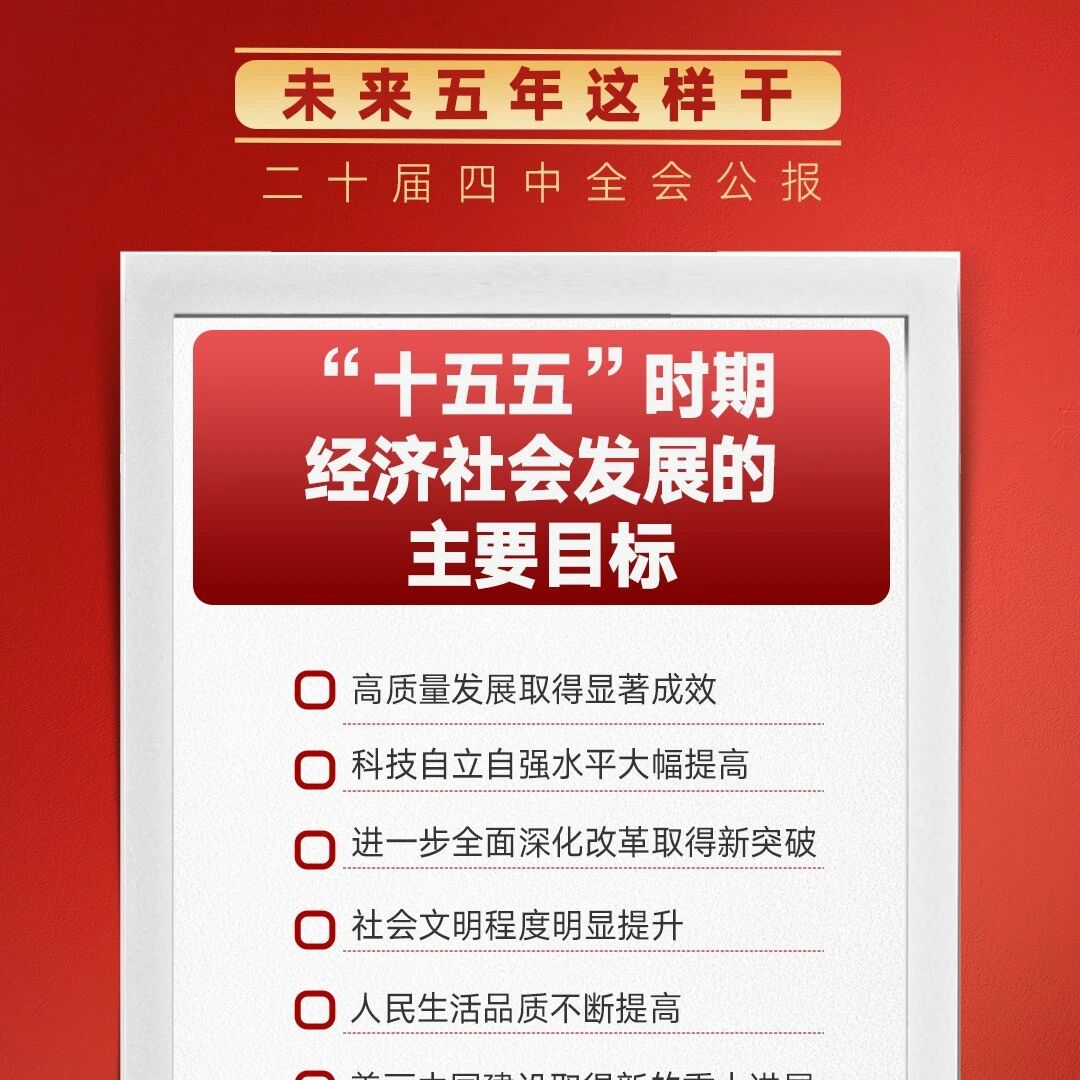
锚定“十五五”主要目标,未来五年这样干!
中汽协会数据· 2025-10-24 02:06
Core Viewpoint - The article outlines the strategic directions and key initiatives for the next five years as articulated in the 20th Central Committee's Fourth Plenary Session, emphasizing high-quality development, technological self-reliance, and the construction of a modern economic system. Group 1: High-Quality Development - Significant achievements in high-quality development have been noted, with improvements in social civilization and living standards [3] - The focus is on consolidating and expanding the foundation of the real economy, promoting intelligent, green, and integrated development [5] Group 2: Technological Self-Reliance - There is a strong emphasis on accelerating high-level technological self-reliance to lead new productive forces, enhancing the national innovation system, and fostering original innovation [7] - The integration of technology innovation with industrial innovation is prioritized to boost overall productivity [7] Group 3: Domestic Market and Economic Structure - The strategy aims to expand domestic demand, enhance consumption, and promote effective investment, ensuring a robust domestic circulation [9] - The construction of a high-level socialist market economy is essential for sustaining high-quality development [11] Group 4: Agricultural Modernization - Addressing agricultural and rural issues is a top priority, with efforts to promote urban-rural integration and enhance agricultural productivity [15][17] Group 5: Regional Development - The strategy includes optimizing regional economic layouts to promote coordinated regional development and enhance the effectiveness of urbanization [19] Group 6: Cultural Development - There is a commitment to invigorating cultural innovation and promoting socialist culture, enhancing the influence of Chinese civilization [21] Group 7: Social Welfare and Common Prosperity - The focus is on improving living standards and ensuring common prosperity through effective social policies and public services [23] Group 8: Green Transformation - A comprehensive green transformation is planned, emphasizing carbon neutrality and ecological safety, while promoting sustainable development practices [25] Group 9: National Security - Strengthening the national security system and enhancing public safety governance are critical components of the strategy [27][29] Group 10: Military Modernization - The modernization of the military is highlighted, focusing on enhancing combat capabilities and integrating advanced technologies [32]
申万宏源赵伟四中全会精神学习理解:续写奇迹新篇章
Xin Lang Zheng Quan· 2025-10-24 01:31
值得关注的是,本次会议再度涉及短期经济判断,明确提出"坚决实现全年经济社会发展目标"。会议强 调"宏观政策要持续发力、适时加力",结合当前近3000 亿元政策性金融工具已投放、财政从地方政府 债务结存限额中安排5000 亿元下达地方的现实基础,全年实现5%的经济增长目标具备相当坚实的支 撑。 二、全会将"建设现代化产业体系"置于更突出的位置,并首次明确提出"保持制造业合理比重"。 本次全会将"建设现代化产业体系"置于更突出的位置,并首次明确提出"保持制造业合理比重"。全会进 一步强调"坚持智能化、绿色化、融合化方向",或意味着要将科技创新成果更深入地融入产业实践,推 动传统产业与新兴产业协同并进。相较于"十四五"规划中"保持制造业比重基本稳定"的表述,本次全会 更加强调"合理比重",体现出对产业结构优化与第三产业发展的统筹考量。 炒股就看金麒麟分析师研报,权威,专业,及时,全面,助您挖掘潜力主题机会! 事件:中国共产党第二十届中央委员会第四次全体会议,于2025 年10 月20日至23日在北京举行。 一、全会强调"集中力量办好自己的事",续写经济快速发展和社会长期稳定两大奇迹新篇章 经济形势研判方面,本次会议 ...
