
第三代半导体

Search documents
中金 | AI进化论(15):服务器电源,下一个千亿级市场
中金点睛· 2025-08-28 00:10
Core Viewpoint - The AI server power supply market is projected to become a trillion-yuan market, with rapid growth expected between 2025E and 2027E, driven by advancements in GaN/SiC technology and the adoption of 800V HVDC and SST architectures [2][3]. Market Size and Growth - The AI server power module market is expected to reach $74 billion in 2025E, $150 billion in 2026E, and $325 billion in 2027E, with a CAGR of 110%. The AI server power chip market is projected to grow from $55 billion in 2025E to $154 billion in 2027E, with a CAGR of 67% [4][6]. - The global AI server power market (chip basis) is anticipated to grow from approximately $55 billion in 2025 to $154 billion in 2027, driven by the continuous ramp-up of NVIDIA's NVL72 and other high-power ASIC models [6][39]. Key Components and Directions - The AI server power supply system can be divided into three layers: power supply system (UPS, HVDC, PDU), AC-DC conversion (PSU, PMC, BBU), and DC-DC conversion (PDB, VRM). The core drivers are high power density, high efficiency, and intelligent management [5][13]. - Future developments in AI server power supplies are expected to focus on three main directions: the upgrade of power supply architecture, the enhancement of core power devices, and the intelligentization of power management [9][10]. Incremental Growth Areas - The main incremental growth areas in the AI server power supply industry include: 1) PSU and DC-DC benefiting from GaN/SiC penetration, leading to increased value [10]. 2) The transition to 800V HVDC and SST architecture, which is expected to drive power system upgrades [10]. 3) The increasing importance of PDU and BBU in high power density and intelligent management scenarios [10][18]. Component Value Breakdown - The estimated value of the NVL72 server power system is approximately $70,855, with key components valued as follows: PSU at $9,647, BBU at $7,200, PDB at $4,500, and VRM at $5,783 [28][29]. - The market for DC-DC converters is projected to grow from $13.61 billion in 2025 to $28.47 billion by 2032, with a CAGR of 9.66% [21]. Competitive Landscape - The UPS market is expected to maintain high demand due to its critical role in ensuring power continuity and efficiency in AI data centers, despite the rise of HVDC systems [15][16]. - The market for GaN power devices is becoming increasingly competitive, with significant growth expected as companies focus on scaling production and integrating supply chains [24].


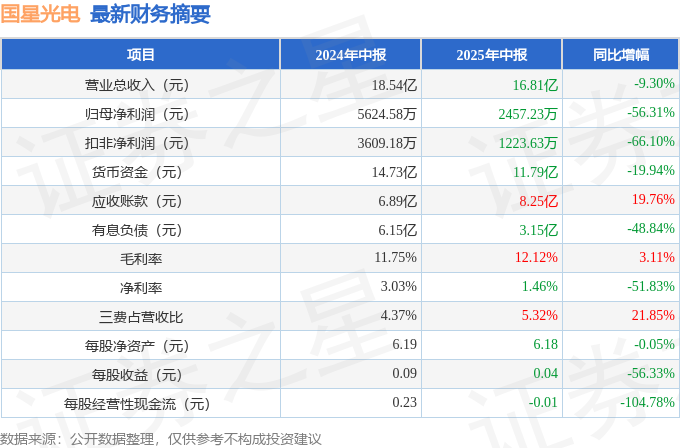
国星光电(002449)2025年中报简析:净利润同比下降56.31%,公司应收账款体量较大
Zheng Quan Zhi Xing· 2025-08-27 11:53
Core Viewpoint - Guoxing Optoelectronics (002449) reported disappointing financial results for the first half of 2025, with significant declines in revenue and net profit compared to the previous year [1] Financial Performance Summary - Total revenue for the first half of 2025 was 1.681 billion yuan, a decrease of 9.3% year-on-year from 1.854 billion yuan in 2024 [1] - Net profit attributable to shareholders was 24.57 million yuan, down 56.31% from 56.25 million yuan in the previous year [1] - The second quarter saw a slight revenue increase of 0.15% year-on-year, totaling 914 million yuan, but net profit dropped 72.17% to 7.88 million yuan [1] - Gross margin improved to 12.12%, up 3.11% year-on-year, while net margin fell to 1.46%, down 51.83% [1] - Total receivables reached 825 million yuan, a 19.76% increase, with receivables accounting for 1601.19% of net profit [1] Cash Flow and Financial Position - Operating cash flow per share was -0.01 yuan, a decrease of 104.78% year-on-year [1] - The company reported a significant decline in cash and cash equivalents, with a net increase of -262.09% due to reduced cash flow from operating and financing activities [6] - The company’s debt situation improved, with interest-bearing liabilities decreasing by 48.84% to 315 million yuan [1] Business Strategy and Future Outlook - The company plans to optimize its layout and actively pursue investment and mergers, focusing on expanding into emerging industries such as LED applications and advanced semiconductor packaging [6] - The company aims to enhance its product offerings in smart cockpit systems, intelligent vision systems, and low-altitude economy sectors [6] - Historical data indicates a weak return on invested capital (ROIC) of 0.86% for the previous year, with a median ROIC of 5.09% over the past decade [7]

汇成真空跌1.37%,成交额5.48亿元,后市是否有机会?
Xin Lang Cai Jing· 2025-08-27 09:52
Core Viewpoint - The company, Guangdong Huicheng Vacuum Technology Co., Ltd., specializes in vacuum coating equipment and has established itself as a key player in the semiconductor supply chain, particularly with major clients like Apple and BYD [2][3][8]. Company Overview - Guangdong Huicheng Vacuum Technology Co., Ltd. was founded on August 14, 2006, and is located in Dongguan, Guangdong Province. The company focuses on the research, production, sales, and technical services of vacuum coating equipment [8]. - The company's main business revenue composition includes: 49.29% from industrial vacuum coating equipment, 19.27% from other consumer products, 10.64% from research, 9.91% from consumer electronics, and 5.88% from technical services [8]. Market Position and Clientele - The company has gained recognition from major domestic and international enterprises, including Apple, Foxconn, and Jabil, due to its production capabilities, product quality, and technological innovation [2]. - The company has been recognized as a "specialized, refined, distinctive, and innovative" small giant enterprise, which is a prestigious title in China for small and medium-sized enterprises that excel in niche markets [4]. Financial Performance - For the first half of 2025, the company reported a revenue of 263 million yuan, a year-on-year decrease of 9.71%, and a net profit attributable to shareholders of 42.64 million yuan, down 27.82% year-on-year [9]. - The company has distributed a total of 45 million yuan in dividends since its A-share listing [10]. Stock Market Activity - On August 27, the company's stock price fell by 1.37%, with a trading volume of 548 million yuan and a turnover rate of 7.45%, resulting in a total market capitalization of 17.69 billion yuan [1]. - The stock has seen a net outflow of 66.19 million yuan from major investors, indicating a trend of reduced holdings over the past three days [5][6]. Technical Analysis - The average trading cost of the stock is 170.09 yuan, with the current price fluctuating between a resistance level of 184.69 yuan and a support level of 166.29 yuan, suggesting potential for range trading [7].
晶方科技涨2.06%,成交额9.29亿元,主力资金净流出1373.78万元
Xin Lang Zheng Quan· 2025-08-27 04:20
Core Viewpoint - The stock of Jingfang Technology has shown significant growth in recent months, with a notable increase in revenue and net profit for the first half of 2025, indicating strong business performance in the semiconductor packaging and testing sector [1][2]. Financial Performance - As of June 30, 2025, Jingfang Technology achieved a revenue of 667 million yuan, representing a year-on-year growth of 24.68% [2]. - The net profit attributable to shareholders for the same period was 165 million yuan, reflecting a year-on-year increase of 49.78% [2]. Stock Market Activity - On August 27, 2023, Jingfang Technology's stock price rose by 2.06%, reaching 33.15 yuan per share, with a trading volume of 929 million yuan and a turnover rate of 4.37% [1]. - The stock has increased by 17.70% year-to-date, with a 4.41% rise over the last five trading days, 15.30% over the last 20 days, and 26.35% over the last 60 days [1]. Shareholder Information - As of June 30, 2025, the number of shareholders for Jingfang Technology increased to 136,900, a rise of 19.44% from the previous period [2]. - The average number of tradable shares per shareholder decreased by 16.28% to 4,762 shares [2]. Dividend Distribution - Since its A-share listing, Jingfang Technology has distributed a total of 496 million yuan in dividends, with 130 million yuan distributed over the past three years [3]. Institutional Holdings - As of June 30, 2025, the second-largest circulating shareholder is Dongwu Mobile Internet Mixed A, holding 14.46 million shares, a decrease of 1.51 million shares from the previous period [3]. - The third-largest shareholder is Guolian An Zhongzheng Semiconductor Products and Equipment ETF, with 6.92 million shares, an increase of 657,000 shares [3].

通富微电涨2.04%,成交额16.11亿元,主力资金净流入5198.37万元
Xin Lang Zheng Quan· 2025-08-27 04:19
Core Viewpoint - Tongfu Microelectronics has shown a positive stock performance with a year-to-date increase of 3.37% and significant gains over various time frames, indicating strong market interest and potential growth in the semiconductor industry [2]. Company Overview - Tongfu Microelectronics, established on February 4, 1994, and listed on August 16, 2007, is located in Chongchuan Development Zone, Nantong, Jiangsu Province. The company specializes in integrated circuit packaging and testing, with 95.97% of its revenue derived from these activities and 4.03% from the sale of molds and materials [2]. - As of March 31, 2025, the company had 295,100 shareholders, a decrease of 10.48% from the previous period, with an average of 5,142 circulating shares per shareholder, an increase of 11.71% [2]. Financial Performance - For the first quarter of 2025, Tongfu Microelectronics reported a revenue of 6.092 billion yuan, representing a year-on-year growth of 15.34%. The net profit attributable to shareholders was 101 million yuan, reflecting a 2.94% increase compared to the previous year [2]. Stock Performance and Trading Activity - On August 27, the stock price of Tongfu Microelectronics rose by 2.04%, reaching 30.50 yuan per share, with a trading volume of 1.611 billion yuan and a turnover rate of 3.53%. The total market capitalization stood at 46.287 billion yuan [1]. - The net inflow of main funds was 51.9837 million yuan, with large orders accounting for significant portions of both buying and selling activities [1]. Dividends and Shareholder Information - Since its A-share listing, Tongfu Microelectronics has distributed a total of 454 million yuan in dividends, with 233 million yuan distributed over the past three years [3]. - As of March 31, 2025, major shareholders included Hong Kong Central Clearing Limited and various ETFs, with notable reductions in their holdings compared to previous periods [3].

天岳先进涨2.07%,成交额1.92亿元,主力资金净流入811.86万元
Xin Lang Cai Jing· 2025-08-27 03:15
Group 1 - Tianyue Advanced's stock price increased by 2.07% on August 27, reaching 65.95 CNY per share, with a trading volume of 1.92 billion CNY and a market capitalization of 31.488 billion CNY [1] - The company experienced a net inflow of main funds amounting to 8.1186 million CNY, with significant buying and selling activities from large orders [1] - Year-to-date, Tianyue Advanced's stock price has risen by 28.81%, with a slight decline of 0.47% over the last five trading days [1] Group 2 - As of March 31, the number of shareholders for Tianyue Advanced was 18,200, showing a slight increase, while the average circulating shares per person decreased by 0.01% [2] - For the first quarter of 2025, Tianyue Advanced reported a revenue of 408 million CNY, a year-on-year decrease of 4.25%, and a net profit attributable to shareholders of 8.5182 million CNY, down 81.52% year-on-year [2] - Among the top ten circulating shareholders, several ETFs showed changes in holdings, with notable decreases in shares held by some funds [2]

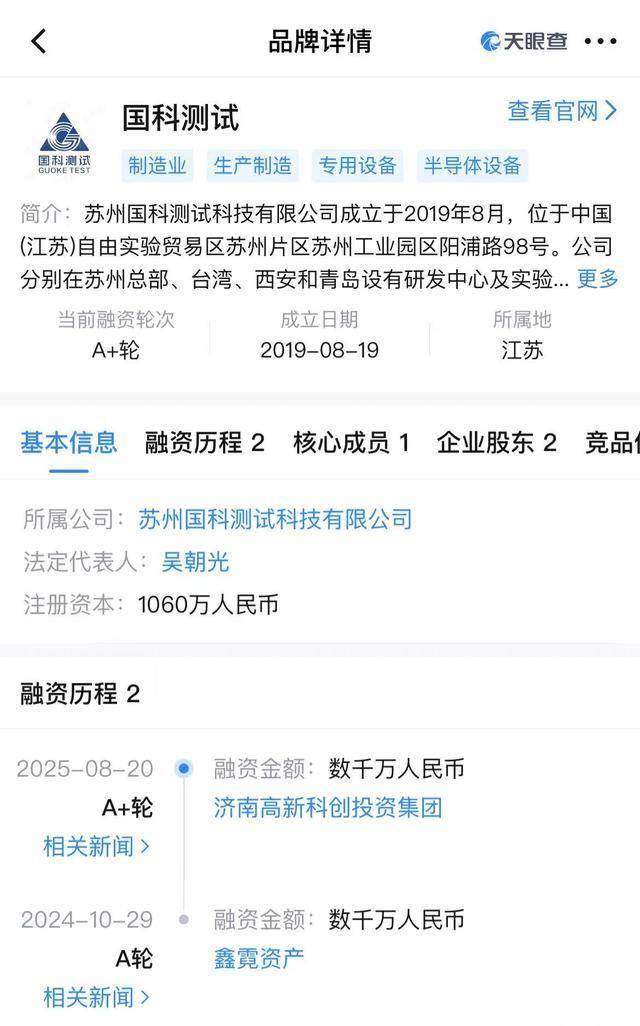
国科测试完成数千万元A+轮融资,加速半导体与新能源检测设备布局
Sou Hu Cai Jing· 2025-08-26 11:53
Group 1 - The core viewpoint of the news is that Suzhou Guoke Testing Technology Co., Ltd. has recently completed a significant A+ round financing, which was exclusively invested by Jinan High-tech Innovation Investment Group [1] - This financing follows the company's A round financing completed in October 2024, marking another important development in the capital market for Guoke Testing [1] - The funds raised in this round will primarily be used for the expansion of production lines for third-generation semiconductor and new energy testing equipment, as well as for the development of wafer-level testing equipment and the mass delivery of high-end flying probe testers [3] Group 2 - Guoke Testing was established on August 19, 2019, and is located in the Suzhou Industrial Park, Jiangsu Province, China [2] - The company focuses on the research and industrialization of testing equipment in the third-generation semiconductor and new energy fields, being the only domestic enterprise capable of testing packaging substrates, wafers, high-end soft boards, and camera modules [3] - In 2023, Guoke Testing established a wholly-owned subsidiary in Dongguan, Guangdong, to enter the new energy sector, primarily developing and producing equipment for capacity aging testing and machine vision detection required for new energy cell production [3]
洲明科技涨2.09%,成交额3.45亿元,主力资金净流入315.46万元
Xin Lang Zheng Quan· 2025-08-26 06:20
Company Overview - Zhouming Technology Co., Ltd. is headquartered in Shenzhen, China, and was established on October 26, 2004, with its IPO on June 22, 2011. The company specializes in the production and sale of LED displays, LED decorative lights, and LED lighting products, as well as providing landscape lighting engineering services [1][2]. Financial Performance - For the first half of 2025, Zhouming Technology achieved operating revenue of 3.658 billion yuan, representing a year-on-year growth of 7.38%. The net profit attributable to shareholders was 121 million yuan, reflecting a year-on-year increase of 20.61% [2]. - The company's stock price has increased by 25.17% year-to-date, with a 1.59% rise over the last five trading days, a 13.39% increase over the last 20 days, and a 23.70% increase over the last 60 days [1]. Shareholder Information - As of June 30, 2025, the number of shareholders for Zhouming Technology was 37,000, a decrease of 1.15% from the previous period. The average number of circulating shares per person increased by 1.17% to 23,973 shares [2]. - The company has distributed a total of 538 million yuan in dividends since its A-share listing, with 331 million yuan distributed over the past three years [3]. Market Activity - On August 26, 2023, Zhouming Technology's stock rose by 2.09%, reaching 8.30 yuan per share, with a trading volume of 345 million yuan and a turnover rate of 4.73%. The total market capitalization stood at 9.056 billion yuan [1]. - The net inflow of main funds was 3.1546 million yuan, with significant buying from large orders amounting to 84.2924 million yuan, while selling from large orders reached 105 million yuan [1]. Industry Position - Zhouming Technology operates within the electronic and optical optoelectronic LED industry and is associated with concepts such as smart lamp poles, Huawei concepts, the Internet of Things, third-generation semiconductors, and Huawei Harmony [2].

英伟达咽喉上的苏州女人
量子位· 2025-08-26 05:46
Core Viewpoint - The article highlights the remarkable rise of InnoScience, a Chinese company that has become a key player in the gallium nitride (GaN) semiconductor market, particularly as a supplier for NVIDIA, showcasing its rapid growth and innovative strategies in a traditionally dominated industry [1][2][3]. Group 1: Company Background and Growth - InnoScience started as a small workshop in Zhuhai, China, and has transformed into a major player in the semiconductor industry, attracting significant investments totaling 6 billion yuan over seven years [3][4]. - The company is set to go public on the Hong Kong Stock Exchange in December 2024, with a current market valuation of 72.268 billion HKD [4]. - InnoScience has achieved a remarkable growth trajectory, with revenue increasing from 68.22 million yuan in 2021 to 593 million yuan in 2023, establishing itself as the leading company in the global GaN power semiconductor market with a market share of 42.4% [31][34]. Group 2: Technological Innovations - The company adopted an Integrated Device Manufacturer (IDM) model, controlling the entire semiconductor production process from design to sales, which is crucial for maintaining pricing power [15][30]. - InnoScience focused on developing 8-inch wafer technology, which allows for more efficient cost distribution and better performance compared to the industry-standard 6-inch technology [17][19]. - The company became the first globally to achieve mass production of 8-inch silicon-based GaN wafers in under six years, a feat that typically takes over a decade [30]. Group 3: Market Position and Future Prospects - InnoScience's chips have penetrated over 100 niche markets, with a customer base expanding to 140, including major players like BYD and various tech giants [99][102]. - The demand for GaN semiconductors is surging, particularly in data centers, driven by the increasing power requirements of AI technologies, with the GaN market in data centers growing from less than 10 million yuan in 2019 to 70 million yuan in 2023 [64][66]. - The collaboration with NVIDIA is expected to scale up significantly as NVIDIA transitions to an 800V direct current power architecture by 2027, positioning InnoScience as a critical supplier in the AI era [39][66][67].

清溢光电上半年营收6.22亿元同比增10.90%,归母净利润9203.76万元同比增3.52%,净利率下降1.03个百分点
Xin Lang Cai Jing· 2025-08-25 14:07
Group 1 - The core viewpoint of the article is that Qingyi Optoelectronics has shown growth in revenue and net profit in the first half of 2025, indicating a positive performance despite some fluctuations in profit margins [1][2]. - The company's operating revenue for the first half of 2025 was 622 million yuan, a year-on-year increase of 10.90% [1]. - The net profit attributable to shareholders was 92.04 million yuan, reflecting a year-on-year growth of 3.52% [1]. Group 2 - The basic earnings per share for the reporting period was 0.29 yuan, with a weighted average return on equity of 4.79% [2]. - As of August 25, 2025, the company's price-to-earnings ratio (TTM) was approximately 60.33 times, and the price-to-book ratio (LF) was about 6.85 times [2]. - The gross profit margin for the first half of 2025 was 31.04%, an increase of 1.89 percentage points year-on-year, while the net profit margin was 14.82%, a decrease of 1.03 percentage points compared to the same period last year [2]. Group 3 - The company reported total expenses of 94.86 million yuan for the first half of 2025, an increase of 28.81 million yuan year-on-year, with an expense ratio of 15.25%, up 3.47 percentage points from the previous year [2]. - The number of shareholders decreased to 11,600 by the end of the first half of 2025, a decline of 251 shareholders or 2.12% from the previous quarter [2]. - The main business of Qingyi Optoelectronics includes the research, design, production, and sales of photomasks, with quartz photomasks accounting for 91.34% of revenue [3].
