
新发展格局

Search documents
冠通期货2025年8月宏观经济数据
Guan Tong Qi Huo· 2025-09-15 05:56
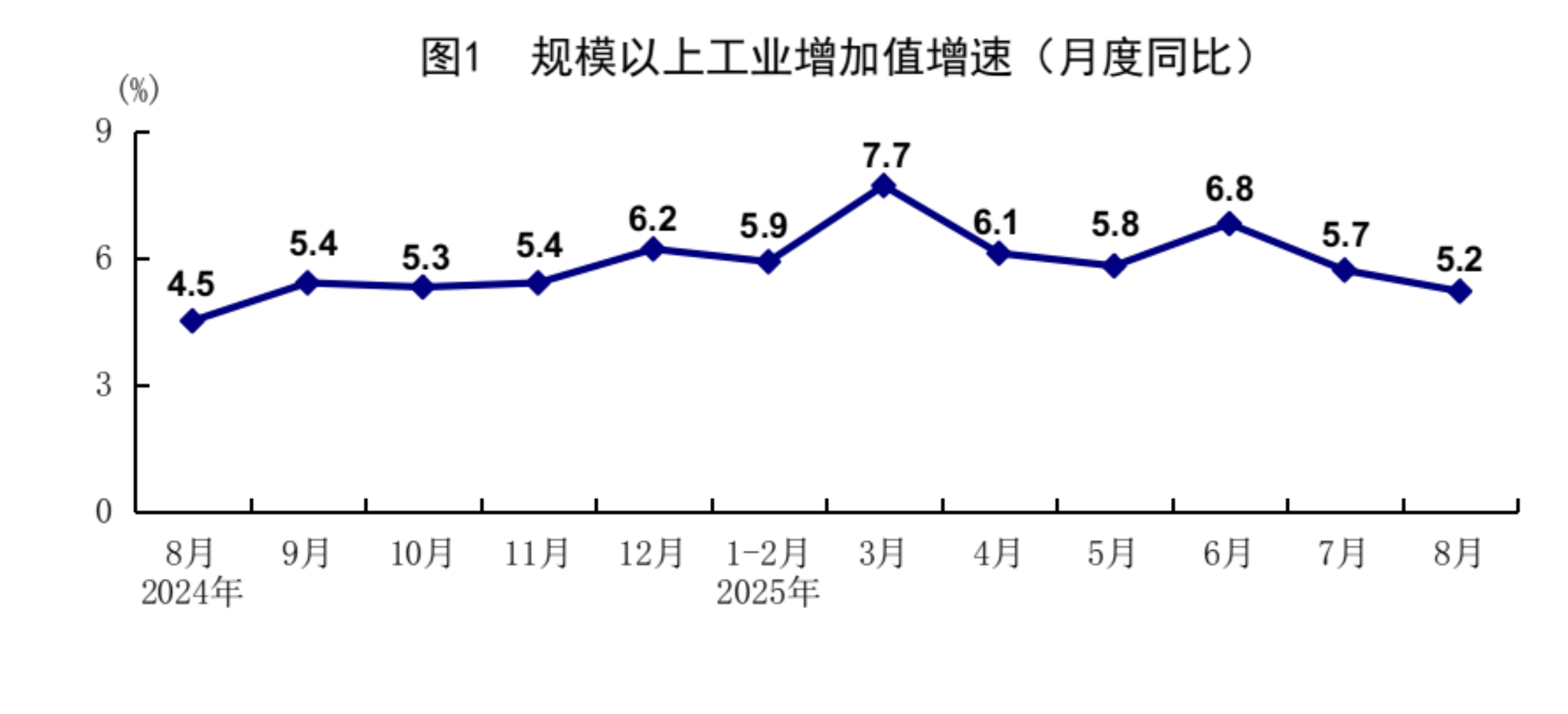
1. Report Industry Investment Rating No relevant content provided. 2. Core View of the Report In August 2025, under the strong leadership of the Party Central Committee with Comrade Xi Jinping as the core, the national economy maintained a generally stable and progressive development trend. Production and demand were basically stable, employment and prices were generally stable, and new driving forces were cultivated and strengthened [3]. 3. Summary by Relevant Catalogs Industry - In August, the added value of industrial enterprises above designated size increased by 5.2% year - on - year and 0.37% month - on - month. The added value of the mining industry, manufacturing, and the production and supply of electricity, heat, gas, and water increased by 5.1%, 5.7%, and 2.4% year - on - year respectively. The added value of the equipment manufacturing industry and high - tech manufacturing industry increased by 8.1% and 9.3% year - on - year respectively, faster than the overall industrial added value [3]. - From January to August, the added value of industrial enterprises above designated size increased by 6.2% year - on - year. In August, the manufacturing purchasing managers' index was 49.4%, up 0.1 percentage points from the previous month; the enterprise production and operation activity expectation index was 53.7%, up 1.1 percentage points [3]. - From January to July, the total profit of industrial enterprises above designated size was 40204 billion yuan, a year - on - year decrease of 1.7% [3]. Services - In August, the national service industry production index increased by 5.6% year - on - year. The production indexes of information transmission, software and information technology services, finance, and leasing and business services increased by 12.1%, 9.2%, and 7.4% year - on - year respectively, faster than the service industry production index [4]. - From January to August, the national service industry production index increased by 5.9% year - on - year. From January to July, the operating income of service enterprises above designated size increased by 7.4% year - on - year [4]. - In August, the service industry business activity index was 50.5%, up 0.5 percentage points from the previous month; the service industry business activity expectation index was 57.0%, up 0.4 percentage points. Some industries were in the high - level boom range [4]. Consumption - In August, the total retail sales of consumer goods were 39668 billion yuan, a year - on - year increase of 3.4% and a month - on - month increase of 0.17%. The retail sales of urban and rural consumer goods increased by 3.2% and 4.6% year - on - year respectively. The retail sales of goods and catering revenue increased by 3.6% and 2.1% respectively [5]. - From January to August, the total retail sales of consumer goods were 323906 billion yuan, a year - on - year increase of 4.6%. The national online retail sales were 99828 billion yuan, a year - on - year increase of 9.6%. The online retail sales of physical goods were 80964 billion yuan, a year - on - year increase of 6.4%, accounting for 25.0% of the total retail sales of consumer goods [5]. - From January to August, the service retail sales increased by 5.1% year - on - year, with relatively fast growth in cultural and sports leisure services, tourism consulting and leasing services, and transportation services [5]. Investment - From January to August, the national fixed - asset investment (excluding rural households) was 326111 billion yuan, a year - on - year increase of 0.5%. Excluding real estate development investment, it increased by 4.2%. Infrastructure investment increased by 2.0%, manufacturing investment increased by 5.1%, and real estate development investment decreased by 12.9% [6]. - The sales area of newly built commercial housing was 57304 million square meters, a year - on - year decrease of 4.7%; the sales volume was 55015 billion yuan, a year - on - year decrease of 7.3% [6]. - In August, fixed - asset investment (excluding rural households) decreased by 0.20% month - on - month [6]. Import and Export - In August, the total volume of goods imports and exports was 38744 billion yuan, a year - on - year increase of 3.5%. Exports were 23035 billion yuan, an increase of 4.8%; imports were 15709 billion yuan, an increase of 1.7% [7]. - From January to August, the total volume of goods imports and exports was 295696 billion yuan, a year - on - year increase of 3.5%. Exports were 176056 billion yuan, an increase of 6.9%; imports were 119640 billion yuan, a decrease of 1.2% [7]. - From January to August, general trade imports and exports increased by 2.2%, accounting for 63.9% of the total import and export volume. Imports and exports to countries along the Belt and Road increased by 5.4%. Private enterprise imports and exports increased by 7.4%, accounting for 57.1% of the total import and export volume, 2.1 percentage points higher than the previous year [7]. Price - In August, the national consumer price index (CPI) decreased by 0.4% year - on - year and remained flat month - on - month. The core CPI excluding food and energy prices increased by 0.9% year - on - year, with the growth rate expanding by 0.1 percentage points from the previous month [8]. - From January to August, the national consumer price index decreased by 0.1% year - on - year [8]. - In August, the ex - factory price of industrial producers decreased by 2.9% year - on - year, with the decline narrowing by 0.7 percentage points, and remained flat month - on - month; the purchase price of industrial producers decreased by 4.0% year - on - year, with the decline narrowing by 0.5 percentage points, and remained flat month - on - month [8]. Employment - From January to August, the average urban surveyed unemployment rate nationwide was 5.2%. In August, the urban surveyed unemployment rate was 5.3%, up 0.1 percentage points from the previous month, the same as the same month of the previous year [8]. - The surveyed unemployment rate of local household registration labor force was 5.4%; the surveyed unemployment rate of non - local household registration labor force was 5.0%, among which the surveyed unemployment rate of non - local agricultural household registration labor force was 4.7% [8]. - The surveyed unemployment rate in 31 large - scale cities was 5.3%, up 0.1 percentage points from the previous month and down 0.1 percentage points from the same month of the previous year. The average weekly working hours of enterprise employees nationwide were 48.5 hours [8].
奋进的中国 我们的“十四五”|瞰见“五色吉林” 白山松水间铺展新答卷
Yang Shi Wang· 2025-09-15 03:58
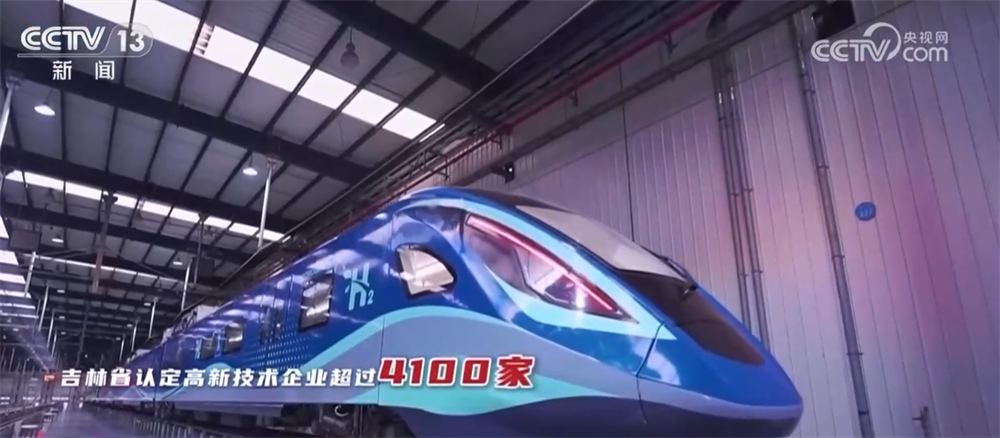
Core Viewpoint - The article highlights the significant development and transformation of Jilin province under the guidance of Xi Jinping, emphasizing high-quality development and integration into the new development pattern of China [1] Group 1: Economic Development - Jilin has embraced high-quality development during the 14th Five-Year Plan, focusing on innovation and practical efforts to enhance its role in national security [1] - The province has transformed from an industrial base to an innovation hub, with advancements such as the "Jilin-1" satellite and hydrogen-powered trains [2] - Jilin's cross-border e-commerce initiatives have strengthened its position in the Belt and Road Initiative, particularly through the Hunchun port [2] Group 2: Agricultural Achievements - Jilin has consistently produced over 800 billion jin of grain, contributing significantly to China's food security [4] - The implementation of the "Black Land Protection Regulations" has helped convert saline-alkali land into productive agricultural areas, supporting rural revitalization [4] Group 3: Tourism and Winter Economy - The province boasts 68 ski resorts, promoting a "white economy" and hosting events like the Changchun Vasa competition, which celebrates its 23rd year [9] - Jilin has successfully transformed its cold resources into vibrant industries, enhancing its appeal as a winter tourism destination [9] Group 4: Environmental Initiatives - Jilin is home to the Northeast Tiger and Leopard National Park, showcasing its commitment to wildlife conservation [12] - The province has developed a green energy landscape with wind and solar power projects, connecting various national parks and nature reserves [12] Group 5: Cultural Heritage - Jilin emphasizes its red heritage, fostering a sense of national unity and pride through its historical narratives and cultural identity [15] - The province's rich history and cultural legacy contribute to its overall development strategy, reinforcing its social fabric [15] Group 6: Overall Progress - The article concludes that Jilin is showcasing its vibrant development and steadfast progress to the world, reflecting the dynamic changes in the region [17]

国家统计局:8月规模以上工业增加值同比增长5.2% 消费品零售总额增长3.4%
Guo Jia Tong Ji Ju· 2025-09-15 02:19
Economic Overview - In August, under the strong leadership of the Central Committee, the national economy maintained overall stability with a steady development trend, supported by macro policy adjustments and the promotion of a unified national market [1][9]. Industrial Production - In August, the industrial added value of large-scale enterprises increased by 5.2% year-on-year and 0.37% month-on-month. The mining industry grew by 5.1%, manufacturing by 5.7%, and electricity, heat, gas, and water production and supply by 2.4% [2][18]. - The equipment manufacturing industry saw an 8.1% increase, while high-tech manufacturing grew by 9.3%, outperforming the overall industrial growth by 2.9 and 4.1 percentage points respectively [2][18]. - From January to August, the industrial added value increased by 6.2% year-on-year [2][18]. Service Sector - The service production index rose by 5.6% year-on-year in August, with significant growth in information transmission, software, and IT services (12.1%), finance (9.2%), and leasing and business services (7.4%) [3][18]. - For the first eight months, the service production index increased by 5.9% year-on-year [3][18]. Retail Sales - In August, the total retail sales of consumer goods reached 39,668 billion yuan, a year-on-year increase of 3.4% [4][18]. - Online retail sales amounted to 99,828 billion yuan, growing by 9.6% year-on-year, with physical goods online retail sales at 80,964 billion yuan, a 6.4% increase [4][18]. Fixed Asset Investment - From January to August, fixed asset investment (excluding rural households) totaled 326,111 billion yuan, a year-on-year increase of 0.5% [5][18]. - Manufacturing investment grew by 5.1%, while real estate development investment fell by 12.9% [5][18]. Trade and Exports - In August, the total value of goods imports and exports reached 38,744 billion yuan, a year-on-year increase of 3.5%, with exports at 23,035 billion yuan (up 4.8%) and imports at 15,709 billion yuan (up 1.7%) [6][18]. - From January to August, the total value of goods imports and exports was 295,696 billion yuan, also a 3.5% increase year-on-year [6][18]. Employment - The urban surveyed unemployment rate in August was 5.3%, a slight increase of 0.1 percentage points from the previous month [7][18]. - The average working hours for employed persons were 48.5 hours per week [7][18]. Price Trends - In August, the Consumer Price Index (CPI) decreased by 0.4% year-on-year, with food prices down by 2.5% [8][18]. - The Producer Price Index (PPI) for industrial producers fell by 2.9% year-on-year, with the decline narrowing by 0.7 percentage points from the previous month [8][18].
8月份国民经济运行总体平稳、稳中有进
Guo Jia Tong Ji Ju· 2025-09-15 02:01
Economic Overview - In August, the national economy maintained overall stability with a steady growth trend, supported by strong leadership and effective macroeconomic policies [2][10] - The industrial production showed a year-on-year increase of 5.2% in August, with a month-on-month growth of 0.37% [3][18] - The service sector's production index grew by 5.6% year-on-year in August, indicating a positive trend in modern service industries [4][18] Industrial Production - The industrial value-added for large-scale enterprises increased by 6.2% from January to August, with manufacturing and high-tech manufacturing sectors growing by 5.7% and 9.3% respectively [3][18] - Notable product growth included 3D printing equipment (40.4%), new energy vehicles (22.7%), and industrial robots (14.4%) [3][18] Service Sector - The service industry saw a production index increase of 5.9% from January to August, with significant growth in information transmission, software, and financial services [4][18] - The business activity index for the service sector was at 50.5 in August, indicating expansion [4][18] Retail Sales - The total retail sales of consumer goods reached 39,668 billion yuan in August, a year-on-year increase of 3.4% [5][18] - Online retail sales amounted to 99,828 billion yuan from January to August, growing by 9.6% year-on-year [5][18] Fixed Asset Investment - Fixed asset investment (excluding rural households) was 326,111 billion yuan from January to August, with a year-on-year growth of 0.5% [6][18] - Manufacturing investment increased by 5.1%, while real estate development investment saw a decline of 12.9% [6][18] Trade and Exports - The total value of goods imports and exports reached 38,744 billion yuan in August, with exports growing by 4.8% [7][18] - From January to August, the total trade value was 295,696 billion yuan, reflecting a year-on-year increase of 3.5% [7][18] Employment - The urban surveyed unemployment rate was 5.3% in August, showing a slight increase from the previous month [8][18] - The average working hours for employees were reported at 48.5 hours per week [8][18] Price Trends - The Consumer Price Index (CPI) decreased by 0.4% year-on-year in August, with food prices dropping by 2.5% [9][19] - The Producer Price Index (PPI) for industrial producers fell by 2.9% year-on-year, indicating a narrowing decline [9][19]
怀柔区“开放共享 链接国际”合作交流会亮相服贸会
Sou Hu Cai Jing· 2025-09-14 07:50
Core Viewpoint - The event held in Huairou District focuses on enhancing international cooperation and promoting high-quality development through strategic partnerships and technological innovation [1][3][4] Group 1: International Cooperation - The Huairou International Chamber of Commerce aims to support local enterprises in their internationalization efforts by providing policy consultation and business matching services [3] - A strategic cooperation agreement was signed between the China International Chamber of Commerce and the Huairou District People's Government to deepen collaboration in international exchange, investment promotion, and publicity [3] Group 2: Technological Innovation - Huairou Science City has established 37 technology facilities and is focused on accelerating the transformation of scientific achievements into productive forces [4] - The district is implementing an "1+N" innovation policy system and has developed over 10 specialized parks and 46 innovation platforms to enhance its global innovation influence [4] Group 3: Industry Development - Five collaborative projects in key industries such as traditional Chinese medicine modernization, high-end precision manufacturing, and new materials testing have been signed to boost industrial development in Huairou [3]

时代专论丨以中国式现代化全面推进强国建设民族复兴伟业的科学行动指南
Zhong Yang Ji Wei Guo Jia Jian Wei Wang Zhan· 2025-09-11 00:32
Group 1 - The publication of the fifth volume of "Xi Jinping on Governance" marks a significant moment in the context of China's planning for modernization and national rejuvenation, reflecting the leadership of the Communist Party of China (CPC) [1][2][3] - The core theme of the CPC's century-long struggle is the construction of a modern socialist state and the realization of the great rejuvenation of the Chinese nation, which is emphasized throughout the volumes [2][3] - The fifth volume emphasizes the importance of economic development as the foundation for achieving the "Two Centenary Goals" and highlights the CPC's leadership in navigating complex domestic and international challenges [3][4] Group 2 - The volumes collectively showcase the progress in establishing a socialist democracy that is institutionalized, standardized, and procedural, reinforcing the CPC's leadership and the importance of people's democracy [4][5] - The focus on cultural construction and ideological work is highlighted, with an emphasis on the role of Marxism in guiding the ideological landscape and promoting traditional Chinese culture [5][6] - The volumes stress the importance of improving the people's sense of gain, happiness, and security, with a focus on social construction and poverty alleviation efforts [6][7] Group 3 - The historical changes in ecological protection are underscored, with a commitment to integrating ecological civilization into the modernization process and promoting harmonious coexistence between humans and nature [7][8] - The need for theoretical innovation is emphasized, particularly in the context of Marxism's adaptation to contemporary Chinese realities, guiding the modernization process [8][9] - The volumes outline the strategic decision to construct a new development pattern that prioritizes domestic circulation while promoting international cooperation [10][11] Group 4 - The shift towards high-quality development is identified as a primary task for the CPC, with a focus on meeting the people's growing needs and ensuring sustainable economic growth [11][12] - The concept of new productive forces is introduced, emphasizing innovation and quality as key components of China's economic transformation [12][13] - The commitment to building a community with a shared future for mankind is highlighted, showcasing China's role in global governance and international cooperation [14][15] Group 5 - The importance of the CPC's leadership in the modernization process is reiterated, with a focus on self-revolution as a means to strengthen the party and ensure effective governance [17][18] - The challenges faced by the CPC as a large ruling party are acknowledged, emphasizing the need for continuous self-improvement and adherence to strict party governance [19][20] - The call for a comprehensive approach to self-revolution is presented, outlining strategic and practical requirements for advancing the party's mission in the new era [21]
全国人大常委会26份调研报告为“十五五”规划纲要编制献策
Xin Hua Cai Jing· 2025-09-10 09:28
Core Viewpoint - The report presented at the 17th meeting of the 14th National People's Congress Standing Committee emphasizes the importance of equalizing basic public services, implementing "AI+" initiatives, and upgrading cultural and tourism consumption as part of the preparation for the 14th Five-Year Plan [1] Group 1: Research and Planning - The report highlights the active participation of 10 specialized committees and 4 working committees in conducting research and gathering opinions for the 14th Five-Year Plan [1] - A total of 26 specialized research reports were produced, covering various fields such as economy, politics, culture, society, and ecology [1] - Suggestions for the 14th Five-Year Plan include recognizing the internal and external environment, promoting technological and industrial innovation, and expanding domestic demand [1] Group 2: Legislative and Development Focus - The report stresses the need for legislation in key, emerging, and foreign-related fields to provide strong legal support for economic and social development during the 14th Five-Year period [1] - The next steps involve the Central Committee proposing recommendations for the economic and social development plan, with the State Council drafting the plan based on these recommendations [1] - The draft of the 14th Five-Year Plan will be reviewed and approved at the fourth meeting of the 14th National People's Congress next year [1]
广东省党政代表团赴新疆喀什考察对接对口援疆工作立足新起点更高质量做好援疆工作携手开创两省区现代化建设新局面黄坤明陈小江艾尔肯·吐尼亚孜何忠友参加有关活动
Nan Fang Ri Bao Wang Luo Ban· 2025-09-07 01:03
Group 1 - The Guangdong provincial party and government delegation visited the Xinjiang Uygur Autonomous Region to implement Xi Jinping's important speeches and directives regarding Xinjiang work and counterpart support work [1][2] - The delegation conducted on-site inspections of various projects in Kashgar, including vocational training institutions and logistics parks, to assess the progress of high-quality development and modernization efforts [1][2] - The meeting highlighted the importance of deepening understanding of the new era's governance strategies for Xinjiang and emphasized the need for Guangdong to enhance its support for Xinjiang's development [2][3] Group 2 - The Xinjiang regional leaders expressed gratitude for Guangdong's assistance and highlighted the political advantages of the Party's leadership in supporting Xinjiang's development [3] - The meeting discussed the "1310" initiative by Guangdong, which aims to achieve significant breakthroughs in various sectors while promoting modernized development [3] - The focus was placed on enhancing cooperation between Guangdong and Xinjiang, particularly in industry collaboration and resource sharing to boost economic growth [3][4]
省委理论学习中心组学习会议强调传承和弘扬伟大抗战精神 奋力谱写中国式现代化建设的陕西新篇章
Shan Xi Ri Bao· 2025-09-06 00:28
Core Points - The meeting emphasized the importance of learning from Xi Jinping's significant speech commemorating the 80th anniversary of the victory in the Chinese People's Anti-Japanese War and the World Anti-Fascist War, highlighting the historical significance and contributions of this victory [1][2] - The meeting called for the inheritance and promotion of the great spirit of the Anti-Japanese War, urging a commitment to modernize and develop Shaanxi in line with Chinese-style modernization [2] Summary by Sections - **Historical Context**: The Chinese People's Anti-Japanese War marked the first complete victory against foreign invasion in modern times and is a crucial part of the World Anti-Fascist War [1] - **Leadership and Ideology**: The meeting underscored the necessity of upholding the leadership of the Communist Party and integrating Xi Jinping's thoughts into practice to unify thoughts, will, and actions [2] - **Development Goals**: There is a focus on high-quality development and modernization, with an emphasis on understanding the role of the people as a powerful force and addressing their concerns [2] - **Strategic Mission**: The meeting highlighted the importance of aligning with the strategic mission assigned to Shaanxi by the central government and implementing new development concepts [2]
习近平经济思想对唯物辩证法的创造性运用
Jing Ji Ri Bao· 2025-09-05 01:02
Core Viewpoint - Xi Jinping's economic thought creatively applies dialectical materialism to various aspects of economic work, emphasizing the importance of understanding and addressing both opportunities and challenges in the current domestic and international landscape [1][2][3]. Group 1: Understanding Domestic and International Trends - The new development stage presents both opportunities and challenges, requiring a dialectical understanding of the evolving domestic and international environment [3][4]. - Xi Jinping's economic thought introduces key concepts such as new normal, new development philosophy, and new development pattern to guide high-quality development [4][5]. Group 2: Methodological Framework - The principle of "seeking progress while maintaining stability" serves as a methodological guide for economic work, emphasizing the need to balance stability and progress [5][6]. - A systematic approach is essential for addressing complex economic issues, requiring coordination across various sectors and levels [6][8]. Group 3: Problem-Oriented Approach - A problem-oriented approach is a hallmark of Xi Jinping's economic thought, focusing on identifying and addressing pressing economic issues [9][10]. - This approach encourages innovation and practical solutions to enhance economic development [10][11]. Group 4: Concentrating on Internal Affairs - Emphasizing the importance of focusing on internal strengths, Xi Jinping's thought advocates for addressing challenges through self-reliance and strategic planning [11][12]. - The approach aims to ensure that external pressures do not hinder national development [12][13]. Group 5: Implementation and Practicality - The "nail-driving spirit" highlights the importance of practical implementation in economic work, ensuring that strategies are effectively executed [13][14]. - Continuous efforts are necessary to translate theoretical insights into actionable practices [14][15]. Group 6: Balancing Key Relationships - Xi Jinping's economic thought emphasizes the need to balance various critical relationships, such as market and government roles, supply and demand dynamics, and efficiency versus equity [19][20]. - These relationships are crucial for achieving sustainable economic growth and addressing systemic challenges [20][21].