算力

Search documents
胜宏科技(300476) - 300476胜宏科技投资者关系管理信息20260123
2026-01-23 14:22
Group 1: Investor Relations Activities - The company conducted an investor relations activity on January 23, 2026, with 53 institutional investors participating [1] - Activities included a company tour, production workshop visit, and a presentation on the company's development [1][2] Group 2: Company Performance and Strategy - The company aims to embrace AI and enhance its technological leadership in the global PCB manufacturing sector [1][3] - High-end products have significantly increased in proportion, driving rapid growth in company performance [3] Group 3: Production Capacity and Expansion - The company maintains a good order backlog and production capacity utilization, with ongoing expansion efforts [3][4] - Domestic production facilities in Huizhou are gradually being put into operation, while overseas facilities in Thailand and Vietnam are progressing as planned [3][4] Group 4: Product Development and Market Position - The company has achieved mass production capabilities for high-precision circuit boards and is advancing in the development of next-generation AI server products [3][4] - The company is actively involved in the research and development of new technologies and materials, collaborating closely with major clients [4] Group 5: Raw Material Supply and Pricing - The company has established stable relationships with key raw material suppliers, ensuring a steady supply [4] - Strategies are in place to mitigate the impact of raw material price fluctuations on product pricing [4] Group 6: Hong Kong Listing Progress - The company is in the process of issuing H shares and has submitted the application to the Hong Kong Stock Exchange [5] - The listing is subject to approval from regulatory authorities and market conditions, with ongoing updates to be provided [5]

看涨率三连涨
第一财经· 2026-01-23 13:42
2026.01. 23 ▲ 0.33% ▲ 0.79% ▲ 0.63% A股三大指数震荡走高,集体收涨。上证指数全天窄幅震荡,银行、保险等金融权重板块表现 疲软对指数形成压制,深证成指领涨市场,中小盘成长股成为推动力,创业板指技术面修复, 光伏设备、机器人等板块贡献主要涨幅。 $$3938\gtrapprox L{\mathrm{Mk}}$$ 13895 涨跌停比 市场呈现普涨态势,做多热情高涨。光伏产业链 全线爆发,商业航天概念股再度大涨,基本金属 板块掀涨停潮,半导体、算力等前期高位题材出 现获利了结,部分个股调整较大. 保险、银行等 权重板块表现相对平淡。 两市成交额 . 09 万亿元 ▲ 14.6% 两市成交额放量,市场活跃度进一步上升。深市 成交额及其增幅均高于沪市,光伏设备、商业航 天、基本金属等热点板块全天强势,AI应用、机 器人等题材也表现活跃,这些板块的炒作和轮 动带来了大量交易,是推高整体成交额的重要 动力。 资金情绪 主力资金净流出 散户情绪 散户资金净流入 极调仓,向政策确定性行业集中,资金从半导体、通信设备等领域出逃,流入光伏设备、能源金属。 散户积极入场,交易行为偏重题材和短期热点 ...


通信行业2026年度投资策略:聚焦AI:算力降本向光而行,应用落地网络先行
Guolian Minsheng Securities· 2026-01-23 12:20
Group 1 - The core viewpoint of the report emphasizes that the demand for AI computing power will continue to grow and diversify in 2026, extending from data centers to network edges and even internal terminals [8][13][27] - The report highlights the significant capital expenditure (Capex) growth driven by business revenue, with major cloud service providers like Google, Microsoft, and Amazon showing consistent revenue growth exceeding 20% year-on-year [27][31][35] - The report identifies the increasing importance of silicon photonics technology, particularly the 1.6T optical module, which is expected to maintain accelerated growth and enhance the global market share of domestic optical chips and devices [7][54][70] Group 2 - The report discusses the emergence of new technologies such as Scale-UP supernodes and their impact on optical link demand, indicating that these technologies will drive additional link requirements in 2026 [7][9][66] - It notes that the AI infrastructure is experiencing a high level of prosperity, with significant investments in data centers and AI capabilities expected to continue, particularly in the U.S. [47][49][53] - The report anticipates that the integration of silicon photonics will significantly increase its market penetration, projecting that by 2026, over half of optical module sales will come from silicon photonics solutions [70][75]


受益于算力需求大增 PCB上市公司业绩普遍预喜
Zheng Quan Shi Bao Wang· 2026-01-23 11:33
Core Viewpoint - The PCB industry is experiencing significant growth driven by the demand for AI computing infrastructure and the upgrade of consumer electronics, leading to positive earnings forecasts for related listed companies [1][4]. Company Summaries - **昊志机电 (Haozhi Electromechanical)**: The company expects a net profit of 128 million to 165 million yuan for 2025, representing a year-on-year increase of 54.4% to 99.03%. The growth is attributed to increased demand in the PCB market driven by AI computing infrastructure and consumer electronics upgrades, as well as accelerated domestic substitution and technological innovation [1]. - **胜宏科技 (Shenghong Technology)**: The company forecasts a net profit of 4.16 billion to 4.56 billion yuan for 2025, with a year-on-year growth of 260.35% to 295%. The growth is driven by the expansion of AI infrastructure and data center upgrades, with a focus on high-end products and global service capabilities [2][3]. - **金安国纪 (Jin'an Guoji)**: The company anticipates a net profit of 28 million to 36 million yuan for 2025, reflecting a year-on-year increase of 655% to 871%. The growth is due to improved market conditions for copper-clad laminates and increased sales volume and prices [3]. - **东威科技 (Dongwei Technology)**: The company expects its net profit to double in 2025, benefiting from the investment boom in Southeast Asia and the rapid development of AI and computing sectors [3]. Industry Insights - The rapid development of AI applications has significantly boosted the demand for high-end printed circuit boards (PCBs), pushing the industry into a high prosperity cycle. New fields such as AI servers and smart driving require higher standards for PCB layers, precision, and reliability, leading to increased demand for high-density interconnect (HDI) and multi-layer boards [4]. - According to Prismark, the global PCB market is projected to grow by approximately 5.8% in 2024 and 6.8% in 2025, with a compound annual growth rate of about 5.2% expected until 2029. The AI server-related HDI segment is predicted to grow at an average annual rate of 16.3% from 2023 to 2028, making it the fastest-growing category in the PCB market [5].


持续看好人工智能的投资机会,关注通信ETF(515880)、软件ETF(515230)
Mei Ri Jing Ji Xin Wen· 2026-01-23 11:08
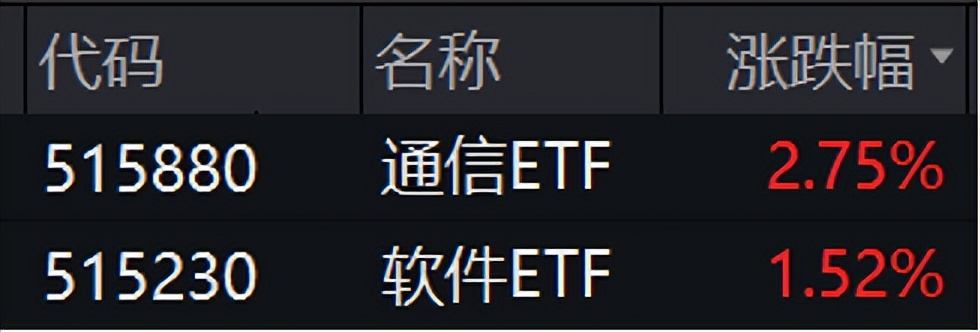
Group 1 - The communication ETF and software ETF showed recovery, with the communication ETF rising by 2.75% and the software ETF increasing by 1.52% after a significant decline [1] - NVIDIA's CEO Jensen Huang plans to visit China in January, focusing on key suppliers, highlighting the ongoing growth in the AI hardware sector, which has been thriving for over three years [3] - The market for optical modules is expected to double by 2026, with projections for 800G optical module shipments reaching 5-7 million units and 1.6T optical module shipments at 2.5-3 million units [3] Group 2 - Despite the booming hardware sector, the commercialization of AI software remains underdeveloped, with few companies achieving profitability in this area [3] - Alibaba announced a major update to its Qianwen app, transforming it into a digital assistant capable of executing tasks and connecting to real services, indicating a trend towards enhanced software capabilities [4] - The upcoming earnings disclosure period for overseas CSPs may lead to unexpected positive performance in the software sector, suggesting continued investment opportunities in AI [4]
沐曦施淑珏:国产GPU商业化加速 软硬协同跨越“好用”门槛
2 1 Shi Ji Jing Ji Bao Dao· 2026-01-23 10:55
Core Insights - The rise of domestic GPU companies is highlighted by the recent IPOs of Moer Thread and Muxi Co., which have intensified market interest in domestic GPUs amid the global AI boom and exponential growth in computing power demand [2][3] Group 1: Market Position and Valuation - The Hurun Research Institute's "2025 Hurun China AI Enterprises Top 50" ranks Cambricon, Moer Thread, and Muxi Co. as the top three AI companies, with Cambricon valued at 630 billion yuan, Moer Thread at 310 billion yuan, and Muxi Co. at 250 billion yuan [2] - Cambricon achieved a revenue of 2.88 billion yuan in the first half of 2025, a staggering 4300% increase year-on-year, while Moer Thread reported a revenue of 780 million yuan in the first three quarters of 2025, up 182% year-on-year [2] Group 2: Industry Trends and Future Outlook - The demand for computing power is expected to double every 3.5 months, with annual growth rates of 500% to 1000%, indicating a strong market outlook for companies like Muxi, Moer, and Cambricon [3] - Muxi Co. is focusing on commercializing its products and has developed a complete self-research technology system from hardware architecture to software stack, enabling a full-stack GPU product matrix [4] Group 3: Commercialization and Product Development - Muxi Co. emphasizes the importance of transitioning from "usable" to "user-friendly" GPUs, assessing performance based on multiple dimensions such as generality, usability, stability, and scalability [4] - The company is one of the few domestic GPU suppliers to achieve large-scale commercial applications with thousands of GPU clusters and is working on the deployment of tens of thousands of GPU clusters [5] Group 4: Strategic Initiatives - Muxi Co. has proposed a "1+6+X" industry layout strategy, targeting six vertical industries including finance, healthcare, energy, education, transportation, and entertainment, while also exploring cutting-edge areas like embodied intelligence and low-altitude economy [7] - The company aims to deepen industrialization and commercialization, with plans for the next-generation C600 product to enter mass production, achieving a closed loop in the domestic supply chain [7][8] Group 5: Ecosystem Development - Muxi Co. is building an open-source ecosystem, with its MXMACA software stack being compatible with mainstream ecosystems, allowing AI applications to migrate to its platform with minimal cost [8] - The MXMACA software stack has over 150,000 users, and the company collaborates with universities to reach over 100,000 students through various activities and courses [8]
沐曦施淑珏:国产GPU商业化加速,软硬协同跨越“好用”门槛
2 1 Shi Ji Jing Ji Bao Dao· 2026-01-23 10:35
Core Insights - The rise of domestic GPU companies is highlighted by the recent listing of companies like Moer Technology and Muxi Co., which has intensified market interest in domestic GPUs [1] - The Hurun Research Institute's report ranks Cambricon, Moer Technology, and Muxi Co. as the top three AI companies in China based on their valuations, with Cambricon valued at 630 billion yuan, Moer Technology at 310 billion yuan, and Muxi Co. at 250 billion yuan [1] - Muxi Co. emphasizes the importance of transitioning from "usable" to "user-friendly" GPUs, focusing on performance in real AI application scenarios [5] Company Valuation and Market Trends - The valuation of domestic GPU companies reflects optimism about their long-term growth potential, with the global AI application output per capita estimated at $20-30 per month and computing power demand doubling every 3.5 months [2] - Muxi Co. is one of the few domestic GPU suppliers achieving large-scale commercial applications with thousands of GPU clusters, indicating strong engineering capabilities in chip design [6] Product Development and Ecosystem - Muxi Co. has developed a complete self-research technology system from hardware architecture to software stack, enabling a full-stack GPU product matrix [3] - The company aims to build an open-source ecosystem, with its MXMACA software stack being compatible with mainstream ecosystems, allowing for easy migration of AI applications [8] Strategic Industry Layout - Muxi Co. has proposed a "1+6+X" industry layout strategy, targeting six vertical industries including finance, healthcare, energy, education, transportation, and entertainment, along with emerging fields like embodied intelligence [7] - The company plans to deepen its industrialization and commercialization efforts, with its next-generation product C600 entering mass production, achieving a closed-loop domestic supply chain [7]

算力告急!“缺口”风暴下,国产AI芯片如何突围
Xin Lang Cai Jing· 2026-01-23 10:27
Core Insights - The announcement from Beijing Zhiyuan Huazhang Technology Co., Ltd. highlights a significant increase in user demand for AI models, leading to a temporary strain on computing resources, reflecting a broader trend in the AI industry [1] - The AI chip market in China is projected to exceed 1 trillion yuan by 2028, accounting for approximately 30% of the global market, emphasizing the need for high-quality, domestically controlled AI computing power to seize opportunities in the AI sector [1] Group 1: Current State of Computing Power - There is a pronounced supply-demand imbalance in computing power, particularly in China, which is more evident than in the global context [3] - Foreign companies dominate the global AI computing power market, holding nearly 70% of the market share in China by 2024, creating a substantial self-sufficiency gap for domestic production [4] - The self-sufficiency rate of AI GPUs in China has increased from less than 10% in 2020 to approximately 34% in 2024, with expectations to reach around 82% by 2027 [4] Group 2: Causes of Supply-Demand Imbalance - The supply of computing resources in China faces multiple constraints, including limitations on high-end chip imports and performance gaps between domestic and international GPU products [5] - The fragmentation of computing resources among service providers leads to low utilization rates, exacerbating the supply-demand mismatch [5] - The rapid deployment of AI applications across various industries has resulted in over 13,000 projects and more than 30,000 smart factories, significantly increasing the demand for computing power [5] Group 3: Solutions to Computing Power Challenges - To address the computing power challenges, it is essential to maximize the potential of domestic computing resources and promote their application [6] - The Chinese government has been actively implementing policies to enhance computing power development, including optimizing infrastructure and improving service levels [6] - Collaboration among stakeholders in the computing power ecosystem is crucial for achieving deep integration of models, applications, and computing resources, which will enable China to gain a competitive edge in the global AI landscape [7]
“不务正业”,中国移动下场卖保险
Tai Mei Ti A P P· 2026-01-23 10:04
Core Insights - China Mobile officially enters the insurance market, leveraging its vast user base of nearly 1 billion and extensive offline channels to disrupt the competitive landscape of the insurance industry [1][10][14] Group 1: Strategic Entry into Insurance - The entry into insurance is a culmination of over 20 years of strategic positioning, starting with the establishment of a national insurance brokerage in 2001, which allowed China Mobile to navigate regulatory frameworks and sales processes effectively [1][2] - In 2016, China Mobile became the second-largest shareholder of China Merchants Renhe Life Insurance, marking a shift from simple channel cooperation to a deeper capital partnership aimed at creating synergistic effects between channels, capital, and products [2][10] - The launch of "Home Insurance" and "Medical Insurance" in early 2026 represents a significant step towards large-scale operations, with initial trials focused on local markets to assess product fit and user acceptance [2][3] Group 2: Product Offerings and Market Response - The "Medical Insurance" product addresses the common pain point of high medical costs, offering low entry barriers and comprehensive coverage, with annual premiums ranging from 199 to 699 yuan and a maximum coverage of 1.118 million yuan [4][10] - The "Home Insurance" product combines property and accident coverage with value-added services, offering flexible pricing from free to 199 yuan per month, with a maximum coverage of 1.442 million yuan [5][6] - Initial market feedback indicates that while the products are attracting attention due to their integration with communication services, there are concerns regarding limited coverage and unclear terms [3][4] Group 3: Financial Performance and Market Context - China Mobile's financial performance remains strong, with a revenue of 1,040.76 billion yuan in 2024, a year-on-year increase of 3.12%, and a net profit of 138.4 billion yuan, reflecting robust profitability and cash flow stability [7][10] - The overall telecom industry is experiencing a slowdown in revenue growth, prompting China Mobile to seek new profit avenues through insurance, which offers stable cash flow and long-term lifecycle benefits [10][12] - The shift towards insurance is seen as a strategic move to diversify revenue streams and alleviate pressure from traditional business segments, which are nearing saturation [10][12] Group 4: Competitive Landscape and Industry Dynamics - The competitive landscape among telecom operators is evolving, with China Unicom focusing on AI and partnerships, while China Telecom is retracting from the insurance sector, highlighting differing strategic responses to market pressures [3][8] - The insurance market in China is characterized by intense competition, with significant growth potential in health and property insurance, particularly in underserved markets [11][12] - China Mobile's strategy to leverage its extensive offline presence and user trust aims to enhance accessibility and integration of insurance services into everyday life, positioning it as a "hidden guardian" in consumers' daily activities [14]

美克家居现资金链危局?控股股东质押“爆表”股份遭冻结 跨界算力能否自救
Xin Lang Cai Jing· 2026-01-23 10:03
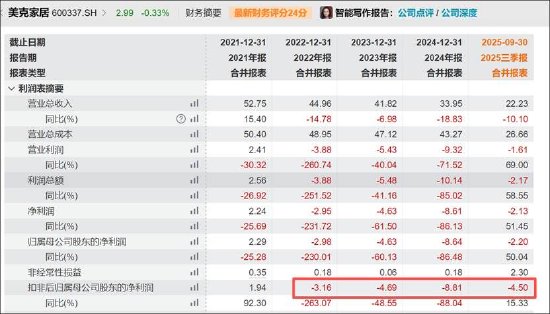
Core Viewpoint - Meike Home is facing a potential liquidity crisis due to significant short-term debt and ongoing operational losses, compounded by the freezing of shares held by its controlling shareholder and concerns over the quality of its recent acquisition target [1][15][10]. Financial Performance - The company has experienced continuous losses since 2021, with total revenue declining from 52.75 billion in 2021 to an estimated 22.23 billion in 2025, reflecting a year-on-year decrease of 10.10% [4][18]. - The net profit attributable to shareholders has also deteriorated, with a projected loss of 2.20 billion in 2025, following a trend of negative profits since 2021 [4][18]. Debt Situation - As of the third quarter of 2025, Meike Home's short-term borrowings exceeded 18 billion, while cash on hand was only 1.16 billion, indicating severe liquidity pressure [7][21]. - The controlling shareholder's shares have been fully pledged, raising concerns about potential margin calls and further financial instability [10][23]. Operational Challenges - The company has seen a significant reduction in its domestic retail operations, with the number of stores dropping from over 470 in 2022 to 327 in 2024, a decline of over 30% [5][19]. - Reports indicate that Meike Home has been delaying salary payments to over 400 employees and owes substantial amounts to suppliers, leading to collective employee actions [5][19]. Acquisition and Strategic Shift - Meike Home has announced plans to acquire 100% of Wande Technology, a company specializing in high-speed copper cables, as part of a strategic shift towards the computing power sector [9][25]. - The financial performance of Wande Technology shows modest revenue growth, with 2023 revenue at 45.98 million and a net profit of 3.98 million, raising questions about the acquisition's potential to enhance Meike Home's profitability [12][26]. Market Reaction - Following the announcement of the acquisition, Meike Home's stock experienced significant volatility, with a near 50% increase followed by a sharp decline, indicating market uncertainty regarding the company's future [12][26].