海洋经济

Search documents
长三角万亿城市排位生变,南通逆袭超过合肥
2 1 Shi Ji Jing Ji Bao Dao· 2025-08-12 14:39
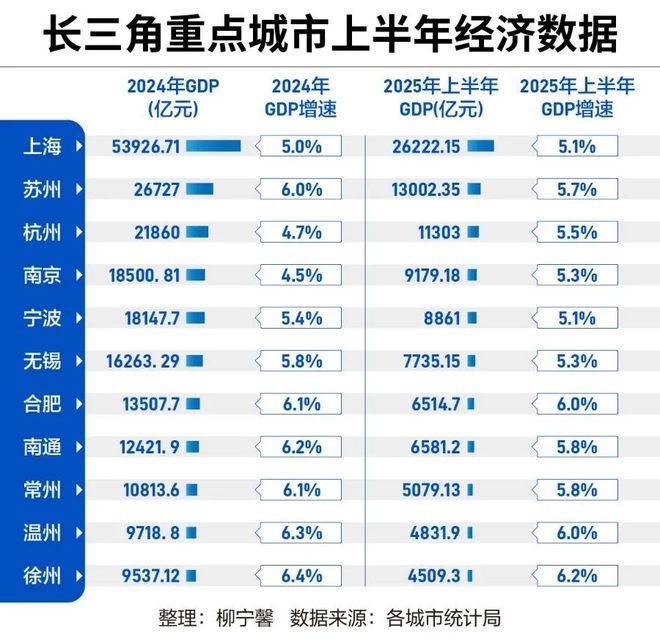
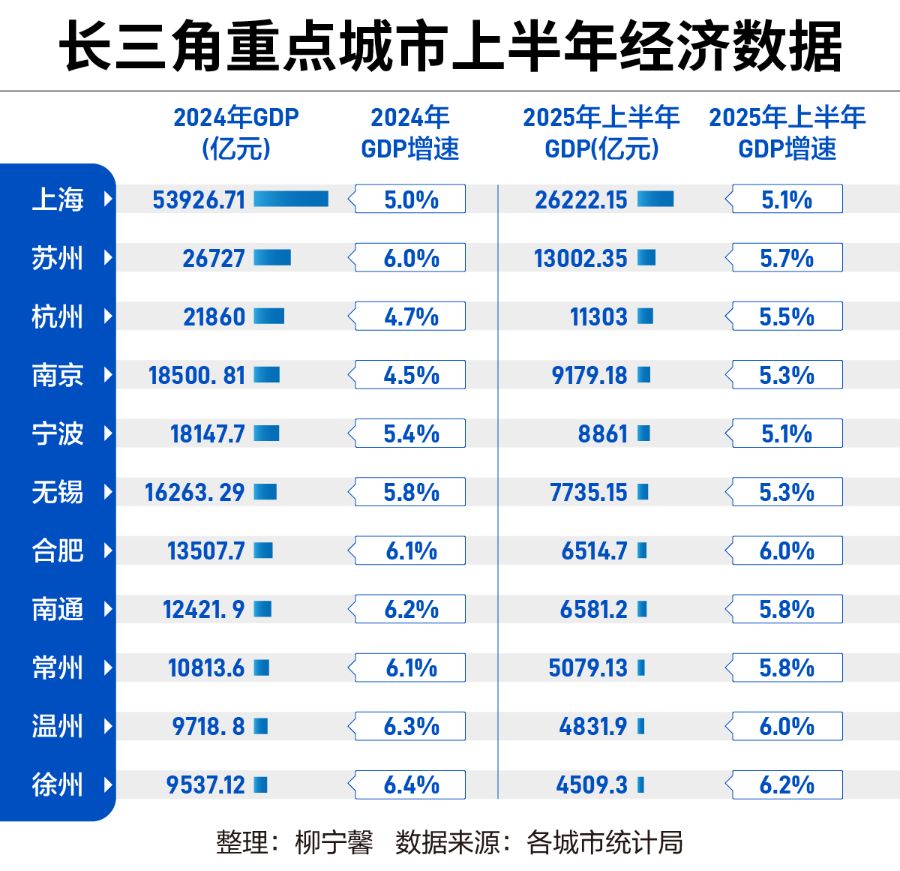
Core Insights - The economic data for 41 cities in the Yangtze River Delta has been released, with Shanghai leading in GDP at 26,222.15 billion yuan, and Zhoushan showing the highest growth rate at 6.9% [1][2] - The nine trillion-yuan cities in the Yangtze River Delta have all surpassed 5,000 billion yuan in GDP, with Wenzhou and Xuzhou being close to the trillion-yuan mark [1][5] - The ranking of trillion-yuan cities has seen minimal changes compared to 2024, with Nantong surpassing Hefei in economic total, while Hefei leads in growth rate at 6% [1][9] Economic Performance - In the first half of the year, 34 cities in the Yangtze River Delta achieved GDP growth rates above the national average of 5.3%, with 17 cities exceeding 6% [2][12] - Shanghai's GDP growth rate was 5.1%, supported significantly by the information service sector, which accounted for 79.1% of its GDP [6][11] - Suzhou's GDP reached 13,002.35 billion yuan, with over 45% of its growth attributed to the secondary industry, particularly advanced manufacturing [8][11] Industrial Insights - The industrial sector remains a key driver for cities like Suzhou, where both traditional and emerging industries are thriving [7][11] - Hangzhou has seen significant growth in its industrial robot production, with a year-on-year increase of 125.4%, and a 117.8% rise in new energy vehicle production [8][11] - Zhoushan's economy is bolstered by its marine economy, with substantial growth in power production, shipbuilding, and petrochemical industries [13] Urban Development - The six metropolitan areas in the Yangtze River Delta are increasingly influential, promoting coordinated development among large, medium, and small cities [4][14] - The integration of infrastructure and public services within these metropolitan areas is improving, paving the way for better collaboration in technology innovation and industrial clusters [4][14] - The development of marine economies and the emphasis on service industries are seen as vital for future growth in the region [12][13]

长三角城市半年报:南通超合肥 “破6”中小城黑马频出
2 1 Shi Ji Jing Ji Bao Dao· 2025-08-12 14:24
Core Insights - The economic data for 41 cities in the Yangtze River Delta has been released, with Shanghai leading in GDP at 26,222.15 billion yuan and Zhoushan showing the highest growth rate at 6.9% [1][4] - The nine trillion-yuan cities in the Yangtze River Delta have all surpassed 5,000 billion yuan in GDP, with Wenzhou and Xuzhou being close to the trillion-yuan mark [1][5] - The economic rankings of these trillion-yuan cities have seen minimal changes compared to 2024, with Nantong surpassing Hefei in total economic output [1][11] Economic Performance - In the first half of the year, 34 cities in the Yangtze River Delta achieved GDP growth rates above the national average of 5.3%, with 17 cities exceeding 6% [4][13] - Zhoushan leads the region in growth, followed by Shaoxing and Huaian, indicating a strong performance from cities focusing on both traditional and emerging industries [4][14] City-Specific Highlights - Shanghai's GDP reached 26,222.15 billion yuan with a growth rate of 5.1%, driven significantly by the information services sector, which accounted for 79.1% of its GDP [6][8] - Suzhou's GDP was 13,002.35 billion yuan, growing by 5.7%, with over 45% of its growth attributed to the secondary industry, particularly advanced manufacturing [8][7] - Hangzhou reported a GDP of 11,303 billion yuan, growing by 5.5%, with notable increases in industrial robot and new energy vehicle production [9][10] Emerging Trends - The development of marine economy is highlighted as a key growth area, particularly for Zhoushan, which has established several modern marine industry chains [14][15] - The collaboration within the six metropolitan areas in the Yangtze River Delta is emphasized, promoting coordinated development among cities [16][17] Future Outlook - The economic competition between Nantong and Hefei is expected to continue, with both cities showing strong industrial outputs [11][12] - The focus on traditional and emerging industries is crucial for sustained economic growth, with cities that balance both showing better performance [12][13]
长三角万亿城市排位生变,南通逆袭超过合肥
21世纪经济报道· 2025-08-12 14:13
Core Viewpoint - The economic performance of the Yangtze River Delta (YRD) region shows strong growth, with Shanghai leading in GDP, while cities like Zhoushan and Hefei demonstrate significant growth rates, indicating a robust economic landscape supported by both traditional and emerging industries [1][4][9]. Economic Data Summary - In the first half of the year, the GDP of Shanghai reached 26,222.15 billion yuan, maintaining its position as the top city in the YRD [1][6]. - Zhoushan recorded the highest GDP growth rate at 6.9%, while Hefei led among the trillion-yuan cities with a growth rate of 6% [1][12]. - The nine trillion-yuan cities in the YRD all surpassed 5,000 billion yuan in GDP, with notable performances from Suzhou and Hangzhou, which reported GDPs of 13,002.35 billion yuan and 11,303 billion yuan respectively [6][7]. Industry Insights - The industrial sector remains a key driver of economic growth in the YRD, with both traditional and emerging industries contributing significantly [4][9]. - Shanghai's service sector, particularly in information technology, has shown remarkable growth, with a 14.6% increase in the value added from the information transmission, software, and IT services sector [6][9]. - Suzhou's economy is bolstered by advanced manufacturing, with high-tech industries accounting for 56.4% of its industrial output [7]. Urban Development and Collaboration - The YRD features six metropolitan areas that enhance collaboration among cities, promoting coordinated development and resource sharing [14]. - Cities like Zhoushan leverage their coastal advantages to develop marine economies, contributing to their rapid economic growth [13]. - The emphasis on urbanization and the integration of smaller cities into the economic framework of larger cities is expected to foster further growth and innovation [14].

海韵干年 渔启新篇 2025茂名博贺开渔嘉年华即将启幕
Nan Fang Nong Cun Bao· 2025-08-12 14:00
南海潮涌,千帆 待发。8月15-17 日,广东最大渔 港--茂名博贺港 海韵干年 渔启 新篇 2025茂名 博贺开渔嘉年华 即将启幕_南方 +_南方plus 载着当地渔民世 代相传的海洋敬 畏与生存智慧, 是博贺渔港千年 渔业文明的鲜活 见证。祭海大典 是博贺疍家赶海 习俗的重要组 成,该习俗于 2023年5月入选 第七批市级非物 质文化遗产代表 性项目名录。 追溯过往,祭海 仪式由出巡、祭 海、回巡三个环 节组成,各种形 式的方阵如锣鼓 队,狮子队,渔民 代表队等伴着欢 快的锣鼓声前 进,出巡从妈祖 庙出发到渔港码 头全程约1.3公 里,每经过一个 停留点,队伍就 会驻足表演舞 狮、舞龙等,祭 海大典是博贺镇 渔民开渔前夕举 行的重要仪式, 由德高望重之人 主持祭海仪式, 仪式庄重而肃 将举办开渔嘉年 华活动。这场 以"海韵千年·渔 启新篇"为主题 的盛会,首次 以"三天两晚沉 浸式体验"模式, 串联祭海仪式、 头鲜拍卖、万人 渔市等十大活 动,打造从文化 传承到产业升级 的海洋经济新样 本。 千年渔脉 活化 传承与现代共舞 千百年来,这片 海域总在开渔前 夕被一场古老的 仪式——"祭海 大典"唤醒,它承 ...

长三角城市半年报:南通超合肥,“破6”中小城黑马频出
2 1 Shi Ji Jing Ji Bao Dao· 2025-08-12 13:17
Economic Overview - In the first half of the year, the economic data of 41 cities in the Yangtze River Delta has been released, with Shanghai leading in GDP at 26,222.15 billion yuan, and Zhoushan showing the highest GDP growth rate at 6.9% [1][14] - The nine trillion-yuan cities in the Yangtze River Delta all surpassed 5,000 billion yuan in GDP, with Wenzhou and Xuzhou as "quasi-trillion cities" at 4,831.9 billion yuan and 4,509.3 billion yuan respectively [1][6] GDP Growth and Rankings - The ranking of trillion-yuan cities has seen minimal changes compared to 2024, with only Nantong surpassing Hefei in economic total, while Hefei leads in growth rate at 6% [1][12] - A total of 34 cities in the Yangtze River Delta achieved GDP growth rates above the national average of 5.3%, with 17 cities exceeding 6% [4][14] Sector Contributions - Shanghai's economy is significantly supported by the information service industry, with the tertiary sector accounting for 79.1% of its GDP and a notable 14.6% increase in the information transmission, software, and IT services sector [7] - Suzhou's GDP reached 13,002.35 billion yuan, with over 45% of its growth attributed to the secondary industry, particularly advanced manufacturing [9] - Hangzhou's GDP totaled 11,303 billion yuan, with industrial robots and new energy vehicles showing remarkable growth rates of 125.4% and 117.8% respectively [10] Emerging Economic Trends - Zhoushan has emerged as a strong performer due to its marine economy, with significant growth in power production, shipbuilding, and petrochemical industries [15][16] - The development of urban agglomerations in the Yangtze River Delta is enhancing collaborative growth among cities, with a focus on integrating infrastructure and public services [17][18] Future Outlook - The economic competition between Nantong, known for its shipbuilding, and Hefei, recognized for its automotive industry, is expected to continue in the second half of the year [12][13] - The emphasis on traditional and emerging industries working in tandem is crucial for sustained economic growth in the region [4][13]
广州:增加海上保险供给,推动保险公司加强传统海上保险产品服务创新
Bei Jing Shang Bao· 2025-08-12 11:35
北京商报讯(记者 胡永新)8月12日,广州市人民政府等印发《关于贯彻落实金融支持广州南沙深化面 向世界的粤港澳全面合作的意见实施方案》,其中提出,增加海上保险供给,推动保险公司加强传统海 上保险产品服务创新,按市场化原则开发海洋牧场保险等海洋新兴产业保险产品,加大对海洋经济发展 的支持力度。 ...
索辰科技:提供海洋环境测试仿真系统解决方案
Sou Hu Cai Jing· 2025-08-12 07:43
以上内容为证券之星据公开信息整理,由AI算法生成(网信算备310104345710301240019号),不构成 投资建议。 索辰科技回复:尊敬的投资者您好!公司控股子公司麦思捷是一家在海洋和船舶工程领域有深厚技术积 累的公司,致力于提供海洋环境和大气环境的测试仿真系统解决方案,尤其是对于海洋大气这些复杂环 境中的工程问题具备大量的技术积累。通过双方协同公司也将不断提升在海洋复杂环境下的仿真能力, 致力于为深海油气开发、深海矿产开采、海底隧道建设等海洋工程项目提供从概念设计到生产制造的工 程仿真解决方案。感谢您的关注。 证券之星消息,索辰科技(688507)08月12日在投资者关系平台上答复投资者关心的问题。 投资者提问:领导多次提及海洋经济,海洋经济大发展是大势所趋,请问公司能为海洋经济做哪些贡献 呢? ...

政策红利持续释放 多地加码布局——十万亿海洋经济驶向高质量发展“蓝海”
Xin Hua Wang· 2025-08-12 05:44
Core Insights - The marine economy in China has surpassed 10 trillion yuan in annual output, indicating a new round of policy benefits aimed at promoting high-quality development in this sector [1][2] Policy Support and Development Goals - The Central Financial Committee emphasized the need for innovation-driven development, efficient collaboration, and industry upgrades in the marine economy [1] - The government aims to enhance top-level design and increase policy support to encourage social capital participation in marine economic development [1][2] - The 2024 marine economy statistics show a strong growth trend, with a total economic output of 10.5438 trillion yuan, a 5.9% increase from the previous year, accounting for 7.8% of the national GDP [2] Regional Initiatives - Coastal regions are accelerating their marine economic layouts, with Shanghai planning to enhance its marine production value and innovation capabilities by 2030 [3] - The "3+5+X" marine industry system proposed by Shanghai includes three leading industries and five emerging industries, aiming for a world-class modern marine industry [3] - Other provinces like Jiangsu, Zhejiang, Guangdong, and Shandong are also actively developing their marine economies, with specific plans and investment targets [4][5] Future Outlook - The marine economy is entering a critical phase of high-quality development, with a focus on fostering new productive forces and building a modern marine industry system [5] - The industry is expected to play a significant role in China's modernization and economic growth, supported by favorable policies and technological advancements [5]
这些沿海大市,要开始“抱团”发展了?
Mei Ri Jing Ji Xin Wen· 2025-08-11 16:11
Core Insights - The total scale of China's marine economy is projected to reach 10.54 trillion yuan in 2024, with a marine GDP of 5.1 trillion yuan in the first half of the year, reflecting a year-on-year growth of 5.8%, surpassing the national GDP growth rate by 0.5 percentage points [1] - The Central Financial Committee emphasizes the need for high-quality development of the marine economy, advocating for enhanced top-level design and policy support [1] - The development of bay economies is being explored across various coastal provinces, with over 150 bays larger than 10 square kilometers along China's 32,000-kilometer coastline [1] Marine City Clusters - Marine city clusters are defined as urban agglomerations centered around port groups, with marine economies at their core, facilitating collaboration among multiple cities [2] - Approximately 60% of global economic output is concentrated in port bays and adjacent areas, with 75% of major cities and 70% of industrial capital located within 100 kilometers of coastal areas [2] Bay Area Development - The Greater Bay Area's marine city cluster aims to create a unique multi-center collaborative development model, leveraging the strengths of Hong Kong, Shenzhen, and Guangzhou [7] - The three cities form a "golden triangle," enhancing resource allocation efficiency and global competitiveness through improved connectivity and collaboration [7][19] Economic Goals - The Greater Bay Area aims for a container throughput of 100 million TEUs by 2030, surpassing the combined throughput of New York and Los Angeles ports [9] - Research and development investment is targeted to exceed 5% by 2025, outpacing Norway's 3.9% [9] - The goal for green shipping is to have 15% of ammonia-fueled vessels by 2035, exceeding the EU's target of 10% [9] Collaborative Development - The concept of "collaborative development" is not unique to the Greater Bay Area, with cities like Qingdao and Ningbo-Zhoushan also pursuing marine city cluster initiatives [11][10] - The integration of surrounding marine cities can enhance economic scale and create economies of scale and scope [11] Current Leaders in Marine Economy - Shanghai remains the leader in marine economy, with a marine GDP projected to reach 1.1387 trillion yuan in 2024, followed by Tianjin, Qingdao, and Shenzhen [15] - The collaborative model among Shenzhen, Hong Kong, and Guangzhou is seen as a necessity due to their individual limitations compared to cities like Shanghai and Singapore [15] Infrastructure and Innovation - The development of transportation infrastructure, such as the Shenzhen-Zhongshan Bridge, is crucial for enhancing connectivity and collaboration among cities [23] - The establishment of marine universities and research institutions is essential for fostering innovation in marine-related fields [23][24] Institutional Innovation - Shenzhen is encouraged to create legal frameworks related to marine development while deepening integration with Hong Kong [24] - The Greater Bay Area is positioned as a testing ground for innovative marine governance models under the "one country, two systems" framework [24]
丰立智能(301368) - 投资者关系活动记录表(2025-005)
2025-08-11 07:52
Group 1: Company Overview and History - The company was established in 1995, initially focusing on small modulus spiral bevel gears and successfully replacing imports, exporting to countries like Germany, Japan, and the USA [5] - From 1998 to 2003, the company entered the supply chain of global top enterprises, establishing long-term partnerships with renowned companies such as Bosch and Siemens [5] - The product range has expanded from single bevel gears to include cylindrical gears, powder gears, and precision mechanical parts, with significant developments in planetary and harmonic reducers [5] Group 2: Financial Performance - In the first half of 2025, the company reported a consolidated revenue of 242 million CNY, a year-on-year increase of 0.25% [8] - The second quarter revenue was 125 million CNY, showing a year-on-year decline of 12.18% but a quarter-on-quarter increase of 7.5% [8] - The gross profit margin decreased by 1.7%, attributed to increased depreciation from new projects and the impact of US tariffs on older business lines [8] Group 3: Business Development and New Ventures - The company is focusing on new business areas, including robotics, automotive, marine economy, and low-altitude economy [6][7] - In the robotics sector, products developed include harmonic reducers and planetary reducers, with clients from major automotive and robotics companies [6] - In the automotive sector, the company is developing gear products for both fuel and electric vehicles, with clients including BYD and Dongfeng [7] Group 4: Investment and Funding Plans - The company plans to raise up to 730 million CNY through a private placement, with funds allocated to projects such as precision gear manufacturing and a research center [10] - Specific projects include: - New energy vehicle precision gear manufacturing: 27 million CNY from raised funds [10] - New generation precision transmission manufacturing: 22 million CNY from raised funds [10] - Precision transmission R&D center: 4 million CNY from raised funds [10] - The company has 53 patents, including 18 invention patents, indicating a strong focus on innovation [9]