
贸易谈判

Search documents
美国财长贝森特:警告各国不要拖延贸易谈判。今天与欧盟谈判代表会面。关税可以上调至4月2日的水平。我们拭目以待欧盟的情况。
news flash· 2025-07-03 11:18
Core Viewpoint - US Treasury Secretary warns countries against delaying trade negotiations, emphasizing the importance of timely discussions to avoid escalating trade tensions [1] Group 1: Trade Negotiations - Meeting held today with EU negotiators to discuss ongoing trade issues [1] - Potential for tariffs to be raised to levels seen on April 2, indicating a significant escalation if negotiations do not progress [1] - The situation with the EU remains under close observation, highlighting the uncertainty in trade relations [1]
美国财长贝森特:警告各国不要拖延贸易谈判进程,关税可以上调回4月2日的水平。
news flash· 2025-07-03 11:14
美国财长贝森特:警告各国不要拖延贸易谈判进程,关税可以上调回4月2日的水平。 ...
研究所晨会观点精萃-20250703
Dong Hai Qi Huo· 2025-07-03 02:02
分[析Ta师ble_Report] 商 品 研 究 研 究 所 晨 会 观 点 投资咨询业务资格: 证监许可[2011]1771号 精 萃 从业资格证号:F0256916 投资咨询证号:Z0000671 电话:021-68756925 邮箱:jialj@qh168.com.cn 明道雨 从业资格证号:F03092124 投资咨询证号:Z0018827 电话:021-68758786 邮箱:mingdy@qh168.com.cn 刘慧峰 从业资格证号:F3033924 投资咨询证号:Z0013026 电话:021-68751490 邮箱:Liuhf@qh168.com.cn 刘兵 从业资格证号:F03091165 投资咨询证号:Z0019876 联系电话:021-58731316 邮箱:liub@qh168.com.cn 王亦路 从业资格证号:F03089928 投资咨询证号:Z0019740 电话:021-68757092 邮箱:wangyil@qh168.com.cn 冯冰 从业资格证号:F3077183 投资咨询证号:Z0016121 电话:021-68757092 邮箱:fengb@qh168.com. ...
特朗普对日本下手的底气:“不敢涨价”的日本车
Hua Er Jie Jian Wen· 2025-07-03 00:26
越不还手,下手越狠? 在全球贸易局势充满不确定性的环境下,日本汽车制造商面对高额关税,选择了自行吸收大部分成本。 这一策略虽然暂时缓解了美国消费者的价格压力,但可能削弱日本在关税谈判中的立场。 据媒体报道,日本六大汽车制造商中仅有三家在美国市场提价,且幅度远低于25%的进口车关税税率。 丰田汽车公司作为全球最大汽车制造商,仅对部分车型提价几百美元,三菱汽车平均涨价2.1%,只有 斯巴鲁的涨幅接近关税水平。 来自日本财务省的另一组数据显示,5月日本对美汽车出口单价同比骤降约20%,而出口量仅减少 3.9%,表明日本通过大幅降价维持出货量和市场份额,利润却因此遭受重创。 相比之下,美国新车平均价格4月份上涨2.5%至约48700美元。 分析师认为,日本车企希望通过低调应对,避免激怒美国消费者,同时为谈判争取时间。 然而,这种避免大幅涨价的做法可能适得其反。由于美国消费者未感受到明显的价格冲击,特朗普政府 改变关税政策的压力减小,这可能强化其在贸易谈判中的立场。 汽车咨询公司Carnorama分析师Miyao Takeshi表示,如果因关税导致汽车价格持续上涨,政府将意识到 提高关税并非简单地有利于美国经济,这可能 ...


关税突发!特朗普再威胁:30%或35%!日本首相回应
Zheng Quan Shi Bao Wang· 2025-07-02 13:22
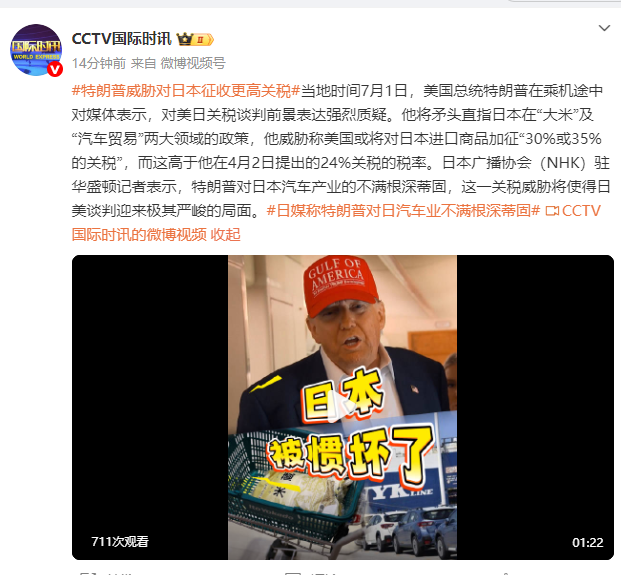
特朗普再发"关税威胁"。 据CCTV国际时讯,当地时间7月1日,美国总统特朗普在乘机途中对媒体表示,对美日关税谈判前景表达强烈质疑。他将矛头直指日本在"大米"及"汽车贸 易"两大领域的政策,他威胁称美国或将对日本进口商品加征"30%或35%的关税",而这高于他在4月2日提出的24%关税的税率。日本广播协会(NHK)驻华 盛顿记者表示,特朗普对日本汽车产业的不满根深蒂固,这一关税威胁将使得日美谈判迎来极其严峻的局面。 针对特朗普7月1日威胁对日本征收更高关税,日本首相石破茂7月2日在就参议院选举进行的党首讨论会上回应称,日本作为美国最大海外投资国,为美创 造了最多就业岗位。他强调,"与其加征关税,不如通过贸易来维护国家利益。" 特朗普威胁提高对日关税 就美日正在进行的谈判,特朗普1日在总统专机"空军一号"上对记者说:"我不确定我们会达成协议。我对此表示怀疑。" 特朗普形容日本"非常强硬""被惯坏了"。他表示,考虑进一步提高从日本进口商品的关税,可能增至30%或35%。 特朗普再次抱怨日本没有从美国进口足够的汽车、大米,称日本"占了我们三四十年的便宜"。 日本官员:希望以"真诚的方式"推进谈判 据共同社报道,日本 ...
关税突发!特朗普再威胁:30%或35%!日本首相回应
证券时报· 2025-07-02 12:56
特朗普再发"关税威胁"。 据CCTV国际时讯,当地时间7月1日,美国总统特朗普在乘机途中对媒体表示,对美日关税谈判前景表达 强烈质疑。他将矛头直指日本在"大米"及"汽车贸易"两大领域的政策,他威胁称美国或将对日本进口商品 加征"30%或35%的关税",而这高于他在4月2日提出的24%关税的税率。日本广播协会(NHK)驻华盛顿 记者表示,特朗普对日本汽车产业的不满根深蒂固,这一关税威胁将使得日美谈判迎来极其严峻的局面。 针对特朗普7月1日威胁对日本征收更高关税,日本首相石破茂7月2日在就参议院选举进行的党首讨论会上 回应称,日本作为美国最大海外投资国,为美创造了最多就业岗位。他强调,"与其加征关税,不如通过 贸易来维护国家利益。" 特朗普威胁提高对日关税 就美日正在进行的谈判,特朗普1日在总统专机"空军一号"上对记者说:"我不确定我们会达成协议。我对 此表示怀疑。" 特朗普形容日本"非常强硬""被惯坏了"。他表示,考虑进一步提高从日本进口商品的关税,可能增至30% 或35%。 特朗普再次抱怨日本没有从美国进口足够的汽车、大米,称日本"占了我们三四十年的便宜"。 日本官员:希望以"真诚的方式"推进谈判 据共同社报 ...
泰国央行副行长:政治的不确定性并未升高担忧,不应影响政府支出和贸易谈判。
news flash· 2025-07-02 08:58
Core Viewpoint - The Deputy Governor of the Bank of Thailand stated that concerns regarding political uncertainty have not increased and should not impact government spending and trade negotiations [1] Group 1 - The Deputy Governor emphasized that the current political landscape does not pose heightened risks to economic stability [1] - Government spending is expected to remain unaffected by political uncertainties, indicating a stable fiscal environment [1] - Trade negotiations are also anticipated to proceed without disruption, reflecting confidence in ongoing economic policies [1]
整理:7月9日“大限”将至,目前全球主要经济体与美国贸易谈判进展如何?
news flash· 2025-07-02 08:24
Economic Negotiations Progress - The UK and US have reached a limited trade agreement covering automotive (10% tariff) and aerospace (duty-free) sectors, but steel and pharmaceutical tariffs remain unresolved [1] - Canada has restarted negotiations with the US after canceling the digital services tax on June 30, aiming to reach an agreement by July 21, while previously imposing a 50% tariff on over-quota steel without further adjustments mentioned [1] - The EU is willing to accept a 10% universal tariff but seeks quotas and exemptions for automotive and steel products, along with lower tax rates for critical industries like pharmaceuticals and semiconductors, while insisting on digital sovereignty not being negotiable [1] - Japan faces a key obstacle with a 25% automotive tariff, with the Japanese side prepared for potential delays in negotiations, while Trump hinted at unilaterally imposing a 30%-35% tariff and threatening to issue a warning to Japan [1] - South Korea proposed a "comprehensive solution" including exemptions for automotive and steel tariffs, but the US remains cautious, with South Korea requesting an extension for negotiations, expected to be decided by July 8 [1] India-US Negotiation Stalemate - The negotiations between India and the US are currently stalled, with India seeking the removal of reciprocal tariffs and concessions on steel and automotive tariffs, while maintaining agriculture as a "red line"; the US desires further reductions in tariffs on agricultural products, automobiles, and alcoholic beverages [2] US Position and Actions - The US Agriculture Secretary indicated that Trump may exempt tariffs on agricultural products that are difficult to grow domestically, such as cocoa beans or coffee [3] - A "final ultimatum" has been issued, warning that if negotiations fail, tariffs could revert to a maximum of 50% by July 9, with Trump stating he does not plan to extend the negotiation deadline [3] - The US is adjusting its negotiation strategy by seeking to narrow the scope of trade agreements, allowing countries that agree to these limited agreements to avoid harsher reciprocal tariffs, while still imposing the existing 10% basic tariff; reports suggest that the US will prioritize negotiations with India before addressing issues with Japan [3]