
电动化转型

Search documents
东风汽车新公司,传出重磅消息!
Chang Jiang Ri Bao· 2025-08-01 14:55
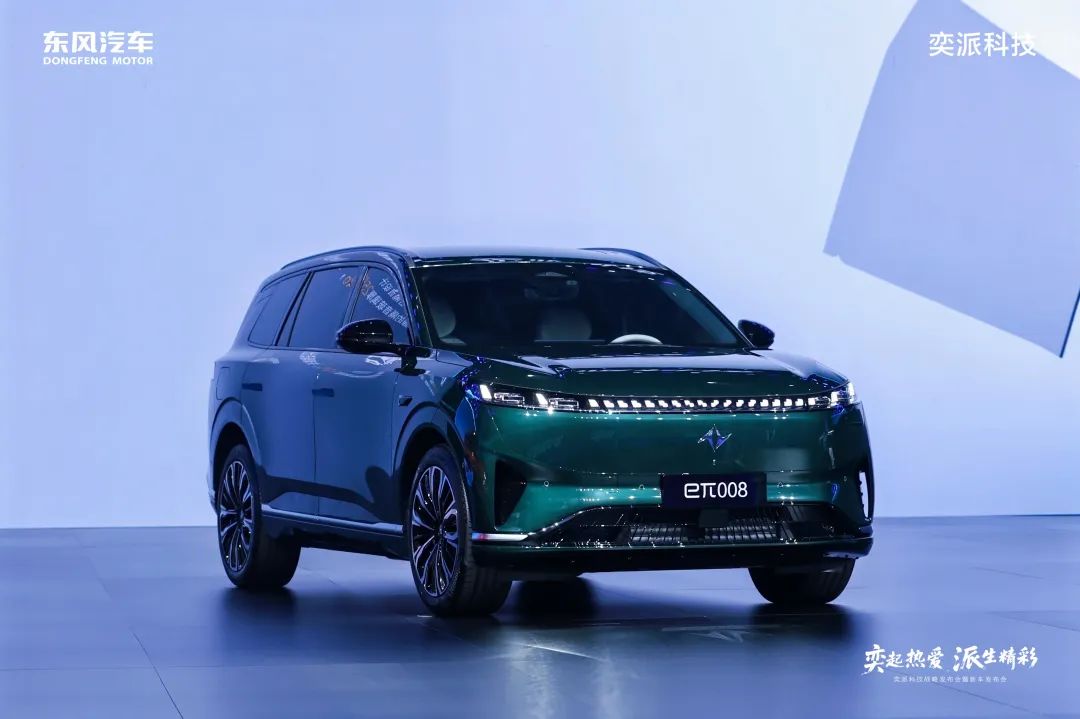
Group 1 - The core message of the event is the launch of the 2026 Dongfeng Yipai eπ008 and the global debut of the Fengshen L8, marking a significant step in Dongfeng's transformation towards smart and electric vehicles [1][3] - Dongfeng Yipai Technology, established on June 26 this year, integrates three major brands: Dongfeng Yipai, Dongfeng Fengshen, and Dongfeng Nano, aiming to create a new landscape for Dongfeng's independent passenger vehicles [3] - The "Future Wing" strategy was unveiled, showcasing advancements in core technologies, including solid-state batteries with over 1000 km range expected by 2026, and self-developed high-voltage architecture with rapid charging capabilities [4] Group 2 - A notable collaboration with Huawei was announced to develop a new series of smart vehicles, leveraging both companies' strengths in technology and resources [6] - The first model from this collaboration is a high-end mid-size smart SUV, expected to launch in 2026, with plans to introduce new models every six months, covering various vehicle types [6] - Dongfeng Yipai Technology aims to expand its product lineup to 20 models by 2028, emphasizing continuous evolution and innovation for each model [8]

大众汽车集团上半年营业利润暴跌33%
Cai Jing Wang· 2025-08-01 01:27
此外,还涉及奥迪、大众乘用车和旗下软件部门Cariad的重组拨备7亿欧元,以及与二氧化碳排放法规 相关的费用支出等也影响了公司业绩。 与此同时,大众汽车还下调了2025年全年业绩展望,预计2025年全年销售收入将与上一年持平,低于此 前预测的5%最高增幅。 汽车巨头大众汽车集团公布了2025年上半年成绩单。业绩报告显示,德国大众2025年上半年营收达1584 亿欧元,同比基本持平;营业利润同比下降33%至67亿欧元,税后利润下跌超过38%,至44.7亿欧元, 低于市场预期。 大众汽车集团的这份财报的多项核心指标表现不佳,其在电动化转型方面也存在巨大压力。 营业利润大降约33% 据央视财经,财报数据显示,2025年上半年德国大众汽车集团销售收入为1584亿欧元,而去年同期这一 数字为1588亿欧元;营业利润为67亿欧元,较去年同期的100亿欧元大幅下降约33%,税后利润更是同 比下降超过38%,至44.77亿欧元。 大众方面称,导致利润大幅下滑的核心因素之一,正是美国政府对电动汽车及零部件加征的新一轮进口 关税。这一政策给大众集团带来了高达13亿欧元的成本负担。 大众汽车集团管理董事会主席奥博穆表示:我们在美国 ...
大众、宝马、奔驰半年业绩下滑明显,中美市场成两大主因
Guan Cha Zhe Wang· 2025-08-01 00:49
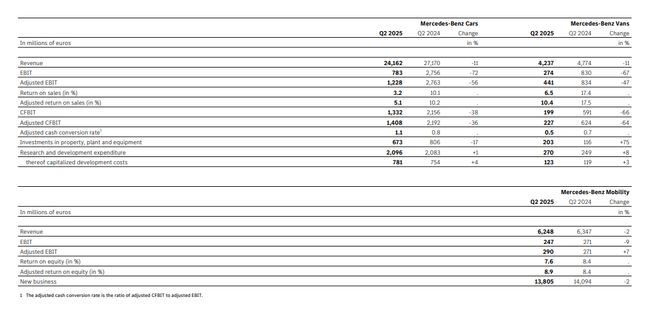
Core Viewpoint - The financial results for the first half of 2025 from major European automakers Volkswagen, Mercedes-Benz, and BMW show significant declines in revenue and profit, attributed to factors such as U.S. tariffs and intense competition in the Chinese market [1][3][9]. Financial Performance Summary - Mercedes-Benz reported a revenue of €72.6 billion (approximately ¥597.9 billion) for the first half of 2025, a decrease of 8.6% year-on-year, with a net profit of €2.7 billion (approximately ¥222.3 billion), down 55.8% compared to the previous year [3]. - Volkswagen's second-quarter revenue was €80.81 billion (approximately ¥665.4 billion), a 3% decline year-on-year, with an operating profit of €3.83 billion (approximately ¥315.3 billion), down 29.4% [3]. - BMW's total sales revenue for the first half of 2025 was €67.7 billion (approximately ¥557.5 billion), a decrease of 8% year-on-year, with a net profit of €4 billion (approximately ¥329.3 billion), down 29% [3]. Sales Performance Summary - Mercedes-Benz's global sales fell by 8% to 1.076 million units in the first half of 2025, with a 14% decline in China, a 6% decline in the U.S., and a 3% decline in Europe [4]. - BMW's global sales decreased by 0.5% to 1.207 million units, with a 15.5% drop in China, although sales in Europe increased by 8.2% [4][6]. Market Challenges - Both Mercedes-Benz and BMW cited U.S. tariffs and fierce competition in the Chinese market as key factors contributing to their declining performance [3][6]. - The impact of U.S. tariffs has been particularly severe, with Volkswagen experiencing a 16% drop in sales in North America and an estimated cost increase of €1.3 billion (approximately ¥10.7 billion) due to tariffs [9][12]. Strategic Responses - Despite the poor financial performance, the companies remain committed to their transformation strategies, with BMW leading in electric vehicle sales, reporting an 18.5% increase in sales of electric and plug-in hybrid models [8]. - Mercedes-Benz and Volkswagen are implementing cost-control measures and restructuring plans to mitigate financial losses, including layoffs and strategic shifts [12][13].
BBA上半年利润齐下跌,原因是什么?
Di Yi Cai Jing· 2025-08-01 00:14
Core Viewpoint - The BBA (BMW, Benz, Audi) group continues to face profit declines in the first half of the year, with Audi being the only company to report revenue growth, while Mercedes-Benz experiences the largest profit drop [1][2]. Financial Performance - BMW reported revenue of €67.7 billion, a year-on-year decline of 8%, with net profit dropping 29% to €4 billion [1]. - Mercedes-Benz's revenue was €66.38 billion, down 8.6%, with net profit falling 55.8% to €2.69 billion [1]. - Audi's revenue increased by 5.3% to €32.57 billion, but net profit decreased by 37.5% to €1.346 billion [1]. Market Performance - Sales in the Chinese market saw significant declines, with BMW, Mercedes, and Audi selling 318,000, 293,000, and 288,000 units respectively, representing year-on-year drops of 15.5%, 14%, and 10.2% [2]. - BMW and Audi experienced some sales growth in European markets, while Mercedes-Benz faced larger declines in both profit and sales [2]. Strategic Adjustments - Audi and Mercedes have adjusted their electric vehicle strategies, with Audi retracting its plan to cease internal combustion engine development by 2033, and Mercedes shifting its focus to a dual development strategy for both fuel and electric vehicles [3]. - BBA is accelerating its electric vehicle transition in China, collaborating with local partners to enhance their offerings and efficiency [3][4]. Impact of Tariffs - Audi's CFO indicated that U.S. tariffs and increased transformation costs are major contributors to profit declines, with losses estimated at €600 million due to tariffs [5]. - Mercedes-Benz warned that tariffs have negatively impacted sales, predicting a significant drop in annual revenue compared to last year [6]. - BMW anticipates a 1.25 percentage point decline in EBIT margin by 2025 due to tariff-related factors [6]. Regional Sales Trends - In North America, BMW saw a slight increase in sales, while Mercedes-Benz and Audi experienced declines of 9% and 6% respectively [7]. - Audi is considering building a factory in the U.S., while BMW is exploring capacity expansion at its Spartanburg facility [7].
奔驰大电池新车,计划采用吉利插混技术|36氪独家
3 6 Ke· 2025-07-31 15:57
Core Viewpoint - Mercedes-Benz is accelerating the localization of its products in China by collaborating with local automaker Geely to develop a new plug-in hybrid vehicle, aiming to enhance its competitiveness in the increasingly heated market for large battery plug-in hybrids [1][3]. Group 1: Collaboration and Strategy - Mercedes-Benz plans to develop a long-range plug-in hybrid vehicle in partnership with Geely, with discussions ongoing regarding the development details [1]. - The collaboration with Geely is seen as a pragmatic choice for Mercedes-Benz to reduce costs and improve efficiency, given the latter's expertise in hybrid technology [2][7]. - Mercedes-Benz has previously engaged in various collaborations with Geely, including the procurement of cockpit solutions from Geely's subsidiaries [1][9]. Group 2: Market Position and Competition - The plug-in hybrid market in China is dominated by local competitors such as BYD and Li Auto, which have developed advanced hybrid technologies that surpass Mercedes-Benz's current offerings [2][3]. - Mercedes-Benz's current plug-in hybrid technology, the P2 parallel hybrid system, is considered outdated compared to the single-gear DHT technologies used by local competitors [3][6]. - In the first half of 2025, Mercedes-Benz's sales of pure electric vehicles declined by 24%, while sales of plug-in hybrid vehicles increased by 34%, indicating a shift in product focus [5]. Group 3: Financial Performance - In the first half of 2025, Mercedes-Benz reported global sales of 1.0763 million vehicles and a net profit of €2.7 billion, with a significant decline in sales in the Chinese market, down over 18% [4]. - Geely's total sales exceeded 1.93 million vehicles in the first half of 2025, with a 30% year-on-year increase, and its new energy vehicle sales surpassed 1 million units, growing by 73% [9]. Group 4: Technological Development - Developing a competitive single-gear DHT technology independently would take Mercedes-Benz approximately 3-4 years, making collaboration with established local players a more immediate solution [6]. - Geely's recent advancements in plug-in hybrid technology, such as the Zeekr 9X, which features an 800V high-voltage system and a pure electric range of 380 km, further solidify its position as a valuable partner for Mercedes-Benz [8].

宝马,突发!
Zhong Guo Ji Jin Bao· 2025-07-31 13:13
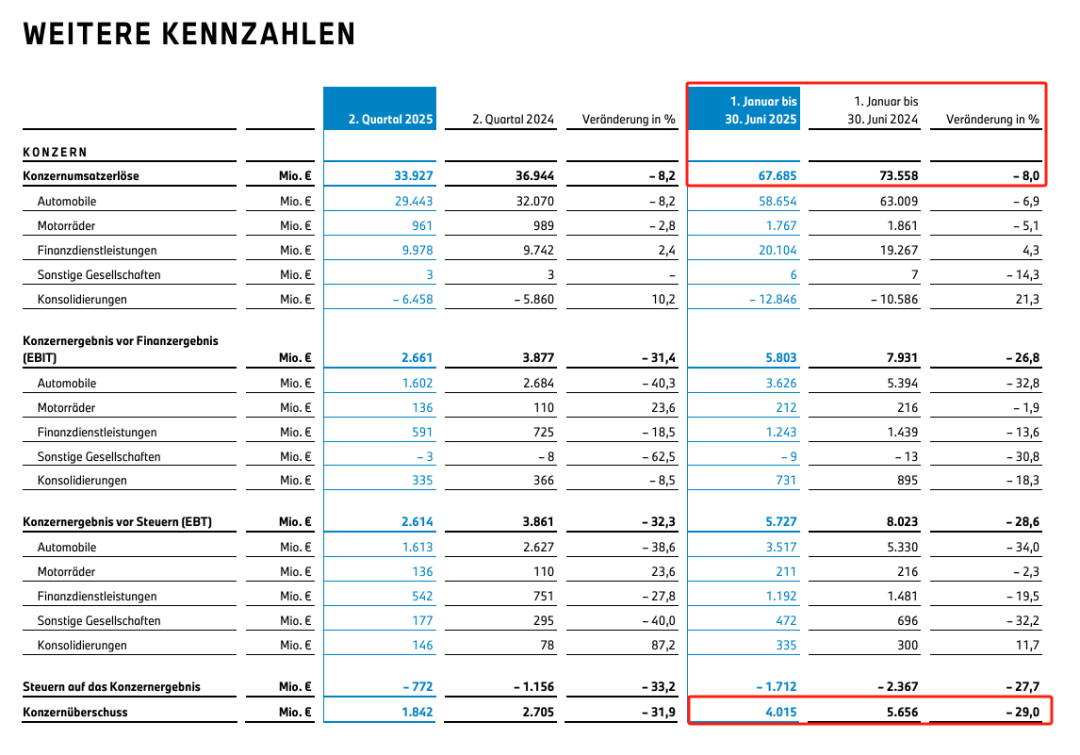
Core Insights - BMW Group reported a decline in sales revenue and net profit for the first half of 2025, with sales revenue at €67.7 billion, down 8% year-on-year, and net profit at €4 billion, down 29% [1][2]. Financial Performance - In Q2 2025, BMW's sales revenue was €33.9 billion, a decrease of 8.2% compared to Q2 2024 [2]. - The EBIT for Q2 2025 was €2.66 billion, reflecting a significant decline of 31.4% year-on-year [2]. - The automotive segment's EBIT margin fell to 5.4% from 8.4% in the previous year [2]. - Total vehicle deliveries for the first half of 2025 were over 1.2 million, remaining stable compared to the previous year [3]. Regional Performance - Sales in the Chinese market dropped by 15.5% due to weak demand for high-end models, indicating a decline in BMW's competitiveness in China [3]. - The European market saw double-digit growth in Q2, with BMW's market share continuing to expand [3]. - The Americas market experienced a cumulative growth of 3.4% in the first half of 2025 [3]. Electric Vehicle Strategy - BMW delivered 318,900 electrified vehicles in the first half of 2025, marking an 18.5% increase year-on-year, with over a quarter of total deliveries being electric models [3]. - The growth in electric models was primarily driven by the i4, iX1, and iX models, with strong performance in plug-in hybrid vehicles in Europe [4]. Strategic Outlook - BMW's Chairman, Oliver Zipse, emphasized the resilience of the company's business model, which is based on globalization, innovation, and attractive products [4]. - The company plans to launch over 40 new and updated models by 2027, covering all market segments and drive types [4]. Market Reaction - Following the disappointing Q2 performance, BMW's stock price has declined, with shares trading at €84, resulting in a total market capitalization of €47.6 billion [5].
宝马,突发!
中国基金报· 2025-07-31 13:10
Core Viewpoint - BMW Group reported a decline in sales revenue and net profit for the first half of 2025, with sales revenue down 8% year-on-year to €67.7 billion and net profit down 29% to €4 billion [2]. Financial Performance - In Q2 2025, BMW Group's sales revenue was €33.9 billion, a decrease of 8.2% compared to Q2 2024 [3]. - The EBIT for Q2 2025 was €2.66 billion, reflecting a significant decline of 31.4% year-on-year [3]. - The automotive segment's EBIT margin fell to 5.4% from 8.4% in the previous year [3]. Sales and Market Performance - BMW Group delivered 621,500 vehicles in the first half of 2025, a slight increase of 0.4% year-on-year [4]. - Sales in the Chinese market dropped by 15.5%, attributed to weak demand for high-end models, while the European market saw double-digit growth in Q2 [4]. - The Americas market experienced a cumulative growth of 3.4% in the first half of the year [4]. Electric Vehicle Transition - BMW Group delivered 318,900 electrified vehicles in the first half of 2025, marking an 18.5% increase year-on-year, with over a quarter of total deliveries being electric models [4]. - The growth in electric models was primarily driven by the i4, iX1, and iX, with strong performance in plug-in hybrid vehicles in the European market [4]. Strategic Outlook - BMW Group's Chairman, Oliver Zipse, emphasized the resilience of the business model, which is based on globalization, innovation, and attractive products [4]. - The company plans to launch over 40 new and updated models by 2027, covering all market segments and drive types, integrating innovative technologies and new design language [4]. Stock Market Reaction - Following the disappointing Q2 performance, BMW Group's stock price has seen a decline, trading at €84 per share with a total market capitalization of €47.6 billion [5].
奔驰上半年净利润暴跌55.8%,裁员降本难阻业绩下滑
Sou Hu Cai Jing· 2025-07-31 11:14
Core Viewpoint - Mercedes-Benz Group reported a significant decline in financial performance for the first half of 2025, with sales revenue dropping by 8.6% year-on-year to €72.6 billion and net profit falling by 55.8% to €2.7 billion, marking the worst performance for the same period in five years [2] Financial Performance - Sales revenue for the first half of 2025 was €72.6 billion, down 8.6% compared to the previous year [2] - Net profit for the same period was €2.7 billion, a decrease of 55.8% year-on-year [2] Challenges Faced - The company cited weak global market demand, high costs associated with electrification, and ongoing supply chain issues as key factors impacting performance [2] - Despite a large-scale cost-cutting plan initiated at the beginning of the year, including layoffs of over 10,000 employees and project suspensions, these measures failed to offset the impact of declining sales [2] Market Competition - High-end vehicle sales remained relatively stable, but entry-level models and electric vehicles performed poorly, particularly in the face of intense competition from Tesla and Chinese brands in the European and American markets [2] Profitability Outlook - Currency fluctuations and rising raw material costs further squeezed profit margins [2] - Analysts indicate that the performance decline reflects a broader struggle among traditional automakers amid industry transformation, with market confidence in a short-term recovery for Mercedes-Benz being low [2] - Following the financial report, Mercedes-Benz's stock price fell by 3.5%, with a cumulative decline of over 20% for the year [2] - Industry forecasts suggest that if the consumer environment does not improve in the second half of the year, Mercedes-Benz may face its first annual loss in a decade [2]
大众汽车利润跌近三成下调全年预期 关税、重组与电动化转型冲击阵痛加剧
Xin Lang Cai Jing· 2025-07-31 08:53
来源:新浪财经 近日,大众汽车集团发布的二季度财报显示,公司营业利润暴跌29%至38.3亿欧元,低于市场预期的 38.9亿欧元。 尽管全球交付量227.2万辆,同比增长1.2%,但汽车部门经营现金流同比骤降36.5%。大众财务总监阿尔 诺·安特利茨在声明中坦言:"尽管产品成功,但运营利润减少了三分之一。" 大众汽车在全球市场的表现呈现明显区域分化。上半年全球交付量达440.5万辆,同比增长1.3%。 欧洲和南美市场成为亮点。欧洲市场增长3.3%,南美市场更是暴涨21.1%。第二季度,得益于折扣促销 以及消费者因马斯克政治立场减少购买特斯拉,大众在欧洲的电动车交付量大幅增长73%。 然而,亚太和北美市场却成为大众的痛点。北美地区销量下滑16%,成为大众全球唯二下滑的主要市场 之一。整个亚太市场也表现疲软,下降1.2%。 中国作为大众最大单一市场,上半年销量131.32万辆,同比下滑2.3%。尽管6月单月交付量同比增长9% 释放复苏信号,但难以弥补前几个月的损失。 Stellantis上半年净营收同比下降12.6%至743亿欧元,并面临23亿欧元的亏损。其旗下汽车品牌在北美市 场的出货量预计第二季度同比下降25% ...
半年报|电动化占比超1/4、个性化车型表现抢眼,宝马上半年业绩韧劲足
Zhong Guo Jing Ji Wang· 2025-07-31 08:41
Group 1 - BMW Group reported stable global sales in the first half of 2025, with over 1.2 million units sold, maintaining year-on-year levels despite a complex international trade environment [1] - The high-end and personalized brands, including BMW M, Rolls-Royce, and MINI, showed strong performance, with BMW M achieving a record sales figure of over 106,000 units, a 6.5% increase year-on-year [1] - The chairman of BMW Group emphasized the company's resilience based on three pillars: global presence, innovation capabilities, and attractive product offerings [1] Group 2 - BMW Group's electric vehicle sales (including BEV/PHEV) grew by 18.6% year-on-year, accounting for over 25% of total sales in the first half of 2025 [2] - MINI brand emerged as a benchmark for electrification, with pure electric models making up 34.3% of its sales, contributing to a 17.4% increase in global sales [2] - The company invested over €4 billion in R&D focused on new generation technology clusters, preparing for the launch of over 40 new and updated models by 2027 [2]