资本市场改革

Search documents
资本市场改革行稳致远
Jing Ji Ri Bao· 2025-10-14 22:18
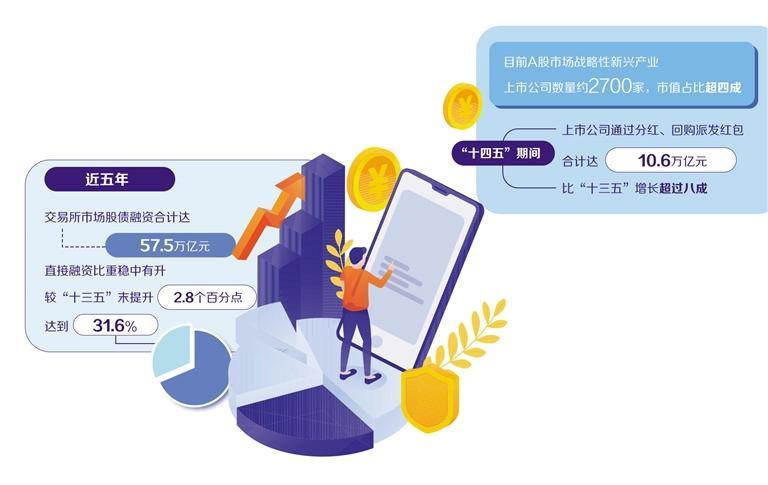
Group 1: Core Views - The capital market reforms during the "14th Five-Year Plan" period have significantly improved the market ecosystem, enhancing its role in supporting new productivity and resource allocation [2] - The "15th Five-Year Plan" period is crucial for achieving high-quality development in the capital market, with expectations for deeper reforms to contribute to China's modernization [2] Group 2: Investment and Financing Reforms - Investment and financing are key components of capital market development, with ongoing reforms enhancing market attractiveness and inclusivity [3] - The stock issuance registration system has been fully implemented, and measures like the "16 Articles for Sci-Tech Innovation" have been introduced to support high-quality tech enterprises [3] - Direct financing has increased, with total financing through stock and bond markets reaching 57.5 trillion yuan over the past five years, raising the direct financing ratio to 31.6% [3] Group 3: Investment Side Reforms - Significant measures have been taken to promote long-term capital investment, with various funds holding approximately 21.4 trillion yuan in A-share market by August, a 32% increase from the end of the "13th Five-Year Plan" [4] - Long-term capital is seen as a stabilizing force in the market, essential for maintaining healthy market operations [4] Group 4: Challenges and Future Directions - Despite progress, challenges remain in fully leveraging the capital market's role in supporting technological innovation and increasing direct financing ratios [5] - Future reforms should focus on enhancing the Sci-Tech Innovation Board and improving the product and service system to better serve new productivity [5] Group 5: Enhancing Listed Company Quality - Regulatory bodies are focused on improving the quality of listed companies through support for mergers and acquisitions and market management [6] - Since the introduction of the "Six Articles for Mergers and Acquisitions," around 230 major asset restructuring cases have been disclosed, indicating a trend towards industry consolidation [6][7] - The total amount distributed through dividends and buybacks by listed companies reached 10.6 trillion yuan during the "14th Five-Year Plan," an increase of over 80% from the previous period [7] Group 6: Exit Mechanisms and Market Health - The implementation of stricter delisting standards has led to the smooth exit of 207 companies over the past five years, promoting a healthier market environment [8] - Future delisting reforms should focus on optimizing standards and enhancing the deterrent effect against major violations [8] Group 7: High-Level Institutional Opening - The capital market has seen the approval of 13 foreign-controlled securities and fund institutions, with foreign holdings in A-shares reaching 3.4 trillion yuan [9] - The number of qualified foreign institutional investors (QFII) has exceeded 900, with significant foreign capital inflows into domestic stocks and funds [9][10] Group 8: Going Global - The "14th Five-Year Plan" has seen 269 domestic companies list abroad, with 83 of them being tech firms, reflecting a strong trend towards internationalization [10] - A-share companies reported overseas revenues of 4.9 trillion yuan in the first half of the year, marking a 4.5% year-on-year increase [10] Group 9: Future Directions for Capital Market Opening - Future efforts should focus on aligning market infrastructure and regulations with international standards, facilitating cross-border financing for tech firms, and expanding foreign investment access [11]

A股新开户数持续增加 透露了哪些利好信息
Zheng Quan Ri Bao· 2025-10-13 22:44
Core Insights - The continuous increase in new A-share accounts indicates growing investor confidence in China's economy and capital market reforms, highlighting the increasing attractiveness of Chinese assets [1][2][3] - The A-share market has shown resilience amid complex external conditions, with the Shanghai Composite Index rising 16.04% year-to-date as of October 13 [1][2] Group 1: Market Dynamics - In September, 2.9372 million new A-share accounts were opened, a year-on-year increase of 60.73% and a month-on-month increase of 10.83%, marking four consecutive months of growth [1] - The total number of new A-share accounts for the first three quarters of the year reached 20.1489 million, reflecting a year-on-year growth of 49.64% [1] - The resilience of the stock market is supported by a recovering economy and effective government measures to stabilize the market, which have led to a steady increase in market indices [2][3] Group 2: Investment Trends - The deepening reforms in the capital market are providing better investment opportunities, particularly in technology sectors, which have become the main focus of the current market rally [2][3] - The emergence of a "1+N" policy framework has led to significant structural changes in the market, fostering a culture of respecting and rewarding investors among listed companies [3] Group 3: Asset Allocation Shifts - There is a noticeable shift in residents' asset allocation towards financial assets, with A-shares expected to become a core vehicle for wealth preservation and appreciation [3][4] - Data from the central bank indicates a decrease of 1.1 trillion yuan in household deposits, while non-bank deposits increased by 2.14 trillion yuan, signaling a migration of funds towards financial assets [3] - High-net-worth clients and industrial capital are driving the growth of securities margin financing, indicating a preference for core assets in the A-share market among risk-tolerant investors [3]
资本市场发生深刻变化
Jing Ji Ri Bao· 2025-10-13 22:06
Group 1: Market Overview - The A-share market reached a historic milestone in August 2025, with a total market value exceeding 100 trillion yuan, reflecting significant growth and transformation during the "14th Five-Year Plan" period [1] - The bond market ranks second globally, while the futures trading volume remains the highest worldwide, indicating a substantial increase in the breadth and depth of China's capital market [3] Group 2: Regulatory Framework - The new "National Nine Articles" released in 2024 established a framework for a safe, standardized, transparent, and vibrant capital market, marking a systemic restructuring of market regulations [2] - The implementation of the new Securities Law and the introduction of the Futures and Derivatives Law signify advancements in the legal framework of the capital market, enhancing risk management [2] Group 3: Market Structure and Composition - The market structure has shifted significantly, with the technology sector now accounting for over 25% of the A-share market capitalization, surpassing traditional sectors like banking and real estate [4] - By August 2025, the electronics industry became the largest sector in the A-share market, with a total market value of 11.54 trillion yuan [4] Group 4: Investment Trends - Long-term funds, including social security, insurance, and foreign capital, have increasingly entered the market, with total holdings reaching approximately 21.4 trillion yuan, a 32% increase from the end of the "13th Five-Year Plan" [4] - The direct financing ratio has risen to 31.6%, indicating that the capital market is becoming a primary engine for supporting technological innovation [6] Group 5: Corporate Governance and Returns - Companies listed on the A-share market distributed a total of 2.4 trillion yuan in cash dividends in 2024, reflecting a 9% increase from 2023, showcasing a shift towards sustainable returns for investors [6] - Over the past five years, listed companies have returned a total of 10.6 trillion yuan through dividends and buybacks, highlighting the growing alignment between investment and financing functions in the capital market [7] Group 6: Market Stability and Regulation - The market stability mechanism has evolved from temporary measures to a normalized operation, enhancing the resilience and risk management capabilities of the A-share market [8] - Regulatory actions have intensified, with 2,214 administrative penalties issued for violations, resulting in fines totaling 41.4 billion yuan, reflecting a commitment to improving market transparency and integrity [9] Group 7: Investor Protection - A comprehensive investor protection system has been established, including regulations on share reductions and quantitative trading, aimed at safeguarding investor interests [10] - Recent legal cases have resulted in significant compensation for investors, indicating a robust approach to holding companies accountable for misconduct [11] Group 8: Future Outlook - The capital market is positioned as a crucial hub for economic transformation and technological innovation, with expectations for continued growth and structural optimization in the upcoming "15th Five-Year Plan" [11]
A股新开户数持续增加透露了哪些利好信息
Zheng Quan Ri Bao· 2025-10-13 16:22
Core Insights - The continuous increase in new A-share accounts indicates growing investor confidence in China's economy and capital market reforms, highlighting the increasing attractiveness of Chinese assets [1][2][3] - The A-share market has shown resilience, with the Shanghai Composite Index reaching a year-to-date increase of 16.04% as of October 13, driven by positive macroeconomic fundamentals and a series of stabilizing measures [1][2] - The deepening reforms in the capital market are providing better investment opportunities, particularly in technology sectors, which are becoming the main focus of the current market rally [2][3] Market Dynamics - The influx of institutional investors, with 10,900 new accounts in September, marks a significant milestone and reflects a growing trend towards long-term and value investing [3] - The shift in residents' asset allocation towards financial assets, particularly A-shares, is becoming evident as traditional investments like real estate face regulatory constraints [3][4] - The trend of asset migration to A-shares is expected to continue, but maintaining investor confidence through protection measures and promoting rational investment practices is crucial for sustaining this trend [4]
贸易摩擦冲击下,10月债市的变与不变
2025-10-13 14:56
Summary of Conference Call Notes Industry or Company Involved - The notes primarily discuss the **Chinese capital market** and its response to **US-China trade relations** and **debt market dynamics**. Core Points and Arguments 1. **Impact of Trade Friction**: The Chinese capital market is adapting to trade tensions, with improved mechanisms to counteract market volatility caused by US-China trade disputes. The ability to respond effectively has increased, leading to a more stable market environment [1][3][10]. 2. **Market Reforms and Economic Stability**: The introduction of new policies, such as the "New National Nine Articles," is expected to enhance long-term market development and stabilize economic policies in the fourth quarter. This includes measures like liquidity support from the central bank [1][3][4]. 3. **Equity Market Outlook**: Despite trade tensions, the overall trend for the equity market remains positive due to structural economic reforms, declining risk-free interest rates, and improved investor sentiment towards capital market reforms [3][10]. 4. **Convertible Bond Market**: The convertible bond market faces challenges due to supply-demand imbalances and historical high valuations. However, there are opportunities for selective investments in bonds with strong underlying stocks and limited exposure to tariffs [5][6][7]. 5. **Monetary Policy**: The monetary policy focuses on reducing costs for the real economy through targeted measures, with no immediate changes to interest rates expected despite trade tensions. The emphasis remains on structural and targeted easing [8][9]. 6. **Fiscal Policy**: The goal of expanding consumer capacity remains unchanged, with fiscal measures aimed at supporting consumption through financial collaboration and wealth effects. Recent US actions in technology sectors reinforce the need for fiscal support for tech companies [9][10]. 7. **Debt Market Dynamics**: The debt market is expected to experience a weak start followed by strength in the fourth quarter, with a potential platform repair phase in October. The risk-return profile for bonds is improving, but the market will not overprice economic recovery or inflation [2][10]. 8. **Public Fund Sales Regulations**: New regulations on public fund sales may increase transaction costs for short-term bond funds, potentially shifting institutional investments towards lower-fee alternatives like bond ETFs [11][12]. 9. **Credit Bond Observations**: The concentration of financial sector bonds in pure debt funds is high, and any redemption triggered by fee adjustments could significantly impact these bonds. The credit spread is expected to remain volatile, with opportunities in mid to short-term bonds [13][14]. Other Important but Possibly Overlooked Content - The notes highlight the importance of selecting specific investment opportunities in the convertible bond market, particularly those with strong fundamentals and limited tariff exposure. The need for a balanced approach in investment strategies is emphasized due to ongoing uncertainties in US-China trade negotiations [6][7]. - The potential for a rebound in sectors less reliant on exports to the US, such as semiconductors and military industries, is noted as a strategic focus for investors [7].
非银金融行业周报:沪指一度突破3900点,关注证券板块配置价值-20251013
East Money Securities· 2025-10-13 12:04
Investment Rating - The report maintains an "Outperform" rating for the non-bank financial sector, indicating a positive outlook for investment opportunities in this industry [2]. Core Insights - The report highlights the recovery of the securities sector, with the Shanghai Composite Index recently surpassing 3900 points, marking a significant milestone since August 2015. This indicates a potential for valuation recovery in the securities sector [5][12]. - The report emphasizes the strong performance of the securities sector during market uptrends, showcasing substantial excess returns compared to major indices [12]. - The report notes that the market's trading activity has increased significantly, with average daily trading volumes reaching 2.11 trillion yuan, a year-on-year increase of 211% [13]. - The report suggests that the insurance sector is entering a new phase focused on quality over quantity, driven by recent regulatory changes aimed at enhancing health insurance and non-auto insurance [34][35]. Summary by Sections 1. Securities Business Overview and Weekly Review - The securities sector has shown resilience, with the East Wealth Securities Index outperforming the Shanghai Composite Index by 2.02 percentage points this week [21]. - The report indicates that the average daily trading volume in the A-share market has increased by 19.47% compared to the previous week, reflecting heightened investor activity [18]. - The report projects that the third quarter will see continued strong performance in brokerage firms, supported by increased trading volumes and new account openings [13]. 2. Insurance Business Overview and Weekly Review - The report discusses the implementation of new regulations aimed at improving the quality of health insurance, marking a shift towards prioritizing quality in the insurance sector [34]. - The report highlights the introduction of a new regulatory framework for non-auto insurance, which aims to curb irrational competition and enhance compliance standards [35]. - The report notes that major insurance companies are expected to leverage their advantages in the evolving regulatory landscape to capture market share [34]. 3. Market Liquidity Tracking - The report details the central bank's recent operations, including a net withdrawal of 4.263 billion yuan from the market, indicating a tightening of liquidity conditions [44]. - The report provides insights into the issuance and maturity of various financial instruments, including interbank certificates of deposit and local government bonds, reflecting the current state of market liquidity [46].
国泰海通 · 晨报1013|宏观、策略、海外策略、固收
国泰海通证券研究· 2025-10-12 13:40
Macro Perspective - The recent trade tensions initiated by the Trump administration are not expected to have a significant negative impact on the market, as the real drivers of asset performance are domestic economic and policy developments [4][5] - Historical context shows that previous tariff disputes led to temporary market reactions, but the U.S. government often softens its stance due to economic realities, suggesting that current tariff uncertainties may also be manageable [5][6] Investment Strategy - The current external shocks present a buying opportunity for Chinese markets, as the trade disputes are seen as disturbances rather than a trend reversal [10] - Unlike previous trade conflicts, the current situation has clearer boundaries regarding risks, and domestic financial stability is more assured, making it a favorable time to increase investments in quality assets [11][12] Industry Comparison - The investment focus should remain on emerging technologies, with sectors like AI, semiconductors, and financials showing strong potential for growth [13] - The financial sector, after adjustments, is expected to provide stable returns, with recommendations for stocks in brokerage, banking, and insurance [13] Overseas Strategy - There has been a notable increase in southbound capital inflows into Hong Kong stocks, while foreign capital outflows have slowed, indicating a shift in market dynamics [16] - Southbound investments are diversifying across various sectors, while foreign investments remain concentrated in technology and finance [16] Fixed Income Analysis - The bond market is expected to experience limited upward movement in interest rates, with a stable outlook for October, despite ongoing trade tensions [20][21] - The current environment suggests a potential for slight declines in bond yields, but overall, the bond market is likely to remain stable [20][21]

尼泊尔财政部牵头进行资本市场改革
Shang Wu Bu Wang Zhan· 2025-10-11 05:45
为提振尼泊尔低迷的资本市场,财政部已下令相关机构立即落实资本市场改革工作组的建议。作为回 应,尼泊尔央行迅速采取行动,取消了银行金融机构2.5亿卢比的股票抵押贷款上限,并将上市公司股 票的锁定期从一年缩短至六个月。这些措施旨在刺激市场交易、提升投资者信心。政府期望通过此次政 策放宽来恢复市场活力,帮助银行改善资产负债表,并缓解金融系统的流动性压力。此举回应了投资者 和私营部门长期以来的呼吁。 ...
汇丰银行称越南将在未来十年受益于资本市场改革
Shang Wu Bu Wang Zhan· 2025-10-10 18:02
(原标题:汇丰银行称越南将在未来十年受益于资本市场改革) 越通社10月8日报道,富时罗素宣布将越南股票市场升级为次级新兴市场,该升级将在2026年9月21 日正式生效。 汇丰银行专家评估,该升级将为越南未来十年吸引大量资本流入和提升其国际地位创造机会。尽管 此次升级附带一些条件,但对于距离发达市场仅两步之遥的越南来说意义重大。下一个目标是到 2030 年获得 MSCI新兴市场指数地位,预计将进一步带动资本流动。专家表示,此次评级上调不仅是一个象 征,还将影响分析师和媒体对市场的看法,以及全球投资者的资产配置决策。越南资本市场在质量和规 模上都取得了显著进步。过去10年,市值和交易账户数量增长了7倍。仅今年一年,越南指数就超过了 新冠疫情期间的峰值,表明市场对越南在全球供应链中的作用充满信心。 ...

券商股强势护盘!“准百亿”的证券ETF(159841)逆市冲高涨近2%,最新规模突破新高,多机构看好低估值券商板块
Xin Lang Cai Jing· 2025-10-10 03:04
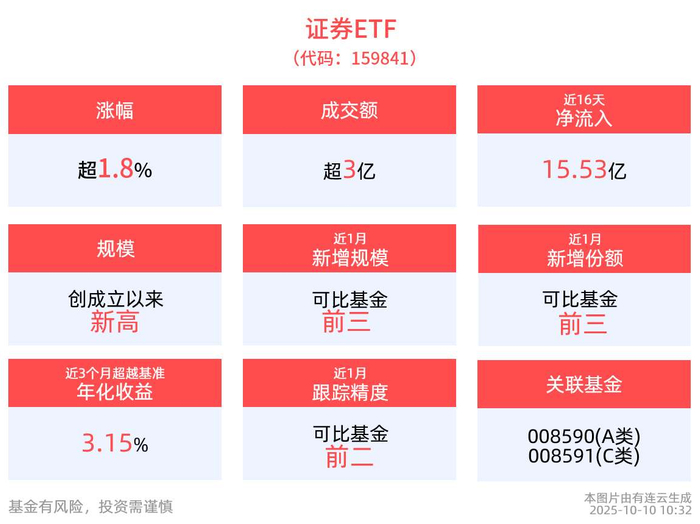
Core Insights - The Securities ETF (159841) has seen a significant increase of 1.83% as of October 10, 2025, with a trading volume of 3.32 billion yuan and a turnover rate of 3.22% [3] - The latest scale of the Securities ETF reached a new high of 9.607 billion yuan, with a notable increase of 13.32 million shares in the past month [3] - There has been a net inflow of 310 million yuan into the Securities ETF, with 14 out of the last 16 trading days showing net inflows totaling 1.553 billion yuan [3] - Leverage funds are actively investing, with a net buying amount of 39.23 million yuan in the previous trading day and a latest financing balance of 392 million yuan [3] Product Highlights - The Securities ETF (159841) tracks a major index focusing on large-cap securities leaders in A-shares, including traditional securities and financial technology leaders [3] Related Events - On September 30, the China Securities Regulatory Commission held a meeting emphasizing the need for comprehensive reforms in the capital market, particularly through the Sci-Tech Innovation Board and the Growth Enterprise Market [4] Institutional Perspectives - Western Securities believes that the investment value of the brokerage sector is gradually being confirmed, with an upward trend in industry prosperity and low valuations combined with high year-on-year growth potential [5] - Guotai Junan Securities notes that the market is overly focused on trading factors, while the fundamental aspects driven by long-term capital inflows and the gradual recovery of investment banking services are underappreciated [5]