中特估

Search documents
申万宏源研究晨会报告-20250616
Shenwan Hongyuan Securities· 2025-06-16 01:11
Group 1: Real Estate Industry - The current housing policy indicates a new model for real estate development, with the implementation of immediate housing sales being orderly and effective. This is part of a long-term mechanism rather than a short-term switch [12][10] - The impact of the immediate housing sales policy includes a significant decline in investment, a reduction in land finance, and a contraction in industry demand. The average pre-sale period in first and second-tier cities has extended from 6 months to 30 months, leading to a drop in investment return rates from 30% to 6% [12][10] - The report maintains a "positive" rating for the real estate sector, emphasizing the need for policy support to stabilize the market and improve the asset-liability situation of residents [12][10] Group 2: Banking Sector - Since the end of 2023, the banking sector has experienced a recovery, with a cumulative increase of 55%, primarily driven by valuation recovery and stable earnings performance [13][11] - The report suggests that the banking sector is significantly undervalued, with an average ROE of about 10% and a PE ratio of approximately 6 times, indicating potential for systematic revaluation [15][11] - The investment strategy focuses on embracing stable, sustainable returns, with recommendations for regional banks and large state-owned banks that are expected to benefit from ongoing reforms and market conditions [15][11] Group 3: Coal Industry - The coal supply is expected to contract due to limited production recovery in Shanxi and declining import volumes, with domestic coal production primarily concentrated in Xinjiang [14][16] - The demand for thermal coal is projected to maintain positive growth in the coming years, supported by stable economic conditions and seasonal demand increases [16][14] - The report highlights that the economic viability of "Xinjiang coal transportation" depends on maintaining high coal prices, with the average price for thermal coal expected to remain between 700-750 RMB/ton [16][14] Group 4: Shipping Industry - The escalation of geopolitical tensions in the Middle East has led to significant increases in oil prices, with Brent crude exceeding 75 USD/barrel, impacting shipping routes and costs [16][3] - The report notes that the closure of the Strait of Hormuz could disrupt approximately 5% of global oil tanker capacity, significantly affecting oil transportation dynamics [16][3] - It is recommended to closely monitor the duration and expansion of the conflict, as well as changes in oil inventory and economic expectations [16][3]





银行股真的涨多了吗?
雪球· 2025-06-15 05:24
风险提示:本文所提到的观点仅代表个人的意见,所涉及标的不作推荐,据此买卖,风险自负。 作者: 倔强的挖挖机 行情进入到2023年 , 六大行率先完成第一轮上涨 , 进入修整 , 恰逢消费向下 , 经济背景弱 , 招行 , 宁波 , 兴业 , 平银等高质量银行大幅补跌 , 整体银行股表现并不明显 ; 但银行 指数却依旧收出"射击之星" ! 这阶段充分验证了前人的话:在你极度悲观时 , 其实行情已经到来 , 其中龙头股可能上涨30% , 当时市场对银行股依旧悲观 , 但是六大行已经悄悄上涨30% 。 真正第一次爆发 , 是2024年 , 我们可以把2024年看作银行股主升的起点 , 对应的是大行的 三浪一 , 中小银行的第一浪 , 2024年银行股上涨一年 , 节奏是一直涨优质行 , 大行 , 9.24后第二梯队银行才开始补涨 , 完成第一浪 。 也充分验证牛市之初 , 先涨优质资产的规律 。 目前进入2025年 , 属于三浪之中 , 其中大行先进入三浪第二轮调整 ( 目前正在进行 ) ; 优 质行也进入三浪第二轮调整 ( 招 、 成 、 江 、 杭 、 宁等挑战1.0pb后 ) ; 而第二梯队银行 将进入三浪第 ...


银行股真的涨多了吗?
雪球· 2025-06-15 05:24
风险提示:本文所提到的观点仅代表个人的意见,所涉及标的不作推荐,据此买卖,风险自负。 作者: 倔强的挖挖机 来源:雪球 银行股开始吸引市场眼球了 , 所以大家看银行股多了起来 , 回望看 , 发现A股银行指数两年 已经上涨50% , h沪银行指数两年上涨70% , 自然冒出了"涨多了"的念头 。 银行股真的涨多了吗 ? 我们来认真分析一下本轮银行股的起始发展 , 来搞清楚目前银行行情所处位置 ( 从这里开始 , 本文非常重要 , 大家要认真看完 ) : 本轮银行股起源于2022年10月 , 那一时期 , 恒大倒了 , 中特估的言论被首次提及 ! 六大行 , 率先起涨 , 顶着恒大破产的压力 , 验证了那句老话:靴子落地 , 股价起涨 。 当讲 了五年"狼来了"的故事兑现后 , 股价制约因素消除 , 开始上涨 。 其中最便宜的交通银行 , 当时股息率已经达到10% , 市净率0.35倍 , 更是在2021年4就已经压不住 , 第一个上涨 ! 行情进入到2023年 , 六大行率先完成第一轮上涨 , 进入修整 , 恰逢消费向下 , 经济背景弱 , 招行 , 宁波 , 兴业 , 平银等高质量银行大幅补跌 , 整体银行 ...

金融行业双周报(2025、5、30-2025、6、12)-20250613
Dongguan Securities· 2025-06-13 09:27
| 银行:超配(维持) | | --- | | 证券:标配(维持) | 2025 年 6 月 13 日 分析师:吴晓彤 SAC 执业证书编号: S0340524070001 电话:0769-22119302 邮箱: wuxiaotong@dgzq.com.cn 金融指数走势 金融行业双周报(2025/5/30-2025/6/12) 保险:超配(维持) 银行板块持续活跃,年内南银转债等多只银行可转债触发强赎 资料来源:东莞证券研究所,iFind 本报告的风险等级为中风险。 本报告的信息均来自已公开信息,关于信息的准确性与完整性,建议投资者谨慎判断,据此入市,风险自担。 请务必阅读末页声明。 请务必阅读末页声明。 投资要点: ◼ 证券:今年以来,证券板块整体呈现震荡调整态势,表现弱于 大盘,目前板块PB为1.40,估值处于近5年45.96%分位点。短期来看,目 前中美谈判处于真空期,政策催化不足,市场主线尚未明晰,整个大盘 缺少向上突破的驱动力。展望下半年,从外围扰动看,若后续美国关税 政策进一步缓和,有望提振全球风险偏好,为券商自营业务创造更稳定 的外部环境;政策层面,资本市场改革持续深化。政府工作报告明确提 ...
沪指重返3400点,关税层面仍有不确定性
Mei Ri Jing Ji Xin Wen· 2025-06-12 00:47
Market Overview - A-shares experienced a rebound with the Shanghai Composite Index surpassing 3400 points, closing up 0.52% at 3402.32 points, while the Shenzhen Component Index rose 0.83% and the ChiNext Index increased by 1.21% [1] - Key sectors leading the market included rare earths, auto parts, and gaming, while the innovative drug sector saw a pullback [1] Economic and Policy Insights - Recent US-China trade talks resulted in a consensus on key economic issues, reflecting a commitment to implement agreements from previous discussions [1] - Despite fluctuations in tariff policies, China's exports maintained steady growth, indicating macroeconomic resilience [1] - The potential for counter-cyclical policies in China may provide positive support for asset prices, suggesting manageable risks for A-shares in the near term [1] Investment Strategies - With long-term capital inflows, the downward space for the market appears limited, and investors are encouraged to consider strategies like dollar-cost averaging and grid trading for opportunistic investments [1] - The upcoming annual dividend distributions in June and July are expected to enhance the appeal of dividend-paying assets [1] Dividend and ETF Focus - The new policies encouraging dividend distributions among listed companies are beneficial for state-owned enterprises, enhancing investor returns and supporting valuation recovery [2] - The Cash Flow ETF and Dividend State-Owned Enterprise ETF have both announced monthly dividends, with the latter achieving 14 consecutive months of distributions [2] - The Cash Flow ETF has outperformed the CSI Dividend Index and the CSI 300 Index over the past nine years, making it an attractive option for investors seeking consistent cash flow [2] Gaming Sector Developments - The Gaming ETF saw a 2.42% increase, driven by the successful launch of new games and the anticipation of major IP products in the second half of the year [3] - Collaborations between gaming companies and AI technology firms are enhancing user experiences and expanding commercial applications within the gaming industry [3][4] - The trend of developing and selling IP-related products is gaining traction among leading film and gaming companies, contributing to revenue growth [4]
股权财政启航下银行业战略配置机遇
HUAXI Securities· 2025-06-12 00:20
Investment Rating - The report maintains a positive outlook on bank stocks, suggesting a "Buy" rating for the sector, with expectations that bank stocks will outperform the Shanghai Composite Index by 15% or more within the next six months [86]. Core Viewpoints - The current rally in bank stocks is primarily driven by state-owned capital, with significant investments from central financial institutions and a shift in foreign capital's stance towards net inflows [30][12]. - The report emphasizes the importance of state-owned capital in stabilizing the banking sector and preventing systemic risks, as well as the potential for bank stocks to provide stable returns for investors seeking income [34][39]. - The anticipated recovery in bank stock valuations is supported by improved asset quality due to policies aimed at stabilizing the housing market and addressing local government debt [60][62]. Summary by Sections 1. State-Owned Capital as the Engine of Bank Stock Rally - The rally began with state-owned banks leading the market, followed by a broader participation from various types of banks in 2024 and 2025 [10][31]. - In 2023, net inflows from ETFs, state-owned capital, and financing funds were significant, while foreign and insurance funds experienced net outflows [12][30]. 2. Restructuring Logic of Equity Finance - The report highlights that state-owned capital's investment in bank stocks serves to stabilize financial markets and provide a reliable income source amid declining land transfer revenues [42][44]. - Bank stocks are viewed as a safe investment due to their high dividend yields and stable performance, with many banks offering yields above 4% compared to lower yields on government bonds [42][44]. 3. Funding Landscape - Long-term Capital as a Stabilizing Force - The report anticipates that insurance and public funds will continue to support bank stocks, with a focus on long-term liquidity [47][51]. - Insurance funds are expected to increase their allocation to bank stocks due to regulatory changes and the need for higher returns in a low-interest-rate environment [51][54]. 4. Fundamental Improvements - Policies aimed at stabilizing the housing market and addressing local government debt are expected to enhance the asset quality of banks, leading to a revaluation of bank stocks [60][62]. - The introduction of new credit tools and technological advancements are seen as catalysts for further growth in the banking sector [60][66]. 5. Policy Environment - Interest Margins Expected to Rebound - The report notes that recent asymmetric interest rate cuts signal a turning point in the excessive benefits provided to the real economy, suggesting a potential rebound in interest margins [70][73]. - Regulatory oversight is focused on maintaining the health of the banking sector while balancing support for economic growth [73]. 6. Investment Recommendations - The report recommends focusing on bank stocks with high dividend yields and strong growth potential, particularly those with robust operational efficiency [80]. - Specific banks highlighted as beneficiaries include China Merchants Bank, Changshu Bank, Chengdu Bank, and Hangzhou Bank [80].



股权财政启航下银行业战略配置机遇:预期破冰,徐徐图之
HUAXI Securities· 2025-06-11 15:12
Investment Rating - The report maintains a positive outlook on bank stocks, recommending a "Buy" rating for the sector, with expectations that stock prices will outperform the Shanghai Composite Index by 15% or more within the next six months [86]. Core Insights - The current rally in bank stocks is primarily driven by state-owned capital, with significant investments from central financial institutions and a shift in foreign capital's stance towards net inflows [30][12]. - The report highlights a strategic opportunity for bank stocks due to their stable performance, high dividends, and the backing of national credit, positioning them as a key asset class in the market [44][42]. - The anticipated recovery in bank stock valuations is supported by policies aimed at stabilizing the real estate market and addressing local government debt, which are expected to enhance asset quality [60][62]. Summary by Sections 1. State-Owned Capital as the Engine of Bank Stock Rally - The bank stock market has seen a continuous rise since 2023, with state-owned banks leading the charge, followed by a broader rally in various bank types in 2024 and 2025 [10][30]. - In 2023, net inflows from ETFs, state-owned capital, and financing funds were significant, while foreign and insurance funds experienced net outflows [12][30]. 2. Restructuring Logic of Equity Finance - The report discusses how state-owned capital's investment in bank stocks serves to stabilize financial markets and provide a buffer against systemic risks, with bank stocks representing over 14% of the A-share market [36][34]. - The focus on equity finance is seen as a means to supplement declining land transfer revenue, with high dividend yields making bank stocks attractive compared to low-yield government bonds [42][44]. 3. Funding Landscape - Long-term Capital as a Stabilizing Force - The report anticipates that insurance and public funds will continue to support bank stocks, with a projected influx of over 1 trillion yuan from insurance capital into the A-share market [54][51]. - The shift in insurance capital from net outflows to inflows in early 2025 indicates a growing interest in bank stocks as a viable investment [52][54]. 4. Fundamental Improvements - Policies aimed at stabilizing the real estate market and addressing local government debt are expected to enhance the asset quality of banks, leading to a revaluation of bank stocks [60][62]. - Innovations in credit expansion and technology are anticipated to provide new growth opportunities for the banking sector [63][66]. 5. Policy Environment - Interest Margins Expected to Rebound - The report notes that recent asymmetric interest rate cuts signal a turning point in the excessive benefits provided to the real economy, suggesting a potential rebound in interest margins [70][73]. - Regulatory measures are being implemented to ensure the health of the banking sector while balancing support for economic growth [73][74]. 6. Investment Recommendations - The report suggests a focus on bank stocks with high dividend yields and strong operational efficiency, highlighting specific banks such as China Merchants Bank, Changshu Bank, Chengdu Bank, and Hangzhou Bank as favorable investment targets [80][76].
A股“红包雨”要来了?
Mei Ri Jing Ji Xin Wen· 2025-06-11 01:19
Group 1 - Ping An Asset Management invested HKD 312 million to increase its stake in Agricultural Bank of China H-shares to 15.09% [1] - In 2023, Ping An Asset Management has been actively increasing its holdings in bank stocks in the Hong Kong market, including a 5% stake in Postal Savings Bank and a 5.01% stake in China Merchants Bank [1] - As of the end of May, insurance funds have issued 15 announcements regarding stake increases, with bank stocks being favored for their high dividend yields [1] Group 2 - The upcoming annual dividend season in June and July is expected to enhance the appeal of dividend-paying assets, particularly for central enterprises [2] - New policies encouraging listed companies to distribute dividends are anticipated to stabilize investor returns and support valuation recovery for state-owned enterprises [2] - The Dividend National Enterprise ETF (510720) announced its 14th consecutive monthly dividend, with a distribution of CNY 0.034 per 10 fund shares [2]
ETF日报:AI相关的板块回调,近期科技重估叙事也有所降温
Xin Lang Ji Jin· 2025-06-10 12:23
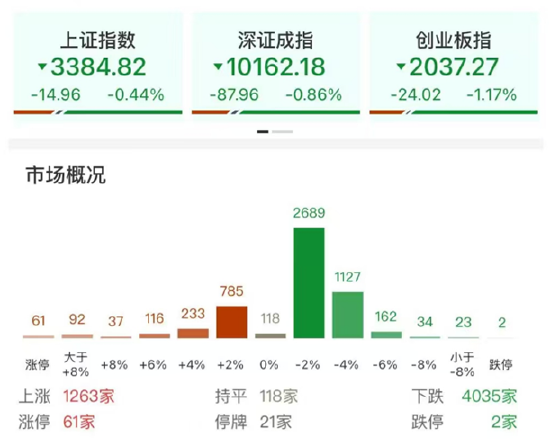
Market Overview - The market experienced a rapid decline in the afternoon, with the ChiNext Index leading the drop. The total trading volume in the Shanghai and Shenzhen markets reached 1.42 trillion yuan, an increase of 129 billion yuan compared to the previous trading day. Over 4,000 stocks fell, with the Shanghai Composite Index down 0.44%, the Shenzhen Component Index down 0.86%, the ChiNext Index down 1.17%, and the CSI A500 Index down 0.59% [1]. US-China Trade Talks - The first meeting of the US-China economic and trade consultation mechanism began in London, aimed at implementing the consensus reached during the recent phone call between the two countries' leaders. Despite fluctuations in tariffs, China's exports maintained steady growth, with a year-on-year increase of 4.8% in May, following an 8.1% increase in April. The growth in exports to the EU and ASEAN offset the decline in exports to the US [3][5]. AI Sector Insights - The AI-related sector saw a pullback, with recent technology revaluation narratives cooling down. However, AI capital expenditures are expected to remain high, and applications such as AI agents and embodied intelligence are gradually commercializing, supported by government policies. This sector continues to be a focus for investors [3][7]. - Major cloud providers and tech companies showed high capital expenditure growth in Q1, unaffected by tariffs and macroeconomic factors, indicating the potential for AI to develop independently [5]. Entertainment Industry Developments - The film market is expected to recover due to a low base from last year and a variety of quality content, with 52 films scheduled for release this summer. The gaming sector is also seeing a surge in new game launches, with several titles quickly entering bestseller lists [8][9]. - Leading companies in the film and gaming sectors are expanding revenue streams by developing and selling IP-related products, enhancing their commercial value [9]. Investment Trends - The banking sector has attracted long-term capital due to its low volatility, high dividends, and low valuations. Ping An Asset Management has increased its stake in Agricultural Bank of China to 15.09%, reflecting a trend of frequent investments in bank stocks [10]. - The upcoming annual dividend distribution in June and July is expected to enhance the appeal of dividend-paying assets. New policies encouraging dividend distributions among listed companies are likely to stabilize investor returns and improve valuations [11].
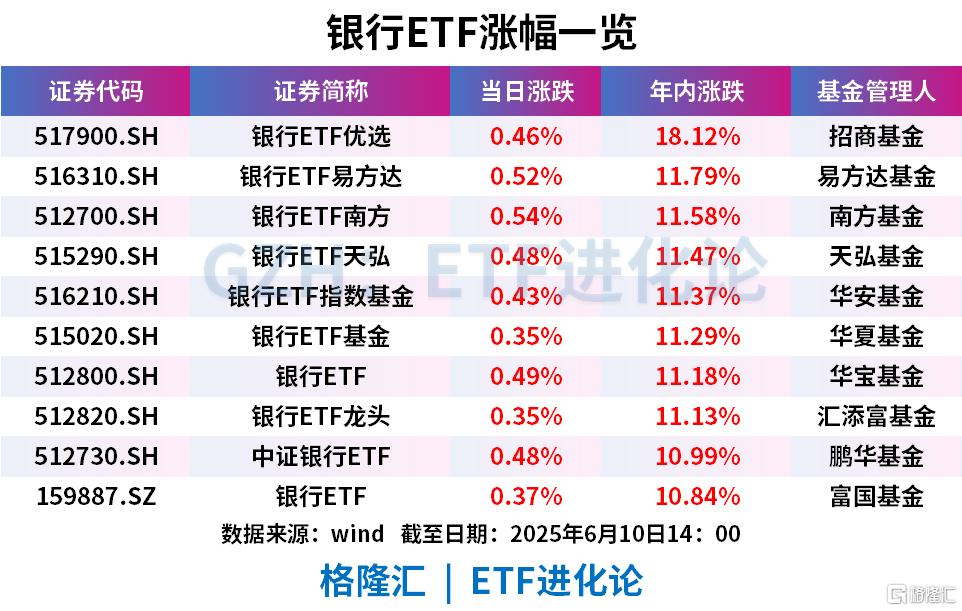
险资频频扫货银行股,银行ETF优选年内涨超18%,银行ETF、中证银行ETF年内涨超10%
Ge Long Hui· 2025-06-10 06:13
Group 1 - Insurance capital frequently purchases bank stocks, with Ping An Life increasing its holdings in China Merchants Bank H-shares to 647 million shares, accounting for over 14% of the total H-shares [1] - The A-share market sees a collective rise in bank stocks, with Minsheng Bank and Zheshang Bank rising over 3%, while several other banks reach historical highs [1] - Various bank ETFs have shown strong performance, with China Merchants Bank ETF up over 18% year-to-date, and other bank ETFs also exceeding 10% gains [1][3] Group 2 - As of June 6, the average dividend yield for listed banks is 4.14%, with state-owned banks yielding between 4.3% and 5%, and several city commercial banks exceeding 4.5% [5] - The dividend distribution schedule has been advanced this year, with many banks completing their annual dividend distributions earlier than in previous years [5] Group 3 - The banking sector has experienced a recovery since the end of 2023, with a cumulative increase of 55%, driven primarily by valuation recovery and high dividend yields [6] - New funding drivers for the banking sector include insurance capital favoring high-dividend banks, estimated incremental funds of 200 billion yuan from insurance premiums, and potential increases from public fund reforms [6] Group 4 - The banking sector is expected to benefit from expansionary policies aimed at stabilizing the economy, with specific banks like Ningbo Bank and Postal Savings Bank highlighted for their potential [7] - The dividend strategy remains sustainable, with banks such as Shanghai Bank and Jiangsu Bank being noted for their positive fundamentals [7]