
国产化替代

Search documents
收购存储芯片资产,300842,火了!超级牛股透露,重磅复产
Zheng Quan Shi Bao· 2025-10-19 00:58
Group 1 - Mindray Medical received the highest number of institutional surveys, with 184 institutions participating, including 14 fund companies, 8 securities companies, 7 private equity firms, 7 insurance companies, and 124 overseas institutions [1] - The company aims to enhance its international influence, align with its global development strategy, attract talent, and optimize shareholder structure and liquidity through its overseas listing [1] - Mindray expects a year-on-year revenue growth by Q3 2025, with a trend of quarterly improvement in revenue, particularly in international markets, which are anticipated to accelerate growth starting from Q3 [1] Group 2 - Rongbai Technology has made significant progress in developing overseas clients, including major companies like Panasonic, and has a robust overseas customer structure [2] - Dike Co. announced a cash acquisition of 62.5% of Jiangsu Jinkai Semiconductor Technology Co., which will become a subsidiary and contribute to the company's consolidated financial statements [2] - Jiangsu Jinkai focuses on storage chip packaging and testing services, with a current capacity of 3KK/month for packaging and 2.5KK/month for testing, planning to expand to 4KK/month [2] Group 3 - Huicheng Environmental has seen a dramatic increase in stock price, nearly 30 times since its low in 2022, with a recent weekly increase of over 20% [3] - The company successfully launched its 20,000 tons/year mixed waste plastic resource utilization project, with stable production following technical upgrades [3] - Jiao Cheng Ultrasonic is increasing its market share in the semiconductor packaging sector by leveraging its technology to compete against foreign equipment manufacturers [3] Group 4 - Hotgen Biotech's affiliate, ShunJing Pharmaceutical, is progressing well with its innovative drug SGC001, having completed Phase I clinical trials and preparing to initiate Phase II trials [4] - Initial results from the trials indicate that the drug's efficacy aligns with expectations, with further statistical analysis underway [4]
双欣环保:打造全球绿色化工新材料一流品牌
Xin Lang Zheng Quan· 2025-10-18 05:15
Core Viewpoint - The successful launch of domestically produced high-end biodegradable water-soluble film additives by Shuangxin Environmental marks a significant breakthrough in achieving independence from foreign monopolies in this sector [1][8]. Group 1: Product Development and Innovation - Shuangxin Environmental has developed a biodegradable water-soluble film additive, achieving a "zero" breakthrough in domestic high-end water-soluble film materials [1][8]. - The company has successfully introduced domestically produced chlorinated vinyl suspension polymer additives, addressing long-standing supply issues in the PVC industry [8]. - The company emphasizes a forward-looking R&D approach, focusing on market demand and customer needs to guide application research and product development [3][6]. Group 2: Quality Management and Operational Excellence - The company implements a comprehensive quality management system that exceeds national and industry standards, ensuring continuous improvement in product quality [2][5]. - Shuangxin Environmental has established a seamless production and sales system, allowing for customized production based on customer requirements [4][6]. - The company has received multiple quality awards, including the Ordos City Mayor's Quality Award and the Inner Mongolia Autonomous Region Chairman's Quality Award [2]. Group 3: Market Position and Brand Strategy - Shuangxin Environmental operates under a dual-brand strategy, collaborating with Mitsubishi Chemical to enhance its market presence in high-end polyvinyl alcohol products [6][7]. - The company has successfully registered 51 domestic trademarks and 26 international trademarks across 18 countries, expanding its global footprint [7]. - The company’s products are now exported to over 40 countries, including regions in Europe, South America, North America, Africa, Southeast Asia, and the Middle East [7].
纳芯微:在人形机器人领域进展顺利
Ju Chao Zi Xun· 2025-10-17 13:29
Core Viewpoint - Naxin Micro (688052.SH) is making significant progress in the humanoid robot sector, having established partnerships with leading industry clients for its core sensor and control chip products [1][2]. Company Overview - Naxin Micro's high-performance analog chips and sensor products are widely used in smart vehicles, industrial control, robotics, and consumer electronics [2]. - The company has achieved application validation of its chips in motion control, torque detection, and position sensing as the humanoid robot industry accelerates its development [2]. Product Development - Naxin Micro has a comprehensive product layout in servo systems, drive control, and sensor detection, covering key technologies such as current detection, angle sensing, pressure detection, and high-precision ADC [2]. - These products provide essential support for precise perception and dynamic control in humanoid robots [2]. Industry Insights - Industry experts believe that the humanoid robot sector has entered a phase of commercial initiation, with accelerated domestic substitution of core components [2]. - Naxin Micro, leveraging its technological accumulation in sensor and signal chain chips, is expected to become a significant supplier in the domestic humanoid robot industry chain [2]. Future Plans - The company plans to continue advancing the iteration of humanoid robot-related chip products and increase R&D investment in smart manufacturing, robot control, and AI perception to enhance product competitiveness [2]. - Naxin Micro aims to actively expand diversified customer collaborations to facilitate the rapid deployment of domestic high-end sensing and control chips in emerging intelligent equipment sectors [2].


研判2025!中国SOC芯片行业相关概述、产业链、市场规模、竞争格局和发展趋势分析:数字化转型浪潮下,SOC芯片行业市场规模增长至3412亿元[图]
Chan Ye Xin Xi Wang· 2025-10-17 01:09
Core Insights - The SOC (System on Chip) industry is experiencing significant growth due to its high integration, low power consumption, and enhanced performance, with the market size in China projected to increase from 221 billion yuan in 2020 to 341.2 billion yuan by 2024, representing a compound annual growth rate (CAGR) of 11.5% [1][9]. SOC Chip Industry Overview - SOC chips integrate all components required for an electronic system into a single chip, including CPU, GPU, memory, and power management units, allowing for a complete microcomputer system [3]. - The applications of SOC chips span across various sectors, including consumer electronics, automotive electronics, IoT, and AI [3]. SOC Chip Industry Chain - The SOC chip industry chain consists of three segments: upstream (chip IP cores, EDA software, semiconductor materials), midstream (chip design, wafer manufacturing, packaging), and downstream (applications in consumer electronics, automotive electronics, IoT, and AI) [5]. SOC Chip Industry Competitive Landscape - The global SOC chip market is highly competitive, with major players like Tesla, NVIDIA, and Qualcomm leading in technology and market share. Domestic companies such as Unisoc, Horizon Robotics, and Huawei HiSilicon are also emerging as significant competitors [9]. SOC Chip Industry Development Trends - Continuous technological innovation is expected to enhance SOC chip performance, with increased R&D investments aimed at achieving higher computing power and lower power consumption [11]. - The trend of domestic substitution is strengthening, with local manufacturers gradually replacing foreign companies in the market, particularly in the smart cockpit SOC chip sector [12]. - The industry has substantial growth potential driven by global digital transformation, 5G proliferation, AI applications, and the rise of IoT devices [14].


海立股份:国际化产业布局成形 数字工厂重塑“智造”新模式 |我在“十四五”这五年 上市公司在行动
Xin Hua Cai Jing· 2025-10-16 11:10
Core Viewpoint - The "14th Five-Year Plan" period is a critical phase for the company to achieve industrial transformation and capability enhancement, with significant revenue growth projected from 11.073 billion yuan in 2020 to 18.747 billion yuan in 2024, representing a 69.3% increase and maintaining a double-digit compound annual growth rate [1] Group 1: Business Development - The company has achieved significant growth in its second main business of automotive parts during the "14th Five-Year Plan" through strategic mergers and acquisitions and independent construction, establishing a global automotive parts business system with over 20 R&D centers and nearly 40 manufacturing bases across 12 countries and regions [2][3] - The company reported a more than 60% increase in overseas revenue from 2021 to 2024, with overseas revenue accounting for 36.38% of total revenue in the first half of 2025 [3] - The company has received recognition from international automotive manufacturers such as Honda, Nissan, and Renault, successfully expanding into the European and American markets [3] Group 2: Technological Innovation and Smart Manufacturing - The company has achieved over 99% localization rate for rotor compressors, driven by advancements in smart manufacturing and digital factories [4] - The establishment of a modern manufacturing technology center in 2009 marked a key milestone in the company's transition from reliance on imported equipment to self-developed production capabilities [4][5] - The company’s intelligent manufacturing strategy is exemplified by its Nanchang smart factory, which integrates lean production, quality excellence, and digital manufacturing technologies, recognized as a leading "future factory" [6] Group 3: ESG and Sustainable Development - The company has established a comprehensive ESG governance system and aims to integrate ESG principles throughout its operations, having joined the United Nations Global Compact [7] - In 2024, the company utilized 54.87 million kWh of green electricity, accounting for 12% of total electricity consumption, and has several national and provincial-level "green factories" [7][8] - The company has improved the energy efficiency of its compressors annually and has been recognized in the "ESG Pioneer 100 Index" by the State-owned Assets Supervision and Administration Commission, ranking 4th in 2024 [8]

新开普:贸易战对新开普的国产化业务长期构成利好
Zheng Quan Ri Bao Wang· 2025-10-16 11:10
Core Viewpoint - The trade war is seen as a long-term benefit for Xinkai Pu's domestic production business, driven by policy-induced market demand and the trend of domestic substitution, providing growth opportunities for the company [1] Summary by Relevant Categories Company Impact - Xinkai Pu's domestic production business is positively influenced by the trade war, which creates a favorable environment for growth [1] Market Trends - The market demand driven by policies and the trend of domestic substitution are identified as key factors supporting the company's business growth [1]

国产开管X-ray设备实现创新突破 赋能芯片检测降本提质
Xin Hua Cai Jing· 2025-10-16 08:00
Core Insights - Wuxi High-tech Zone has significantly increased investment in chip research and development, focusing on overcoming critical "bottleneck" technologies [1] - Rilian Technology Group has successfully developed China's first open-tube X-ray source, enabling nanometer-level resolution detection of high-density integrated circuits and third-generation semiconductor internal structural defects [1][2] - The open-tube X-ray source is a key quality control tool for the semiconductor manufacturing industry, supporting the trend towards smaller, more complex, and integrated designs [1] Company Developments - Rilian Technology's self-developed 160kV open micro-focus X-ray source has achieved standardized production processes, allowing for mass production of its AX9600 semiconductor intelligent inspection equipment [2] - The AX9600 equipment captures 0.8μm-level defects and provides nanometer-level imaging, ensuring a closed-loop quality control process for semiconductor packaging defects [2] - The deployment of this equipment in advanced production bases has significantly improved detection accuracy and reduced reliance on imported high-end detection equipment, enhancing the market share of domestic devices [2] Industry Context - Rilian Technology is recognized as a leading player in the industrial inspection field, competing globally and reshaping the industry landscape [3] - According to a recent Frost & Sullivan report, Rilian Technology is part of the "GUN" group alongside GE and Nordson, noted for its comprehensive service capabilities in industrial X-ray detection [3] - Wuxi High-tech Zone is optimizing its business environment and has introduced several policies to support the development of the integrated circuit industry, aiming to accelerate the domestic replacement of key technologies [3]

中晶科技(003026) - 中晶科技:投资者关系活动记录表
2025-10-16 07:50
Group 1: Shareholding and Control - After the completion of the share reduction, the controlling shareholder's stake remains above 35%, ensuring stable control [2] - The share reduction was executed as planned, primarily due to personal financial needs [2] Group 2: Research and Development - The company is actively monitoring industry trends and potential opportunities in the semiconductor materials sector, planning to enhance R&D and production capacity in cutting-edge areas [2] - The company aims to continuously strengthen its main business and increase R&D efforts to optimize product structure and improve profitability [3] Group 3: Market Expansion and Product Strategy - The company has made significant progress in expanding into downstream markets such as automotive electronics and industrial control, with plans to further optimize product structure and increase the proportion of high-margin products [3] - The company is committed to advancing the domestic production of semiconductor single crystal silicon materials, aligning with national policies to enhance competitiveness [3] Group 4: Employee Incentives - The company holds some shares in a repurchase account, which may be used for employee incentives to boost team cohesion and innovation [3]
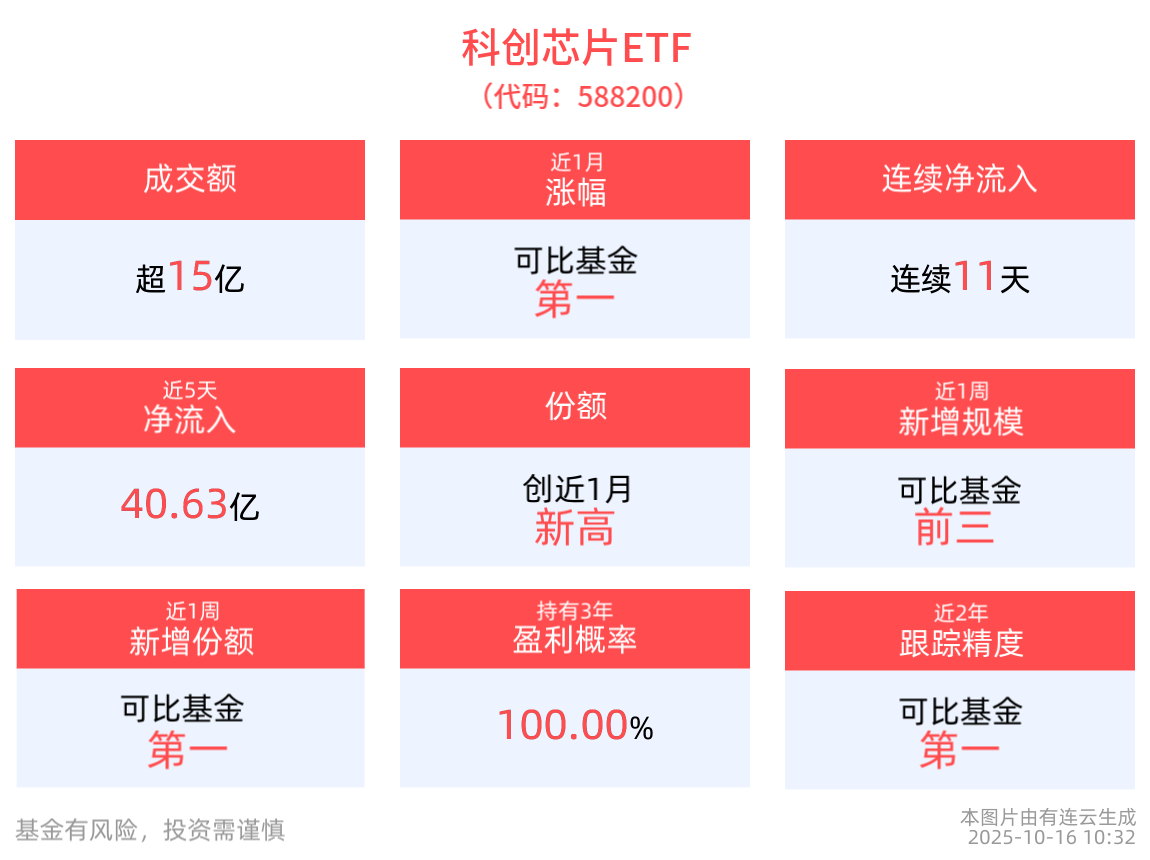
近11天获得连续资金净流入,科创芯片ETF(588200)最高单日“吸金”超27亿元,份额创近1月新高!
Sou Hu Cai Jing· 2025-10-16 04:25
Group 1: ETF Performance - The Sci-Tech Chip ETF experienced a turnover of 3.59% during trading, with a transaction volume of 1.512 billion yuan [2] - The ETF's scale increased by 261 million yuan over the past week, reaching a new high of 17.38 billion shares, ranking first among comparable funds [2] - The ETF has seen continuous net inflows for 11 days, with a single-day peak net inflow of 2.748 billion yuan, totaling 7.428 billion yuan in net inflows [2] - As of October 15, the ETF's net value has risen by 143.18% over the past three years, ranking 14th out of 1890 index equity funds, placing it in the top 0.74% [2] - The ETF's highest monthly return since inception was 35.07%, with the longest streak of consecutive monthly gains being 4 months and the longest gain percentage being 74.17% [2] Group 2: Semiconductor Industry Insights - On October 15, Haiguang Information released the first A-share semiconductor performance report for Q3 2025, reporting a revenue of 9.49 billion yuan, a year-on-year increase of 54.65%, and a net profit of 1.961 billion yuan, up 28.56% year-on-year [3] - The semiconductor industry is experiencing strong demand, with ongoing domestic substitution driving the need for domestic semiconductor equipment [3] - Institutions recommend focusing on companies that have achieved technological breakthroughs in key areas and have entered the mainstream chip manufacturing supply chain [3] - Donghai Securities believes that investment intensity in the AI sector remains strong, indicating long-term growth potential [3] - The domestic semiconductor substitution process is expected to accelerate, enhancing local semiconductor supply chain construction and reshaping global semiconductor supply chain dynamics [3] Group 3: Top Weighted Stocks - The top ten weighted stocks in the Shanghai Sci-Tech Chip Index account for 59.69% of the index, with notable companies including Haiguang Information, Lanke Technology, and SMIC [2][3] - The performance of these stocks varies, with notable changes in stock prices, such as Huami Information down 2.58% and Cambrian up 3.67% [5] - Investors without stock accounts can access domestic chip investment opportunities through the Sci-Tech Chip ETF linked fund (017470) [5]





科创板IPO双过会!打破国际厂商垄断,昂瑞微预计2027年实现盈亏平衡
Sou Hu Cai Jing· 2025-10-16 01:55
Core Viewpoint - The article discusses the IPO status and regulatory scrutiny of Angrui Micro, highlighting its current unprofitability and the focus on product growth potential, operational sustainability, and distribution model during the review process [1][4]. IPO Status - Angrui Micro's IPO was accepted by the Shanghai Stock Exchange on March 28, 2025, and the company is currently not profitable [1][4]. - The company completed two rounds of inquiry responses during the review process, with repeated questions regarding product growth, sustainability, and distribution model [1][4]. Financial Performance - Angrui Micro reported a net loss of -47,409.76 million, -45,013.32 million, and -11,002.69 million for the reporting periods, with cumulative losses of -123,862.61 million by the end of 2024 [14]. - The company expects to achieve profitability by 2026 and break even by 2027, with projected revenue of around 3 billion and a gross margin of over 23% at that time [20]. Revenue Breakdown - The main business revenue for Angrui Micro is derived from RF front-end chips, with significant contributions from 5G PA and modules, which accounted for 50.42% of total RF front-end revenue in 2024 [7][8]. - The revenue from distributors increased significantly, with sales of 69,472.12 million, 128,169.04 million, and 157,285.71 million in the reporting periods, representing 75.26%, 75.62%, and 74.85% of total revenue respectively [21]. Market Position and Competition - Angrui Micro is positioned as a key player in the RF and analog integrated circuit design sector, focusing on domestic supply chain replacement and breaking foreign monopolies [6]. - The company has achieved industry-leading levels in 5G RF front-end modules and has a strong market presence in the low-power Bluetooth SoC segment, ranking second among domestic manufacturers [10]. Regulatory Scrutiny - The regulatory body has raised concerns regarding Angrui Micro's operational sustainability, product growth potential, and the impact of competitive pressures on pricing and profitability [14][18]. - The company has been asked to clarify the rationale behind the significant increase in the number of distributors and corresponding sales revenue in 2024 [22][23].
