
量子科技

Search documents
量子科技概念异动拉升 神州信息直线涨停
Xin Lang Cai Jing· 2026-01-08 02:41
Group 1 - Quantum technology concept saw significant intraday movement, with Shenzhou Information hitting the daily limit up [1] - Other companies such as Keda Guokai, Fujida, Geer Software, Zhejiang Dongfang, and Guodun Quantum also experienced rapid gains [1]






A股指数集体低开:沪指跌0.2%,有色·锌、航天系等板块跌幅居前
Feng Huang Wang Cai Jing· 2026-01-08 01:35
Market Overview - The three major indices in China opened lower, with the Shanghai Composite Index down 0.20%, the Shenzhen Component Index down 0.42%, and the ChiNext Index down 0.63% [1] - The market saw declines in sectors such as non-ferrous metals, aerospace, and cobalt [1] Index Performance - Shanghai Composite Index: 4077.72, down 0.20%, with 572 gainers and 1388 losers, trading volume of 96.55 billion [2] - Shenzhen Component Index: 13971.89, down 0.42%, with 710 gainers and 1791 losers, trading volume of 150.90 billion [2] - ChiNext Index: 3308.74, down 0.63%, with 378 gainers and 876 losers, trading volume of 54.66 billion [2] External Market - U.S. stock indices showed mixed performance, with the S&P 500 closing down due to declines in financial stocks like JPMorgan and Blackstone, while Nvidia and Alphabet saw gains, pushing the Nasdaq slightly up [3] - The Dow Jones Industrial Average fell by 466.00 points (0.94%) to 48996.08, while the Nasdaq rose by 37.10 points (0.16%) to 23584.27 [3] - The Nasdaq Golden Dragon China Index fell by 1.58%, with major Chinese stocks like Full Truck Alliance and Tencent Music experiencing significant declines [3] Industry Insights - CITIC Securities predicts that the commercial aerospace industry is entering a new era, driven by national policy support and technological breakthroughs [4] - The report highlights key areas in commercial aerospace, including remote sensing applications, satellite control systems, and space computing capabilities [4] - CITIC Securities also forecasts that by 2026, the oil market will enter a supply surplus phase, with significant opportunities in refining, shale oil, and natural gas sectors [5] - The report indicates that the global oil market will see a surplus of 3.84 million barrels per day, leading to a systemic decline in oil prices [5] - Galaxy Securities emphasizes the advancement of quantum technology and its transition from research to industrial application, recommending investment in high-barrier technologies and core components [6] - CICC expresses optimism about the inflow of funds into insurance, fixed income products, and private equity funds, highlighting the growth potential in these areas [8]


合肥“十五五”规划建议:推进氢能、氨能等技术迭代应用,布局小型堆等先进核能技术
Zheng Quan Shi Bao Wang· 2026-01-08 01:31
Core Viewpoint - The Hefei Municipal Committee emphasizes the development of future industries with a focus on "quantum intelligence" and aims to drive innovation in sectors with technological advantages and development foundations [1] Group 1: Quantum Technology Industry - The plan includes promoting breakthroughs and applications in quantum communication, quantum computing, and quantum precision measurement [1] - There is a focus on accelerating the research and industrialization of key materials, devices, and equipment [1] - The initiative aims to expand "quantum+" demonstration projects in government, finance, energy, and meteorology sectors [1] Group 2: Nuclear Fusion and Hydrogen Energy Industry - The development of compact fusion energy experimental devices is highlighted as a key infrastructure project [1] - The plan aims to accelerate the development of superconducting materials, equipment, and smart sensors [1] - There is an emphasis on advancing the application of hydrogen and ammonia energy technologies and laying out advanced nuclear energy technologies like small reactors [1] Group 3: Biomanufacturing Industry - The focus is on biobased chemicals and materials, new food products, bio-agriculture, and non-food biomass raw materials [1] - The initiative aims to expand large-scale applications in these areas [1] Group 4: Embodied Intelligence Industry - The plan promotes the integrated development of intelligent decision-making systems, high-precision control systems, and innovative structural design [1] - It aims to construct a full-chain innovation ecosystem encompassing precision processing, data training, evaluation, and competitive testing [1] Group 5: Emerging Technologies - The strategy includes tracking and laying out plans in niche areas such as brain-computer interfaces, sixth-generation mobile communication, and deep space and deep sea exploration [1] - The goal is to promote more technological research and industrialization to achieve "parallel running" and "leading" positions in these fields [1]
银河证券:量子科技发展超预期 超前投资领跑可期
Di Yi Cai Jing· 2026-01-08 00:21
Group 1 - The National Development and Reform Commission (NDRC) aims to promote quantum technology and sixth-generation mobile communication as new economic growth points [1] - The quantum technology industry is transitioning from laboratory research to industrial application [1] - Current investments should focus on upstream core components with high technical barriers and clear commercialization paths, as well as midstream system integration [1]

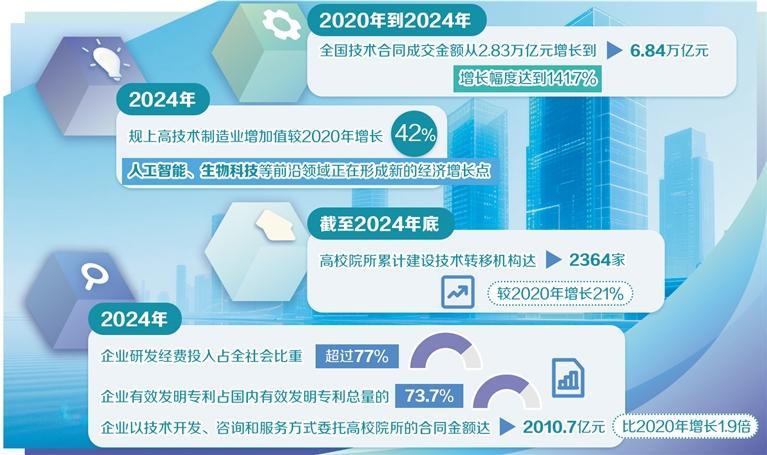
科技成果加速“变现”
Xin Lang Cai Jing· 2026-01-07 21:21
Core Insights - The report presented by Chen Jiachang, Vice Minister of the Ministry of Science and Technology, highlights a significant increase in the national technology contract transaction amount from 2.83 trillion yuan in 2020 to 6.84 trillion yuan in 2024, marking a growth of 141.7% [2] - The report emphasizes the importance of transforming technological innovation into high-quality development, with a focus on streamlining the path for technology transfer [2] Policy Guidance - The primary challenge in accelerating the transformation of scientific and technological achievements is the lack of coordination between the innovation chain and the industrial chain [3] - A comprehensive institutional framework for technology transfer has been established, with over 200 supporting policy documents created at local levels [3] - During the 14th Five-Year Plan period, China has made significant advancements in fields such as quantum technology and artificial intelligence, transitioning from a "follower" to a "leader" in these areas [3] Mechanism Innovation - The "island effect" among innovation entities hinders the systematic advancement of technology transfer [4] - Universities and research institutions are taking the lead in breaking through these barriers by integrating resources and establishing comprehensive platforms for technology transfer [4] - By the end of 2024, the number of technology transfer institutions in universities and research institutes reached 2,364, a 21% increase from 2020 [4] Funding Support - Funding is identified as a critical factor for the transformation of technological achievements, with many technology-based enterprises facing challenges in financing [6] - The National Technology Transfer Guidance Fund has invested in over 700 technology enterprises, leading to a total scale of local technology transfer funds exceeding 1.4 trillion yuan [6] - By the end of Q3 2025, loans to technology-based small and medium-sized enterprises reached 3.56 trillion yuan, a year-on-year increase of 22.3% [6] Capital Market and Insurance Support - The bond market for technology has progressed steadily, with around 100 institutions issuing technology innovation bonds exceeding 250 billion yuan [7] - Insurance for technology research and transfer provided risk coverage of approximately 9 trillion yuan in 2024 [7] - Continuous support for venture capital institutions and the establishment of a comprehensive evaluation mechanism for state-owned venture capital funds are essential for sustaining the momentum of technology transfer [7]
资金涌入!3天超50亿
Zhong Guo Zheng Quan Bao· 2026-01-07 14:32
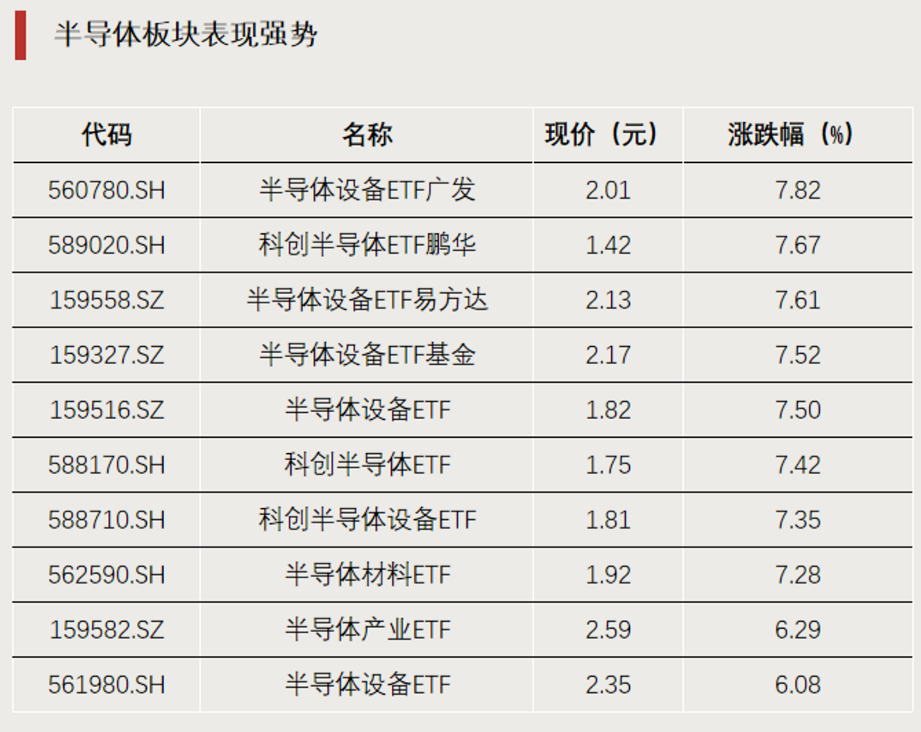
Group 1: Semiconductor Sector Performance - The semiconductor sector showed strong performance on January 7, with multiple related ETFs rising over 7% in a single day [1][3] - The semiconductor equipment ETF from Guangfa reached a peak increase of 8% during the morning session, closing with a total market increase of 7.82% [3][4] - Several semiconductor-themed ETFs have seen a cumulative increase of over 18% in the first three trading days of 2026 [3] Group 2: Other Sector Movements - The aviation and fintech sectors experienced a pullback on January 7, with several related ETFs declining by over 2% [5][6] - The performance of various Hong Kong stocks, including automotive, brokerage, software, satellite, real estate, and oil and gas ETFs, was also weak [5] Group 3: Fund Flows into ETFs - Significant capital inflows were observed in broad-based, non-ferrous, and gold sectors, with over 10 billion yuan flowing into several ETFs from January 5 to 6 [7][8] - In the last three trading days of 2025, over 50 billion yuan was invested in non-ferrous themed ETFs, indicating strong interest in this sector [2][9] Group 4: Factors Driving Semiconductor Growth - Three core factors are driving the upward movement of the semiconductor sector: policy support for frontier technologies, technological breakthroughs reshaping demand, and a tight supply-demand balance [10] - The National Development and Reform Commission has emphasized the promotion of quantum technology and brain-machine interfaces as new economic growth engines, providing a clear development direction for the semiconductor sector [10] - The demand for AI computing power continues to rise, leading to a historical supply shortage in memory chips, which is expected to maintain a high prosperity cycle in the storage industry [10]
中国银河证券:量子科技带来新经济增长动能 超前投资领跑可期
Zhi Tong Cai Jing· 2026-01-07 02:47
Group 1 - The core viewpoint of the report emphasizes that the quantum technology industry is transitioning from laboratory research to industrial application, with current investments focusing on high technical barriers and clear commercialization paths in upstream core components and midstream system integration [1] - The National Development and Reform Commission (NDRC) aims to promote quantum technology and sixth-generation mobile communication as new economic growth points [2] Group 2 - Quantum technology, based on the principles of quantum mechanics, enables breakthroughs in information processing, transmission, and measurement, distinguishing itself from traditional technologies that rely on classical physics [3] - The global quantum technology industry is projected to reach a total scale of $8 billion by 2024, with North America accounting for 31.45%, Europe for 26.91%, China for 24.03%, and the Asia-Pacific region (excluding China) for 12.74% [4] - By 2035, the global quantum industry scale is expected to reach $908.91 billion, with quantum computing alone projected to reach $807.75 billion, indicating significant future market potential [4] Group 3 - Investment recommendations include focusing on companies such as Guodun Quantum, Hexin Instruments, and IonQ, which are positioned to benefit from the growth in the quantum technology sector [5]
科创产业新词频现政府工作报告
Chang Jiang Ri Bao· 2026-01-07 01:16
Group 1: Government Initiatives and Innovations - The government report highlights the launch of the world's first Beidou high-precision chip and the fastest magnetic levitation technology, showcasing advancements in various fields [1] - The report emphasizes the establishment of "Wan Zhao Pioneer" cities, aiming to enhance high-performance computing capacity by over 2500P, which is crucial for future industrial ecosystems [5] - The construction of facilities like the magnetic confinement deuterium-deuterium fusion neutron source is accelerated, representing a significant step towards sustainable energy solutions [8] Group 2: Smart Manufacturing and Industry Leadership - Two companies, Wuhan Changfei Optical Fiber and Cable Co., Ltd. and Wuhan BOE Optoelectronics Technology Co., Ltd., have been recognized as the first batch of national leading smart factories, marking Wuhan's leadership in intelligent manufacturing [4] - The concept of "root technology, root enterprises, and root industries" is introduced, focusing on fostering innovation and long-term growth within the local ecosystem [10] - The establishment of "Silicon Alleys" aims to create innovation clusters that facilitate the transformation of technological achievements into market applications, enhancing the local entrepreneurial environment [9] Group 3: Future Technologies and Research - The government report outlines a strategic focus on emerging industries such as embodied intelligence, future displays, 6G, synthetic biology, quantum technology, brain-machine interfaces, hydrogen energy, and nuclear fusion [3] - The emphasis on building a robust computing infrastructure is seen as essential for meeting the increasing demands of artificial intelligence across various sectors [7]



火石创造年度盘点:纵览2025热门产业脉搏
Sou Hu Cai Jing· 2026-01-07 00:45
Core Insights - The year 2025 marks the end of the "14th Five-Year Plan" and the beginning of the "15th Five-Year Plan," focusing on industrial and corporate development in China, with an emphasis on emerging fields such as artificial intelligence, low-altitude economy, quantum technology, humanoid robots, and industrial mother machines [1] Artificial Intelligence - The fourth technological revolution is driven by artificial intelligence, with 29 provinces prioritizing "artificial intelligence" in their 2025 work plans, aiming for deep integration with traditional industries [2] Low-altitude Economy - The low-altitude economy is becoming a competitive arena globally, with 30 provinces including it in their 2025 government work reports, exploring differentiated development paths based on regional characteristics [3] Quantum Technology - Quantum technology is a key focus in the "15th Five-Year Plan," seen as essential for fostering new productive forces and high-quality development, with cities like Hefei, Beijing, and Shanghai leading the way [4] Humanoid Robots - Humanoid robots are recognized as one of the "Top Ten Engineering Achievements of 2025," representing a fusion of artificial intelligence and advanced manufacturing, with significant development in regions like Beijing-Tianjin-Hebei, Yangtze River Delta, and Pearl River Delta [5] Industrial Mother Machines - Industrial mother machines are crucial for manufacturing competitiveness, with the "15th Five-Year Plan" advocating for breakthroughs in key technologies, showing regional clustering in areas like the Yangtze River Delta and Pearl River Delta [6] AI Large Models - 2025 is a pivotal year for AI large models, with 611 generative AI services registered as of November 1, showcasing a pyramid distribution across provinces [7] Embodied Intelligence - Embodied intelligence is highlighted in the government work report for the first time, with various policies being introduced to accelerate its development, attracting global tech companies [8] Additive Manufacturing - Additive manufacturing is rapidly integrating into China's economy, with significant clustering in regions like Beijing-Tianjin-Hebei, Yangtze River Delta, and Pearl River Delta, alongside emerging hubs in central and western regions [9][10] Computing Power - Computing power is deemed essential in the digital economy, with regions actively developing resources to transform potential into high-quality growth, supported by the "East Data West Computing" initiative [11] High-end Medical Devices - The high-end medical device sector is experiencing rapid technological advancements and industrial upgrades, driven by geopolitical tensions and tariff escalations, with a focus on innovation and domestic substitution [12] Financial Services in Technology - The company has established technology finance service platforms in multiple provinces, supporting technology-based enterprises with significant loan disbursements, exemplified by nearly 80 billion yuan in loans in Hubei [14]

新赛道升级 塑造发展新优势
Jing Ji Ri Bao· 2026-01-06 22:35
Core Insights - The "15th Five-Year Plan" emphasizes the cultivation and expansion of emerging and future industries, aiming to create new pillar industries and strategically position future industries for growth [1] Group 1: Emerging Industries - During the "14th Five-Year Plan," China's emerging industries accelerated development, forming significant scale effects with several trillion-yuan market opportunities emerging by 2025 [2] - The commercial aerospace industry is on the verge of explosion, with advancements such as the successful launch of the Zhuque-3 rocket and accelerated deployment of satellite internet constellations [2] - The low-altitude economy is entering a commercial phase, marked by the issuance of operational certificates for manned civil unmanned aerial vehicles and the promotion of typical application scenarios by the Ministry of Transport [2] - New materials are crucial for breakthroughs in aerospace performance, with innovations in high-strength stainless steel and carbon fiber composites being utilized in key projects [2] Group 2: Energy Transition - China's energy transition has accelerated, establishing the world's largest power infrastructure and renewable energy systems, with plans to increase the share of renewable energy significantly by 2026 [3] - The "15th Five-Year Plan" aims to enhance emerging pillar industries, focusing on innovation in sectors like renewable energy, new materials, aerospace, and low-altitude economy [3] Group 3: Future Industries - Rapid advancements in future industries such as artificial intelligence, quantum information, and biomanufacturing have been noted, with significant breakthroughs achieved during the "14th Five-Year Plan" [4] - The development of 6G technology is prioritized, with expectations for commercial applications to begin around 2030, indicating a deep integration with AI [4][5] - Future industries are characterized by their potential to create new demands and economic forms, with quantum technology and nuclear fusion energy expected to play pivotal roles [6] Group 4: Market Opportunities and Challenges - Emerging industries are entering a rapid growth phase, with key scenarios being validated and replicable business models established, while future industries are still in the exploratory phase [7] - The uncertainty in future industries stems from both technological and commercial aspects, requiring significant R&D investment and policy support [8] - The collaboration between emerging and future industries is essential for driving new economic engines, with a focus on innovation and long-term value creation [9]