
产业链供应链合作

Search documents
中国贸促会:本届链博会在服务中外企业方面实现提质升级
Zhong Guo Xin Wen Wang· 2025-06-17 04:38
Group 1 - The core innovation of the current Chain Expo is to better implement the overall deployment of the 20th National Congress of the Communist Party of China regarding the improvement of a high-level open system, aligning the expo with the national opening strategy for enhanced service to domestic and foreign enterprises [1] - The proportion of foreign exhibitors at this year's Chain Expo has increased to 35%, up from 32% last year, with several international organizations setting up dedicated booths for the first time, indicating a stronger international presence [1] - A new alliance of domestic and foreign exhibitors will be established during the expo to promote resource sharing and industrial collaboration, aiming to create a "never-ending Chain Expo" [1] Group 2 - The Chain Expo will create new platforms for communication and cooperation to optimize regional opening layouts, with many enterprises from Hainan continuing to participate and a supply-demand matching event being held to support the development of Hainan Free Trade Port [2] - The expo will focus on promoting the construction of the New Land-Sea Corridor and China-ASEAN supply chain cooperation, contributing to a comprehensive opening pattern [2] - An innovation chain area will be set up to facilitate the integration of technological and industrial innovation, inviting leading enterprises and specialized firms to participate [2] Group 3 - The expo will introduce a "Six Chains and One Exhibition Area" industrial map to showcase key materials, technologies, products, and enterprises across various industrial chains [3] - A white paper on industrial chain risk research will be jointly released with China People's Insurance Company to identify risk points and propose solutions, enhancing the resilience and security of the industrial chain [3] - The Chain Expo is positioned as a significant platform for cooperation between Chinese and foreign businesses, aiming to deepen the concept of "chain" and create a memorable event [3]
2025中国(广东)—东盟贸易促进与供应链合作机制建设对接交流会在广州举行
Yang Shi Wang· 2025-06-11 08:18
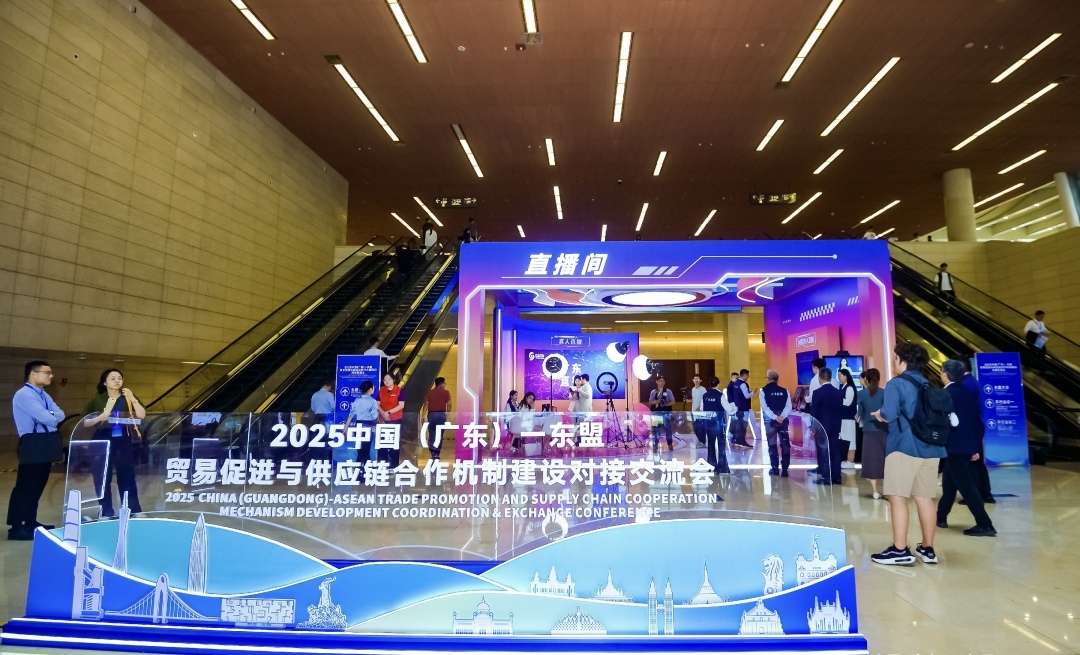
Core Points - The event aims to enhance cross-border cooperation between Guangdong and ASEAN in supply chains and promote bilateral trade and investment growth [1][3] - Multiple cooperation outcomes were announced, including the signing of memorandums and the establishment of trade service centers in several ASEAN countries [3] - Guangdong's trade with ASEAN accounts for one-fifth of China's total trade with the region, highlighting its strategic importance [3] Group 1 - The 2025 China (Guangdong) - ASEAN Trade Promotion and Supply Chain Cooperation Mechanism Construction Exchange Conference was held in Guangzhou [1] - The conference included discussions on deepening supply chain cooperation and enhancing resilience in industrial chains [1] - Parallel meetings focused on trade cooperation with Indonesia and cross-border e-commerce with ASEAN [1] Group 2 - The Guangdong Provincial Council for the Promotion of International Trade signed a cooperation memorandum with ASEAN business organizations [3] - The "Yue Chain ASEAN" online service platform was launched to facilitate business services [3] - Seven additional cooperation projects were initiated, with a total value exceeding 3.1 billion USD [3] Group 3 - Guangdong enterprises have achieved significant results in investment, factory establishment, and cooperation in various sectors within ASEAN [3] - Increasingly, ASEAN companies view Guangdong as a primary gateway to enter the Chinese market [3] - The Guangdong Provincial Council aims to leverage resources and channels to foster collaboration across various fields, including economy, trade, technology, culture, education, and tourism [3]

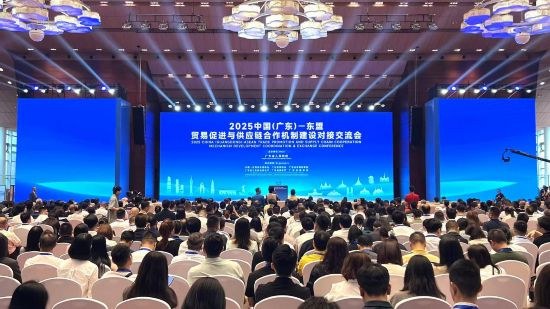
广东东盟携手共谋合作新路径!“粤链东盟”平台启动助力跨境发展
Guang Zhou Ri Bao· 2025-06-10 15:22
Group 1 - The event held in Guangzhou on June 10 focused on enhancing cross-border cooperation between Guangdong and ASEAN countries, aiming to boost bilateral trade and investment [1][3] - Multiple cooperation outcomes were achieved, including the signing of a memorandum of cooperation between Guangdong Provincial Council for the Promotion of International Trade and ASEAN business organizations, and the establishment of the "Guangdong-ASEAN International Supply Chain Cooperation Alliance" [1][10] - The total trade volume between Guangdong and ASEAN is projected to account for one-fifth of China's trade with ASEAN by 2024, highlighting the growing importance of this partnership [3][6] Group 2 - The "Yue Chain ASEAN" online platform was launched to facilitate cross-border cooperation and enhance the level of supply chain collaboration between Guangdong and ASEAN [9][10] - Guangdong enterprises are increasingly investing in ASEAN markets, with significant projects in sectors such as green energy, digital economy, and manufacturing [3][6] - The establishment of trade and investment service centers in Cambodia, Malaysia, Singapore, Indonesia, and Vietnam aims to support Guangdong enterprises in expanding their market presence [10][12] Group 3 - The beauty and cosmetics industry is expected to see significant growth in trade between China and ASEAN, with bilateral trade projected to reach $982.3 billion by 2024 [6] - Guangdong's manufacturing capabilities and technological innovation are seen as key advantages for ASEAN countries, particularly Indonesia, which is looking to strengthen its industrial base [4][6] - The collaboration between Guangdong and ASEAN is expected to create new business opportunities and enhance the efficiency of regional supply chains [3][10]

第9届中国—南亚博览会亮点前瞻
Xin Hua She· 2025-06-06 11:35
Group 1 - The 9th China-South Asia Expo will be held from June 19 to 24 in Kunming, Yunnan, focusing on the theme of "Unity and Cooperation for Common Development" [1] - Trade cooperation between China and South Asian countries has shown steady growth, with trade volume expected to approach $200 billion by 2024, doubling over the past decade with an average annual growth rate of approximately 6.3% [1][2] - China has become the largest trading partner for countries like Pakistan and Bangladesh, highlighting the deepening economic ties [1] Group 2 - Investment cooperation is expanding, with significant projects like the upgraded China-Pakistan Economic Corridor and investments in Sri Lanka's Hambantota Port [1] - The China-Maldives Free Trade Agreement has come into effect, and negotiations for upgrading investment agreements with Bangladesh are underway [1] - The expo will feature Sri Lanka as the theme country and Thailand as a special partner, with nearly 800 exhibition booths, including a significant number from India and Pakistan [2] Group 3 - The expo will emphasize green trade, digital trade, and service trade, aiming to promote deeper economic cooperation and lead new consumption trends [3] - A total of 11 specialized pavilions will be set up, focusing on advanced manufacturing, clean energy, and modern agriculture, with nearly 70% of the exhibition space dedicated to specialized exhibits [2][3] - The event will also host around 40 professional economic and trade activities, including the 6th China-South Asia Cooperation Forum, to facilitate industry resource matching [3] Group 4 - China and South Asian countries have complementary advantages in industrial and supply chains, presenting opportunities for collaborative development [4] - The Chinese side is willing to work with South Asian countries through trade, investment, and technology cooperation to maintain global supply chain stability and promote mutual development [4]
【重磅招募】2025长安汽车前瞻技术交流盛会 · 7月专场。「长安汽车官方主办,年度性供应商交流合作平台 」→附重点采购方向清单
半导体芯闻· 2025-06-05 10:04
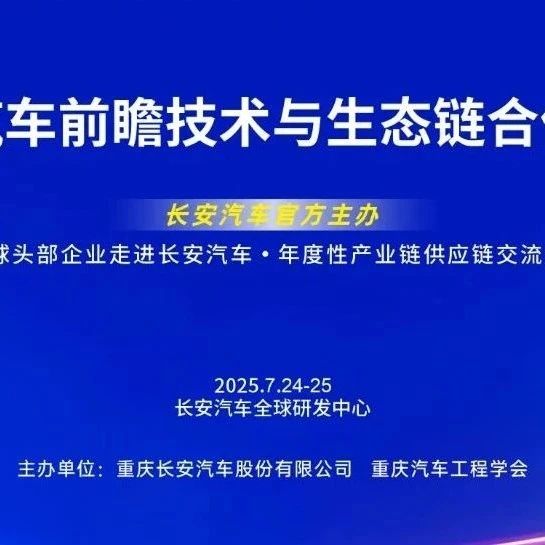
Group 1 - Changan Automobile is one of the four major automotive groups in China, with a history of 163 years and over 40 years of vehicle manufacturing experience, operating 12 manufacturing bases and 22 factories globally [3] - In 2024, Changan Automobile achieved sales of 2.683 million vehicles, a year-on-year increase of 5.1%, with 730,000 units of new energy vehicles sold and over 530,000 units sold overseas [3] - The company aims to reach total sales of 3 million vehicles, 1 million new energy vehicles, and 1 million overseas sales in 2025 as part of its "third entrepreneurial plan" focusing on smart electric transformation and globalization [3] Group 2 - The Changan Automobile Global R&D Center, covering over 1,000 acres with an investment of 4.3 billion yuan, integrates seven major functions and 180 laboratories, serving as a hub for product development and experimental verification [4] - The center collaborates with various R&D centers across nine countries to drive Changan's transformation and provide new opportunities for global partners [4] Group 3 - The "Changan Automobile Forward Technology and Ecological Chain Cooperation Exhibition and Exchange Conference" series aims to build an innovative technology exchange platform for smart electric vehicles, enhancing communication and cooperation within the industry [7] - Since its inception in 2023, over 300 industry-leading companies have participated in the events, facilitating cross-industry collaboration and joint research [7] Group 4 - The event will feature an opening ceremony, product exhibitions, a forward technology forum, supply-demand matching, and interactive visits, specifically inviting over 100 innovative enterprises from the automotive supply chain [21] - A closed-door forum will focus on key technology areas such as intelligent driving, vehicle networking, and automotive chips, with over 10 thematic discussions planned [30] Group 5 - Key procurement directions include intelligent systems, power systems, chassis systems, electronic systems, new supply chains, and testing and quality control technologies [41][45][48][50][52][55] - The focus is on components and technologies essential for smart electric vehicles, including advanced sensors, electric drive systems, and digital technologies [41][45][48][50][52][55]

【重磅招募】2025长安汽车前瞻技术交流盛会 · 7月专场。「长安汽车官方主办,年度性供应商交流合作平台 」→附重点采购方向清单
半导体芯闻· 2025-06-05 10:04
Group 1 - Changan Automobile is one of the four major automotive groups in China, with a history of 163 years and over 40 years of vehicle manufacturing experience, operating 12 manufacturing bases and 22 factories globally [2] - In 2024, Changan Automobile achieved a total sales volume of 2.683 million vehicles, a year-on-year increase of 5.1%, with 730,000 units of new energy vehicles sold and over 530,000 units sold overseas [2] - The company aims to reach total sales of 3 million vehicles, including 1 million new energy vehicles and 1 million overseas sales in 2025, as part of its "third entrepreneurial plan" focusing on smart electric transformation and globalization [2] Group 2 - The Changan Automobile Global R&D Center covers over 1,000 acres with a total investment of 4.3 billion yuan, featuring 180 laboratories across various fields such as hybrid power, air conditioning systems, and non-metal materials [4] - The center serves as a hub for product development and experimental verification, providing new engines for Changan's transformation and upgrading [5] Group 3 - The automotive industry is undergoing a transformation driven by smart electric vehicles, with intensified competition and new challenges arising from changes in manufacturing methods and business models [8] - Changan Automobile is accelerating the implementation of its three major plans: "Shangri-La" for new energy, "Beidou Tianshu" for intelligence, and "Haina Baichuan" for globalization, establishing a new development pattern to meet diverse market demands [8] Group 4 - The annual "Changan Automobile Forward Technology and Ecological Chain Cooperation Exhibition" series aims to create a platform for innovative technology exchange and cooperation, enhancing communication and collaboration within the industry [9] - In 2025, the event will focus on hot topics and further innovate and upgrade its format based on Changan's R&D and procurement needs [9] Group 5 - The event will feature an opening ceremony, product displays, a forward technology forum, supply-demand matching, and interactive visits, with targeted invitations to well-known enterprises in the supply chain [24] - A closed-door forum will be held to discuss key technologies and industry bottlenecks, focusing on areas such as intelligent driving, vehicle networking, and automotive chips [32] Group 6 - Key procurement directions include advanced perception systems, operating systems, automotive chips, and various technologies related to intelligent cockpit systems [46][49][51][53][56] - The event aims to optimize the supply chain by enhancing collaboration between existing suppliers and potential new partners, fostering a new type of "partner" supply chain ecosystem [15]
自贸区升级拓展合作共赢空间——访新加坡国立大学东亚研究所高级研究员陈波
Jing Ji Ri Bao· 2025-06-04 21:56
Core Viewpoint - The completion of the China-ASEAN Free Trade Area 3.0 negotiations is a significant step towards enhancing regional economic cooperation and countering unilateralism and protectionism in global trade [2][6]. Group 1: Strategic Significance - The upgrade of the China-ASEAN Free Trade Area 3.0 serves as a strong counteraction to rising unilateralism and protectionism, particularly in light of the U.S. government's trade policies [2]. - China and ASEAN have been each other's largest trading partners for several consecutive years, with bilateral trade reaching 1.71 trillion yuan in the first quarter of this year, a year-on-year increase of 7.1%, accounting for 16.6% of China's foreign trade [2]. Group 2: Trade and Emerging Fields - The 3.0 version establishes a dual-driven mechanism of "industrial complementarity + mutual recognition of rules," facilitating cooperation in sectors like the electronic information industry [2]. - It is projected that by 2024, intermediate goods will account for 67% of bilateral trade, with the upgrade expected to enhance supply chain collaboration efficiency by approximately 15% [2]. Group 3: Digital and Green Economy - The cross-border e-commerce transaction volume between China and ASEAN is expected to exceed 1.2 trillion USD by 2026, with service trade in digital payments anticipated to grow by over 25% [3]. - The establishment of a regional green development fund aims to support ASEAN in developing renewable energy projects, with countries like Vietnam and the Philippines targeting a 35% share of renewable energy by 2030 [3]. Group 4: Supply Chain Resilience - The inclusion of a chapter on supply chain connectivity in the 3.0 version aims to ensure the free flow of key products and services, enhancing infrastructure connectivity to address supply chain disruptions [4]. Group 5: Challenges and Cooperation Deepening - Potential challenges include U.S. pressure and significant developmental disparities within ASEAN. A "classified docking" strategy is suggested to enhance cooperation based on the specific needs of different ASEAN countries [5]. - The global economic recovery remains weak, necessitating the exploration of trade potential through cross-border e-commerce and initiatives like "cross-border consumption vouchers" to stimulate regional circulation [5]. Group 6: Global Trade Cooperation Insights - The China-ASEAN Free Trade Area 3.0 model offers an Asian paradigm for global governance reform, demonstrating the feasibility of multilateralism through consensus and gradual openness [6]. - This model emphasizes economic complementarity rather than exclusivity, aligning with ASEAN's central role and China's collaborative vision, potentially serving as a new driving force for global economic governance [6].
中国贸促会会长任鸿斌会见日本国际贸易促进协会会长河野洋平
news flash· 2025-06-04 04:03
Group 1 - The meeting between the President of China Council for the Promotion of International Trade, Ren Hongbin, and the President of the Japan International Trade Promotion Association, Kono Yohei, took place on June 3 [1] - The discussion focused on enhancing cooperation between the industrial and supply chains of China and Japan, as well as the upcoming third Chain Expo and the 2025 Osaka World Expo [1] - The Japanese delegation, led by Kono Yohei, included over a hundred representatives from the Japanese economic sector visiting Beijing at the invitation of the China Council for the Promotion of International Trade [1]
中国贸促会:东盟、海合会均高度重视与中国产业链供应链合作
Zhong Guo Xin Wen Wang· 2025-05-30 06:05
赵萍强调,工商界始终是中国与东盟、海合会国家经贸合作高质量发展的积极参与者和推动者。中国贸 促会长期致力于促进同各方工商合作,推动成立中国—东盟商务理事会、中国—东盟商务与投资峰会、 中阿企业家大会等机制性平台,将东盟、中东区域作为全国贸促系统"千团出海"行动重要目的地。本次 出访前夕,任鸿斌会长在京专程应邀出席东盟驻北京委员会交流晚宴,与东盟十国驻华使节进行深入交 流,围绕RCEP高质量实施、中国—东盟自由贸易区3.0版升级谈判全面完成,以及中国—新加坡、中国 —柬埔寨等自贸安排叠加赋能,推进地区产业链供应链融合发展达成重要共识。 参加论坛的东盟、海合会国家政商界人士普遍积极评价近年来中国经济社会发展成就,认为中国为地区 乃至世界经济注入更多稳定性和确定性,期待同中国拓展多领域合作,实现优势互补、互利共赢,共同 维护多边贸易体制。东盟、海合会各国均高度重视与中国的产业链供应链合作,表示将依托链博会平 台,共同致力于打造开放、稳定、可持续的区域供应链体系。 本次东盟—中国—海合会峰会发布联合声明,强调加强产业链供应链韧性,促进可持续贸易,探讨建立 区域性商务理事会,促进三方企业对话。中国贸促会将与相关方充分利 ...
任鸿斌会见马来西亚—中国商务理事会主席卢成全
news flash· 2025-05-21 13:15
中国贸促会会长任鸿斌在京会见马来西亚—中国商务理事会主席卢成全一行,双方围绕落实好中马两国 领导人重要共识、促进中马工商界多层次往来、深化两机构交流、加强产业链供应链合作等议题进行深 入交流。(中国贸促微信公号) ...