产业链协同发展

Search documents
中国一汽:严格履行“60天付款”承诺 以切实行动响应汽车工业协会倡议
Shang Hai Zheng Quan Bao· 2025-09-15 10:16
中国一汽表示,作为国有特大型汽车企业集团,中国一汽始终高度重视产业链协同发展,坚持与供应商 合作伙伴命运与共、互利共赢。2025年6月,中国一汽已正式宣布,将供应商付款期限统一至60天内, 并同步优化内部采购与财务结算流程,以实际行动维护市场经济秩序健康稳定。 后续,中国一汽将坚定不移深入贯彻党中央、国务院决策部署,以高度的责任感践行央企使命担当,继 续坚决贯彻落实《保障中小企业款项支付条例》要求,积极响应《汽车整车企业供应商账款支付规范倡 议》,严格履行"60天付款"承诺,携手产业链上下游企业,聚力构筑更为健康、更具可持续性的汽车产 业发展生态。 来源:上海证券报·中国证券网 上证报中国证券网讯(记者 田甜)9月15日,中国一汽发布消息称,近期,工业和信息化部、国资委等 国家部委围绕保障产业链供应链稳定、促进汽车产业高质量发展作出一系列部署要求。当日,中国汽车 工业协会发布《汽车整车企业供应商账款支付规范倡议》,对整车企业与供应链企业采购合同中账款支 付相关内容提出了规范倡议。 ...

湖北宜化:公司当前磷铵产能位于行业前列
Zheng Quan Ri Bao Wang· 2025-09-02 13:14
Core Viewpoint - Hubei Yihua (000422) has established a significant competitive advantage in the phosphate ammonium production industry, focusing on further industrial upgrades and collaborative development within its chemical park [1] Group 1: Company Advantages - The company currently ranks among the industry leaders in phosphate ammonium production, showcasing notable scale, cost, brand, and channel advantages [1] Group 2: Future Strategy - Hubei Yihua plans to implement an industrial upgrade strategy in the Yichang chemical park, aiming to enhance the integration of chemical elements and develop a modern chemical industry cluster characterized by high technological intensity and significant ecological economic benefits [1] - The company will focus on phosphate and fluorine chemical industries as the main line for its development [1]

透视广汽集团半年报:再造一个“新广汽”的决心很大动作很快
2 1 Shi Ji Jing Ji Bao Dao· 2025-09-02 09:51
Core Viewpoint - GAC Group's semi-annual report for 2025 indicates a focus on reform and adjustment, with a commitment to improving performance despite current pressures [1][4][8] Financial Performance - The company's consolidated revenue for the first half of 2025 was CNY 42.611 billion [1] - As of June 30, 2025, GAC's debt-to-asset ratio improved to 44.65%, down from 47.61% at the end of 2024, indicating enhanced financial health [2] - The automotive industry average debt-to-asset ratio is 66.32%, with GAC's ratio significantly lower than many competitors [2] Reform and Strategy - The report emphasizes the importance of reform, with the chairman mentioning "reform" five times, "focus" six times, and "cost" ten times in his address [5][6] - GAC aims to shorten the vehicle development cycle to 18 months and reduce R&D costs by over 10% [4][6] - The "Panyu Action" initiative aims to increase GAC's self-owned brand sales to 2 million units by 2027, with integrated management and supply chain optimization [5][6] Market Outlook - Analysts from CMB International maintain a "buy" rating for GAC, expecting profitability to improve from the second half of 2025 [8] - JPMorgan upgraded GAC's investment rating from "underweight" to "overweight," raising target prices for both A and H shares [8] Sales and Production - GAC's total sales of energy-saving and new energy vehicles reached 366,000 units, with a sales share of 48.43% [10] - The company launched several new models in the first half of 2025, contributing to a 18% year-on-year increase in sales of energy-saving and new energy vehicles [10] - GAC's overseas sales of self-owned brands grew by 45.8%, with expansion into new markets and the introduction of new models [11]

首程控股:与阿尔特及阿尔瑞特签订战略合作框架协议
Zhi Tong Cai Jing· 2025-08-28 10:15
Group 1 - The core of the collaboration is to leverage "robotics + automotive" as an entry point to promote the application of robotics technology in automotive research, manufacturing, smart transportation, and mobility services [1][2] - The parties involved will establish a priority procurement mechanism to enhance upstream and downstream collaboration, ensuring rapid market conversion of technological achievements into commercial products [2] - The strategic partnership aims to create a comprehensive iterative and application ecosystem by combining the technological advantages of domestic robotics companies and the collaboration resources of the robotics company with hundreds of upstream and downstream quality enterprises [2] Group 2 - The collaboration will expand into broader fields, gradually constructing a "robotics +" application matrix with demonstrative effects, accelerating the large-scale development of the industry [2] - The long-term strategic cooperation will focus on building a full-chain cooperation mechanism from technology validation to commercialization, enhancing the efficiency and stability of the industrial chain [1][2] - The involved companies will work together on technological innovation, joint research and development, talent cultivation, and exploring industrial cooperation [1]

聊城|聊城汽车及零部件产业链上半年完成产值161亿元
Da Zhong Ri Bao· 2025-08-26 01:33
Core Insights - The automotive and parts industry chain in Liaocheng achieved an output value of 16.1 billion yuan in the first half of the year, representing a year-on-year growth of 14.9%, the highest among 12 industry chains [1] - Liaocheng is implementing a "strong manufacturing city" strategy, focusing on the integration of technological and industrial innovation to promote collaborative development and quality upgrades across the industry chain [1] - The city has 71 enterprises above designated size, including 2 "little giant" enterprises, 48 specialized and innovative small and medium-sized enterprises, and 12 gazelle enterprises [1] - Key players in the industry include three leading vehicle manufacturers: Zhongtong Bus, Zhongtong New Energy, and Shifeng Group, along with various companies producing aluminum alloy materials, battery components, air conditioning, and wiring harnesses [1] - The city has cultivated 56 high-tech enterprises and 35 technology-based small and medium-sized enterprises, and is implementing the "one chain, one academy" initiative to foster collaboration between leading enterprises and educational institutions [1] - Liaocheng aims to leverage its industrial foundation and innovation resources to drive the automotive and parts industry towards high-end, intelligent, and green transformation and upgrades [1]

新业态要用新公式
Zhong Guo Zi Ran Zi Yuan Bao· 2025-08-25 07:43
Core Viewpoint - The new marine equipment industry is showing vast development prospects, driven by robust network infrastructure, logistics support, industry chain construction, policy coordination, and standard formulation [1][2] Group 1: Network Infrastructure - A solid network foundation is essential for the development of new marine equipment, acting as the "nervous system" [1] - Intelligent monitoring systems for offshore rocket launch platforms require real-time data transmission to ensure launch safety, which relies on stable and efficient networks [1] - The "Gesheng 1" semi-submersible aquaculture platform and "Jiuzhou No. 1" aquaculture vessel have achieved intelligent transformation through network-based real-time monitoring and precise management of aquaculture environments [1] - The domestic large cruise ship "Aida·Modu" utilizes 5G+AR remote inspection technology for digital management of 25 million components, significantly shortening the construction cycle, supported by a strong network foundation [1] Group 2: Logistics Foundation - A strong logistics foundation facilitates the transportation and application of new marine equipment, paving the way for development [1] - In 2023, China's shipbuilding industry achieved over 50% international market share across three major indicators, with export value increasing by 35.4%, indicating robust shipping capabilities [1] - Projects like the 1.5 million kW offshore wind power in Shandong Peninsula and the "wind-solar co-location" project in Shanghai rely on effective logistics support for equipment transportation [1] Group 3: Industry Chain Construction - Industry chain construction serves as the "skeleton" for the development of new marine equipment [2] - Anti-corrosion materials and intelligent monitoring systems for offshore rocket launches enhance the design of offshore wind power infrastructure, extending the lifespan of single piles from 20 to over 30 years [2] - The composite utilization model of offshore wind power and photovoltaics, which integrates power generation and aquaculture, exemplifies collaborative development within the industry chain, effectively increasing the comprehensive yield per acre of sea area [2] - Vertical integration within the industry chain drives continuous upgrades in new marine equipment manufacturing [2] Group 4: Standard Formulation - The formulation of relevant standards acts as a "compass" for the regulated development of new marine equipment [2] - Clear standards can regulate market order, ensure product quality and safety, and promote orderly competition and healthy development within the new marine equipment industry [2] - Both the construction of offshore launch platforms and the operation of marine ranches require corresponding standards for guidance [2]
国内单套规模最大粗苯加氢项目中交
Zhong Guo Hua Gong Bao· 2025-08-20 03:04
Core Viewpoint - The completion of the hydrogenation project for crude benzene in Guangxi Free Trade Zone marks a significant milestone as the largest single-unit crude benzene hydrogenation facility in China, filling a gap in the regional industrial chain and providing essential products for the local petrochemical park [1][2] Project Overview - The project covers an area of 82,100 square meters and includes a 200,000 tons/year crude benzene hydrogenation unit and an 180,000 tons/year aromatics extraction unit [1] - The facility will utilize by-products from nearby coking enterprises and hydrogen resources from large petrochemical companies in the park to produce pure benzene, toluene, and heavy aromatics [1] Safety and Management - A "full-time penetration safety grid management system" was established, dividing the project into five safety responsibility zones to ensure comprehensive coverage of personnel, equipment, and processes [1] - The project team identified and rectified 320 safety hazards, achieving a 100% rectification rate [1] Innovation and Challenges - The project team implemented an innovative "Party Building + Engineering" integration mechanism, establishing four Party responsibility zones and three Party pioneer posts to tackle technical challenges [2] - Despite adverse weather conditions, the team completed the installation of three large equipment units within 144 hours and achieved a welding pass rate of 98.05% for 176,000 inches of piping [2] Industry Impact - The project is expected to enhance the safety and sustainability of the high-end new materials industry chain in South China, providing a new starting point for the region's crude benzene refining industry [2]

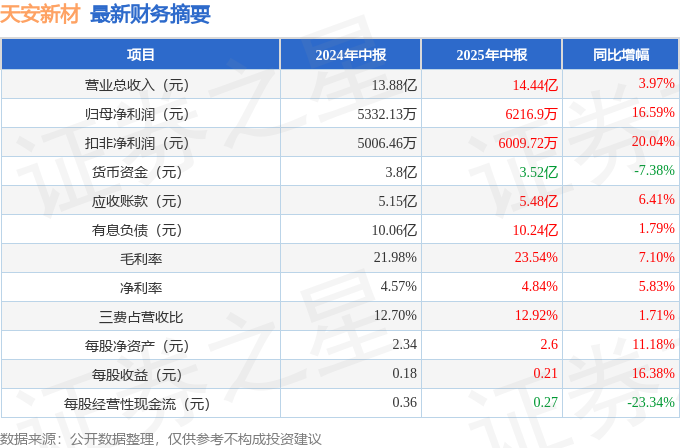
天安新材2025年中报简析:营收净利润同比双双增长,盈利能力上升
Zheng Quan Zhi Xing· 2025-08-15 23:05
Core Viewpoint - Tianan New Materials (603725) reported a revenue of 1.444 billion yuan for the first half of 2025, a year-on-year increase of 3.97%, and a net profit attributable to shareholders of 62.169 million yuan, up 16.59% year-on-year [1] Financial Performance - Total revenue for Q2 2025 was 863 million yuan, a slight increase of 0.1% year-on-year [1] - Q2 net profit attributable to shareholders reached 46.997 million yuan, reflecting a year-on-year growth of 14.47% [1] - Gross margin improved to 23.54%, up 7.1% year-on-year, while net margin increased to 4.84%, up 5.83% year-on-year [1] - Total expenses (selling, administrative, and financial) amounted to 186 million yuan, accounting for 12.92% of revenue, an increase of 1.71% year-on-year [1] - Earnings per share rose to 0.21 yuan, a 16.38% increase year-on-year [1] Key Financial Metrics - Cash flow per share decreased to 0.27 yuan, down 23.34% year-on-year [1] - The company’s return on invested capital (ROIC) was 8.63% last year, indicating average capital returns [3] - The company has experienced cyclical performance, with a historical median ROIC of 9.74% [4] Business Model and Strategy - The company relies on R&D and marketing to drive performance, with a focus on developing high-quality, environmentally friendly products [6] - The company is positioned as a "solution partner" rather than just a material supplier, enhancing customer collaboration [7] - In the building ceramics sector, the company is implementing a dual-track strategy of "ceramics + home furnishing" to optimize brand marketing and regional channel development [8] Product Development - The company launched over 60 new products across nine series during the spring product launch event [8] - The focus is on continuous product innovation and technology upgrades to meet changing consumer demands [8] Industry Positioning - The company is capitalizing on the rapid growth of the new energy vehicle market and the rise of domestic brands, aiming to expand its market presence [7] - The company has established a comprehensive supply chain that integrates design, construction, and material supply, enhancing operational efficiency [10][11]


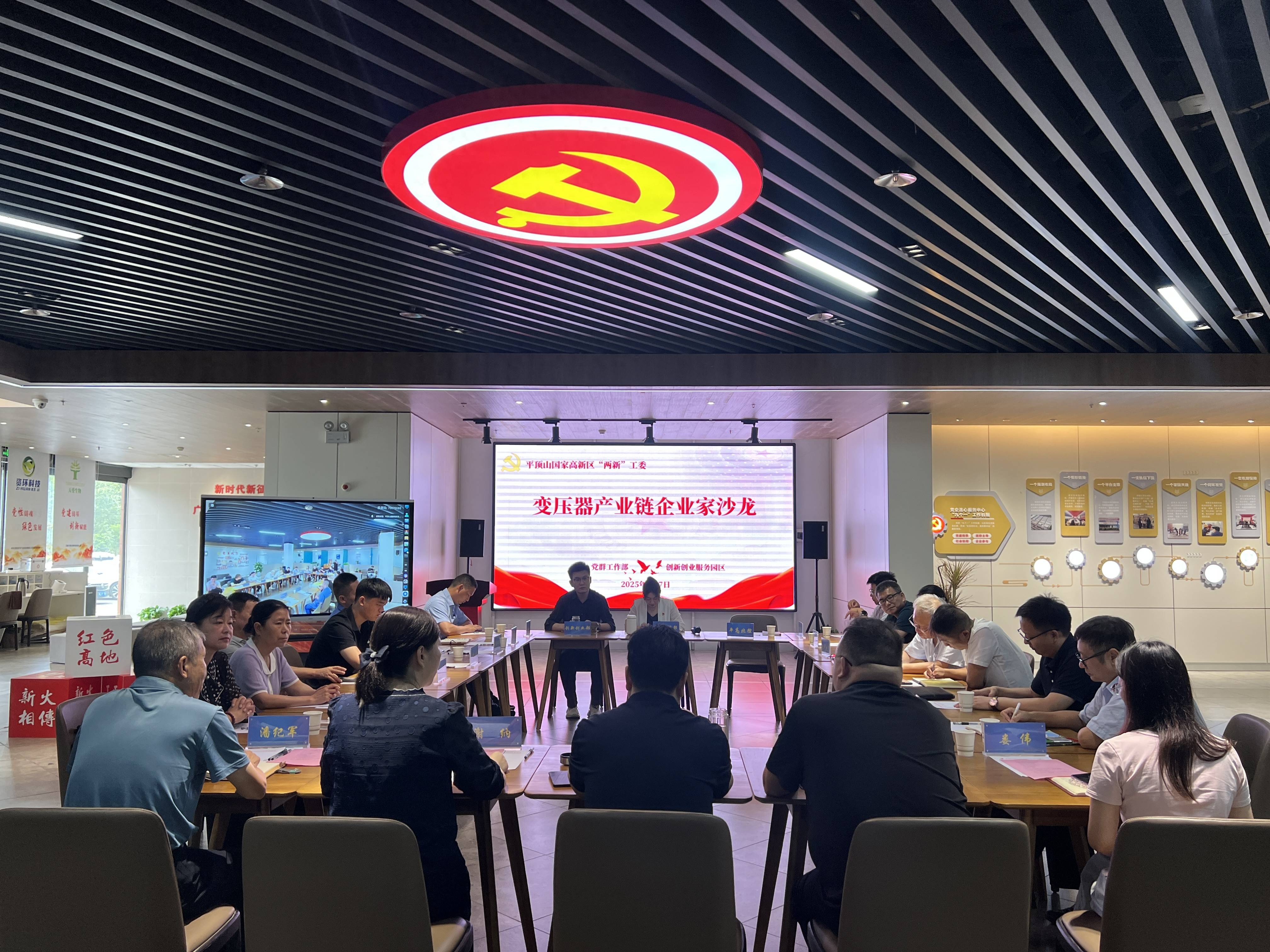
共探发展新路径!平顶山高新区举办变压器产业链企业家沙龙
Sou Hu Cai Jing· 2025-08-09 08:42
Core Viewpoint - The event highlighted the importance of collaboration and high-quality development within the transformer industry, emphasizing the role of party-building in driving enterprise growth [1][4][5]. Group 1: Industry Development - The Secretary-General of the Henan Transformer Industry Association provided insights into the current status and future trends of private enterprises in the transformer industry, aiding companies in market direction and strategic planning [4]. - Representatives from key enterprises shared their experiences in technological innovation and market expansion, offering constructive suggestions on industry collaboration and resource integration [5]. Group 2: Party-Building and Support - A representative emphasized the role of party-building in guiding non-public enterprises towards high-quality development, highlighting the importance of organizational support for business growth [5]. - The Deputy Secretary of the High-tech Zone Party Committee outlined the future direction for the transformer industry chain, stressing that strong party-building is fundamental to enterprise strength and development [5].
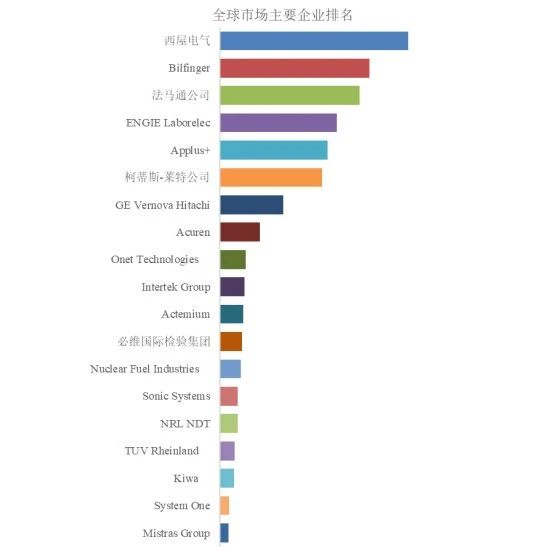
2030年全球核工业无损检测服务市场将达16.9亿美元,年复合增长率7.6%
QYResearch· 2025-07-31 10:49
Core Viewpoint - The nuclear industry non-destructive testing (NDT) services market is projected to reach $1.69 billion by 2030, with a compound annual growth rate (CAGR) of 7.6% in the coming years [1]. Market Overview - NDT services are essential for assessing the integrity and safety of nuclear components without causing damage [1]. - The global market for nuclear NDT services is dominated by radiographic testing (RT), which holds approximately 44.5% market share [9]. - Pressurized water reactors (PWR) represent the largest downstream market, accounting for about 79.6% of demand [11]. Key Drivers - Emerging markets such as Southeast Asia, the Middle East, and India are becoming new growth engines for the industry, with significant nuclear power expansion plans [13]. - Collaborative development across the supply chain is enhancing market growth, with manufacturers and service providers working together to optimize technologies and standards [14][16]. - The expansion of nuclear power capacity and the increasing demand for decommissioning services are driving the need for NDT services [17]. Major Obstacles - High technical barriers exist due to stringent requirements for sensor precision and stability in NDT equipment [18]. - The cost of transitioning to intelligent systems is high, which may deter smaller companies from adopting new technologies [19]. - The lack of unified standards for emerging technologies, such as additive manufacturing, poses challenges for market adoption [20]. Industry Development Opportunities - The integration of artificial intelligence (AI) in NDT is rapidly growing, with companies like Trueflaw leading in automated defect recognition [21]. - The penetration of automated inspection devices is increasing, enhancing detection capabilities while reducing radiation exposure for personnel [22]. - Industry concentration is rising, with leading companies expanding globally and offering comprehensive lifecycle services [23].