
人民币汇率稳定

Search documents
“十五五”首席观察|专访田轩:我国降准、降息尚有一定空间
Bei Jing Shang Bao· 2025-12-17 04:11
Core Viewpoint - The Chinese economy is showing resilience under policy coordination, with a focus on balancing short-term recovery and long-term transformation as it enters the "15th Five-Year Plan" period [1] Group 1: Economic Policy and Consumption - The shift in consumption policy from "incremental stimulation" to "structural optimization" is necessary for high-quality economic development, addressing diminishing marginal returns of traditional policies [5] - Key mechanisms for sustainable consumption growth in 2026 include establishing a virtuous cycle of income and consumption, optimizing supply-side reforms, and enhancing urban-rural integration [6] - To alleviate preventive savings pressure and boost consumption potential, policies must address housing, education, and healthcare costs while promoting income growth and improving the consumption environment [8] Group 2: Monetary Policy - The monetary policy framework under the "15th Five-Year Plan" allows for multiple avenues of action, including flexible use of tools like reserve requirement ratio cuts and open market operations to maintain liquidity [9] - There is still room for interest rate cuts to lower financing costs for banks and support long-term funding [9] - Structural monetary policy tools can be upgraded to enhance credit support for key sectors, ensuring effective allocation of financial resources [10][11] Group 3: Exchange Rate and External Factors - The Chinese yuan is expected to appreciate moderately in 2026, supported by economic recovery and improved trade structures, despite external uncertainties [12] - Internal factors such as economic resilience and increased demand for yuan-denominated assets contribute to this trend, while external factors include global economic disparities and potential shifts in U.S. monetary policy [13] - Challenges to maintaining a stable exchange rate include capital flow volatility and geopolitical risks, which could lead to irrational short-term fluctuations [14] Group 4: Internal and External Circulation - Strengthening "internal circulation" and promoting "high-level opening up" are complementary strategies that can enhance economic resilience and attract global resources [14] - A clear strategic plan is essential for coordinating these two approaches, ensuring systematic and stable policy implementation while managing external risks [15]

人民币强势升值创新高!年内破7可期?
Bei Jing Shang Bao· 2025-12-16 11:17
人民币近期升值势头强劲。12月16日,在岸人民币对美元汇率最高来到7.0417,创下2024年10月来新高;离岸人民币对美元汇率升破 7.04,最高报7.0374,同样触及阶段性高点。这已是人民币汇率连续两日刷新"纪录"。 底在结汇需求与外部因素叠加下,汇率存在阶段性、短暂突破7.0关口的可能性,但预计年内汇率中枢将围绕7.0关口双向波动、稳中 偏强运行,出现单边行情的概率不高。市场的理性预期将从"能否破7"转向"如何在合理区间内实现动态平衡"。 12月以来,人民币连续升破7.07、7.05多个关口,月初至今涨幅接近0.5%。中国外汇交易中心12月12日更新的数据显示,CFETS人民 币汇率指数报97.71,按周涨0.06,BIS货币篮子人民币汇率指数报104.28,SDR货币篮子人民币汇率指数报92.19。 谈及近期人民币对美元汇率连续上行的原因,东方金诚首席宏观分析师王青表示,首先是12月11日美联储降息前后,美元指数持续下 行,跌破100,这带动包括人民币在内的非美货币普遍出现一个升值过程。其次,年底临近,企业结汇需求增加,也会带动人民币季 节性走强;特别近期人民币持续走强后,前期累积的结汇需求有可能在 ...

铂:内盘领涨,料继续突破,铂:ETF增持边际上扬,继续冲击前高
Guo Tai Jun An Qi Huo· 2025-12-16 02:02
铂:内盘领涨,料继续突破 2025 年 12 月 16 日 钯:ETF 增持边际上扬,继续冲击前高 资料来源:同花顺,Wind,彭博,国泰君安期货 请务必阅读正文之后的免责条款部分 1 刘雨萱 投资咨询从业资格号:Z0020476 liuyuxuan023982@gtjas.com 【基本面跟踪】 铂钯基本面数据 | | | 昨日收盘价 | | 涨幅 | | | --- | --- | --- | --- | --- | --- | | | 铂金期货2606 | 482. 40 | | 6. 71% | | | | 金交所铂金 | 466. 85 | | 4. 78% | | | | 纽约铂主连 | 1815. 90 | | 2. 93% | | | | 伦敦现货铂金 | 1785. 30 | | 2. 47% | | | | 纪金期货2606 | 407. 60 | | 4.66% | | | | 人民币现货纪金 | 368. 00 | | 0. 82% | | | 价格 | 纽约锂主连 | 1.622.00 | | 4. 81% | | | | 伦敦现货纪金 | 1,572. 50 | | 5.51% | ...
早知道:我国首批L3级自动驾驶车型获准入许可;美股三大指数集体收跌
Zheng Quan Shi Bao Wang· 2025-12-16 00:06
Group 1 - China's first batch of L3-level autonomous driving vehicles has received approval for market access [1] - The China Securities Regulatory Commission (CSRC) has initiated the implementation of reforms to accelerate the landing of the "1+6" reform measures for the Sci-Tech Innovation Board [1] - Six departments have deployed actions to promote high-quality development in the service outsourcing sector [1] Group 2 - The State Administration of Foreign Exchange (SAFE) aims to maintain the basic stability of the RMB exchange rate at a reasonable and balanced level [1] - The Hong Kong Stock Exchange (HKEX) is set to soon launch a consultation on the reform of the minimum trading unit for securities [1] - Muxi Co., Ltd. will have its stock listed on the Sci-Tech Innovation Board on December 17 [1] Group 3 - The three major U.S. stock indices collectively declined, with the Nasdaq falling by 0.59% [1]
国家外汇管理局:加强外汇市场宏观审慎管理和预期引导 保持人民币汇率在合理均衡水平上的基本稳定
智通财经网· 2025-12-15 11:30
Core Viewpoint - The meeting led by Zhu Hexin emphasized the importance of expanding high-level institutional openness in the foreign exchange sector while ensuring effective management and aligning with international trade rules [1][2][3]. Group 1: Economic Work and Policy Direction - The meeting conveyed the significance of Xi Jinping's speech at the Central Economic Work Conference, which outlines the economic work for 2026 and beyond, providing a clear direction for future economic policies [2][3]. - The meeting highlighted the achievements of the current year, attributing success to the leadership of the Communist Party and the guiding principles of Xi Jinping's thought [2][3]. Group 2: Foreign Exchange Management Focus - The foreign exchange management department is tasked with enhancing the vitality of high-quality development by reforming bank foreign exchange operations and facilitating cross-border trade and investment [3][4]. - There is a commitment to steadily expand high-level institutional openness in the foreign exchange sector, aligning with international standards and optimizing policies for free trade zones and ports [3][4]. - Maintaining a stable foreign exchange market is crucial, with a focus on macro-prudential management and ensuring the RMB exchange rate remains stable at a reasonable level [3][4]. Group 3: Regulatory and Leadership Enhancements - The meeting emphasized the need for improved regulatory measures using advanced technologies like AI and big data to combat illegal activities in the foreign exchange sector [4][5]. - There is a focus on enhancing the management of foreign exchange reserves to ensure asset safety and value preservation [5]. - Strengthening the Party's leadership in foreign exchange management is essential, with ongoing efforts to promote strict governance and build a high-quality professional team [5][6].
【新华解读】货币政策延续“适度宽松”基调 “灵活高效”降准降息可期
Xin Hua Cai Jing· 2025-12-12 00:46
新华财经北京12月12日电(记者翟卓)12月10日至11日,中央经济工作会议在北京举行,分析当前经济 形势并部署2026年工作。会议强调"要继续实施适度宽松的货币政策""灵活高效运用降准降息等多种政 策工具""保持流动性充裕"等。 再综合考虑明年经济金融形势以及物价走势,东方金诚首席宏观分析师王青判断,2026年政策性降息幅 度或达0.2至0.3个百分点,降准幅度有望达到1个百分点。 "若从稳定明年一季度宏观经济运行等角度出发,不排除今年底或明年初就有降息降准落地的可能。而 着眼于推动房地产市场止跌回稳,2026年还有可能引导5年期以上贷款市场报价利率(LPR)单独下 行。"王青说。 业内专家表示,总的来看,货币政策延续了"适度宽松"基调,降准降息仍然可期,但也会更加注重"相 机抉择"以提高实施质效,结构性货币政策工具或再度"量增价降",政策落地成效则有望成为下阶段宏 观政策部门的主要关注对象。 ——延续"适度宽松"政策基调强调"灵活高效"降准降息 会议明确,要继续实施适度宽松的货币政策。"该表述延续了去年中央经济工作会议基调,表明我国 在'十五五'开局之年仍需以适度宽松的货币金融环境支持实体经济高质量发展。 ...
人民币在错综复杂的国际环境中稳步前行
Sou Hu Cai Jing· 2025-12-09 02:04
the the state of the AND STORE THE and and the company e No t 2017-01-11 the state of the ME Spec 前行支撑:内生韧性与政策调控的双重保障 在错综复杂的外部环境中,人民币之所以能保持稳步前行态势,核心在于国内经济基本面提供的"硬核支撑"与政策调控形成的"稳定锚"。经济基本面是汇率 走势的根本决定因素,2025年前三季度我国国内生产总值同比增长5.2%,这一增速在全球主要经济体中保持领先。进入四季度,各地通过提振消费、推进 重大项目投资、强化企业支持等政策冲刺全年目标,经济延续稳中有进态势。产业层面的数据更凸显结构性韧性:11月官方制造业PMI环比回升至49.2,高 技术制造业PMI连续10个月位于50的临界点以上,有色金属冶炼、铁路船舶航空航天设备等行业的生产经营活动预期指数均超过57.0%,处于较高景气区 间。 外贸韧性与结汇需求形成的市场支撑尤为显著。尽管10月出口同比出现短期回落,但前10个月出口累计同比增长6.2%,显示我国外贸在全球贸易放缓背景 下仍具较强竞争力。四季度作为传统结汇高峰,出口企业的结汇需求 ...
张明:中国外汇宏观审慎政策——框架塑造、政策实践与经验启示
Sou Hu Cai Jing· 2025-11-05 04:07
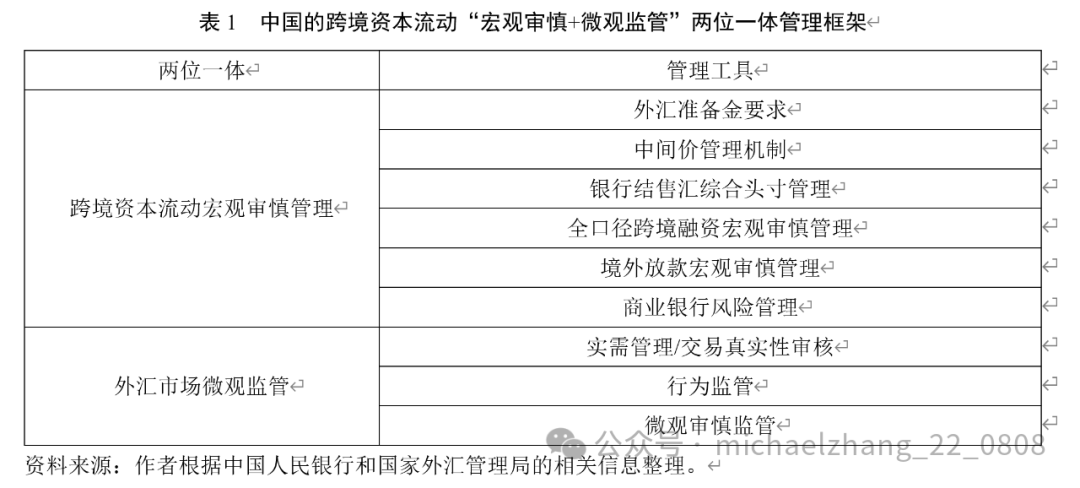
Core Viewpoint - After the global financial crisis, China has actively explored and implemented foreign exchange macro-prudential policies with Chinese characteristics during its gradual financial opening process. The main goals of these policies are to stabilize the RMB exchange rate and manage cross-border borrowing by domestic enterprises, rather than solely addressing systemic risks from volatile capital flows [1][2][3]. Summary by Relevant Sections Framework of China's Foreign Exchange Macro-Prudential Policy - The reform of China's foreign exchange management system has undergone three significant phases since the opening up in 1979, transitioning from a planned to a market-oriented system, and establishing a managed floating exchange rate system [4]. - The current phase, starting from 2013, focuses on balancing facilitation and risk prevention, particularly after the "8·11" exchange rate reform in 2015, which established a more market-oriented exchange rate formation mechanism [4][5]. Key Measures of Foreign Exchange Macro-Prudential Policy - Key measures include foreign exchange reserve requirements, middle price management mechanisms, comprehensive position management for banks' foreign exchange transactions, and macro-prudential management of cross-border financing and overseas lending [7][10]. - The foreign exchange reserve requirement includes three types: foreign exchange deposit reserve ratio, forward foreign exchange risk reserve ratio, and reserve ratio for deposits from foreign financial institutions [7][10]. Policy Effects and Adjustments - The foreign exchange deposit reserve ratio has been adjusted multiple times since its introduction in 2004, with the most recent adjustments occurring in 2022 and 2023, reflecting the central bank's response to changing market conditions [13][14]. - The foreign exchange risk reserve ratio was introduced in 2015 to curb excessive volatility in the foreign exchange market, with adjustments made based on market conditions [16][19]. - The comprehensive position management for banks has evolved since 2005, allowing for greater flexibility in managing foreign exchange risks and enhancing the overall development of the foreign exchange market [32][36]. Future Directions - The central bank aims to strengthen macro-prudential management of the foreign exchange market to support high-quality development of the real economy and maintain the RMB exchange rate at a reasonable and balanced level [3][39]. - The implementation of all-encompassing cross-border financing macro-prudential management has been expanded nationwide, allowing for better monitoring and management of cross-border financing activities [39][40].
潘功胜:落实落细适度宽松的货币政策,研究储备新的政策举措
Sou Hu Cai Jing· 2025-10-28 12:27
Core Viewpoint - The People's Bank of China (PBOC) aims to implement a moderately accommodative monetary policy to support the ongoing economic recovery and create a suitable financial environment [1] Monetary Policy Implementation - The PBOC will execute existing monetary policy measures effectively and continuously release policy effectiveness [1] - There will be a comprehensive use of various monetary policy tools to maintain ample liquidity, aligning the growth of social financing scale and money supply with economic growth and price level expectations [1] Efficiency and Cost Management - The focus will be on revitalizing existing funds and optimizing new funds to improve capital utilization efficiency [1] - Strengthening the execution and supervision of interest rate policies, and promoting a reduction in the comprehensive financing costs for society [1] Exchange Rate Stability - The PBOC will maintain exchange rate flexibility, enhance expectation guidance, and prevent excessive exchange rate fluctuations, ensuring the stability of the RMB at a reasonable and balanced level [1]
中国央行:防范汇率超调风险,保持人民币汇率在合理均衡水平上的基本稳定
Hua Er Jie Jian Wen· 2025-10-28 11:06
Core Viewpoint - The report from the State Council emphasizes the implementation of a moderately loose monetary policy to support the ongoing economic recovery and create a conducive financial environment [1] Monetary Policy Implementation - The report highlights the need to effectively execute existing monetary policy measures and continuously release their effectiveness [1] - It calls for the comprehensive use of various monetary policy tools to maintain ample liquidity, ensuring that the growth of social financing and money supply aligns with economic growth and price level expectations [1] Efficiency and Cost Management - The focus is on revitalizing existing funds and optimizing new funds to improve capital utilization efficiency [1] - There is an emphasis on strengthening the execution and supervision of interest rate policies, as well as deepening the work on the comprehensive financing cost of loans to drive down the overall financing costs in society [1] Exchange Rate Stability - The report advocates for maintaining exchange rate flexibility, enhancing expectation guidance, and preventing excessive fluctuations in the exchange rate [1] - It aims to keep the RMB exchange rate stable at a reasonable and balanced level [1]