估值泡沫

Search documents
盘点生成式AI最豪“金主”:孙正义第一,一年投出840亿
3 6 Ke· 2025-06-18 23:44
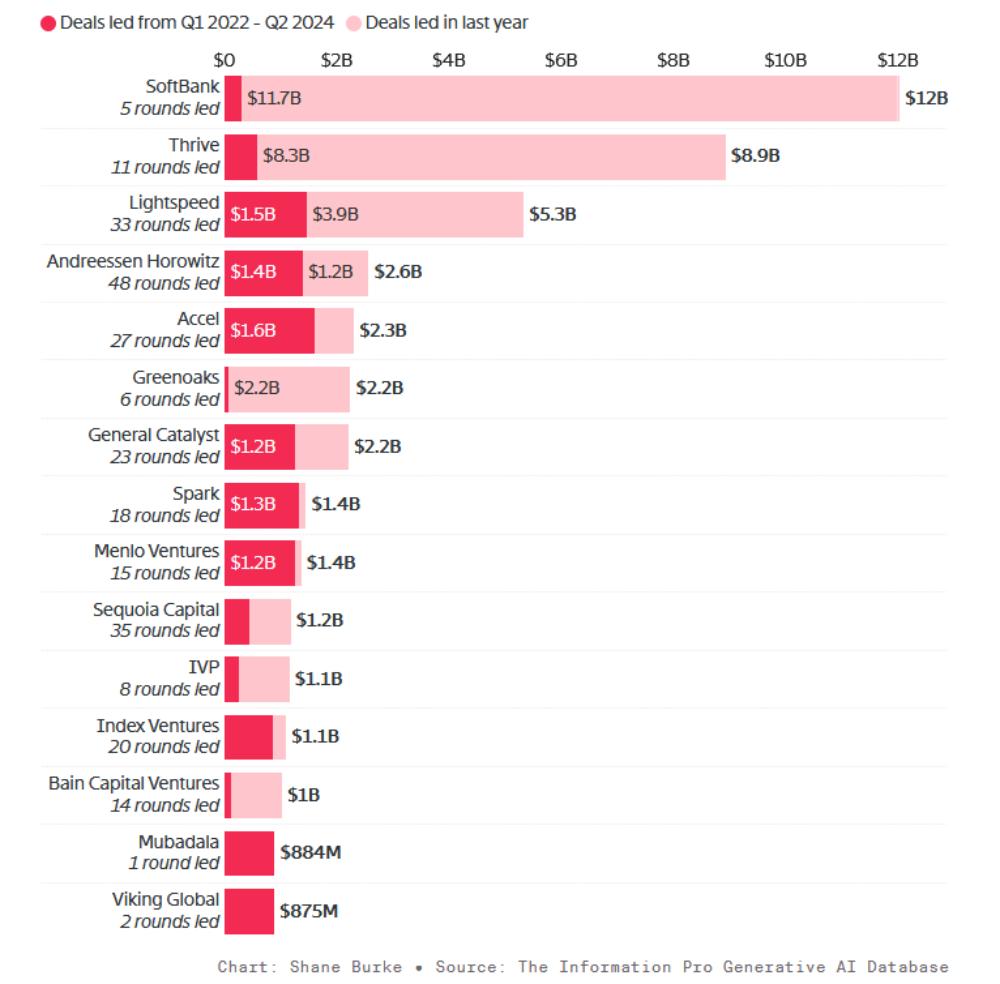
Core Insights - The total amount of venture capital investment in generative AI startups has reached $85 billion (approximately 610.3 billion RMB) from Q1 2022 to mid-June 2024, with a significant increase in average deal size to $372 million (approximately 2.67 billion RMB) [1][2][9] - Major investors such as SoftBank and Thrive Capital have emerged as leaders in this space, with SoftBank leading five rounds totaling $12 billion (approximately 86.2 billion RMB) and Thrive Capital leading eleven rounds totaling $8.9 billion (approximately 64 billion RMB) [5][8] - The investment landscape is becoming increasingly concentrated, with top firms dominating funding rounds, while smaller startups face challenges in securing financing [12][13] Investment Trends - The venture capital landscape for generative AI has seen a total of 724 rounds of funding, with the largest deals being concentrated among a few key players [1][2] - Notable investments include a $10 billion (approximately 72 billion RMB) round for OpenAI led by SoftBank and Thrive Capital, reflecting a trend of significant capital flowing into leading AI firms [10][11] - The average deal size has increased dramatically, with the top nine investors leading 74 rounds totaling $27.5 billion (approximately 197.4 billion RMB) in the past year alone [9] Investor Activity - Andreessen Horowitz has become the most active investor with 48 rounds led, while other firms like Accel and Lightspeed have also increased their investment activity significantly [5][9] - The ranking of venture capital firms is based on the total amount of capital they have led in funding rounds, which may overstate their risk exposure to individual companies [2][3] - The focus of investments is shifting towards companies developing leading models and commercial applications, with substantial funding directed at firms like Scale AI and ElevenLabs [10][11] Market Dynamics - The influx of capital into AI startups has led to a bifurcated market, where top-tier companies attract significant investment while smaller firms struggle to secure funding [12][13] - The recent acquisition of a stake in Scale AI by Meta for $14.3 billion (approximately 102.8 billion RMB) signals strong investor confidence in the potential of AI technologies [12] - There are concerns about a valuation bubble as top firms continue to receive funding, while smaller players face difficulties, leading to a potential risk of market correction if expectations are not met [13]


寻找新一代“茅台” 公募解码新消费
Shang Hai Zheng Quan Bao· 2025-06-08 18:08
Core Viewpoint - The new consumption trend originating from China is gaining global traction, with significant stock market performance in the new consumption sector, particularly the SHS New Consumption Index, which has risen by 72.67% from early 2024 to June 4, 2025, outperforming other indices [1][2]. Group 1: Market Performance - The SHS New Consumption Index has significantly outperformed the CS Consumption Index, which increased by 4.93%, and the China Securities White Wine Index, which decreased by 25.27% during the same period [1][2]. - Notable companies in the new consumption sector, such as Miko, Pop Mart, and Laopu Gold, have seen their stock prices reach new highs amid market volatility [2]. Group 2: Investment Trends - Many top-performing public funds have heavily invested in new consumption stocks, with examples including Pengyang Consumption Theme Mixed Fund A, which has seen a net value increase of 23% year-to-date [2]. - The Southern Hong Kong Growth Fund, which has increased by 36.68% this year, has significant holdings in Pop Mart, Laopu Gold, and Miko, collectively accounting for nearly 30% of its portfolio [2]. Group 3: Consumer Behavior and Market Dynamics - The rapid rise of new consumption sectors such as trendy toys, pet economy, and jewelry is attributed to the ability of local companies to meet previously unmet consumer demands through high-quality supply [3]. - The shift in consumer preferences from price-driven to value and experience-driven consumption is highlighted, with brands like Pop Mart and Miniso leading this transformation [3]. Group 4: Investment Strategy and Outlook - Investment strategies are evolving from a focus on sector-wide opportunities to a more fundamental approach, emphasizing companies that can create differentiated value and solidify product strength [1][7]. - The new consumption sector is characterized by companies in the growth phase, presenting both higher uncertainty and explosive growth potential compared to traditional consumption [5][6]. Group 5: Risk Assessment and Market Sentiment - Despite the significant stock price increases, some new consumption stocks are experiencing volatility, with examples like Pop Mart showing fluctuations of over 5% in a single day [7]. - Analysts suggest a potential divergence in performance among new consumption companies, with some facing bubble risks while others may continue to see upward revisions in earnings forecasts [7][8].
2500亿泡泡玛特,遭重要股东清仓式减持
商业洞察· 2025-05-12 09:12
Core Viewpoint - The article discusses the recent developments surrounding Pop Mart, highlighting significant shareholder sell-offs and the company's impressive growth trajectory, particularly in overseas markets, while also raising concerns about potential valuation bubbles and future growth sustainability [2][6][12]. Group 1: Shareholder Actions - Early investor Fengqiao Capital has completely liquidated its holdings in Pop Mart, selling approximately 11.91 million shares for a total of 2.264 billion HKD, equivalent to about 2.11 billion RMB [2]. - Prior to this, Fengqiao Capital held 0.9% of Pop Mart's shares, making it the seventh-largest shareholder [4]. - The founder of Pop Mart, Wang Ning, also reduced his stake by selling 21.7 million shares at an average price of 71.98 HKD, cashing out over 1.56 billion HKD [7]. Group 2: Company Performance - Pop Mart's stock has surged over 1100% since the beginning of 2024, establishing itself as a top-performing stock in the Hong Kong market, although its dynamic price-to-earnings ratio has reached 76 times [6]. - The company reported a revenue of 13.04 billion RMB for 2024, a year-on-year increase of 106.9%, with adjusted net profit rising by 185.9% to 3.4 billion RMB [10]. - The overseas market has been a significant growth driver, with revenue from international operations increasing by 375.2%, contributing nearly 40% to total revenue [10]. Group 3: Market Strategy and Future Outlook - Pop Mart's international expansion strategy has shown promising results, with overseas revenue reaching 3.76 billion RMB in the first half of 2023, a 139.8% increase year-on-year [10]. - The company has expanded its business to nearly 100 countries and regions since its internationalization began in 2018 [13]. - Analysts from Goldman Sachs and Nomura have raised their earnings forecasts for Pop Mart, citing strong sales momentum and a robust IP ecosystem, while also adjusting target prices upward [14][15]. Group 4: Concerns and Risks - Despite the impressive growth, there are concerns about the sustainability of Pop Mart's overseas success and the potential for valuation bubbles, especially given the significant shareholder sell-offs [12][16]. - The article emphasizes the need to be cautious about the company's high valuation and the risks associated with potential declines in growth rates, which could lead to significant stock price volatility [16].

石基信息商誉高悬仍要收购 标的公司营收净利润双降
Xin Lang Zheng Quan· 2025-04-25 01:25
Core Viewpoint - Shiji Information plans to acquire 13.50% of Shenzhen Sihon Software Co., Ltd. through a share issuance, which may indicate a continuation of high premium pricing based on historical acquisition patterns [1][2] Group 1: Company Overview - Shenzhen Sihon Software, established in April 2004, specializes in digital solutions for the retail industry, offering products such as smart retail, SaaS, digital operations, and Sihon Pay [1] - In 2023, Sihon Software attempted an IPO on the Beijing Stock Exchange but later terminated it [1] Group 2: Financial Performance - For the first three quarters of 2024, Sihon Software reported a 10.79% year-on-year decline in revenue and a 12.38% decrease in net profit attributable to shareholders [1] - As of September 2024, Shiji Information's goodwill reached 1.194 billion yuan, accounting for 12.5% of total assets, primarily from multiple acquisitions [1] Group 3: Acquisition Context - Historical acquisitions by Shiji Information, such as those of Zhongdian Devices, showed significant premiums due to shareholder differences, suggesting a potential for high premium pricing in the current acquisition [1] - The acquisition of Sihon Software may have limited synergy with Shiji Information's main hotel information business, as evidenced by past integration challenges faced by Alibaba Group with Shiji's retail business [2] Group 4: Financial Risks - In 2019, Shiji Information did not recognize impairment for goodwill related to loss-making subsidiaries, raising concerns about aggressive accounting practices [2] - As of Q3 2024, Shiji Information's cash reserves decreased by 276 million yuan, and while the acquisition will not directly consume cash, it may dilute earnings per share [2]

遇见小面冲击IPO:先“斩”公关总监,再挤估值泡沫?
Sou Hu Cai Jing· 2025-04-23 13:41
与此相呼应的是,在递交招股书后的第三天,也就是4月18日,遇见小面公关总监在社交媒体上发布了一系列动态,随后引发广泛关注。4月18日,该总监 首次发声,透露自己在孩子生病且不在公司的情况下,突然收到公司的裁员通知,且通知发给了其家人而非联系本人。 据了解,该总监自1月入职遇见小面,收到解除劳动关系通知时仍处于试用期。根据通知说明,在其离职时,遇见小面会正常为其结算工资和发薪,且参 照法定标准给予离职赔偿。截至发稿,针对该事件,遇见小面暂无官方回应。 而在此之前,遇见小面已经长跑11年,三百多家门店主要集中在广东市场,品牌走过了O2O和互联网高峰时代,2021年估值逼近30亿元,却带着行业彼时 不可遏制的"泡沫"。 即使从现在的视角看,遇见小面也撑不起30亿元估值。进一步来说,挤掉估值泡沫,或是遇见小面冲击IPO的第一课。 那么,这个刚刚走到IPO阶段的遇见小面,在快速斩掉公关总监后,能够顺利登录资本市场么? 作者/壹览商业 响马 很少有人会料到,川渝街头再寻常不过的重庆小面会激发创业热情,落地、发展成连锁餐饮品牌,并摇身一变,向"中式面馆第一股"发起冲锋。 这正是遇见小面的经历。 去年,该品牌成立十周年时,创 ...

纳斯达克暴跌的三大原因
雪球· 2025-03-13 04:54
Group 1 - The overall forward P/E ratio and median of the US stock market reached the highest level in 22 years (excluding the pandemic bubble period) by early 2025, indicating extreme market optimism and a significant valuation bubble, particularly among the "Seven Sisters" (Apple, Microsoft, Amazon, Nvidia, etc.), whose market capitalization accounts for nearly 60% of US GDP, far exceeding reasonable levels [1][2] - The proportion of financial assets allocated to stocks by US households reached a historical high of 43.4%, indicating that market risk tolerance has reached its limit, with excessive capital concentration in tech giants leading to high liquidity dependence on a few companies [2] Group 2 - DeepSeek's innovative MLA architecture and MoE Sparse structure reduced model training costs to 5% of that of international giants, with inference capabilities comparable to top models like GPT-4o, undermining Nvidia's chip scarcity and directly impacting the core profit logic of the US AI industry, which relies on high capital investment to create barriers [3][4] - The global competitive landscape is being restructured as DeepSeek demonstrates that computational power embargoes do not constitute absolute barriers, weakening the US's technological advantage and shifting global AI discourse from a US-centric model to a more diversified competition [4] Group 3 - Trump's signing of a memorandum on tariffs related to digital taxes and the imposition of tariffs on Mexico and Canada raised concerns about global supply chain stability, causing companies like Apple to commit to shifting their supply chains to avoid tariff impacts, resulting in a decline of over 6.6% in the S&P 500 and over 10% in the Nasdaq [5][6] - The contradiction in Trump's "America First" policy, which aims to rebuild manufacturing while relying on robots to replace labor, has led to rising unemployment and structural imbalances in job creation, further complicating market expectations and increasing risk aversion [6][7] Group 4 - The failure of Trump's $500 billion AI investment plan (Stargate) due to DeepSeek's low-cost path has diminished global capital confidence in the US AI industry, compounded by rising credit risk indicators in the US, leading investors to worry that policy uncertainty will undermine economic fundamentals [7][8] - The recent Nasdaq decline is attributed to a confluence of factors: the fragile valuation bubble of tech giants under interest rate risks, the direct disruption of AI valuation logic by DeepSeek's technological breakthrough, and the exacerbation of market uncertainties by Trump's policies, prompting a shift of funds from overvalued tech stocks to defensive sectors [8]