非理性繁荣

Search documents
【环球财经】芝商所上调保证金 金银期货价格震荡
Xin Hua She· 2026-02-03 05:49
Group 1 - International gold and silver futures prices continued to fluctuate on February 2, with April gold futures closing at $4653 per ounce, down 1.95% from the previous trading day, and March silver futures down 1.94% at $77 per ounce [1] - Following the initial decline, gold and silver futures rebounded significantly in overnight trading, with increases exceeding 4% and 9% respectively [1] - The Chicago Mercantile Exchange Group announced on January 30 an increase in metal futures margin requirements, raising the margin for gold futures from 6% to 8% and for silver futures from 11% to 15%, effective after the close on February 2 [1] Group 2 - The increase in margin requirements is expected to negatively impact related contracts, as higher capital expenditures may suppress speculative participation, reduce liquidity, and force traders to liquidate positions [1] - On January 30, gold futures fell over 10% and silver futures dropped more than 30%, influenced by market expectations of a hawkish monetary policy from the Federal Reserve following President Trump's nomination of Kevin Walsh as the next Fed Chair [1] - Christopher Forbes from CMC Markets described the sharp decline in gold prices as a typical correction after a significant rise, indicating that the long-term bullish trend remains unchanged [1] Group 3 - Matthew Pigott from the independent research firm Metal Focus characterized the January price increase in precious metals as "irrational exuberance," suggesting that the current extreme sell-off is a healthy adjustment [2]
芝商所上调保证金,金银期货价格震荡
Xin Lang Cai Jing· 2026-02-03 03:17
Group 1 - The core viewpoint of the articles highlights the volatility in gold and silver futures prices, with significant declines followed by a rebound in the market [2][3] - On February 2, 2023, gold futures closed at $4653 per ounce, down 1.95% from the previous trading day, while silver futures fell 1.94% to $77 per ounce [2] - Following the price drop, both gold and silver futures experienced a notable rebound in overnight trading, with increases exceeding 4% and 9% respectively [2] Group 2 - The Chicago Mercantile Exchange Group announced an increase in margin requirements for metal futures on January 30, raising gold futures margin from 6% to 8% and silver futures margin from 11% to 15%, effective after the close on February 2 [2] - The increase in margin requirements is expected to negatively impact related contracts by reducing speculative participation and liquidity, potentially forcing traders to liquidate positions [2] - Matthew Pigott from the independent research firm Metal Focus described the recent sell-off in precious metals as a "healthy correction," despite its extremity [3]



芝商所上调保证金 金银期货价格震荡
Xin Hua Wang· 2026-02-03 02:52
Core Viewpoint - The international gold and silver futures prices experienced fluctuations, with a notable decline followed by a rebound in overnight trading, indicating volatility in the precious metals market [1]. Group 1: Price Movements - On February 2, April gold futures closed at $4653 per ounce, down 1.95% from the previous trading day, while March silver futures fell 1.94% to $77 per ounce [1]. - Following the initial decline, both gold and silver futures rebounded significantly, with increases exceeding 4% and 9% respectively in overnight trading [1]. Group 2: Margin Changes - The Chicago Mercantile Exchange Group announced an increase in metal futures margin requirements on January 30, raising gold futures margin from 6% to 8% and silver futures margin from 11% to 15% [1]. - The new margin requirements took effect after the market closed on February 2, which typically negatively impacts related contracts by reducing liquidity and forcing traders to liquidate positions [1]. Group 3: Market Sentiment - On January 30, gold futures dropped over 10% and silver futures fell more than 30%, influenced by market expectations of a hawkish monetary policy from the Federal Reserve following President Trump's nomination of Kevin Walsh as the next Fed Chair [1]. - Christopher Forbes from CMC Markets described the sharp decline in gold prices as a typical correction after a significant rise, suggesting that the long-term bullish trend remains intact [1]. Group 4: Expert Opinions - Matthew Pigott from the independent research firm Metal Focus characterized the January price surge in precious metals as "irrational exuberance," indicating that the current sell-off, while extreme, is a healthy adjustment [2].
聚酯数据日报-20260115
Guo Mao Qi Huo· 2026-01-15 03:01
Group 1: Report Industry Investment Rating - No relevant information provided Group 2: Report's Core View - PTA market experiences a tug - of - war between cost support and falling demand, with a slight price increase; PX market is at a critical juncture where speculative sentiment intersects with fundamental tension; MEG price is under supply pressure, but may be supported by policies [2] Group 3: Summary by Related Catalogs 1. Market Data Comparison - INE crude oil price dropped from 445.6 yuan/barrel on January 13th to 445.5 yuan/barrel on January 14th [2] - PTA - SC decreased from 1901.8 yuan/ton to 1878.5 yuan/ton, and PTA/SC ratio dropped from 1.5873 to 1.5802 [2] - CFR China PX decreased from 899 to 897, and PX - naphtha spread decreased from 341 to 336 [2] - PTA main futures price decreased from 5140 yuan/ton to 5116 yuan/ton, while the spot price increased from 5060 to 5075 yuan/ton [2] - PTA spot processing fee increased from 302.1 yuan/ton to 311.5 yuan/ton, and the disk processing fee decreased from 382.1 to 367.5 yuan/ton [2] - MEG main futures price increased from 3815 yuan/ton to 3867 yuan/ton; the domestic price increased from 3686 to 3711 yuan/ton [2] 2. Industry Chain Start - up Situation - PX start - up rate remained at 87.87%, PTA start - up rate at 77.40%, MEG start - up rate increased slightly from 61.12% to 61.15%, and polyester load remained at 87.80% [2] 3. Product Price and Cash - Flow Changes - POY150D/48F price increased from 6650 to 6715, and its cash - flow improved from - 161 to - 117 [2] - FDY150D/96F price increased from 6870 to 6920, and its cash - flow improved from - 441 to - 412 [2] - DTY150D/48F price increased from 7795 to 7830, and its cash - flow improved from - 216 to - 202 [2] - 1.4D direct - spun polyester staple fiber price decreased from 6520 to 6510, and its cash - flow decreased from 59 to 28 [2] - Semi - bright chip price decreased from 5780 to 5770, and its cash - flow decreased from - 131 to - 162 [2] 4. Product Sales Situation - Long - filament sales remained at 46%, short - fiber sales decreased from 93% to 68%, and chip sales increased from 50% to 79% [2] 5. Device Maintenance Dynamics - Sanfangxiang's 500,000 - ton device is restarting, and a 750,000 - ton device is under maintenance; some devices of Xinjiang Yipu, Jinyu, Tiansheng, and Guxiandao are either under maintenance or have reduced loads [2]
瓶片短纤数据日报-20260114
Guo Mao Qi Huo· 2026-01-14 02:57
Group 1: Report Industry Investment Rating - No relevant information provided Group 2: Core View - The PX market has experienced a rapid increase, driven mainly by speculative funds rather than fundamental changes. The futures market dominates price discovery, creating an "irrational boom" with self - reinforcing trends. Despite concerns about bubbles, the PX fundamentals are supported, and the market is expected to remain tight in 2026. The PX - naphtha spread has widened to $360, and the PX - mixed xylene spread has reached $155, improving aromatics extraction economics. The PX market is at a critical juncture between speculative sentiment and fundamental tension. Domestic PTA maintains high - level operations, benefiting from stable domestic demand and the resumption of exports to India since the end of November. The high gasoline spread supports aromatics, and new polyester installations keep polyester load and PTA consumption high, with increasing inventory willingness and strengthening basis. Although domestic polyester demand weakens seasonally, polyester factory production cuts are insufficient to form a negative feedback [2] Group 3: Summary by Indicators Price and Spread Indicators - PTA spot price decreased from 5100 on 2026/1/12 to 5060 on 2026/1/13, a decline of 40 [2] - MEG inner - market price dropped from 3734 on 2026/1/12 to 3686 on 2026/1/13, a decrease of 48 [2] - PTA closing price fell from 5142 to 5140, a decline of 2 [2] - MEG closing price decreased by 65, from 3880 to 3815 [2] - 1.4D direct - spinning polyester staple fiber price remained unchanged at 6520 [2] - Short - fiber basis decreased from 38 to 34, a drop of 4 [2] - The 2 - 3 spread increased from 18 to 16, an increase of 2 [2] - 1.4D imitation large - fiber price decreased from 5275 to 5250, a decline of 25 [2] - The price difference between 1.4D direct - spinning and imitation large - fiber increased from 1245 to 1270, an increase of 25 [2] - East - China water - bottle chip price decreased from 6125 to 6097, a decline of 28 [2] - Hot - filling polyester bottle chip price decreased from 6125 to 6097, a decline of 28 [2] - Carbonated - grade polyester bottle chip price decreased from 6225 to 6197, a decline of 28 [2] - Outer - market water - bottle chip price remained unchanged at 810 [2] - T32S pure polyester yarn price remained unchanged at 10600 [2] - T32S pure polyester yarn processing fee remained unchanged at 4080 [2] - Polyester - cotton yarn 65/35 45S price remained unchanged at 16600 [2] - Cotton 328 price increased from 15365 to 15610, an increase of 245 [2] - Polyester - cotton yarn profit decreased from 1469 to 1377, a decline of 93 [2] - Primary three - dimensional hollow (with silicon) price remained unchanged at 7210 [2] - Primary low - melting - point short - fiber price remained unchanged at 7775 [2] Cash Flow and Processing Fee Indicators - Polyester staple fiber cash flow increased from 240 to 246, an increase of 6 [2] - Bottle - chip spot processing fee increased from 514 to 536, an increase of 22 [2] - Hollow short - fiber 6 - 15D cash flow increased from 399 to 449, an increase of 50 [2] Market and Production Indicators - Direct - spinning short - fiber load (weekly) increased from 86.77% to 88.84%, an increase of 2.07 percentage points [3] - Polyester staple fiber production and sales decreased from 87.00% to 80.00%, a decline of 7.00 percentage points [3] - Polyester yarn startup rate (weekly) remained unchanged at 66.00% [3] - Recycled cotton - type load index (weekly) remained unchanged at 51.10% [3] Market Conditions - Short - fiber: The short - fiber main - contract futures decreased by 24 to 6506. In the spot market, polyester staple fiber production factory prices were stable, while trader prices slightly declined. Downstream buyers purchased on - demand, and on - site transactions were limited. The price of 1.56dtex*38mm semi - bright natural - white (1.4D) polyester staple fiber in the East - China market was 6380 - 6650 yuan for cash - on - delivery, tax - included self - pick - up; in the North - China market, it was 6500 - 6770 yuan for cash - on - delivery, tax - included delivery; and in the Fujian market, it was 6440 - 6630 yuan for cash - on - delivery, tax - included delivery [2] - Bottle - chip: The mainstream negotiation price of polyester bottle chips in the Jiangsu and Zhejiang markets was 6100 - 6180 yuan/ton, with the average price increasing by 10 yuan/ton compared to the previous working day. PTA and bottle - chip futures fluctuated upward. The cost - side support was strong. Most supply - side quotes remained stable, with local supplies being slightly tight. The low - end price center shifted slightly upward. The overall market trading atmosphere was light, and the market negotiation center shifted slightly upward [2]
聚酯数据日报-20260113
Guo Mao Qi Huo· 2026-01-13 07:28
Group 1: Report Investment Rating - No information provided on the industry investment rating Group 2: Core Viewpoints - PX market has seen a rapid increase, mainly driven by speculative funds rather than fundamental changes. The futures market dominates price discovery, showing "irrational exuberance" with self - reinforcing trends. Despite concerns about bubbles, PX fundamentals are supported, and the market is expected to tighten in 2026 due to new PTA capacity in India and organic demand growth [2] - PTA maintains high - level operation, benefiting from stable domestic demand and resumed exports to India since late November. The high gasoline spread supports aromatics, and new polyester installations keep polyester load high, leading to high PTA consumption and a strengthening basis [2] - For MEG, overseas plant maintenance plans increase, but with the continuous decline of coal prices and new plant production, market supply pressure is large. However, it may be supported by domestic policies under the carbon neutrality background [2] Group 3: Summary by Relevant Catalogs 1. Market Data Comparison - **Crude Oil**: INE crude oil price rose from 432.7 yuan/barrel on January 9, 2026, to 437.5 yuan/barrel on January 12, 2026, an increase of 4.80 yuan [2] - **PTA**: PTA - SC decreased by 0.88 yuan/ton, PTA/SC ratio decreased, CFR China PX increased by 5 to 897, PX - naphtha spread increased by 5 to 346. PTA main - contract futures price rose by 34.0 yuan/ton to 5142 yuan/ton, and the spot price rose by 65.0 yuan to 5035 yuan/ton. Spot processing fee increased by 39.9 yuan/ton to 352.3 yuan/ton, and the disk processing fee increased by 8.9 yuan/ton to 394.3 yuan/ton. The main - contract basis decreased by 3.0, and the number of PTA warehouse receipts increased by 600 to 100820 [2] - **MEG**: MEG main - contract futures price rose by 14.0 yuan/ton to 3880 yuan/ton, MEG - naphtha decreased by 5.5 yuan/ton, MEG internal - market price rose by 37.0 yuan to 3734 yuan/ton, and the main - contract basis decreased by 7.0 [2] - **Industry Operation Rates**: PX operation rate remained at 87.87%, PTA operation rate remained at 77.40%, MEG operation rate increased by 0.41% to 61.12%, and polyester load decreased by 0.32% to 87.80% [2] - **Polyester Products**: POY150D/48F price rose by 155.0 to 6695, POY cash flow increased by 87.0. FDY150D/96F price rose by 145.0 to 6890, FDY cash flow increased by 77.0. DTY150D/48F price rose by 35.0 to 7780, DTY cash flow decreased by 33.0. 1.4D direct - spinning polyester staple fiber price rose by 5 to 6520, polyester staple fiber cash flow decreased by 63.0. Semi - bright chip price rose by 45.0 to 5770, chip cash flow decreased by 23.0. Long - filament sales rate increased from 45% to 69%, short - fiber sales rate increased from 77% to 81%, and chip sales rate increased from 64% to 72% [2] 2. Device Maintenance - This week, the 500,000 - ton device of Sanfangxiang is in the process of restarting, and another 750,000 - ton device will be under maintenance soon, with the load gradually decreasing. In addition, the devices of Xinjiang Yipu and Jinyu in December are under maintenance, and some factories such as Tiansheng and Guxiandao have reduced their loads [2]

时隔近4个月 A股成交额历史第6次突破3万亿
2 1 Shi Ji Jing Ji Bao Dao· 2026-01-09 07:56
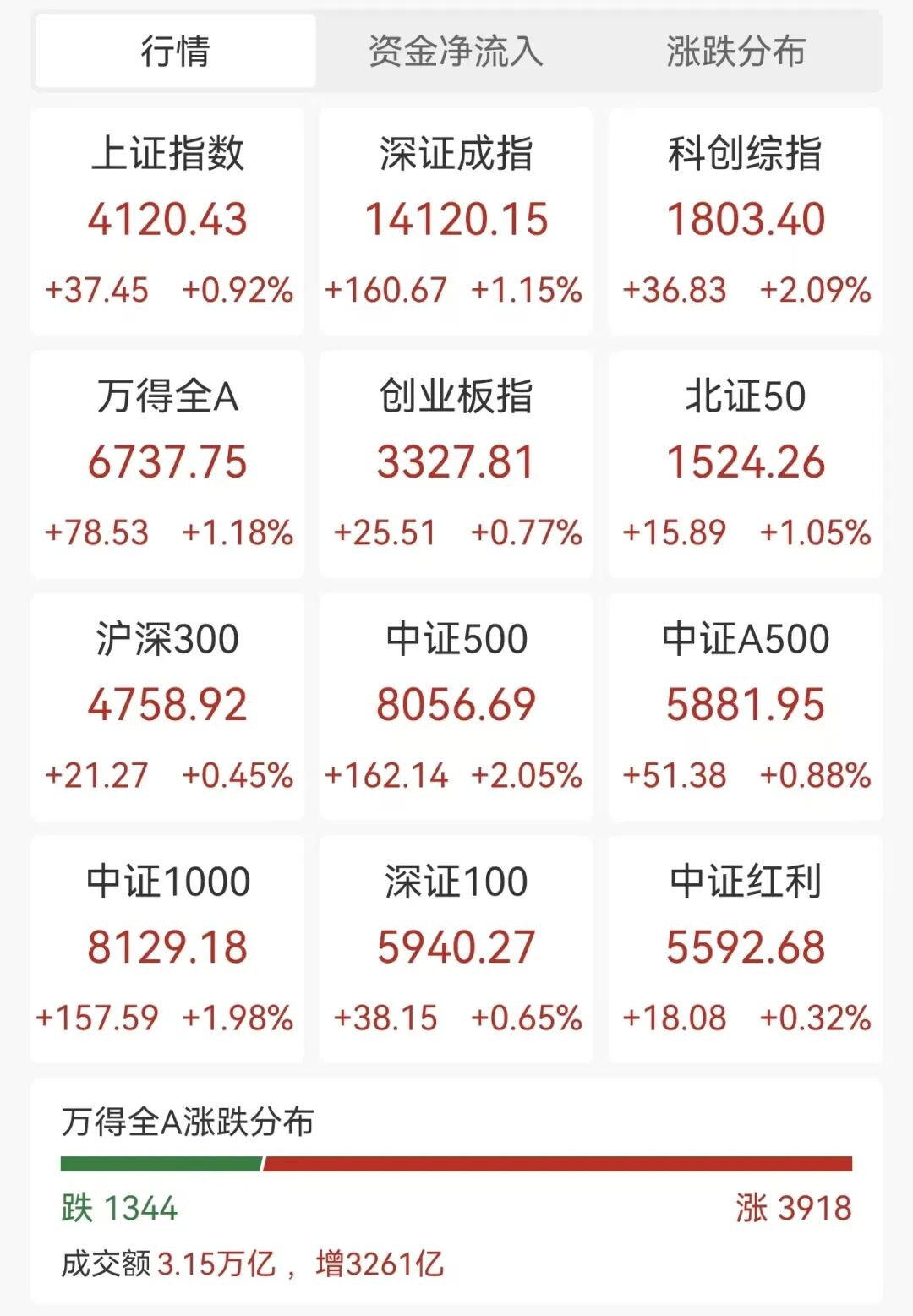
Group 1 - The A-share market has entered a strong bullish phase, with the Shanghai Composite Index rising 0.92% and surpassing the 4100-point mark for the first time in 10 years, achieving a 16-day consecutive increase [1] - The market's trading volume has significantly increased, with the A-share market's turnover exceeding 3 trillion yuan for the first time in nearly four months, indicating a surge in investor sentiment [2] - Economic expert Pan Helin suggests that the current rise in A-shares is driven by the appreciation of the RMB, leading to a global capital inflow, and that this bullish trend is within a reasonable range [2] Group 2 - Pan Helin notes that while the bull market may experience fluctuations, the overall stock market will remain strong until the global economic boom cycle ends, indicating a structural bull market [3] - Certain popular sectors are expected to continue reaching new highs, while less favored sectors may need to wait for market rotation opportunities [3]
时隔近4个月,A股成交额再度突破3万亿
2 1 Shi Ji Jing Ji Bao Dao· 2026-01-09 07:21
Core Viewpoint - The A-share market has experienced a strong rally, with all three major indices rising and the Shanghai Composite Index surpassing the 4100-point mark for the first time in 10 years, indicating a significant increase in investor sentiment and market activity [1]. Trading Volume - The trading volume in the A-share market has exceeded 30 trillion yuan for the first time in nearly four months, with a total transaction amount of 30,000 billion yuan on January 9 [1]. - Since the beginning of 2026, the market has maintained a trading volume of over 25 trillion yuan for four consecutive trading days, with January 9 alone seeing a half-day trading volume of over 20 trillion yuan [1]. - Historical data shows that there have only been six instances where the daily trading volume exceeded 30 trillion yuan, with the most recent occurrences in October 2024 and August 2025 [1][2]. Market Sentiment and Future Outlook - Analysts suggest that the surge in trading volume and market activity may lead to further upward momentum, although this phase of growth may be characterized by irrational exuberance, with less correlation to earnings and value [5]. - Despite potential fluctuations during the upward trend, the overall stock market is expected to remain strong until the end of the global economic boom cycle [5]. - The current rally is described as structural, with certain popular sectors likely to continue reaching new highs, while less popular sectors may need to wait for market rotation opportunities [5].

时隔近4个月,A股成交额历史第6次突破3万亿
21世纪经济报道· 2026-01-09 07:18
Market Overview - The A-share market experienced a strong rally on January 9, with all three major indices rising. The Shanghai Composite Index increased by 0.92%, surpassing the 4100-point mark for the first time in 10 years, marking a 16-day consecutive rise [1] - The ChiNext Index rose by 0.77%, driven by surges in AI application themes, particularly in the film, short drama, and gaming sectors. Other leading sectors included commercial aerospace, humanoid robots, and small metal concepts, while the photovoltaic and large financial sectors weakened [1] Trading Volume and Investor Sentiment - Since the beginning of 2026, the market has maintained a trading volume exceeding 2.5 trillion yuan for four consecutive trading days, with today's half-day volume surpassing 2 trillion yuan, indicating a rapid increase in investor sentiment [3] - Historical data shows that such high trading volumes are rare in A-share history, with only six instances of daily trading volumes exceeding 3 trillion yuan. The most recent occurrence was on October 8, 2024, with a volume of 34,835.43 billion yuan [3][4] Market Dynamics and Economic Analysis - Economist Pan Helin stated that the current performance of the A-share market indicates a transition into a full bull market phase, driven by the appreciation of the yuan and the return of global capital. He noted that the upward trend in A-shares is still within a reasonable range compared to global markets [9] - Pan further analyzed that once trading volumes exceed 3 trillion yuan, market sentiment will likely push the market higher. This phase of growth may be less correlated with earnings and value, representing a typical characteristic of a bull market [9] Structural Characteristics of the Bull Market - Despite the bullish trend, Pan cautioned that fluctuations may occur during the bull market, with potential for short-term adjustments. However, the overall market is expected to remain strong until the end of the global economic prosperity cycle [10] - The current bull market is characterized as structural, with certain popular sectors likely to continue reaching new highs, while less popular sectors may need to wait for market rotation opportunities [10]

时隔近4个月,A股成交额历史第6次突破3万亿
2 1 Shi Ji Jing Ji Bao Dao· 2026-01-09 07:17
Market Performance - The A-share market experienced a strong rally, with all three major indices rising; the Shanghai Composite Index increased by 0.92%, surpassing the 4100-point mark for the first time in 10 years, marking a 16-day consecutive rise [1] - The ChiNext Index rose by 0.77%, while the overall trading volume exceeded 3 trillion yuan, a significant increase of 326.1 billion yuan from previous levels [2][3] Sector Performance - AI application themes surged, leading sectors included film, short dramas, and gaming, while commercial aerospace, humanoid robots, and small metal concept stocks also saw significant gains [1] - Conversely, the photovoltaic and large financial sectors showed weakness during this trading session [1] Trading Volume Insights - The trading volume of the A-share market has consistently remained above 2.5 trillion yuan for four consecutive trading days since the beginning of January 2026, indicating a rapid increase in investor sentiment [3] - Historical data shows that such high trading volumes are rare, with only six instances of daily trading volumes exceeding 3 trillion yuan in the past [3][4] Economic Analysis - Economist Pan Helin stated that the current performance indicates that the A-share market has entered a full bull market phase, driven by the appreciation of the yuan and the return of global capital [6] - The increase in trading volume beyond 3 trillion yuan is expected to further boost market sentiment, although it may lead to irrational exuberance typical of a bull market [6]