品牌管理

Search documents
赋能增长:数字时代市场经理的核心能力重构与提升路径
Sou Hu Cai Jing· 2025-10-13 02:45
Core Competencies of Modern Marketing Managers - Digital marketing skills are now essential, including SEO/SEM, social media marketing, content marketing, and email marketing, with a focus on channel integration for enhanced effectiveness [3] - Data analysis capabilities are crucial for decision-making, moving from basic conversion tracking to complex attribution analysis [3] - Brand management skills encompass brand positioning, image building, and asset management, serving as a competitive advantage [3] Business Insights - Understanding the company's profit model, cost structure, and market competition is vital for marketing managers to enhance their influence [5] - Customer insights require a deep understanding of customer demographics, needs, pain points, and decision-making processes, with regular customer interviews being essential [6] - Financial knowledge is necessary for creating marketing budgets and evaluating ROI, transforming marketing expenses into investments [7] Leadership and Soft Skills - Strategic thinking aligns marketing activities with overall company strategy, avoiding distractions from daily tasks [9] - Cross-department collaboration is critical, requiring trust and influence among marketing, sales, product, and technology teams [9] - Project management skills ensure that marketing activities are completed on time, within quality standards, and budget [9] - Adaptability and continuous learning are essential due to the rapid evolution of platforms, tools, and trends in marketing [9] Growth Path for Marketing Managers - Junior Marketing Managers (1-3 years) focus on executing specific marketing tasks and mastering tools and channels [11] - Intermediate Marketing Managers (3-6 years) manage entire marketing channels, optimizing resources and integrating strategies [11] - Senior Marketing Managers/Directors (6+ years) develop marketing strategies, drive business growth, and build marketing teams [12] Professional Certifications - Digital marketing certifications, such as Google Analytics and Google Ads, are foundational for understanding traffic acquisition and conversion optimization [14] - Content marketing certification from HubSpot enhances content strategy, creation, and distribution skills [15] - CDA Data Analyst certification is valuable for data-driven marketing decisions, ROI quantification, and establishing competitive advantages [16][17][18] - The CDA certification is highly recognized in the industry, aiding job prospects and career advancement [19][22] Employment and Salary Insights - Job opportunities for CDA holders include roles in data analysis, financial technology, market research, and operations, with starting salaries around 15K+ [24]


每经热评丨一场烟花,两份声明:到底谁说了算
Mei Ri Jing Ji Xin Wen· 2025-09-22 04:28
每经评论员 孙宇婷 环境保护议题在全球范围内,特别是中国市场的重要性日益凸显。现代消费者,尤其是年轻一代,对品 牌的期待已超越产品功能本身,他们更关注品牌价值观和社会责任。在这种背景下,一个户外品牌在中 国的重要生态屏障进行可能影响环境的艺术项目,本身就显示出对当代消费者价值观的误判。而这种误 判,根源在于品牌本地化团队与全球管理层的沟通隔阂,以及战略监管的缺失。 品牌价值的建立需要长期积累,而破坏可能只在一夕之间。一次不当的品牌活动,不仅会影响始祖鸟在 消费者心中的高端户外形象,也会波及其所属的整个品牌矩阵的声誉。这种"品牌涟漪效应"在多品牌运 营中尤为明显,需要更加精细化的品牌管理和危机应对机制。 从企业治理角度看,这次事件为所有通过跨国运营实现全球化扩张的企业敲响了警钟。国际化不仅仅是 市场拓展,更是文化整合、管理协同和价值共建的复杂过程。真正的"管得好"和"协同好"需要建立现代 化的全球企业治理结构,包括统一的品牌价值观、有效的跨文化沟通机制和敏捷的危机应对体系。 始祖鸟烟花事件最终会随着时间流逝而淡出公众视野,但它所暴露的跨国企业在全球化治理中的挑战却 值得长期关注。作为一家具有全球影响力的高端户外 ...

若羽臣(003010):自有品牌持续放量,多品牌矩阵打开长期空间
NORTHEAST SECURITIES· 2025-08-21 08:50
Investment Rating - The report initiates coverage with a "Buy" rating for the company [6]. Core Views - The company has demonstrated strong growth in its proprietary brand management, with a significant increase in revenue and net profit in the first half of 2025 [2]. - The company is in a phase of rapidly increasing penetration of its proprietary brands in the domestic market, which is expected to gradually release profits as business scales up [3]. - The global expansion strategy is progressing steadily, potentially opening up overseas growth opportunities [3]. Financial Performance Summary - For the first half of 2025, the company achieved revenue of 1.319 billion yuan, representing a year-on-year increase of 67.55%, and a net profit attributable to shareholders of 72 million yuan, up 85.60% [1]. - The revenue breakdown shows that brand management business revenue was 335 million yuan (+52.53%), accounting for 25.42% of total revenue, while the self-owned brand "Zhanjia" generated 444 million yuan (+157.11%), making up 33.63% of total revenue [2]. - The company’s gross margin improved significantly to 56.92% (+11.39 percentage points) in the first half of 2025, while the net profit margin remained relatively stable at 5.48% (+0.53 percentage points) [3]. Future Projections - Revenue projections for 2025-2027 are estimated at 2.898 billion yuan, 3.784 billion yuan, and 4.723 billion yuan, respectively, with net profits expected to be 182 million yuan, 257 million yuan, and 344 million yuan [5]. - The corresponding price-to-earnings (PE) ratios are projected to be 71 times, 51 times, and 38 times for the years 2025, 2026, and 2027, respectively [3].
广州若羽臣上半年收入超13亿元 家清品牌绽家增长157%
Nan Fang Du Shi Bao· 2025-08-19 14:50
Core Viewpoint - The company, Ruoyuchen, reported significant growth in its 2025 semi-annual financial results, with revenue reaching 1.319 billion yuan, a year-on-year increase of 67.55%, and net profit of 72.63 million yuan, up 85.60% [2][3]. Revenue Breakdown - The self-owned brand business generated 603 million yuan in revenue, a substantial increase of 242.42%, accounting for 45.75% of total revenue [4]. - The brand Zhanjia achieved revenue of 444 million yuan, growing by 157.11%, while the health product brand FineNutri generated 160 million yuan [2][4]. Business Model and Growth Drivers - Ruoyuchen operates as an e-commerce service provider, managing online stores and marketing for brands, evolving from a pure agency model to brand management and self-owned brands [2]. - The brand management segment reported revenue of 335 million yuan, a growth of 52.53%, indicating a new growth curve for the company [7]. Sales Channels and Performance - The sales channel analysis shows that Douyin accounted for the highest sales proportion at 37.24%, with sales amounting to 489 million yuan during the reporting period [6]. - During the 618 shopping festival, the overall GMV for Zhanjia increased by over 160%, with significant growth across multiple platforms [4]. International Expansion Plans - The company plans to issue H-shares and list on the Hong Kong Stock Exchange, aiming to raise funds for product development, brand building, and global expansion [10]. - Ruoyuchen is considering entering the Southeast Asian market, where the cleaning products sector is projected to grow significantly, particularly in laundry products [11]. Legal Disputes - The company faced legal disputes with Mead Johnson and Mentholatum, involving contract and trademark issues, but has taken steps to mitigate potential impacts on its operations [8][9].
广州若羽臣上半年收入超13亿元,家清品牌绽家增长157%
Nan Fang Du Shi Bao· 2025-08-19 14:49
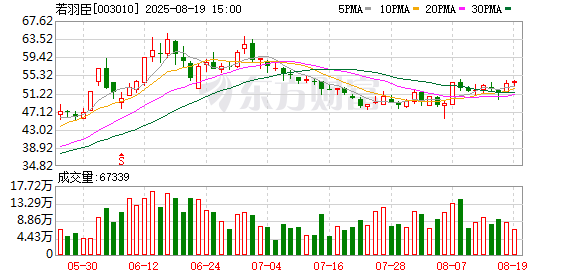
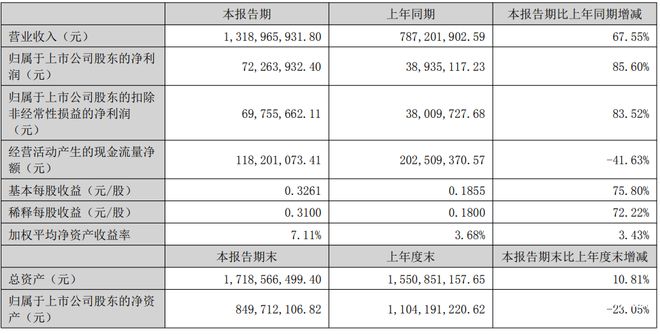
Core Viewpoint - The company, Ruoyuchen, reported significant revenue and profit growth in its 2025 semi-annual report, driven by its own brand business and brand management services [1][3]. Financial Performance - The company achieved operating revenue of 1.319 billion yuan, a year-on-year increase of 67.55% [2]. - Net profit attributable to shareholders was 72.26 million yuan, up 85.60% compared to the previous year [2]. - The self-owned brand business generated 603 million yuan in revenue, a substantial growth of 242.42%, accounting for 45.75% of total revenue [1][3]. Brand Performance - The brand "Zhanjia" generated 444 million yuan in revenue, reflecting a growth of 157.11% [3]. - The health product brand "Feicui" achieved revenue of 160 million yuan, with significant growth during the second quarter [5]. Sales Channels - The highest sales revenue came from Douyin, accounting for 37.24% of total sales, with a reported sales amount of 489 million yuan [6]. - During the 618 shopping festival, the overall GMV for "Zhanjia" increased by over 160%, with significant growth across multiple platforms [3]. Brand Management and Operations - The brand management business generated 335 million yuan, a year-on-year increase of 52.53% [6]. - The company’s agency operation business reported revenue of 380 million yuan, a slight decline of 2.79%, but with improved overall gross profit margins [7]. Legal Disputes - The company faced legal disputes with Mead Johnson and Mentholatum, involving contract and trademark issues, respectively [7][8]. - A court ruling required Mead Johnson to pay Ruoyuchen 18.47 million yuan, while Ruoyuchen was ordered to pay 750,000 yuan for product costs [7][8]. Future Plans - Ruoyuchen plans to issue H-shares and list on the Hong Kong Stock Exchange, aiming to raise funds for product development, brand building, and global expansion [9]. - The company is focusing on expanding into Southeast Asian markets, particularly with its self-owned brand "Zhanjia," which has significant growth potential in the region [10].
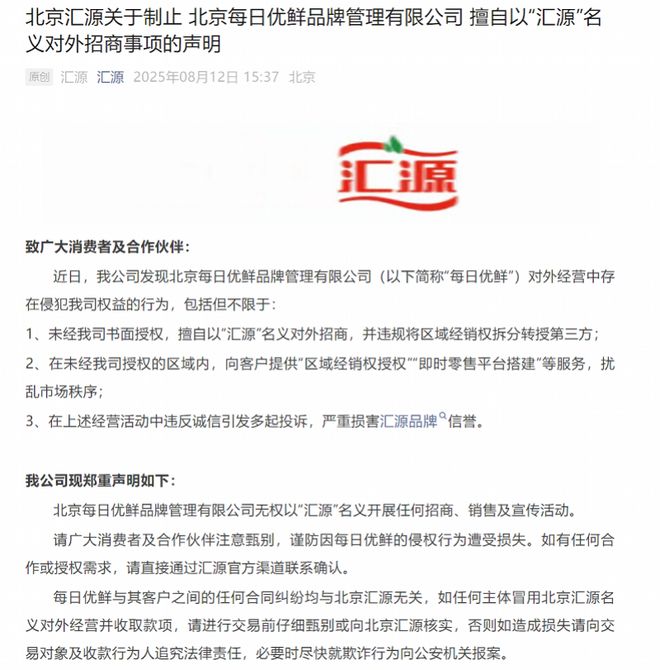
汇源果汁指控“每日优鲜”冒名对外招商,被质疑品牌管理失序
Nan Fang Du Shi Bao· 2025-08-12 11:15
Core Viewpoint - The recent dispute between Beijing Huiyuan Food and Beverage Co., Ltd. and Beijing Meiri Youxian Brand Management Co., Ltd. highlights significant issues in Huiyuan's brand authorization and distributor management system, leading to reputational damage for the Huiyuan brand [1][8]. Group 1: Dispute Details - Huiyuan publicly accused Meiri Youxian of unauthorized activities, including soliciting business under the Huiyuan name without written authorization and splitting regional distribution rights [2][6]. - The dispute arose after the expiration of the authorization agreement between Huiyuan and Meiri Youxian, which had been in place but is now no longer valid [6][8]. Group 2: Company Background - Beijing Meiri Youxian Brand Management Co., Ltd. is a small enterprise established in November 2023 and is not related to the well-known Meiri Youxian e-commerce platform [7][8]. - The original Meiri Youxian e-commerce platform, founded in 2014, had previously raised over 10 billion yuan in funding and went public in the U.S. before facing operational crises and delisting [8]. Group 3: Management Issues - The incident reveals deeper management issues within Huiyuan, particularly regarding the lack of effective mechanisms to prevent unauthorized use of brand assets after the expiration of agreements [8]. - Huiyuan's brand value is considered a significant asset, but the company has faced numerous challenges, including internal management chaos and family governance issues, leading to struggles in the capital market [8].

南方投资发展(广东)有限公司成立,注册资本500万人民币
Sou Hu Cai Jing· 2025-08-09 12:10
Core Insights - Southern Investment Development (Guangdong) Co., Ltd. has been established with a registered capital of 5 million RMB, fully owned by Yingfu Bao Group Co., Ltd. [1] Company Overview - The legal representative of Southern Investment Development (Guangdong) Co., Ltd. is Ou Gaolin [1] - The company is classified as a limited liability company (wholly owned by a legal person) [1] - The business scope includes brand management, bidding agency services, investment activities with self-owned funds, social and economic consulting services, asset evaluation, financial consulting, supply chain management services, enterprise management, and various technical services [1] Shareholding Structure - Yingfu Bao Group Co., Ltd. holds 100% of the shares in Southern Investment Development (Guangdong) Co., Ltd. [1] Business Activities - The company is involved in venture capital limited to investments in unlisted enterprises, financial institution entrusted services for overdue credit reminders, and information technology and process outsourcing services [1] - The operational address is located at Room C205-137, No. 1331 Nanzhou Road, Haizhu District, Guangzhou [1] - The business registration is valid until August 8, 2025, with no fixed term thereafter [1]
颖通控股(06883):颖中国香水品牌管理龙头,重视长期价值与全渠道布局
Haitong Securities International· 2025-07-29 12:57
Investment Rating - The report does not explicitly state an investment rating for Eternal Beauty Holdings Core Viewpoints - Eternal Beauty Holdings Limited is the largest perfume brand management company in China, established in 1983 and has been operating in the Chinese market for nearly 40 years [1][7] - The company focuses on long-term value and brand image building rather than short-term discount promotions [4][11] - The business model is primarily B2B, with 80% of operations in brand agency and distribution, while 20% is direct retail [2][8] - The company has exclusive agency rights for over 90% of brands in the Chinese market, covering a comprehensive sales network [9][10] - Eternal Beauty Holdings ranks third in the Chinese perfume market, behind international giants Chanel and LVMH, and offers a diverse range of approximately 2,000 scents across 52 perfume brands [5][12] Summary by Sections Company Overview - Eternal Beauty Holdings is headquartered in Hong Kong and officially listed on the Hong Kong Stock Exchange on June 26, 2025, with an issue price of HK$2.88 per share [1][7] Business Model - The company operates a B2B brand agency and distribution model, ensuring stable profit margins for partners and maintaining long-term relationships [2][8] - Direct retail operations are concentrated in top commercial areas of 13 cities, avoiding lower-tier city channels [2][8] Market Strategy - The company emphasizes full-channel control to maintain stable pricing and prevent market disruption [9][10] - It provides a one-stop solution for brands entering the Chinese market, leveraging its extensive network and market experience [10] Brand Management - Eternal Beauty Holdings prioritizes long-term brand value and customer mindset cultivation, collaborating with brands for over 10 years [4][11] - The company recognizes the personalized nature of perfume consumption in China and tailors its offerings accordingly [5][12]
颖通控股(06883):中国香水品牌管理龙头,重视长期价值与全渠道布局
Haitong Securities International· 2025-07-28 14:06
Investment Rating - The report does not explicitly state an investment rating for Eternal Beauty Holdings Core Viewpoints - Eternal Beauty Holdings Limited is the largest perfume brand management company in China, established in 1983 and has been operating in the Chinese market for nearly 40 years [1][7] - The company focuses on long-term value and brand image building rather than short-term discount promotions [4][11] - The business model is primarily B2B, with 80% of operations in brand agency and distribution, and 20% in direct retail [2][8] - The company has exclusive agency rights for over 90% of brands in the Chinese market, covering a comprehensive sales network [9][10] - Eternal Beauty Holdings ranks third in the Chinese perfume market, behind international giants Chanel and LVMH, and offers a diverse range of approximately 2,000 scents across 52 perfume brands [5][12] Summary by Sections Company Overview - Eternal Beauty Holdings is headquartered in Hong Kong and officially listed on the Hong Kong Stock Exchange on June 26, 2025, with an issue price of HK$2.88 per share [1][7] Business Model - The company operates a B2B brand agency and distribution model, ensuring stable profit margins for partners and maintaining long-term relationships [2][8] - Direct retail operations are concentrated in top commercial areas of 13 cities, avoiding lower-tier city channels [2][8] Market Strategy - The company emphasizes full-channel control to maintain stable pricing and prevent market disruption [9][10] - It provides a one-stop solution for brands entering the Chinese market, leveraging its extensive network and market experience [10] Brand Management - Eternal Beauty Holdings prioritizes long-term brand value and customer mindset cultivation, collaborating with brands for over 10 years [4][11] - The company recognizes the personalized nature of perfume consumption in China and tailors its offerings accordingly [5][12]
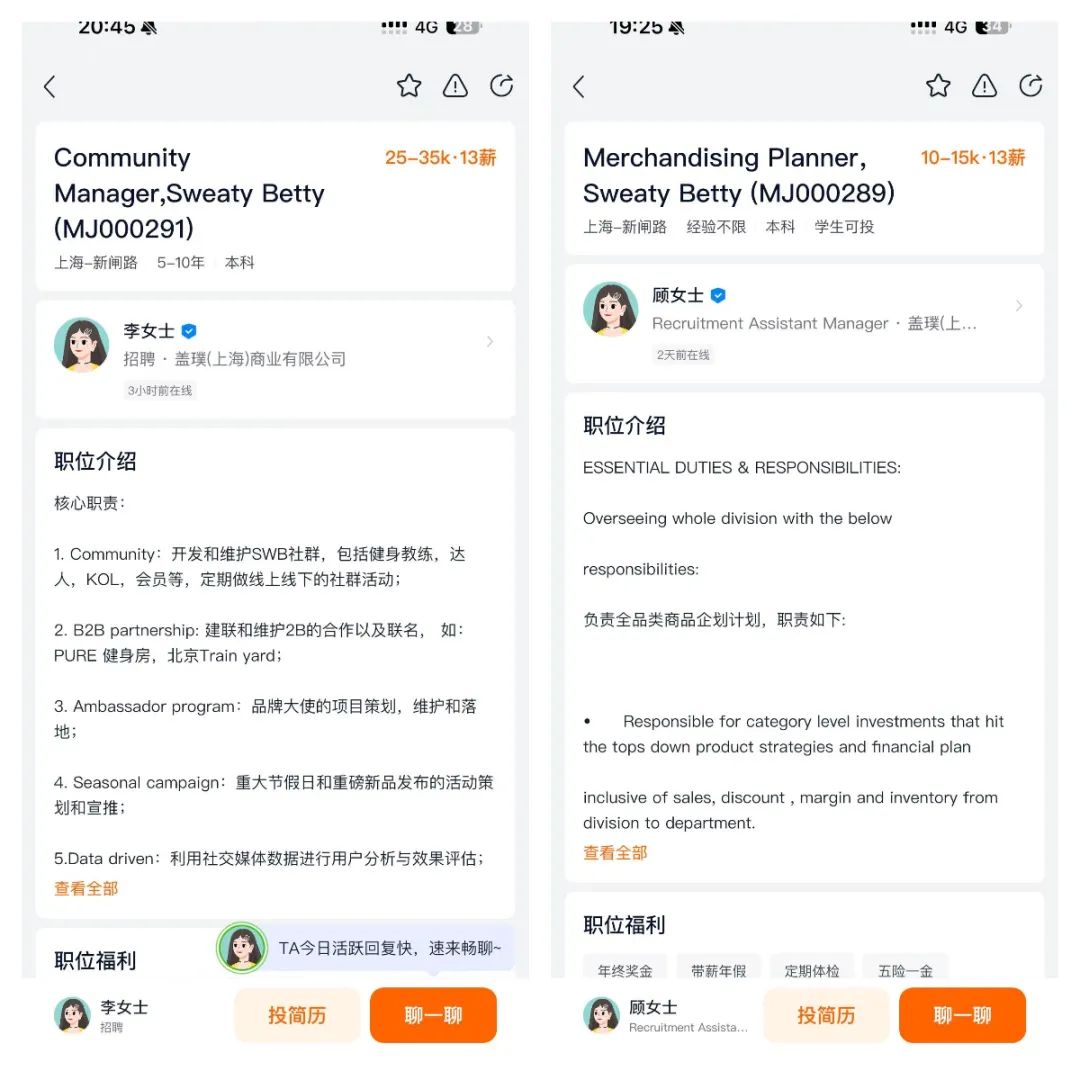
宝尊接手Sweaty Betty中国经营权,重塑英国版lululemon
3 6 Ke· 2025-07-16 03:28
Core Insights - Sweaty Betty, a UK yoga apparel brand, is ending its direct operation model in China and transferring its operational rights to Baozun, marking it as the third international brand under Baozun's management after GAP and Hunter [1][5][9] Group 1: Company Transition - The operational rights of Sweaty Betty in China have been handed over to Baozun, which is actively recruiting for roles related to sports community and product operations [1][5] - The team managing Sweaty Betty will share resources with the teams handling GAP and Hunter, indicating a streamlined operational approach [7][11] - The decision to transfer the operational rights comes after Sweaty Betty faced challenges in the Chinese market, struggling to compete with lululemon, which has seen over 50% growth in the region [3][5] Group 2: Market Performance - Sweaty Betty's products are priced similarly to lululemon, with training leggings priced between 750 to 1180 RMB and training tops between 480 to 750 RMB [3] - The brand's revenue for the year was reported at $199 million, reflecting a decline of 2.4%, with expectations of low single-digit revenue decline in 2025 [9][15] - The overall high-end yoga apparel market in China is experiencing a slowdown, with lululemon's growth in the region dropping to around 20% [15][18] Group 3: Competitive Landscape - The competitive landscape includes not only lululemon but also emerging brands like Vuori and alo, which are expanding their presence in China [15][18] - Baozun's strategy may need to focus on differentiation and brand positioning to effectively compete against established players like lululemon [13][14] - The success of Baozun in managing Sweaty Betty will depend on its ability to navigate the challenges posed by both local and international competitors in the high-end yoga apparel market [18]