
快递反内卷

Search documents
信达证券:快递反内卷涨价成效显著 关注旺季盈利修复
Zhi Tong Cai Jing· 2025-10-27 03:32
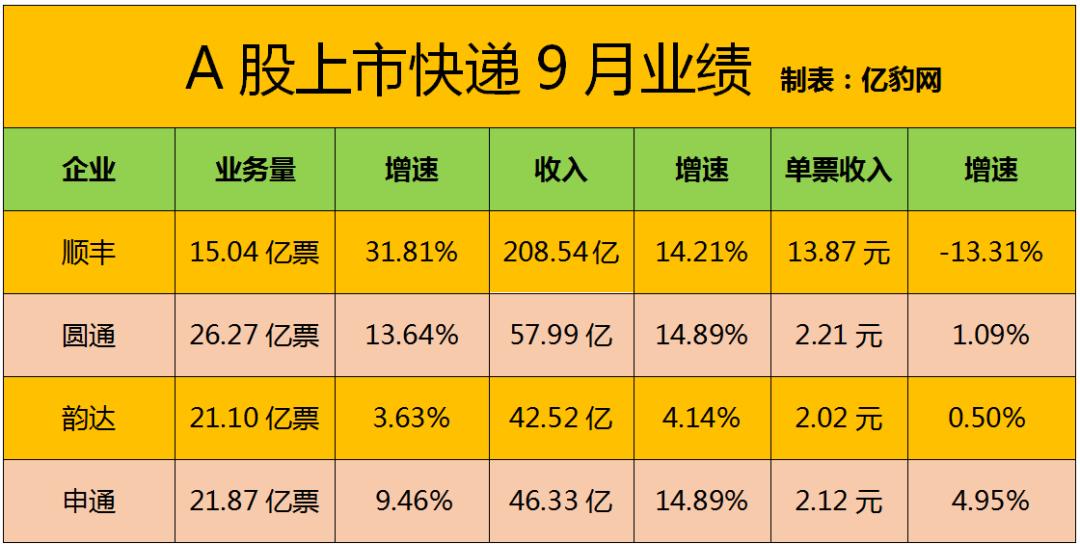
Core Viewpoint - The express delivery industry is experiencing a significant recovery in performance due to a rise in single-package prices and an increase in business volume during the peak season, driven by the "anti-involution" trend in the industry [1][5]. Group 1: Business Volume - In September, the express delivery industry saw a year-on-year business volume growth of 12.7%, with SF Express leading at 31.81% [2]. - Cumulatively, from January to September, the total express delivery volume reached 1,450.8 billion packages, representing a year-on-year increase of 17.2% [2]. - The business volume for major companies in September was as follows: YTO Express 2.627 billion packages, Shentong Express 2.187 billion packages, Yunda Express 2.110 billion packages, and SF Express 1.504 billion packages [2]. Group 2: Market Share - Cumulative market share from January to September shows YTO Express at 15.6%, Yunda Express at 13.2%, Shentong Express at 13.0%, and SF Express at 8.3%, with SF Express gaining 0.7 percentage points year-on-year [3]. Group 3: Pricing Situation - The express delivery industry experienced a significant month-on-month price increase of 2.4% in September, with an average price of 7.55 yuan per package, down 4.9% year-on-year [4]. - For major companies in September, the average prices were: YTO Express 2.21 yuan, Yunda Express 2.02 yuan, Shentong Express 2.12 yuan, and SF Express 13.87 yuan [4]. - Cumulatively, from January to September, the average price for SF Express was 13.83 yuan, down 13.00% year-on-year [4]. Group 4: Industry Outlook - The express delivery industry continues to show growth potential, with the "anti-involution" price increases proving effective, and attention should be paid to the upcoming peak season's volume and pricing dynamics [5]. - The expansion of e-commerce and the rise of live-streaming commerce are expected to further enhance the penetration rate of online shopping, contributing to the growth of the express delivery sector [5].


国泰海通:快递量持续较快增长 反内卷开启盈利修复
Zhi Tong Cai Jing· 2025-10-27 01:48
Core Insights - The report from Guotai Junan indicates that the trend of "anti-involution" in the express delivery industry has spread nationwide, significantly increasing the per-package revenue for companies and is expected to improve the profitability of e-commerce express delivery firms in the second half of this year and next year, with profitability elasticity depending on the sustainability of price increases [1] Group 1: Industry Trends - The trend of small-package delivery continues, with the industry expected to maintain resilient growth in business volume. By August 2025, the cumulative express delivery volume reached 128.2 billion packages, a year-on-year increase of 17.8% (on a comparable basis), indicating counter-cyclical growth [1] - The consumption potential in lower-tier markets, such as the central and western regions and rural areas, is being released, which is expected to contribute to resilient growth in industry business volume in the second half of 2025 and 2026 [1] Group 2: Financial Performance - In the first eight months of 2025, the express delivery industry's per-package revenue was 7.48 yuan, a year-on-year decline of 7.3%, but the decline has narrowed compared to a 12.3% drop at the end of 2024, reflecting a slowdown in price competition under the "anti-involution" regulation [1] - The upcoming peak season for e-commerce is anticipated to stabilize and repair express delivery prices in the second half of 2025 and 2026 [1] Group 3: Cost Dynamics - The weakening of economies of scale is noted, with the core cost per package declining at a slower pace. As transportation and transfer costs have limited room for reduction, the introduction of unmanned vehicle technology is expected to lower the delivery costs at the final stage [2] - New social security regulations are expected to lead to a short-term increase in per-package costs, but in the long term, they may drive the industry towards a value competition transformation [2]


申万宏源交运一周天地汇(20251019-20251024):三大因素反转强调船舶板块历史机会,油轮影响因素过多转向现实驱动
Shenwan Hongyuan Securities· 2025-10-25 14:09
Investment Rating - The report recommends investment in companies such as China Shipping, COSCO Shipping Energy, and China Shipbuilding Industry Corporation, highlighting a historical opportunity for the shipping sector due to a reversal of negative factors [23]. Core Views - The transportation industry index increased by 0.72%, underperforming the CSI 300 index by 2.52 percentage points, with the shipping sector showing the smallest decline at -1.28% [4][11]. - The report emphasizes that the shipping sector is experiencing a historical opportunity as negative influences such as policies, exchange rates, and ship prices have shifted to positive impacts [23]. - The VLCC freight rates have stabilized around $80,000 per day, with potential upward adjustments in rental rates expected due to market dynamics [24]. Summary by Sections 1. Industry Performance - The transportation index rose by 0.72%, while the shipping sector saw a decline of -1.28% [4][11]. - The coastal dry bulk freight index in China increased by 3.83%, and the Shanghai export container freight index rose by 7.11% [4]. 2. Sub-industry Insights - The report highlights that the shipping sector is at a historical low in terms of market value orders, with a potential recovery to historical averages of 1-3 times [23]. - The report notes that the oil tanker market is influenced by various factors, including geopolitical tensions and sanctions, which may affect freight rates [24]. 3. High Dividend Stocks - The report lists high dividend stocks in the transportation sector, including Bohai Ferry with a TTM dividend yield of 8.09% and Zhonggu Logistics with a yield of 10.88% [21][22]. 4. Market Trends - The report indicates that the shipping market is experiencing a shift with freight rates stabilizing and potential increases in rental rates, driven by supply and demand dynamics [23][24]. - The report also mentions that the dry bulk market is seeing fluctuations due to seasonal demand and geopolitical factors affecting trade [25][26].
交运行业2025年四季度投资策略:岁暮回暖,超越季律
Changjiang Securities· 2025-10-24 05:27
Group 1: Logistics - The logistics industry is expected to undergo a paradigm shift towards high-quality development, driven by policy changes and the "anti-involution" movement, which aims to ensure the rights of delivery personnel and improve profitability [4][24][30] - The logistics sector is entering a new phase of overseas expansion, with companies like Jitu Express and Jiayou International transitioning from initial stages to more advanced operations, focusing on management and capacity exports [4][8][35] Group 2: Aviation - The aviation industry is poised for recovery, benefiting from a resurgence in business travel demand since September, leading to improved revenue and cost dynamics [9][51] - The supply side is tightening, with low aircraft deliveries expected in 2025 and high capacity utilization rates, indicating a potential for revenue and cost resonance in the industry [9][51] Group 3: Shipping - The shipping sector is influenced by both seasonal and non-seasonal factors, with a focus on oil transportation due to OPEC+ production adjustments and the expected positive impact of new projects in the dry bulk segment [10][20] - The container shipping market is facing tariff disruptions, but demand is anticipated to rise due to proposed measures from the 301 investigation, which may boost feeder vessel demand [10][20] Group 4: Highways - Highway companies are regaining attractiveness in terms of valuation and dividend yield, with a focus on low valuation and high dividend characteristics [11][20] - The widening gap between highway company dividend yields and ten-year government bond yields suggests a return to a high cost-performance ratio for these assets [11][20]




申万宏源:25Q3快递涨价初步兑现至收入端 关注Q4业绩弹性
Zhi Tong Cai Jing· 2025-10-22 09:05
Core Viewpoint - The express delivery industry in China is experiencing a growth in business volume and revenue, driven by a reduction in internal competition and an increase in pricing [1][2][4] Industry Summary - According to the National Postal Bureau's report, the express delivery business volume is expected to grow by approximately 12% year-on-year in September, while revenue is projected to increase by around 7% year-on-year [1][2] - The average revenue per package in September is estimated at 7.58 yuan, reflecting a month-on-month increase of 3% [1][2] - The trend of reducing internal competition is leading to a continuous rise in express delivery prices across the country [2][4] Company Performance - YTO Express achieved a business volume of 2.627 billion packages in September, a year-on-year increase of 13.64%, with a revenue per package of 2.21 yuan, up 1.4% [1] - Shentong Express reported a business volume of 2.187 billion packages, a year-on-year increase of 9.46%, with a revenue per package of 2.12 yuan, up 4.95% [1] - Yunda Express completed a business volume of 2.110 billion packages, a year-on-year increase of 3.63%, with a revenue per package of 2.02 yuan, up 0.50% [1] Profitability Outlook - The third quarter is expected to show initial profit recovery for express delivery companies due to price increases, with a focus on profit elasticity in the fourth quarter [4][5] - The industry is entering a new phase of reducing internal competition, with potential implications for pricing and profitability [5] Investment Recommendations - Companies with significant profit elasticity such as Shentong Express (002468.SZ) and YTO Express (600233.SH) are recommended for investment, along with J&T Express (01519) benefiting from Southeast Asian e-commerce growth [6]


交通运输行业周报(2025年10月13日-2025年10月19日):9月快递价格持续上涨,中美港费落地或将影响海运效率-20251020
Hua Yuan Zheng Quan· 2025-10-20 11:51
Investment Rating - The investment rating for the transportation industry is "Positive" (maintained) [3] Core Views - The express logistics sector is experiencing resilient demand, with a "de-involution" trend driving up express prices, enhancing corporate profitability. The long-term outlook for e-commerce express logistics is positive due to healthy competition [3][13] - The shipping sector is expected to benefit from the OPEC+ production increase and the Federal Reserve's interest rate cuts, with a notable improvement in VLCC freight rates anticipated in Q4 2025 [13] - The aviation industry is seeing stable demand growth, with supply chain issues leading to increased costs for airlines. The overall passenger demand is projected to grow by 10.4% in 2024, outpacing capacity growth [9][14] Summary by Sections Express Logistics - In September 2025, major express companies reported improved performance, with YTO, Shentong, and Yunda achieving business volumes of 2.627 billion, 2.187 billion, and 2.110 billion pieces, respectively, representing year-on-year growth of 13.64%, 9.46%, and 3.63% [3][27] - The average revenue per piece for these companies also saw increases, indicating a trend of rising prices in the express delivery sector [3][27] Shipping and Ports - The implementation of new port fees between China and the US is expected to create a dual market structure, granting strategic pricing power to compliant shipping capacities [5] - China has secured pricing power for iron ore, marking a significant shift in global commodity trade dynamics [6] - The Shanghai Container Freight Index (SCFI) rose by 12.9% week-on-week, indicating a positive trend in shipping rates [7] Aviation - The International Air Transport Association (IATA) reported that supply chain bottlenecks are delaying aircraft production, leading to increased costs for airlines, estimated to exceed $11 billion in 2025 [9] - Chinese airlines collectively oppose the US Department of Transportation's proposed flight restrictions, highlighting concerns over operational impacts [10] Road and Rail - National logistics operations were reported to be running smoothly, with significant increases in highway freight traffic [12] - The National Development and Reform Commission plans to enhance electric vehicle charging infrastructure along highways by 2027 [12] Overall Market Performance - From October 13 to October 17, 2025, the transportation sector index increased by 0.73%, outperforming the Shanghai Composite Index, which fell by 1.47% [18]


快递总部利润持续修复,网点不应成为反内卷看客
3 6 Ke· 2025-10-20 11:34
Core Viewpoint - The express delivery industry in China is experiencing a recovery in both volume and pricing due to anti-involution measures, with significant revenue growth observed among major players in September. Group 1: Performance Metrics - SF Express achieved a business volume of 1.504 billion parcels, a growth rate of 31.81%, with revenue reaching 20.854 billion yuan, up 14.21%, but a decrease in average revenue per parcel by 13.31% to 13.87 yuan [1] - YTO Express reported a business volume of 2.627 billion parcels, a growth of 13.64%, with revenue of 5.799 billion yuan, up 14.89%, and an average revenue per parcel of 2.21 yuan, an increase of 1.09% [1] - Yunda Express had a business volume of 2.110 billion parcels, growing by 3.63%, with revenue of 4.252 billion yuan, up 4.14%, and an average revenue per parcel of 2.02 yuan, a slight increase of 0.50% [1] - Shentong Express reported a business volume of 2.187 billion parcels, a growth of 9.46%, with revenue of 4.633 billion yuan, up 14.89%, and an average revenue per parcel of 2.12 yuan, an increase of 4.95% [1] Group 2: Market Trends - The industry is seeing a slowdown in growth rates due to price increases, with SF Express leading the market for seven consecutive months, achieving an average daily volume of over 50 million parcels in September [2] - The State Post Bureau anticipates a year-on-year growth of approximately 12% in express delivery volume and 7% in revenue for September, with total volume expected to reach around 1.45 trillion parcels and revenue exceeding 1 trillion yuan for the first three quarters [2] - The anti-involution price increase actions have been expanding nationwide since July, showing positive effects on the performance of major express companies as the peak season approaches [2] Group 3: Challenges for Frontline Operations - While headquarters are benefiting from anti-involution measures, frontline outlets are facing varied situations, with some reporting increased losses due to rising shipping costs without a corresponding decrease in volume assessments [4] - Many outlets are struggling with the implementation of price increases, with some areas not fully passing on the increased costs to customers, leading to concerns about profitability during the peak season [5] - Despite the overall price increases, frontline outlets are still waiting for adjustments in delivery fees, with some regions only seeing minor increases, which do not alleviate the financial pressures faced by these outlets [6]

三季度涨价初步兑现至收入端,关注Q4业绩弹性:快递行业点评
Shenwan Hongyuan Securities· 2025-10-20 08:34
Investment Rating - The report rates the express delivery industry as "Overweight" [8] Core Insights - The express delivery industry continues to show growth, with September business volume increasing by approximately 12% year-on-year, and revenue expected to grow by around 7% [3] - The average revenue per package in September was 7.58 yuan, reflecting a month-on-month increase of 3% [3] - The report highlights a significant upward trend in pricing due to the ongoing "anti-involution" efforts within the industry, leading to improved profitability for express companies [3] Summary by Sections Business Volume and Revenue - YTO Express reported a business volume of 2.627 billion packages in September, a year-on-year increase of 13.64%, with an average revenue per package of 2.21 yuan, up 1.4% [1] - Shentong Express completed 2.187 billion packages, a 9.46% increase year-on-year, with an average revenue per package of 2.12 yuan, up 4.95% [1] - Yunda reported a business volume of 2.110 billion packages, a 3.63% increase year-on-year, with an average revenue per package of 2.02 yuan, up 0.50% [1] Pricing Trends - The report notes that the average package price has increased significantly, with Yunda seeing a month-on-month increase of 0.10 yuan, YTO and Shentong both increasing by 0.06 yuan [3] - The report anticipates that the third quarter will see express companies begin to realize profits from price increases, with a focus on the profit elasticity in the fourth quarter [3] Market Outlook - The report suggests three potential scenarios for the future of the express delivery industry: 1. Continued price recovery leading to significant dividends while ensuring the rights of delivery personnel 2. Ongoing competitive dynamics in various regions, resulting in increased industry differentiation 3. Potential for higher-level consolidation and supply-side optimization [3] - Companies recommended for investment include Shentong Express, YTO Express, and Jitu Express, with a focus on Zhongtong Express and Yunda [3]
快递行业点评:三季度涨价初步兑现至收入端,关注Q4业绩弹性
Shenwan Hongyuan Securities· 2025-10-20 06:14
Investment Rating - The report maintains an "Overweight" rating for the express delivery industry, indicating an expectation for the industry to outperform the overall market [3]. Core Insights - The express delivery sector is experiencing a significant increase in pricing, with September showing a year-on-year growth of approximately 12% in business volume and a 7% increase in revenue [3]. - The report highlights that the average single ticket revenue for September was 7.58 yuan per item, reflecting a month-on-month increase of 3% [3]. - The report anticipates that the third quarter will see express companies begin to realize profit recovery due to price increases, with a focus on profit elasticity in the fourth quarter [3]. - The report outlines three scenarios for the new phase of price competition in the industry, including the potential for sustained profit recovery and significant dividends, continued competitive dynamics in certain regions, and the possibility of higher-level mergers and acquisitions [3]. Summary by Sections Business Volume and Revenue - In September, major express companies reported the following business volumes: YTO Express at 2.627 billion items (up 13.64%), Shentong Express at 2.187 billion items (up 9.46%), and Yunda at 2.110 billion items (up 3.63%) [3]. - The average single ticket revenue for YTO was 2.21 yuan (up 1.4%), for Shentong was 2.12 yuan (up 4.95%), and for Yunda was 2.02 yuan (up 0.50%) [3]. Price Trends - The report notes a significant month-on-month increase in pricing across the industry, with Yunda showing the largest recovery in single ticket pricing [3]. - The report emphasizes the ongoing trend of price increases driven by the reduction of internal competition within the industry [3]. Future Outlook - The report suggests that the express delivery industry is entering a new phase of competition, with a focus on the upcoming quarterly reports and peak season pricing [3]. - Companies recommended for investment include Shentong Express, YTO Express, and Jitu Express, with a focus on Zhongtong Express and Yunda for their competitive advantages [3]. Valuation Table - The report includes a valuation table for key companies in the transportation sector, detailing their market capitalization and projected net profits for 2025 to 2027 [4].
极兔速递-W涨近4% 三季度包裹量超市场预期 反内卷政策推动下公司利润有望修复
Zhi Tong Cai Jing· 2025-10-20 02:27
Group 1 - The core viewpoint of the article highlights that Jitu Express (极兔速递-W) has seen a significant increase in its stock price, rising by 3.64% to HKD 10.25, with a trading volume of HKD 325.93 million [1] - According to Daiwa's report, Jitu's total parcel volume in Q3 increased by 23% year-on-year to 7.677 billion parcels, with Southeast Asia showing remarkable growth of 78.7% to approximately 2 billion parcels, exceeding both management and Daiwa's expectations [1] - Daiwa believes that the Southeast Asian express delivery market has entered a new development phase due to intensified platform competition and market share consolidation, positioning Jitu favorably in this new growth stage due to its market positioning and competitive costs [1] Group 2 - Shenwan Hongyuan points out that the high growth in new market parcel volume is primarily due to Jitu's continuous investment and deepening cooperation with e-commerce platforms [1] - Additionally, the express delivery industry is experiencing a price increase driven by anti-involution policies, which is expected to lead to profit recovery for Jitu in Q3 [1] - Since August, the ongoing anti-involution measures have resulted in rising express delivery prices, with reports indicating that the average price for major express companies has increased month-on-month, and this trend is anticipated to continue, positively impacting company profits [1]