
系统观念

Search documents
抓好党的创新理论宣讲,切实提升执法效能
Zhong Guo Huan Jing Bao· 2025-09-11 03:12
Core Viewpoint - The integration of the Party's innovative theories, especially Xi Jinping's ecological civilization thought, into the entire process of ecological environment law enforcement is essential for enhancing enforcement effectiveness, addressing complex challenges, building social consensus, and developing a competent workforce [1][2][3]. Group 1: Strengthening Ideological Foundation - The Party's innovative theories provide fundamental guidance for ecological environment law enforcement, ensuring that enforcement work aligns with the correct political direction and maintains ecological safety [1]. Group 2: Enhancing Enforcement Effectiveness - The systematic and complex nature of ecological issues requires the application of the Party's innovative theories, which serve as a "golden key" to resolve enforcement challenges. This includes using systematic thinking to trace pollution sources, legal thinking to ensure procedural compliance, and problem-oriented thinking to identify violations [2]. Group 3: Building Public Trust - The enforcement of ecological laws is closely related to public interest and can attract social attention. Theoretical dissemination is crucial for explaining enforcement actions, addressing public concerns, and promoting understanding of the enforcement's role in safeguarding health and ecological security [2]. Group 4: Promoting Source Governance - Effective ecological governance relies on source prevention and multi-party collaboration. The Party's theories advocate for a shared responsibility model, encouraging enterprises and the public to engage in environmental protection and compliance with regulations [3]. Group 5: Developing a Competent Enforcement Team - A strong enforcement team is essential for implementing theories and fulfilling responsibilities. Theoretical education should be integrated into enforcement work to enhance the team's capabilities in understanding regulations, communication, and problem-solving, particularly for younger enforcers [3].
习近平经济思想对唯物辩证法的创造性运用
Jing Ji Ri Bao· 2025-09-05 01:02
Core Viewpoint - Xi Jinping's economic thought creatively applies dialectical materialism to various aspects of economic work, emphasizing the importance of understanding and addressing both opportunities and challenges in the current domestic and international landscape [1][2][3]. Group 1: Understanding Domestic and International Trends - The new development stage presents both opportunities and challenges, requiring a dialectical understanding of the evolving domestic and international environment [3][4]. - Xi Jinping's economic thought introduces key concepts such as new normal, new development philosophy, and new development pattern to guide high-quality development [4][5]. Group 2: Methodological Framework - The principle of "seeking progress while maintaining stability" serves as a methodological guide for economic work, emphasizing the need to balance stability and progress [5][6]. - A systematic approach is essential for addressing complex economic issues, requiring coordination across various sectors and levels [6][8]. Group 3: Problem-Oriented Approach - A problem-oriented approach is a hallmark of Xi Jinping's economic thought, focusing on identifying and addressing pressing economic issues [9][10]. - This approach encourages innovation and practical solutions to enhance economic development [10][11]. Group 4: Concentrating on Internal Affairs - Emphasizing the importance of focusing on internal strengths, Xi Jinping's thought advocates for addressing challenges through self-reliance and strategic planning [11][12]. - The approach aims to ensure that external pressures do not hinder national development [12][13]. Group 5: Implementation and Practicality - The "nail-driving spirit" highlights the importance of practical implementation in economic work, ensuring that strategies are effectively executed [13][14]. - Continuous efforts are necessary to translate theoretical insights into actionable practices [14][15]. Group 6: Balancing Key Relationships - Xi Jinping's economic thought emphasizes the need to balance various critical relationships, such as market and government roles, supply and demand dynamics, and efficiency versus equity [19][20]. - These relationships are crucial for achieving sustainable economic growth and addressing systemic challenges [20][21].
呵护绿饭碗 擦亮金名片(连线评论员)
Ren Min Ri Bao· 2025-08-17 22:01
Core Viewpoint - Inner Mongolia has successfully completed a 1,856-kilometer desertification prevention and control green belt, showcasing a comprehensive approach to combating desertification through innovative technologies and collaborative efforts [1][2]. Group 1: Technological and Institutional Innovations - The region has enhanced innovation awareness by exploring suitable afforestation techniques for arid areas, such as aerial seeding and new planting methods, while promoting mechanized and intelligent sand control technologies [1][2]. - Institutional innovations include the establishment of a desertification prevention fund and a collaborative mechanism for regional management, which creates a robust framework for combating desertification [1][2]. Group 2: Systematic and Collaborative Approaches - A systematic view is emphasized, where desertification prevention requires multi-regional cooperation, leading to agreements with neighboring provinces for joint efforts in combating desertification [2]. - The establishment of a comprehensive network for desertification control reflects a shift from isolated efforts to integrated strategies, enhancing the effectiveness of ecological governance [2][3]. Group 3: Community Involvement and Economic Integration - Community participation is identified as a vital driving force, with mechanisms established to encourage public investment and involvement in desertification control initiatives [3]. - The integration of ecological protection with economic development is highlighted, where protecting ecological resources is seen as a pathway to achieving high-quality economic growth [3][4]. Group 4: Commitment to Sustainable Development - Inner Mongolia is committed to integrating ecological protection into its overall development strategy, ensuring that green development principles are embedded in all aspects of economic and social progress [4]. - The region aims to balance ecological preservation with economic benefits, contributing to a sustainable and beautiful China [4].
我国湿地保护获世界点赞有哪些秘诀?
Zhong Guo Huan Jing Bao· 2025-08-15 05:22
Group 1 - The core viewpoint of the articles emphasizes the importance of wetland protection and restoration, highlighting China's leadership in international wetland cities and the implementation of the Wetland Protection Law [1][2] - China has achieved the certification of "International Wetland Cities" for 9 cities, bringing the total to 22, showcasing its global leadership in wetland conservation [1] - The implementation of the Wetland Protection Law in 2022 marks a significant step in integrating wetland protection into the legal framework, reflecting the increasing policy emphasis on ecosystem maintenance [1] Group 2 - The approach to mangrove restoration should focus on selecting suitable tree species based on specific environmental conditions rather than merely expanding planting areas [2] - Effective management of invasive species like Spartina alterniflora requires a principle-based approach to restore biodiversity and ecological service functions in coastal areas [2] - The transformation of ecological resources into economic value is a key topic in wetland governance, with various local initiatives developing tailored models for ecological agriculture, tourism, and carbon trading [2]
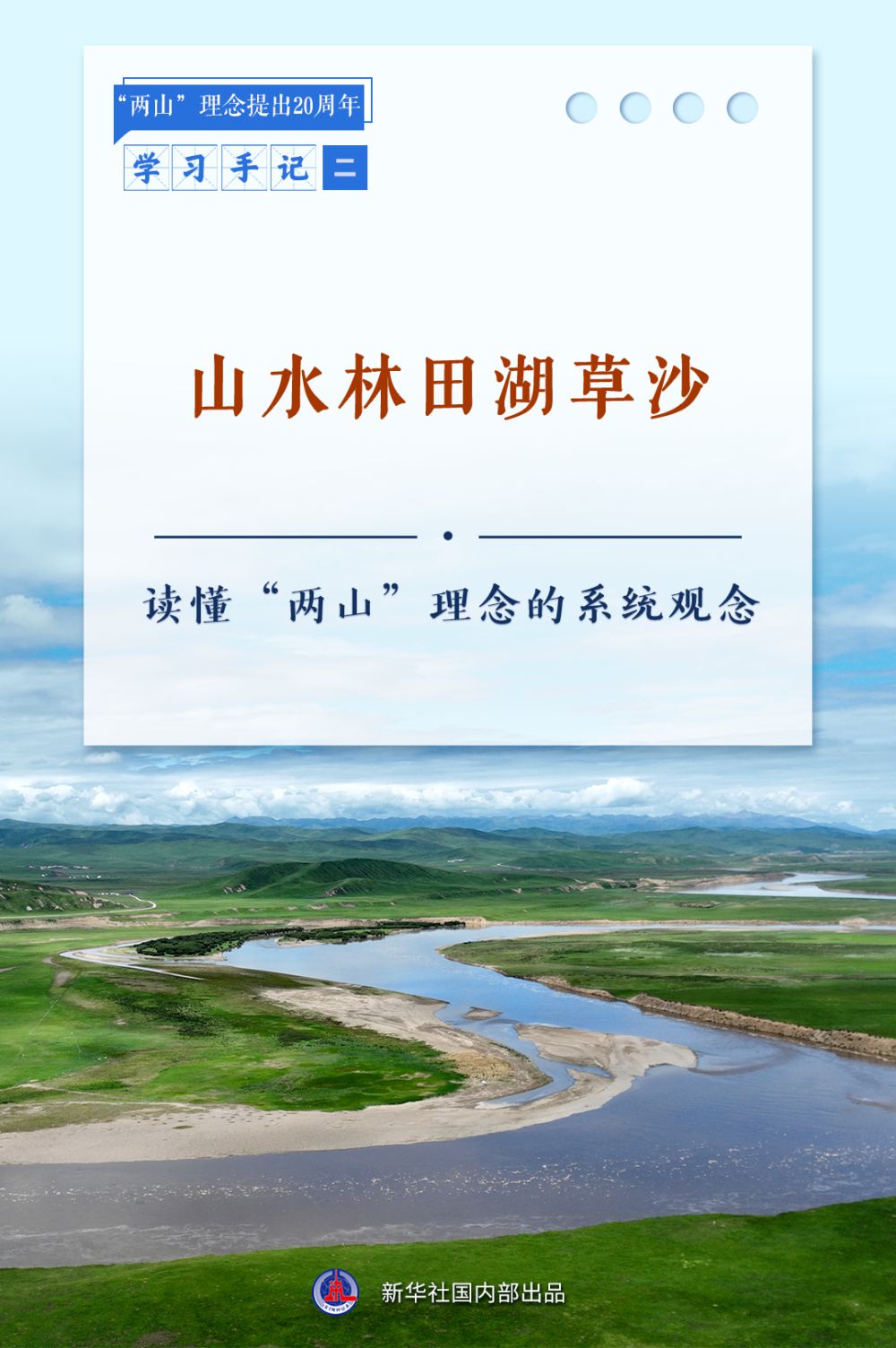
学习手记丨山水林田湖草沙——读懂“两山”理念的系统观念
Xin Hua She· 2025-08-14 12:49
Core Concept - The article commemorates the 20th anniversary of the "Green Mountains and Clear Water are Gold and Silver Mountains" concept, emphasizing the importance of a systematic approach to ecological civilization and integrated management of natural resources [4][6]. Group 1: Systematic Governance - The concept of "Two Mountains" promotes a comprehensive and coordinated approach to ecological governance, which includes the integration of mountains, water, forests, fields, lakes, grasslands, and sand [4][6]. - The addition of "sand" to the governance framework reflects a deepening understanding of ecological systems and the need for holistic management [4][6]. - Historical context shows a consistent evolution of this systematic view, starting from the recognition of "mountains, water, forests, fields, and lakes as a community of life" in 2013 to the current comprehensive governance model [4][5]. Group 2: Economic and Ecological Balance - The article stresses the necessity of achieving both economic growth and ecological advancement, advocating for a new development path that prioritizes ecological preservation and green development [5][6]. - It highlights the importance of top-level design in exploring high-quality development that harmonizes economic and ecological benefits [5][6]. Group 3: Long-term Strategy - The article discusses the long-term nature of ecological restoration, likening it to a chronic illness that requires comprehensive and sustained efforts for effective treatment [6]. - It emphasizes the need for a multi-faceted approach to address environmental issues, integrating various strategies for holistic governance [6][7]. Group 4: Practical Implementation - The successful case of Uliangsu Lake illustrates the effectiveness of a systematic governance approach, where recognizing the interconnectedness of ecological issues led to significant improvements in the local environment and economy [7][8]. - The article advocates for a dialectical materialist approach to understanding and addressing ecological problems, emphasizing the importance of a comprehensive perspective in both thought and action [8].

为新时代党校(行政学院)事业高质量发展提供制度保障
Ren Min Ri Bao· 2025-08-11 22:01
Core Points - The revised "Regulations on the Work of the Party School (Administrative Academy)" aims to enhance the scientific, institutional, and standardized level of the Party school work, reflecting the importance of training and educating Party members and officials [1][2][3] Summary by Sections Background and Significance - The revision of the regulations is a response to the new tasks and missions outlined by the Party's 20th Central Committee, emphasizing the need for a robust training mechanism for Party members and officials [1][2] Main Revisions - The revised regulations maintain the original framework while adding 5 new articles and modifying 66 articles, totaling 75 articles across 13 chapters [3] - Key modifications include: - Clarification of the Party school's role as the main channel for educating and training officials and Party members [3] - Specification of the establishment and system of Party schools, including the requirement for ordinary higher education institutions to set up Party schools [3] - Introduction of regular training, particularly basic training, with clear requirements for training objects, content, and duration [3] - Optimization of teaching content to focus on enhancing capabilities for socialist modernization [3] - Strengthening research and decision-making consultation work, emphasizing the importance of theoretical and countermeasure research [3] Training and Talent Development - The regulations stress the unique value of Party schools in nurturing talent for the Party, with specific requirements for basic training, including the use of both online and offline methods [4][5] - Emphasis on the importance of theoretical education and party spirit education as core components of the training curriculum [4] Research and Decision-Making - The regulations outline new requirements for Party schools to enhance their research capabilities, focusing on systematic and theoretical studies of Xi Jinping's thoughts [6] - Emphasis on the integrity of research and the establishment of academic norms tailored to the characteristics of Party schools [6] Systematic Approach - The addition of a "systematic perspective" principle aims to enhance collaboration and resource integration among Party schools at various levels [7] - The regulations encourage inter-school cooperation and resource sharing to create a comprehensive training framework [7] Implementation and Compliance - The implementation of the regulations is crucial, with directives for Party committees and schools to ensure effective execution and integration into training programs [8] - Plans for nationwide training sessions and promotional activities to ensure understanding and adherence to the new regulations [8]
科学制定和接续实施生态环境保护中长期规划
Zhong Guo Huan Jing Bao· 2025-08-10 23:12
Core Viewpoint - The article emphasizes the importance of scientifically formulating and continuously implementing five-year plans for ecological environment protection as a key experience in governance and a significant political advantage of socialism with Chinese characteristics [1] Group 1: Historical Context of Ecological Planning - The establishment of the People's Republic of China created conditions for planned economic and social development, laying a green foundation from the First Five-Year Plan to the Fifth Five-Year Plan [2] - The introduction of the "32-character guideline" for environmental protection in 1973 marked a significant step in integrating ecological considerations into national planning [2] - Since the 18th National Congress, ecological civilization has been incorporated into the overall layout of socialism with Chinese characteristics, guiding ecological protection planning to new heights [3] Group 2: Experience Accumulation in Ecological Governance - The ecological environment protection planning serves as a green design for the modernization strategy, with the Communist Party of China accumulating governance experience through comprehensive ecological protection efforts [4] - The process of formulating ecological protection plans is seen as a continuous innovation in theory, practice, and systems, enhancing the understanding of ecological civilization [4] Group 3: Problem-Solving and Systematic Approach - The focus on problem orientation allows for the identification of key issues in ecological protection, leading to targeted solutions and enhanced governance capabilities [5] - A systematic approach is advocated, recognizing the interdependence of human society and nature, and promoting integrated management of natural resources [6] Group 4: Comprehensive Promotion of Beautiful China - High-quality planning is essential for transforming all sectors towards green and low-carbon development, aligning with the goal of building a beautiful China [7] - The article stresses the need for coordinated development across various ecological systems, emphasizing the importance of maintaining balance among natural elements [8] - Regional ecological civilization construction should be tailored to local conditions, promoting a complementary ecological economic layout across different regions [9] Group 5: Societal Engagement in Ecological Civilization - The construction of ecological civilization is framed as a collective effort, requiring the establishment of a modern environmental governance system that encourages participation from all sectors of society [9] - The promotion of a green lifestyle is highlighted as a crucial aspect of fostering ecological awareness and shared values among the populace [9]
奋力开创国库高质量发展新局面
Jin Rong Shi Bao· 2025-08-08 07:56
Core Viewpoint - The article highlights the significant achievements and developments of the People's Bank of China (PBOC) in managing the national treasury over the past 40 years, emphasizing the importance of legal frameworks, organizational structures, technological advancements, and service improvements in supporting economic and social development. Group 1: Achievements in Treasury Management - The PBOC has continuously innovated in treasury systems, technology, and management, enhancing the treasury's role in budget execution and contributing positively to economic and governance modernization [2][4][6]. - A comprehensive legal framework has been established, including the "National Treasury Regulations" and other laws, which solidify the PBOC's role in treasury management [2][3]. - The PBOC has developed a five-tier treasury organizational system, with 4,271 treasury offices established nationwide, ensuring effective management and oversight [3]. Group 2: Technological Advancements - The PBOC has built a modern treasury information technology platform, transitioning from manual to automated processes, significantly improving budget execution efficiency [4][6]. - The integration of new technologies such as artificial intelligence and big data into treasury operations has enhanced data sharing and operational efficiency [4][6]. Group 3: Service to Government and Society - The treasury has established a unified accounting system and standardized processes, with budget funds processed exceeding 100 trillion yuan by 2021, reflecting a 10.6% annual growth since the 18th National Congress [5]. - The PBOC has effectively managed cash flow and supported major tax reforms, facilitating over 2.4 trillion yuan in VAT refunds in 2022 alone [6][7]. Group 4: Strengthening Supervision and Governance - The PBOC has enhanced its supervisory framework, ensuring compliance and risk management through a collaborative approach with relevant departments [8][9]. - Continuous improvement in legal and regulatory frameworks has been emphasized to adapt to new business models and ensure effective treasury operations [10][11]. Group 5: Future Directions - The PBOC aims to deepen the integration of treasury management with national economic policies, focusing on high-quality development and modernization of the treasury system [14][18]. - Emphasis on technological empowerment and legal frameworks will be crucial for enhancing treasury capabilities and meeting public service demands [16][17].
学好用好新时代改革方法论 推进主流媒体系统性变革
Jing Ji Ri Bao· 2025-08-07 22:26
Group 1 - The core viewpoint emphasizes the necessity of continuous reform and innovation to adapt to new challenges and opportunities in the context of China's modernization [1][19] - The article outlines the importance of adhering to major principles and scientific methods for deepening reforms, ensuring that reforms yield effective results [2][4] - It highlights the need for a problem-oriented approach to identify and address significant issues hindering development, such as technological innovation and income disparity [4][7] Group 2 - The concept of a systematic perspective is crucial for enhancing the overall effectiveness and coordination of reforms, addressing various economic and social relationships [5][6] - The article stresses the importance of balancing the processes of breaking old systems and establishing new ones to ensure steady and deep reform progress [6][14] - It discusses the role of mainstream media in reform, emphasizing the need for a robust media mechanism to adapt to the evolving communication landscape [8][12] Group 3 - The article underscores the significance of talent development in media organizations to enhance their capabilities in a competitive environment [13][17] - It points out the necessity for media to engage in proactive narrative-building to counter negative perceptions and promote positive economic stories [18][19] - The need for a strong ideological foundation in media work is highlighted, ensuring alignment with the central political direction and enhancing public confidence in reforms [15][16]
精准发力促进解决群众反映强烈突出问题
Zhong Yang Ji Wei Guo Jia Jian Wei Wang Zhan· 2025-07-31 00:29
Core Points - The emphasis on promoting strict governance of the Party at the grassroots level is highlighted, with a focus on addressing corruption and misconduct that affects the public [1] - The need for a systematic approach to establish an effective operational mechanism for addressing corruption and misconduct is stressed [2] - The importance of prioritizing the needs and concerns of the people in governance and problem-solving is underscored [3] - A comprehensive strategy to combat corruption through a three-pronged approach of deterrence, prevention, and aspiration is advocated [4][5] Group 1 - The necessity for local Party committees, especially at the city and county levels, to prioritize the rectification of misconduct and corruption affecting the public [1] - The call for integrating various resources and efforts to effectively address prominent issues raised by the public [1] - The establishment of a collaborative work structure involving Party leadership, disciplinary committees, and public participation [2] Group 2 - The focus on a people-centered approach, ensuring that public grievances are addressed promptly and effectively [3] - The implementation of a feedback loop for public complaints, ensuring accountability and timely responses [3] - The creation of a multi-channel network for collecting public opinions and complaints [3] Group 3 - The promotion of a unified strategy to combat corruption, emphasizing the need for a comprehensive approach that includes deterrence, prevention, and aspiration [4] - The commitment to addressing specific corruption cases with a focus on impactful and significant cases [5] - The importance of continuous education and awareness programs to reinforce party discipline and ethics among members [5]