
趋势跟踪策略

Search documents
【UNFX课堂】为什么巴菲特反对它,而西蒙斯依赖它趋势跟踪的哲学分裂
Sou Hu Cai Jing· 2025-07-12 12:01
Core Concepts - Trend following is not blind speculation; it emphasizes acting in accordance with market trends and avoiding counter-trend operations [1] - Price reflects all fundamentals, sentiment, and policies, ultimately manifesting in price trends [2] - Cut losses quickly and let profits run; quickly stop losses on losing trades while holding profitable trades until the trend ends [3] - Trends have inertia; once established, they are more likely to continue than to reverse [4] - Do not predict; instead, react to market signals and follow trends [5] Trend Identification - Moving Average System: A bullish signal occurs when a short-term moving average crosses above a long-term moving average (e.g., 5-day > 20-day) [6] - Channel Breakout: Enter long when price breaks above the N-day high and short when it breaks below the N-day low [6] - Momentum Indicators: An expanding MACD histogram indicates trend acceleration [6] - Trend Structure: Higher highs and higher lows indicate an uptrend, while lower highs and lower lows indicate a downtrend [6] - Volatility Confirmation: A breakout of the Average True Range (ATR) from recent averages signals trend initiation [6] Strategy Execution - Entry Rules: Enter trades on price breakouts with increased volume or on pullbacks to moving averages [7] - Position Sizing: Limit single trade risk to 1% of total capital [7] - Stop Loss Settings: Use volatility-based stops (±2 times ATR) or structural stops based on previous highs/lows [7] - Profit Taking Logic: Implement trailing stops based on a percentage retracement from the highest price [7] - Multi-Market Adaptation: Different strategies for various asset classes, such as focusing on moving averages for stock index futures and momentum indicators for cryptocurrencies [7] Risk Management - Diversification: Hold 5-10 non-correlated trend positions simultaneously [8] - Leverage Control: Limit futures leverage to 5 times and cryptocurrency leverage to 3 times [8] - Drawdown Triggers: Enforce a 50% reduction in positions if account drawdown reaches 15% [8] - Correlation Monitoring: Reduce positions if the correlation coefficient among holdings exceeds 0.7 [8] Cognitive Misconceptions - Trend following is not equivalent to long-term holding; exit immediately when a trend ends [9] - Holding periods typically range from days to months, not high-frequency trading [9] - Avoid over-optimization, which can lead to failure in real trading [9] - Emotional interference can lead to premature exits; adhere to trailing stops [9] Practical Cases - Oil Price Crash 2020: Trend signals indicated a short position after breaking the 200-day moving average [10] - Nvidia AI Surge 2024: Trend initiation was confirmed by a weekly MACD crossover [10] - Federal Reserve Rate Hikes: The dollar index rose 15% during the 2022 rate hike cycle, validating breakout strategies [10] - Bitcoin Halving Trends: Historical data shows significant price increases following halving events [10]
港股投资周报:港股精选组合年内上涨43.22%,相对恒生指数超额22.88%-20250712
Guoxin Securities· 2025-07-12 08:39
Quantitative Models and Construction Methods - **Model Name**: Hong Kong Stock Selection Portfolio Strategy **Model Construction Idea**: The strategy is based on a dual-layer selection process that combines fundamental and technical analysis to identify outperforming stocks from an analyst-recommended stock pool[14][15] **Model Construction Process**: 1. **Analyst Recommendation Pool**: Constructed using three types of analyst recommendation events: upward earnings revisions, first-time coverage, and research reports with unexpected positive titles[15] 2. **Fundamental and Technical Screening**: Stocks in the recommendation pool are further filtered based on fundamental support and technical resonance to identify stocks with both strong fundamentals and positive technical trends[15] 3. **Backtesting**: The backtesting period spans from January 1, 2010, to June 30, 2025, assuming a fully invested portfolio with transaction costs considered[15] **Model Evaluation**: The strategy demonstrates strong performance with significant excess returns over the Hang Seng Index[15] - **Model Name**: Stable New High Stock Screening **Model Construction Idea**: This model leverages momentum and trend-following strategies, focusing on stocks that have recently reached 250-day highs and exhibit stable price paths[20][22] **Model Construction Process**: 1. **250-Day High Distance Calculation**: $ 250\text{-day high distance} = 1 - \frac{\text{Close}_{\text{latest}}}{\text{ts\_max(Close, 250)}} $ Where $\text{Close}_{\text{latest}}$ is the latest closing price, and $\text{ts\_max(Close, 250)}$ is the maximum closing price over the past 250 trading days[22] 2. **Screening Criteria**: - Stocks must have reached a 250-day high in the past 20 trading days - Analyst coverage: At least five "Buy" or "Overweight" ratings in the past six months - Relative strength: Top 20% in 250-day returns among all Hong Kong stocks - Stability: Evaluated using metrics such as price path smoothness and the time-series average of the 250-day high distance over the past 120 days[22][23] 3. **Final Selection**: The top 50 stocks based on stability and trend continuation metrics are selected[23] **Model Evaluation**: The model effectively identifies stocks with strong momentum and stable price trends, aligning with the principles of momentum investing[20][22] Model Backtesting Results - **Hong Kong Stock Selection Portfolio Strategy**: - Annualized Return: 19.11% - Excess Return over Hang Seng Index: 18.48% - Information Ratio (IR): 1.22 - Maximum Drawdown: 23.73%[15][19] - **Stable New High Stock Screening**: - Not explicitly quantified in the report, but the model identifies stocks with strong recent performance and stable price paths, such as those in the financial, healthcare, and consumer sectors[22][23] Quantitative Factors and Construction Methods - **Factor Name**: 250-Day High Distance **Factor Construction Idea**: Measures the proximity of the latest closing price to the highest closing price in the past 250 trading days, capturing momentum and trend-following characteristics[22] **Factor Construction Process**: $ 250\text{-day high distance} = 1 - \frac{\text{Close}_{\text{latest}}}{\text{ts\_max(Close, 250)}} $ - If the latest closing price reaches a new high, the factor value is 0 - If the price has fallen from the high, the factor value is positive, indicating the degree of pullback[22] **Factor Evaluation**: This factor is effective in identifying stocks with strong momentum and limited pullbacks, which are likely to continue their upward trends[22] Factor Backtesting Results - **250-Day High Distance**: - Specific performance metrics are not provided, but the factor is used to screen stocks with strong momentum and stable trends, contributing to the selection of outperforming stocks in the financial, healthcare, and consumer sectors[22][23]
由创新高个股看市场投资热点
量化藏经阁· 2025-07-11 09:09
Group 1 - The report tracks stocks, industries, and sectors that are reaching new highs, indicating market trends and hotspots [1][4] - As of July 11, 2025, the distance to the 250-day new high for major indices is as follows: Shanghai Composite Index 0.00%, Shenzhen Component Index 6.95%, CSI 300 5.67%, CSI 500 4.79%, CSI 1000 2.28%, CSI 2000 0.00%, ChiNext Index 13.46%, and STAR Market 11.75% [5][24] - The sectors closest to their 250-day new highs include Power and Utilities, Steel, Comprehensive Finance, Pharmaceuticals, and Non-ferrous Metals, while Food and Beverage, Coal, Consumer Services, Automotive, and Oil and Petrochemicals are further away [8][24] Group 2 - A total of 873 stocks reached a 250-day new high in the past 20 trading days, with the most significant numbers in Basic Chemicals, Machinery, and Pharmaceuticals [2][13] - The highest proportion of new high stocks is found in Banking, Comprehensive Finance, and National Defense and Military Industry, with respective proportions of 90.48%, 40.00%, and 33.61% [13] - The manufacturing and cyclical sectors had the most new high stocks this week, with 245 and 233 stocks respectively [15] Group 3 - The report identifies 38 stocks that are considered stable new highs, including Shenghong Technology, Beijing North, and Nanhua Futures, with the most in the Manufacturing and Technology sectors [3][21] - The Manufacturing sector had the highest number of new highs, particularly in the National Defense and Military Industry, while the Technology sector saw the most in the Electronics industry [21][25]


热点追踪周报:由创新高个股看市场投资热点(第199期)-20250620
Guoxin Securities· 2025-06-20 11:12
- The report tracks the market trend by monitoring stocks, industries, and sectors that have reached new highs, using a 250-day high distance metric[11][12][13] - The 250-day high distance is calculated as: $ 250 \text{ day high distance} = 1 - \frac{Closet}{ts\_max(Close, 250)} $ where Closet is the latest closing price and $ ts\_max(Close, 250) $ is the maximum closing price in the past 250 trading days[11] - As of June 20, 2025, the 250-day high distances for major indices are: Shanghai Composite Index 3.72%, Shenzhen Component Index 12.96%, CSI 300 9.62%, CSI 500 10.92%, CSI 1000 9.26%, CSI 2000 7.07%, ChiNext Index 21.19%, and STAR 50 Index 14.99%[2][12][13] - The report identifies 816 stocks that reached a 250-day high in the past 20 trading days, with the highest numbers in the pharmaceutical, basic chemicals, and machinery industries[3][19][20] - The report also tracks "stable new high stocks" based on analyst attention, relative stock strength, trend continuity, price path stability, and new high sustainability, selecting 26 stocks such as Sijia Photon, Shenghong Technology, and Boryung Pharmaceutical[3][25][27] - The selected stable new high stocks are mainly from the financial and cyclical sectors, with the financial sector having the most new highs in the banking industry and the cyclical sector in the basic chemicals industry[3][28][29]
由创新高个股看市场投资热点
量化藏经阁· 2025-06-13 09:46
Group 1 - The report tracks stocks, industries, and sectors that are reaching new highs, indicating market trends and hotspots [1][4] - As of June 13, 2025, the distance to the 250-day new high for major indices is as follows: Shanghai Composite Index 3.23%, Shenzhen Component Index 11.94%, CSI 300 9.21%, CSI 500 9.33%, CSI 1000 7.65%, CSI 2000 4.96%, ChiNext Index 19.86%, and STAR Market 13.66% [5][25] - The industry indices that are closest to their 250-day new highs include non-ferrous metals, banking, pharmaceuticals, agriculture, forestry, animal husbandry, fishery, and electric power and public utilities [8][25] Group 2 - A total of 838 stocks reached a 250-day new high in the past 20 trading days, with the most significant numbers in the pharmaceutical, basic chemicals, and machinery sectors [2][13] - The highest proportion of new high stocks is found in the banking, textile and apparel, and pharmaceutical industries, with respective proportions of 71.43%, 29.29%, and 24.95% [13][16] - The manufacturing and cyclical sectors had the most new high stocks this week, with 262 and 212 stocks respectively [16] Group 3 - The report identifies 42 stocks that have shown stable new highs, with the majority coming from the manufacturing and consumer sectors, each contributing 9 stocks [22][26] - The mechanical industry had the most new highs within the manufacturing sector, while the food and beverage industry led in the consumer sector [22][26] - The selection criteria for stable new high stocks include analyst attention, relative strength of stock prices, price path stability, and continuity of new highs [19][20]

他们为何能在期货市场长胜不败?顶级交易员的实战策略全公开
Sou Hu Cai Jing· 2025-05-31 22:53
Core Insights - The article explores the lives and strategies of some of the most famous futures traders, highlighting their innovative methods, risk management techniques, and discipline, which provide valuable lessons for traders and investors [1][13]. Group 1: Richard Dennis - Richard Dennis, known as the "King of Trading," turned a small loan into over $200 million by his early 30s and is famous for the "Turtle Traders" experiment, proving that trading can be taught [2][4]. - His breakout strategy involves buying when prices break above a certain level and selling when they fall below, based on the assumption that trends tend to continue [4]. - Dennis emphasizes strict risk management, typically risking only 1-2% of his capital on any single trade, which helps him survive consecutive losses [4]. - He adjusts position sizes based on market volatility, increasing positions in low-volatility markets and decreasing them in high-volatility ones [4]. - Quick stop-loss orders are a key rule for Dennis, ensuring that losses are kept to a minimum [4]. Group 2: Paul Tudor Jones - Paul Tudor Jones, founder of Tudor Investment Corp, is renowned for predicting and profiting from the 1987 stock market crash, reportedly tripling his funds that day [2][6]. - His global macro trading strategy involves making large bets across multiple asset classes based on macroeconomic trends, including futures [6]. - Jones values technical analysis alongside macroeconomic analysis, looking for chart patterns and signals for entry and exit points [6]. - He often takes contrarian positions, betting against prevailing market sentiment, believing that the best investment opportunities arise when market consensus is wrong [6]. - Dynamic risk management is central to his strategy, involving strict stop-losses and adjusting position sizes based on market volatility and confidence in trades [6]. Group 3: John W. Henry - John W. Henry, a legendary futures trader and owner of the Boston Red Sox and Liverpool FC, is known for his systematic, algorithm-driven trading approach [3][8]. - His trading strategy is based on systematic trend following, focusing on a wide range of futures markets to diversify risk and capture various market trends [8]. - Henry implements strict risk management rules, including capital allocation limits per trade and using stop-loss orders to protect against significant losses [8]. - He adopts a long-term perspective, willing to hold positions through drawdowns, believing in the long-term profitability of his strategies [8]. - Continuous research and development are crucial to his success, as he adapts his trading systems based on historical data and market behavior [8]. Group 4: Ed Seykota - Ed Seykota, an influential futures trader, is recognized for developing and implementing computerized trading systems in the 1970s [3][10]. - His strategy combines systematic trend following with emotional discipline, using automated systems to generate trading signals based on technical indicators and historical data [10]. - Seykota emphasizes the importance of position management in risk control, adjusting trade sizes based on market volatility to prevent significant damage to the overall portfolio [10]. - He is known for his focus on trading psychology, stressing the need to manage emotions and adhere to trading systems even during losing periods [10]. - Quick stop-loss orders are central to Seykota's strategy, allowing for rapid exits from losing trades to prevent small losses from escalating [10]. Group 5: Larry Williams - Larry Williams, a renowned commodity and futures trader, is famous for his short-term trading strategies and winning multiple trading competitions [3][12]. - His strategy focuses on short-term trading and precise market timing, particularly in commodity futures [12]. - Williams utilizes seasonal patterns in commodities as part of his trading approach [12]. - He emphasizes risk control, likening traders to warriors who need shields to protect themselves from losses, advocating for strong capital management [12]. - Williams believes that trading strategies should be personalized, akin to finding the right pair of shoes that fit well, rather than adhering to universally accepted methods [12].
由创新高个股看市场投资热点
量化藏经阁· 2025-05-23 09:15
Group 1: Market Trends and Highs - The report tracks stocks, industries, and sectors reaching new highs, serving as market indicators and highlighting the effectiveness of momentum and trend-following strategies [1][4] - As of May 23, 2025, the distance to the 250-day new high for major indices is as follows: Shanghai Composite Index 4.05%, Shenzhen Component Index 11.85%, CSI 300 8.78%, CSI 500 10.70%, CSI 1000 9.41%, CSI 2000 7.40%, ChiNext Index 20.73%, and STAR Market 12.98% [5][18] Group 2: New High Stocks Overview - A total of 647 stocks reached a 250-day new high in the past 20 trading days, with the highest numbers in the basic chemicals, machinery, and pharmaceuticals sectors, totaling 93, 88, and 53 stocks respectively [11][19] - The highest proportion of new high stocks is found in the banking, textile and apparel, and transportation sectors, with respective proportions of 64.29%, 24.24%, and 23.58% [11][19] Group 3: Stable New High Stocks - The report identifies 41 stable new high stocks, with the manufacturing and consumer sectors contributing the most, each with 11 stocks selected [16][19] - The automotive industry leads in the manufacturing sector for new highs, while the food and beverage industry leads in the consumer sector [16][19] Group 4: Sector and Concept Indexes - Among the sector indices, banking, automotive, home appliances, electric power and utilities, and non-ferrous metals are closest to their 250-day new highs, with distances of 0.96%, 2.38%, 3.08%, 1.95%, and 4.71% respectively [7][18] - Concept indices such as automotive, banking selection, gold, innovative drugs, and banking are also near their 250-day new highs [8][18]

由创新高个股看市场投资热点
量化藏经阁· 2025-05-16 09:18
Group 1: Market Trends and Highs - The report tracks stocks, industries, and sectors reaching new highs, serving as market indicators and highlighting the effectiveness of momentum and trend-following strategies [1][4] - As of May 16, 2025, the distance to the 250-day new high for major indices is as follows: Shanghai Composite Index at 3.50%, Shenzhen Component Index at 11.44%, CSI 300 at 8.62%, CSI 500 at 9.71%, CSI 1000 at 8.22%, CSI 2000 at 5.97%, ChiNext Index at 20.03%, and STAR Market 50 Index at 11.68% [5][24] Group 2: High-Performing Stocks - A total of 544 stocks reached a 250-day new high in the past 20 trading days, with the highest numbers in the basic chemical, machinery, and pharmaceutical sectors, totaling 81, 64, and 43 stocks respectively [2][13] - The highest proportion of new high stocks is found in the banking, transportation, and defense industries, with respective proportions of 64.29%, 20.33%, and 17.65% [13][26] Group 3: Sector Analysis - The manufacturing and cyclical sectors had the most stocks reaching new highs this week, with 174 and 157 stocks respectively, while the consumer, technology, pharmaceutical, and financial sectors had 68, 67, 43, and 32 stocks respectively [16] - The proportion of new high stocks in various indices includes: CSI 2000 at 10.05%, CSI 1000 at 7.80%, CSI 500 at 7.40%, CSI 300 at 10.33%, ChiNext Index at 5.00%, and STAR Market 50 Index at 6.00% [16][26] Group 4: Stable High-Performing Stocks - The report identifies 47 stable high-performing stocks, including Shuanglin Co., Wanchen Group, and Zhongchong Co., with the majority from the manufacturing and consumer sectors, totaling 17 and 11 stocks respectively [3][21] - The automotive industry leads in the manufacturing sector for new highs, while the agriculture, forestry, animal husbandry, and fishery industry leads in the consumer sector [21]

小摩唱多:美股脱离黑洞困局 标普500下一目标位6125-6170
智通财经网· 2025-05-15 07:59
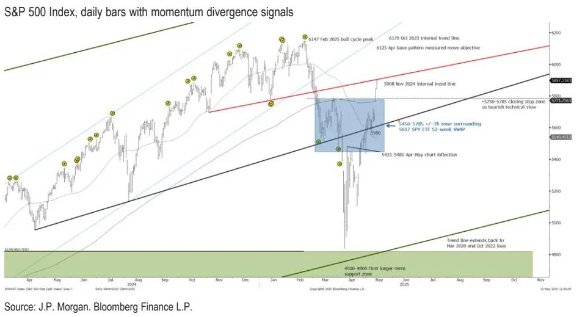
Core Viewpoint - The easing of the US-China trade war has led to a breakout of the S&P 500 index above the critical resistance level of 5750-5785, confirming a return to a low-volatility rebound phase [1][2] Group 1: Market Analysis - The S&P 500 index has jumped above the 5750-5785 resistance level, indicating a shift back to a low-volatility rebound mode, with a suggested stop-loss at 5600 and a target range of 6125-6170 [1][2] - The "Magnificent 7 Index" has regained its leadership position after underperforming for several months, breaking through key technical levels including the 200-day moving average [3][4] - The report highlights the consistency of technical signals with historical patterns, while cautioning against potential short-term topping formations or geopolitical risks impacting market sentiment [1] Group 2: Technical Indicators - The S&P 500 index has effectively broken the trend line at 5908 points, with the 25429-25618 range identified as short-term resistance and long-term targets set at 27794-28060 [2][4] - The report suggests using the 3% threshold above the volume-weighted average price (VWAP) as a stop-loss for bearish views, while recommending a shift to a more bullish trend-following strategy [2][3] - The "Magnificent 7 Index" has broken through several key resistance levels, shifting focus to potential resistance zones at 25429-25618 and 27794-28060 [3][4]
【UNFX课堂】外汇知识系列:如何建立黄金期货投资思维体系
Sou Hu Cai Jing· 2025-04-13 02:56
Core Viewpoint - Establishing a systematic investment thinking framework for gold futures requires integrating macroeconomic logic, commodity attributes, market sentiment, and trading strategies to form a comprehensive understanding of gold price fluctuations [1]. Group 1: Understanding the Gold Market - Gold's intrinsic properties include being a safe-haven asset that attracts risk-averse funds during geopolitical conflicts and economic crises, as seen during the 2022 Russia-Ukraine conflict [1]. - Gold futures have unique characteristics, such as leveraged trading through standardized contracts (e.g., COMEX gold at 100 ounces per contract) and a margin system that amplifies risk and returns [2]. Group 2: Analytical Framework Construction - Geopolitical events and black swan occurrences, like wars and sovereign credit crises (e.g., the 2011 European debt crisis), can trigger safe-haven buying, but caution is needed for profit-taking after events settle [3]. - Technical analysis involves assessing long-term trends through weekly/monthly charts (e.g., a decade-long bull market from 2001-2011) and capturing short-term fluctuations via hourly charts [4]. - Historical price points, such as the peak of $2075 per ounce in August 2020 and key psychological levels (e.g., $1800, $1900), are critical for analysis [5]. Group 3: Fundamental Analysis - Key macroeconomic indicators include the U.S. CPI and non-farm payroll data, which influence inflation and employment, subsequently affecting Federal Reserve policies and gold prices through real interest rates [6]. - The 10-year TIPS yield (real interest rate) shows a significant negative correlation with gold prices [6]. - Central bank policies, particularly during the initial phase of a rate hike cycle, can suppress gold prices, but expectations of economic recession may lead to a reversal in gold's favor [6]. - Global central bank gold purchases provide long-term support for gold prices [6]. Group 4: Trading Strategies - Trend-following strategies are suitable during rising recession expectations and ongoing central bank easing [12]. - Mean reversion strategies apply when gold prices deviate from implied values based on real interest rates or when overbought/oversold indicators signal a reversal [15]. - Event-driven strategies involve adjusting positions before key data releases (e.g., non-farm payrolls, CPI) and entering trades based on market reactions [17]. Group 5: Risk Management - Leverage control is essential due to gold futures' high volatility (daily fluctuations of 1-3%), recommending a maximum risk of 2% of the trading capital per trade [19]. - Dynamic stop-loss strategies can be based on support/resistance levels or volatility measures like the Average True Range (ATR) [21][22]. - Hedging strategies may involve inverse positions in the U.S. dollar index or balancing with equity assets [23]. Group 6: Trading Psychology and Cognitive Upgrades - Overcoming cognitive biases, such as anchoring effects and overtrading, is crucial for successful trading in gold [24][25]. - Recognizing the "inflation-recession" cycle of gold can help traders adapt their strategies accordingly [26]. - Continuous review and iteration of trading logic and strategy performance are necessary for improvement [29]. Group 7: Common Misconceptions and Responses - Misconception 1: Viewing gold solely as an inflation hedge; real interest rates must be negative for gold to be truly bullish [31]. - Misconception 2: Ignoring liquidity risks, especially during significant market events that may lead to liquidity shortages [32]. - Misconception 3: Confusing futures with physical gold, as futures contracts incur time costs and potential roll-over losses [33]. Summary of the Gold Investment Framework - The core of the gold investment thinking system is a triadic driving model comprising real interest rates (fundamentals), dollar cycles (monetary attributes), and risk-averse sentiment (emotional factors) [35]. - Strategies should align with market conditions, utilizing trend strategies in trending markets and mean-reversion strategies in sideways markets [36]. - Prioritizing risk management is vital due to gold's volatility, emphasizing survival over profit [37].