AI芯片

Search documents
投出爱芯、壁仞的耀途资本:中国AI芯片的胜算
投中网· 2026-02-11 03:25
Core Viewpoint - The article emphasizes the importance of edge AI chips in the context of China's growing AI chip industry, highlighting the potential for world-class companies to emerge from this sector due to its rich application scenarios and complete supply chain [12][25][37]. Group 1: Investment and Market Dynamics - Aixin Yuan Zhi, an edge AI inference chip company, successfully listed on the Hong Kong Stock Exchange on February 10, 2026, marking a significant milestone in the AI chip industry [3]. - Yao Tu Capital's investment in Aixin Yuan Zhi reflects a long-term belief in the company's technology and the potential of the edge AI chip market, which has seen a surge in demand due to the shift from cloud to edge computing [4][6]. - The company has captured a significant share of the visual terminal computing market and has expanded into the smart automotive sector, becoming China's second-largest domestic smart driving SoC supplier with nearly one million units shipped over four years [8][9]. Group 2: Technological Trends and Challenges - The article discusses the shift in the AI chip landscape, where software capabilities are becoming critical for success, with many AI chip companies employing a majority of software engineers [28][29]. - The edge AI chip market is characterized by a fragmented application landscape, necessitating the construction of an ecosystem involving chip manufacturers, solution providers, and end applications to create a competitive advantage [30][31]. - The evolution of AI models is driving new requirements for AI chips, with increasing demands for performance and capabilities in areas such as autonomous driving and robotics [22][23]. Group 3: China's Competitive Edge - China's edge AI chip market benefits from a rich array of application scenarios and a robust supply chain, positioning it well to develop leading companies in this space [12][37]. - The rapid adoption and iteration of new technologies in sectors like autonomous driving in China create a fertile ground for chip demand, allowing domestic companies to establish a competitive edge [38][39]. - The article posits that the future of AI chips lies in their ability to understand and cater to specific application needs, with a focus on vertical markets that can sustain large-scale chip demand [43]. Group 4: The Role of Open Source - Open-source models are seen as a key factor in enabling Chinese AI chip companies to thrive, as they lower the barriers to entry for application deployment and enhance compatibility with domestic chips [45][49]. - The shift towards open-source in the AI industry allows for a more inclusive distribution of profits and fosters a "sovereign AI" ecosystem where domestic companies control the entire stack from chips to applications [46][53]. - The article highlights that the open-source approach has significantly reduced the compatibility barriers for AI chips, creating a complete ecological loop that benefits local enterprises [54].

刷新历史纪录!iPhone迎来史上最佳季度表现!果链含量超45%的电子ETF(515260)盘中上探1.7%,冲击4连阳!
Xin Lang Cai Jing· 2026-02-10 02:20
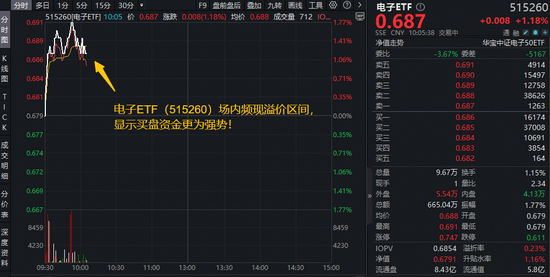
Core Viewpoint - Apple is expected to launch a series of new products in the coming weeks, including the iPhone 17e, upgraded iPad, and a new Mac, which has positively impacted the electronic ETF related to Apple's supply chain [1][10]. Group 1: Market Performance - The electronic ETF (515260), heavily weighted by Apple's supply chain, saw an intraday increase of 1.77%, currently up by 1.18%, recovering the 10-day moving average and aiming for a fourth consecutive daily gain [1][10]. - Notable stock performances include Chipone Technology leading with a 9.60% increase, followed by Haiguang Information at 6.17%, and several other companies in the electronic sector showing gains of over 3% [4][13]. Group 2: Apple Financial Performance - In the first quarter of fiscal year 2026, Apple reported iPhone revenue of $85.27 billion, Mac revenue of $83.9 billion, and iPad revenue of $8.6 billion, with CEO Tim Cook highlighting unprecedented market demand driving record performance across all regions [3][12]. - Analysts from CMB International express optimism regarding Apple's ongoing "iPhone cycle and pricing cycle," particularly with the upcoming iPhone Fold/18 upgrade cycle [3][12]. Group 3: Industry Outlook - Apple is anticipated to gradually introduce new products in 2026, including foldable phones and innovative devices like smart glasses and lightweight headsets, which are expected to boost demand for upstream equipment in Apple's supply chain [3][12]. - The electronic ETF (515260) tracks the electronic 50 index, focusing on key sectors such as semiconductors and consumer electronics, with significant weightings in major tech companies like Apple, Nvidia, and Google [6][15].

高盛给予壁仞科技和沐曦股份买入评级,料中国云厂商支出将驱动增长
Jin Rong Jie· 2026-02-10 01:36
高盛给予壁仞科技和沐曦股份首次买入评级,并称中国云计算资本开支上升、先进制程产能扩张等料驱 动其业务增长。高盛预计壁仞科技在2025–2030年间的AI训练/推理GPU业务将实现101%复合年增长 率,AI芯片出货量料从2025的3万片增长至2030年的90万片。预计沐曦股份的AI训练与推理GPU业务将 在同期实现88%的复合年增长率。壁仞科技12个月目标价定为54港元,沐曦股份则定为811元人民币。 本文源自:金融界AI电报 ...
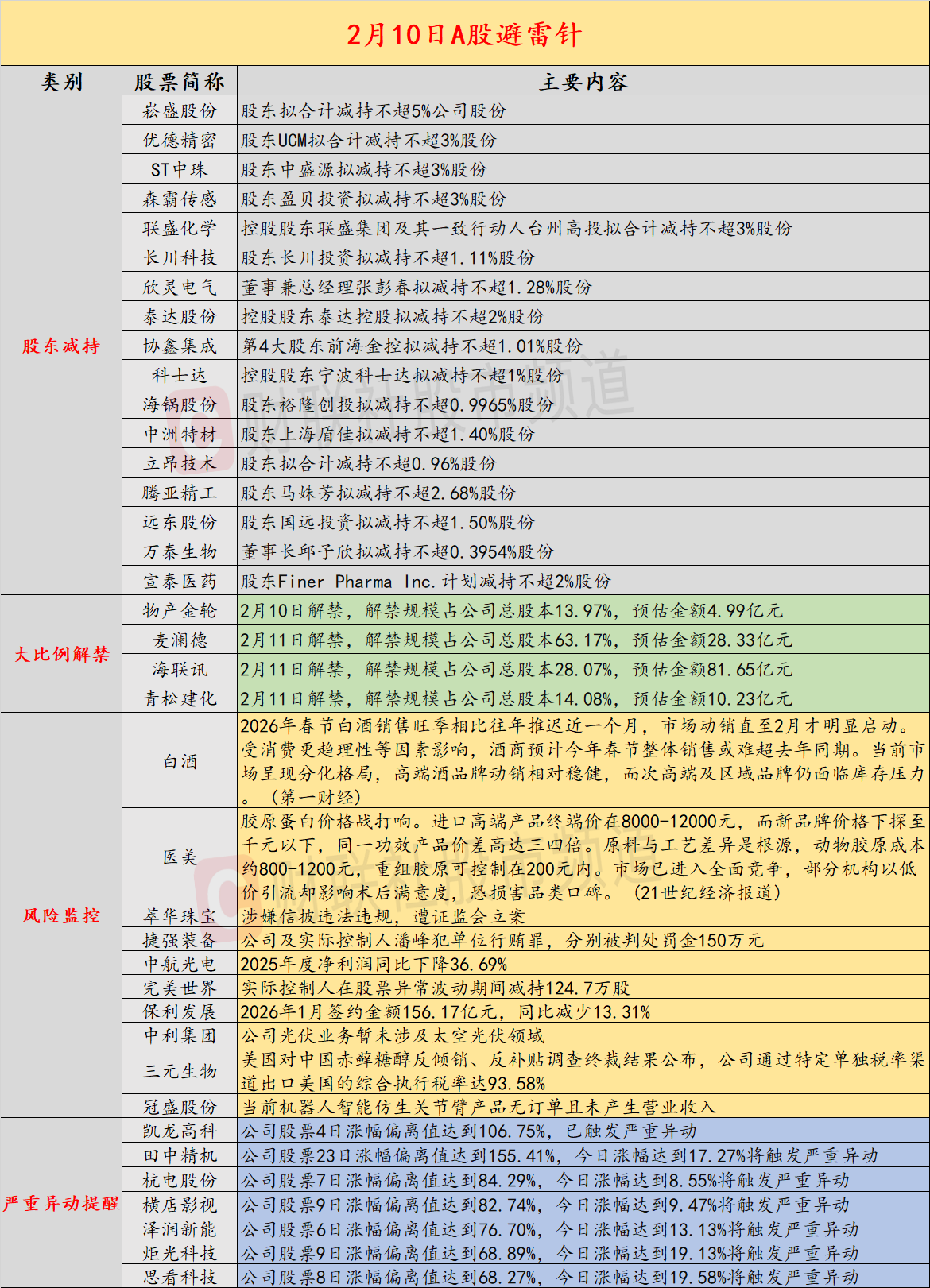
2月10日投资避雷针:4连板光伏人气股突发 第四大股东拟减持不超1.01%
Xin Lang Cai Jing· 2026-02-10 00:24
Economic Information - The "Qianwen Toolbox" mini-program by Alibaba has been restricted by WeChat due to numerous user complaints regarding potential fraud [2] - The peak sales season for liquor during the Spring Festival in 2026 is delayed by nearly a month compared to previous years, with overall sales expected to be difficult to exceed last year's levels due to more rational consumer behavior [2] - A price war in collagen products has emerged, with imported high-end products priced between 8,000 to 12,000 yuan, while new brands are priced below 1,000 yuan, leading to significant price differences for similar efficacy products [2] - Insurance companies are set to disclose their solvency reports for Q4 2025, with 57 life insurance companies reporting a net profit increase of over 150% year-on-year, marking a "strongest profit year" despite pressures from a low-interest-rate environment [2] Company Alerts - Ruihua Jewelry is under investigation by the China Securities Regulatory Commission for suspected information disclosure violations [4] - Jieqiang Equipment and its actual controller were fined 1.5 million yuan for committing bribery [4] - Several companies, including Congsheng Co. and Uder Precision, have announced plans to reduce their shareholdings by up to 5% and 3% respectively [4][6] Overseas Alerts - Research firm Semianalysis has downgraded Micron's market share in Nvidia's next-generation AI chip Vera Rubin's HBM4 to 0%, predicting that SK Hynix will capture 70% of the supply [4] - Federal Reserve Governor Christopher Waller indicated that the optimistic sentiment in the cryptocurrency market, which surged after Donald Trump's election, may be fading [4] Stock Movement Alerts - Companies such as Hengdian Film and Television and Zairun New Energy have experienced significant stock price fluctuations, triggering severe abnormal movement alerts due to high deviation percentages [8]
盘中线索丨日东纺拟年内上调T型玻纤价格,玻璃玻纤板块活跃
2 1 Shi Ji Jing Ji Bao Dao· 2026-02-09 06:16
Group 1: Industry Overview - The glass fiber sector is experiencing significant activity, with companies like Jinjing Technology hitting the daily limit and Honghe Technology rising over 6% [1] - The demand for AI chips is causing a tightening supply of T-type glass fiber cloth, leading to price increases [1] - Nitto Denko, a major supplier, plans to triple its production capacity by 2028, but still anticipates a supply-demand gap, prompting a price increase of potentially 25% or more [1] Group 2: Company Developments - Zhongcai Technology's subsidiary, Taishan Glass Fiber, has successfully developed and mass-produced special fiber products for AI applications, gaining certification from several well-known domestic and international manufacturers [2] - Honghe Technology's high-performance electronic cloth products have entered the supply chains of multiple leading copper-clad laminate manufacturers, with major clients including Taiming Electronics and Panasonic [2] - Lite-On Optoelectronics has formed a team with experience in Q cloth R&D and has acquired some production equipment [3]
铝:关注节后去库,氧化铝:震荡收敛,铸造铝合金:跟随电解铝
Guo Tai Jun An Qi Huo· 2026-02-09 05:13
期 货 研 究 2026 年 02 月 09 日 铝:关注节后去库 氧化铝:震荡收敛 铸造铝合金:跟随电解铝 王蓉 投资咨询从业资格号:Z0002529 wangrong2@gtht.com 王宗源(联系人) 期货从业资格号:F03142619 wangzongyuan@gtht.com 所 铝、氧化铝、铸造铝合金基本面数据更新 | | | | T | T-1 | T-5 | T-22 | T-66 | | --- | --- | --- | --- | --- | --- | --- | --- | | | | 沪铝主力合约收盘价 | 23315 | -70 | -1245 | 745 | 2270 | | | | 沪铝主力合约夜盘收盘价 | 23585 | ー | ー | l | ー | | | | LME铝3M收盘价 | 3110 | 84 | -26 | 161 | 305 | | | | 沪铝主力合约成交量 | 383322 | -90349 | -884795 | -235303 | 250592 | | | | 沪铝主力合约持仓量 | 199482 | -7888 | -85417 | -897 ...
2nm良率已达50%,三星目标增长130%
半导体行业观察· 2026-02-07 03:31
公众号记得加星标⭐️,第一时间看推送不会错过。 据最近报道,其 2nm GAA 工艺的良率已达到 50%,这表明虽然还有改进空间,但三星可以达到能 够与台积电相提并论的阶段。由于后者面临生产问题,这家韩国代工厂的机会已经成熟,最新报告称 三星正关注 2nm GAA 订单 130% 的增长。特斯拉已经是该技术的知名客户,据此前报道,这家电 动汽车制造商已签署了一份价值 165 亿美元的合同。 分析师预测,三星 2nm GAA 芯片订单精确的 130% 增长数字是"获得客户支持信心的体现"。 虽然 2nm GAA 工艺成功的关键仍然是健康的良率和稳定的量产,但《电子时报》(DigiTimes)报 道称,三星正在采取激进举措为其下一代光刻技术争取订单。随着 Exynos 2600 已经证明良率有所 稳定,报告指出三星现在的重点是 AI 芯片。韩国分析师将公司给出的 130% 这一精确数字解读为锁 定客户信心的迹象。 END 今天是《半导体行业观察》为您分享的第 4311 期内容,欢迎关注。 推荐阅读 另一个迹象是该公司位于美国的泰勒(Taylor)工厂,该工厂最初是为 4nm 生产设计的。然而,三 星可能希望在削减 ...
老黄鸽了游戏卡!30年来首次咕咕,内存优先让路AI
量子位· 2026-02-06 12:00
Core Viewpoint - Nvidia has indefinitely postponed the release of the RTX 50 Super and the next-generation RTX 60 series due to a global shortage of memory chips, prioritizing AI GPU production instead [2][15][18]. Group 1: Nvidia's Product Delays - Nvidia has historically released new gaming GPUs every other year, but this year, it has broken tradition by not launching the RTX 50 Super as expected [8][10]. - The RTX 50 Super was reportedly already designed under the codename "Kicker," but the release was delayed as of December last year [12][13]. - The delay will also affect the planned production of the RTX 60 series, originally set for late 2027 [14]. Group 2: Market Impact and Pricing - The price of the RTX 5090 has surged from an initial MSRP of $1999 to between $3500 and $4000, with projections suggesting it could reach $5000 by the end of the year [27][28]. - The ongoing chip shortage is causing price increases across all PC gaming components, leading to a potential shift in consumer behavior towards cloud services or delaying hardware upgrades [26][35]. - Companies like Valve and Nintendo are also reevaluating their product pricing and release schedules due to the memory shortage, with Nintendo having already increased the prices of its Switch models [29][33].


IPO雷达|酷芯微递表港交所,产品生产依赖第三方,资产负债率达419%
Sou Hu Cai Jing· 2026-02-06 08:20
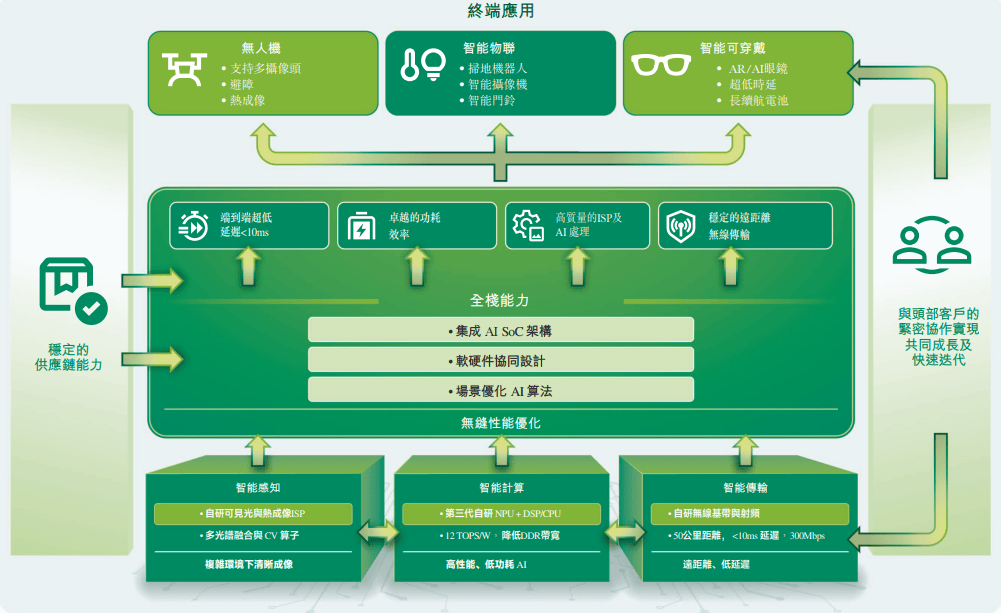
净利润未扭亏 深圳商报·读创客户端记者 梁佳彤 日前,据港交所官网,合肥酷芯微电子股份有限公司(下称"酷芯微")递交主板上市申请。该公司收入增速显著放缓,产品生产依赖第三方代 工厂,15.66亿元赎回负债悬顶。 招股书介绍,酷芯微是一家视觉处理AI SoC供应商,提供以视觉处理AI SoC与无线视频传输SoC为核心的集成化解决方案,产品组合融合芯片 设计、软件工具包、场景优化算法及工程支持服务,协助客户在快速演进的AI应用环境中缩短开发周期并加速产品上市进程。 公司的产品是驱动智能设备的智能引擎,并推动AI加速普及。公司全面的视觉处理AI SoC及视频传输SoC产品及解决方案广泛应用于无人机、 智能物联及智能可穿戴行业。 酷芯微业务架构。来源:招股书 收入增速显著放缓 2023年至2024年及2025年前三季度(下称"报告期"),酷芯微分别实现收入1.05亿元、4.49亿元和3.41亿元;公司2024年和2025年前三季度收 入同比变动327%和-0.6%,增速显著放缓。 | | 截至12月31日止年度 | | 载至9月30日止九個月 | | | --- | --- | --- | --- | --- | | ...
腾讯投的上海AI芯片独角兽,要IPO了!拟募资60亿
芯世相· 2026-02-06 04:47
Core Viewpoint - The article discusses the recent IPO application of Suiyuan Technology, a Shanghai-based AI chip unicorn, and its potential impact on the domestic AI chip industry, highlighting its product development plans and market positioning [6][8][16]. Group 1: Company Overview - Suiyuan Technology was established in March 2018 with a registered capital of 387 million yuan and has developed four generations of cloud AI chips [8]. - The company has a complete product system that includes AI chips, AI acceleration cards, intelligent computing systems, and AI computing software platforms [10]. - Major shareholders include Tencent Technology, National Big Fund Phase II, and Meitu Technology, holding 19.95%, 4.32%, and 1.31% respectively [12]. Group 2: Market Position and Competitors - The domestic cloud AI chip industry is in its early stages, with key players including Huawei HiSilicon, Cambricon, and Suiyuan Technology [12]. - As of January 22, 2023, the total market capitalization of competitors like Cambricon and Moore Threads is significant, with Cambricon at 570.5 billion yuan [13]. - Suiyuan Technology's market share in the AI acceleration card segment is approximately 1.4%, ranking it among the top domestic AI chip manufacturers [13]. Group 3: Financial Performance - Suiyuan Technology's revenue for 2022, 2023, and projected for 2024 is 90 million yuan, 301 million yuan, and 722 million yuan respectively, with net losses of 1.116 billion yuan, 1.665 billion yuan, and 1.510 billion yuan [17][20]. - The company's gross margin has been below the average of comparable companies, with figures of 78.07%, 22.60%, 30.59%, and 36.23% for the respective years [20][21]. - The company expects to reach breakeven by 2026 based on current orders and product delivery schedules [21]. Group 4: Product Development and R&D - The company plans to raise 6 billion yuan through its IPO to fund the development and industrialization of its fifth and sixth-generation cloud AI chip series [16][17]. - Suiyuan Technology has established a strong R&D team, with 658 R&D personnel, accounting for 76.51% of its total workforce [34]. - The company has developed a full-stack AI computing and programming software platform, "Yusuan TopsRider," to facilitate the integration of its hardware with AI applications [32]. Group 5: Customer Base and Sales Strategy - Suiyuan Technology has a high customer concentration, with sales to its top five customers accounting for over 90% of its revenue in recent years, primarily driven by sales to Tencent Technology [36][38]. - The company has established a stable partnership with Tencent, which has been its largest customer since 2019, contributing significantly to its sales [37]. - The company is actively exploring collaborations with domestic network operators and expanding into various industry verticals [39]. Group 6: Future Outlook - The company aims to enhance its domestic supply chain capabilities and develop a fully localized AI chip product line [49][53]. - Predictions indicate that the share of non-GPGPU chips in AI server chip shipments will increase from 36% in 2024 to 45% by 2027, highlighting a growing market opportunity for Suiyuan Technology [49].