
卫星互联网

Search documents
浙商证券浙商早知道-20260108
ZHESHANG SECURITIES· 2026-01-07 23:30
Market Overview - On January 7, the Shanghai Composite Index rose by 0.05%, while the CSI 300 fell by 0.29%. The Sci-Tech 50 increased by 0.99%, the CSI 1000 rose by 0.53%, and the ChiNext Index went up by 0.31%. The Hang Seng Index decreased by 0.94% [4][5]. - The best-performing sectors on January 7 were comprehensive (+3.86%), coal (+2.47%), electronics (+1.25%), communication (+1.24%), and power equipment (+0.62%). The worst-performing sectors included oil and petrochemicals (-1.73%), non-bank financials (-1.13%), beauty and personal care (-1.03%), computers (-0.81%), and banks (-0.72%) [4][5]. - The total trading volume for the entire A-share market on January 7 was 28,815.66 billion yuan, with net inflow from southbound funds amounting to 9.178 billion Hong Kong dollars [4][5]. Important Recommendations - The report highlights Zhenyou Technology (688418) as a key player in satellite internet, positioned as the "central brain" of the industry. The company is expected to benefit from the acceleration of low-orbit satellite internet deployment and overseas business expansion, which could drive performance beyond expectations [6]. - The revenue forecast for Zhenyou Technology from 2025 to 2027 is projected to be 1,010 million yuan, 1,479 million yuan, and 1,975 million yuan, respectively, with growth rates of 6.17%, 46.35%, and 33.53%. The net profit attributable to the parent company is expected to be 19 million yuan, 182 million yuan, and 346 million yuan, with growth rates of -30.82%, 857.42%, and 90.52% [6]. - The company’s earnings per share are forecasted to be 0.10 yuan, 0.94 yuan, and 1.80 yuan for the years 2025, 2026, and 2027, respectively, with price-to-earnings ratios of 441.34, 46.08, and 24.18 [6]. Important Insights - The report discusses public REITs as an investment tool characterized by "high dividends + anti-inflation + asset growth." They provide a unique combination of stable income and potential asset appreciation, making them an ideal "fixed income +" solution to address the current "asset shortage" [7][8]. - The report notes that the public REITs market is moving towards normalization in its expansion mechanism, with an expectation of increased capital inflow. It highlights that certain asset classes, such as consumer infrastructure, affordable rental housing, and warehousing logistics, show relatively high investment value [7][8]. - The report suggests a "barbell" investment strategy and a "high dividend yield" tactic to enhance returns, focusing on sectors with economic resilience and stable dividends, such as infrastructure and affordable housing, while also considering long-duration quality assets like premium data centers [8].

冲刺与破冰:卫星互联网产业趋势洞察
Sou Hu Cai Jing· 2026-01-07 16:56
Core Insights - The Chinese satellite internet industry is entering a critical phase of policy support, technological breakthroughs, and commercial expansion in 2026, following a record 92 launches in 2025, including significant contributions from both state and commercial entities [1][4][31] - The market for satellite internet has surpassed a trillion-dollar scale, driven by diverse applications across various sectors, including aerospace, maritime, and emergency communications [4][5] Industry Overview - The satellite internet industry is characterized by a dual-track development approach, with high and low orbit satellites evolving at different stages [2][4] - The scarcity of orbital spectrum resources is a key factor influencing development priorities, with low Earth orbit (LEO) resources entering a phase of "stock competition" [5][6] Structural Characteristics - China's LEO satellite internet construction is in a phase of large-scale network deployment, with plans for over 25,000 LEO satellites, supported by policy and market demand [5][6] - The high orbit satellite sector has matured, providing comprehensive coverage and laying the groundwork for expanding applications in aviation and maritime sectors [5][6] Application Scenarios - The integration of high and low orbit satellite services is creating a complementary ecosystem, with applications in low-altitude economies, autonomous driving, and satellite broadcasting [6][7] - The high orbit sector is expected to rapidly expand into new commercial markets, leveraging its broad coverage and communication capabilities [6][7] National and Commercial Dynamics - The industry is transitioning from government-led initiatives to a market-driven model, with state-owned enterprises focusing on core technologies and high orbit satellite construction, while commercial companies drive low orbit satellite development [7][8] Future Outlook - The Chinese satellite internet industry has significant growth potential, with advancements in technology and commercial applications expected to enhance its global competitiveness [8] Value Chain Analysis - The satellite internet industry can be segmented into satellite manufacturing, launch services, and operational services, with a clear division of roles among state-owned and private enterprises [11][25] - The satellite manufacturing sector is dominated by state-owned enterprises for large satellites, while private companies are emerging in the small satellite segment [14][17] Launch Services - The satellite launch sector is experiencing a transformation characterized by scale expansion, technological upgrades, and cost optimization, with a notable increase in launch frequency and capacity [20][23] - The demand for LEO satellite constellations is straining existing launch capacities, necessitating improvements in commercial rocket launch frequency and efficiency [23][24] Operational Services - The operational segment is primarily led by state-owned enterprises, with increasing participation from private companies in ground equipment manufacturing and satellite communication services [25][26] - The issuance of satellite internet licenses is expected to accelerate the growth of operational services, particularly in emerging markets [28][31] Investment Landscape - The financing landscape for the satellite internet sector has been heating up since 2019, with a significant increase in notable financing events and amounts in 2024 [31] - The reintroduction of policies allowing unprofitable companies to list on the Sci-Tech Innovation Board is anticipated to spur a new wave of IPOs in the satellite internet sector [31][32]





竞赛白热化,中国将迎低轨卫星大爆发!如何逐梦“星辰大海”?
Jin Rong Jie· 2026-01-07 07:10
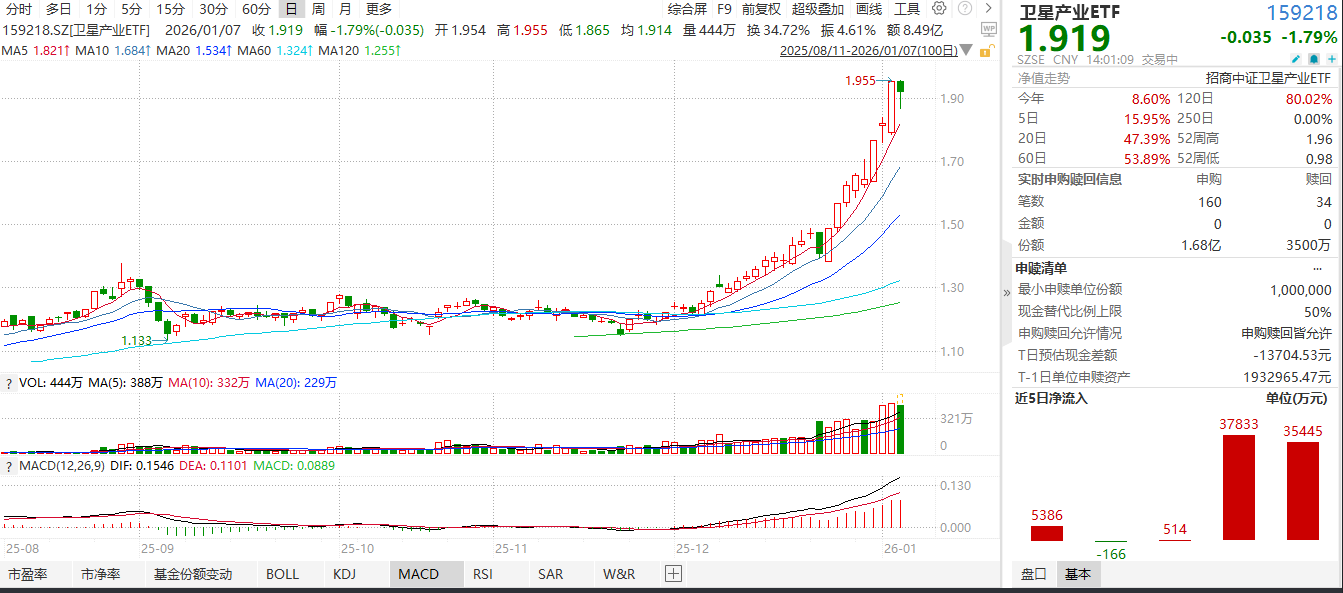
资金关注度同步上升,今日成交已超3.5亿,资金逢低加仓。这场"星辰大海"的盛宴,已经不是说说而已! 消息面,昨日星河动力航天官宣,将于近期择机发射"谷神星一号海射型(遥七)"火箭,任务代号"望海潮"。如果顺利,它有望成为2026年首家实现发射的 民营航天企业,打响新年商业航天"第一枪"! 身为商业航天主要板块,卫星产业近期爆发可不是偶然事件—— 一方面,是高层直接定调:去年12月的全国工业和信息化工作会议明确,2026年要有序开展卫星物联网等新业务商用试验;另外新版《无线电频率划分规 定》发布,相当于为卫星产业发展提供了清晰的政策指引和资源保障。 另一方面,是需求摆在眼前:赛迪顾问发布的白皮书指出,全球至今仍有超过70%的地理空间和约30亿人未被地面网络覆盖。卫星互联网是填补这片信息荒 漠的现实选择,其商用场景明确且紧迫,无论是服务偏远地区、保障远洋与航空通信,还是灾难应急,都是实实在在的刚需。 再者,从国家战略层面看,2029年地球近地轨道预计将部署总计约5.7万颗低轨卫星,轨位资源将趋近饱和。布局卫星互联网,早已不只是产业选择,更是 关乎未来的国家必争之举。东兴证券也表示,为了抢占宝贵的轨道和频谱资源,2 ...
本轮商业航天概念爆发的底层逻辑是什么
2026-01-07 03:05
本轮商业航天概念爆发的底层逻辑是什么?20260106 摘要 中国商业航天受益于政策规划明晰和关键技术突破,如液体可重复发射 火箭技术,降低发射成本,提升竞争力。下游卫星互联网建设预期推动 市场需求,相关公司股价活跃,反映资金关注。 SpaceX 通过 Falcon 9 等可重复使用火箭实现成本优势,单次发射成本 仅 1,500 万美元,毛利率高达 68%,对传统军工企业形成降维打击。 中国商业航天可借鉴其发展路径,积极推进液体可重复发射火箭技术。 Starlink 已发射 1 万颗卫星,覆盖全球大部分地区,拥有 900 万用户, 2025 年收入预计达 120-130 亿美元。中国积极布局低轨通信卫星市场, 如"星网"和"原信",预计 2029 年将达 2000-3,000 颗。 美国政府通过立法、技术转让、人才输送和设施共享等方式扶持 SpaceX。中国也在加强政策支持,如将商业航天提升至与新能源汽车 同等地位,成立国家级监管机构,并出台行动计划。 国家重视商业航天源于卫星通信的巨大价值和海外进度超预期。低轨道 通信卫星提供高信息载量和低延迟,适合手机直连上网,但轨道资源有 限,各国加速推进卫星互联网组网 ...
开盘10分钟,过亿资金加码卫星产业ETF(159218)!北方导航逆市封板!
Sou Hu Cai Jing· 2026-01-07 02:01
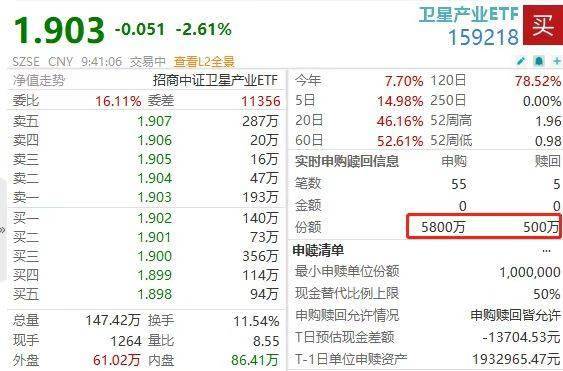
Core Viewpoint - The satellite industry is undergoing significant adjustments, with the satellite industry ETF (159218) experiencing a notable decline of 2.41% as of 9:40 AM on January 7, while Northern Navigation saw a counter-trend surge with a trading volume exceeding 290 million CNY and a net inflow of over 100 million CNY during the session [1][2]. Group 1: Market Performance - The satellite industry ETF (159218) has shown a six-year growth of 7.70% and a 120-day increase of 78.52%, indicating strong long-term performance despite recent volatility [2]. - The ETF's trading volume reached 147.42 million shares with a turnover rate of 11.54%, reflecting active market participation [2]. Group 2: Industry Dynamics - Recent developments in the international aerospace sector have heightened the urgency for domestic advancements in autonomous satellite systems, particularly in light of SpaceX's adjustments to its Starlink satellite orbits, which underscore the complexities of low-Earth orbit competition and governance [3]. - Research indicates that China is planning a long-term lunar navigation system, showcasing a grand vision from Earth to deep space, which reinforces the strategic resource attributes of satellite internet [3]. Group 3: Investment Outlook - The satellite industry ETF (159218) is recognized as the first investment tool covering the entire industry chain, including rocket launches, satellite manufacturing, ground equipment, and operational services, making it a preferred vehicle for systematic and efficient investment in the "aerospace economy" [3]. - The convergence of policy, capital, and technology is creating a strong and certain trend, enhancing the medium to long-term growth logic of this sector, positioning the ETF as a focal point of market attention [3].

卫星产业回调,资金逆势加仓!中金首席刘中玉:卫星制造与发射领域迎来业绩兑现期
Jin Rong Jie· 2026-01-07 02:01
1月7日,卫星产业ETF(159218)迎来回调,开盘跌3.68%,成份股涨跌互现,中科星图、中国卫星、航天环宇跌超6%,北方导航涨超6%,北斗星通、海 格通信、航天电子、西部超导跟涨。资金逆势加仓趋势明显,根据Wind level2实时行情预估,卫星产业ETF(159218)净流入超1亿。 2025年是卫星产业引发关注的元年,资金关注度显著提升,卫星产业ETF(159218)近五日揽金近8亿,近十日份额增幅100%。卫星产业在政策突破、技术 验证与资本赋能的共同驱动下,正在实现从技术探索阶段向加速发展阶段的跃迁。 卫星产业持续走高,其上涨是否透支了未来涨幅?中金公司军工机械首席刘中玉指出,板块进入加速成长期,未来业绩兑现有望消化板块高估值。建议把握 波动节奏,关注回调机会。 以下观点整理自1月6日中金公司军工机械首席刘中玉路演《卫星板块热度走高,2026年机会怎么看》。 【路演核心观点】 近期卫星板块领涨市场,主要来源于政策、产业和资本三个维度共同催化。 产业处加速成长初期,不宜用静态估值,需动态追踪产业变化,未来随业绩兑现将逐步消化高估值。 制造与发射能力正迈向规模化,有望支撑行业从"资源争夺"向"全球商 ...
2026 民营航天火箭发射潮将到来,星河动力航天官宣最新商业火箭发射任务;黄仁勋:未来十年里,世界上大部分汽车将实现自动驾驶或高度自动驾驶——《投资早参》
Mei Ri Jing Ji Xin Wen· 2026-01-07 00:44
Market Performance - The three major U.S. stock indices closed higher, with the Dow Jones up 0.99%, the Nasdaq up 0.65%, and the S&P 500 up 0.62%, marking historical closing highs for both the Dow and S&P 500 [1] - Major tech stocks showed mixed performance, with Amazon rising over 3%, Microsoft and Intel up more than 1%, while Tesla fell over 4% and Apple dropped more than 1% [1] - The Nasdaq Golden Dragon China Index decreased by 0.78%, with notable gains in companies like Hesai and Pony.ai, which rose over 10% and 5% respectively [1] Commodity Prices - International oil prices saw a significant decline, with U.S. oil down 2.38% at $56.93 per barrel and Brent crude down 2.06% at $60.49 per barrel [1] - Gold prices increased, with spot gold rising 0.97% to $4492.07 per ounce and COMEX gold futures up 1.15% to $4502.9 per ounce [1] - Silver prices surged, with spot silver up 6.15% to $81.23 per ounce and COMEX silver futures up 5.85% to $81.14 per ounce [1] Industry Insights - Star River Dynamics announced a significant commercial rocket launch task, aiming to become the first private aerospace company to complete a launch by 2026, which could invigorate the private aerospace sector in China [2] - The satellite internet sector is projected to grow significantly, with the satellite communication industry expected to exceed 200 billion to 400 billion yuan by 2030, driven by technological advancements and cost reductions [3] - Strong Brain Technology completed approximately 2 billion yuan in financing, positioning itself as a major player in the brain-computer interface sector, with products that have received FDA and CE certifications [4] Automotive Technology - NVIDIA's CEO announced that most cars will achieve automated or highly automated driving within the next decade, introducing new AI models for autonomous vehicle development [5] - The integration of vehicle-road-cloud systems is projected to generate significant economic value, with an estimated increase of 725.9 billion yuan by 2025 and 25,825 billion yuan by 2030 [6]
商业航天板块涨势不减 产业爆发拐点将至
Shang Hai Zheng Quan Bao· 2026-01-06 17:56
Core Viewpoint - The commercial aerospace sector in China is experiencing a significant surge due to favorable government policies, technological advancements, and market dynamics, indicating a potential turning point for the industry [2][4]. Group 1: Government Initiatives and Strategic Planning - The National Space Administration has established a commercial aerospace department and released the "Action Plan for Promoting High-Quality and Safe Development of Commercial Aerospace (2025-2027)" [2]. - The "14th Five-Year Plan" identifies aerospace as a strategic emerging industry cluster, emphasizing the importance of low-cost, large-scale commercial aerospace for global space competition [2][3]. Group 2: Technological Developments - China is planning to launch thousands of satellites as part of the "Thousand Sails Constellation" and "National Network Constellation (GW Constellation)," with launches starting in 2024 and increasing in frequency by 2025 [3]. - The development and testing of reusable rockets are progressing, which could significantly reduce launch costs and enable high-frequency launches [3]. Group 3: Market Dynamics and Capital Support - The A-share market for commercial aerospace and satellite internet has seen a resurgence, with leading stocks like China Satellite and China Satcom experiencing substantial gains of over 165% and 109%, respectively, from late November 2025 to early January 2026 [2]. - The introduction of IPO guidelines for commercial rocket companies on the Sci-Tech Innovation Board is expected to facilitate capital inflow and resource optimization within the industry [4]. Group 4: Commercialization Potential - The global commercial aerospace leader, SpaceX, serves as a model for creating a commercial ecosystem, with its upcoming IPO anticipated to be the largest in history [4]. - The concept of "space computing" is emerging as a new path for achieving a commercial closed loop in China's aerospace sector, with projected operational costs significantly lower than terrestrial computing [5]. Group 5: Future Growth and Investment Opportunities - The commercial aerospace sector is expected to be recognized as a "new growth engine" in government reports, highlighting its importance in the economy [5]. - Analysts suggest that private commercial aerospace companies in China may experience explosive growth in 2026, with a focus on key suppliers across the industry chain, including satellite assembly and core component suppliers [5].
新赛道活力迸发 塑造经济发展新优势
Zheng Quan Ri Bao· 2026-01-06 16:28
Core Insights - During the "14th Five-Year Plan" period, China has made significant strides towards high-level technological self-reliance, with emerging and future industries showing robust vitality and growth potential [1][3] Emerging Industry Development - The emerging industries in China have rapidly developed and formed scale effects, with multiple trillion-yuan markets accelerating formation [2] - By 2025, China's commercial aerospace industry is on the brink of explosion, with significant advancements in reusable launch vehicles and satellite internet applications [2] - The low-altitude economy is also gaining traction, with the issuance of operational certificates for manned civil unmanned aerial vehicles marking the entry into commercial use [2] New Energy Industry - China has established the world's largest power infrastructure and renewable energy system, creating the most complete new energy industry chain globally [3] - The "15th Five-Year Plan" emphasizes the development of emerging pillar industries, including new energy, new materials, aerospace, and low-altitude economy [3] Future Industry Breakthroughs - Significant progress has been made in future industries such as artificial intelligence, quantum information, and biomanufacturing, with key breakthroughs achieved [4] - The integration of 6G and AI is becoming a consensus in the industry, with clear development directions emerging [4] - The biomanufacturing industry has expanded steadily, reaching a total scale of 1.1 trillion yuan, becoming a new economic growth point [4] Dual-Engine Development - Emerging and future industries, while both part of the "long slope, thick snow" track, have different development stages, leading to varying market opportunity release rhythms [6] - Emerging industries are entering a rapid growth phase, with vertical segments expected to explode in the next 3 to 4 years, while future industries will focus on technology and application exploration in the early stages of the "15th Five-Year Plan" [6] Investment and Market Dynamics - The future industries face challenges related to technological and commercial uncertainties, with unclear business models and long investment return cycles [7] - The "15th Five-Year Plan" period is seen as a critical window for future industries, with policy support and technological breakthroughs expected to drive development [7] - Investors are advised to focus on companies' core technology reserves and their progress in validating business value through application scenarios [8]
亚光科技:公司产品已应用于部分卫星星座建设项目
Zheng Quan Ri Bao Zhi Sheng· 2026-01-06 14:09
Core Viewpoint - The company Aiguang Technology is actively involved in the development and sales of self-researched MMIC chips, which are utilized in various applications, including satellite communication [1] Group 1: Product Development and Sales - The MMIC chips developed by the company not only meet internal product demands but are also sold externally to a wide range of customers [1] - The company offers various supporting products for satellite internet and communication applications, including low-noise amplifiers, mixers, power dividers, filters, and signal detection circuits [1] Group 2: Market Applications and Future Plans - The company's products have already been applied in certain satellite constellation construction projects, such as the GW constellation plan [1] - The company plans to continue aligning with the trends in satellite communication and low Earth orbit constellation development, actively addressing customer needs and expanding its market share in related fields [1]
