
新旧动能转换

Search documents
汽车零部件巨头上半年业绩分化:关税、智驾、需求三重角力
Jing Ji Guan Cha Wang· 2025-08-05 09:07
Core Insights - The global automotive parts industry is experiencing significant performance divergence due to U.S. tariff policy fluctuations, accelerated automotive intelligence transformation, and the reshaping of the Chinese market landscape [2] Group 1: Impact of U.S. Tariff Policy - U.S. tariff adjustments have become a core variable affecting the performance of multinational parts companies in the first half of the year, with varying responses leading to performance disparities [2] - Companies like Autoliv successfully transferred tariff costs to automakers, achieving record high net sales and operating profit margins, with a 14% increase in adjusted operating profit to $251 million [3] - Faurecia managed to mitigate tariff impacts through strict cost management, reporting a 7.8% increase in adjusted EBITDA to €1.76 billion [3] - NXP Semiconductors faced a 6% revenue decline and a 23% drop in operating profit due to U.S. import tariffs and ongoing chip inventory issues [4] - Brembo's net profit fell by 37.4% and revenue decreased by 6.2%, attributed to geopolitical instability and a sluggish automotive market [5] Group 2: Chinese Market Dynamics - The Chinese market presents both opportunities and challenges for multinational parts companies, characterized by high demand for new energy vehicles and rapid market changes [2] - ZF Friedrichshafen's sales in China dropped significantly, with a 10.3% decline in sales and a 42% drop in EBIT, primarily due to weakened competitiveness in smart driving and electric products [6][7] - Local competitors like Huawei and Momenta are gaining market share in the smart driving sector, intensifying competition for foreign suppliers [7] - Texas Instruments reported a 32% revenue growth in China, but acknowledged the fierce competition from local semiconductor manufacturers [7] - STMicroelectronics experienced a 14% revenue decline, with automotive chip sales slightly below expectations, indicating potential challenges for European chip manufacturers [8] Group 3: Industry Transformation and Future Outlook - The performance divergence among multinational parts companies highlights the ongoing transition in the global automotive parts industry, balancing short-term risk management with long-term transformation investments [8] - Companies must accurately grasp demand changes in core markets like China to determine their positioning in the industry restructuring [8]


7月PMI点评:政策持续提振高技术行业生产经营预期
Orient Securities· 2025-08-05 05:44
Economic Indicators - July manufacturing PMI recorded at 49.3%, down from 49.7% in the previous month[5] - Service industry business activity index at 50.1%, a decrease from 50.5%[5] - New export orders PMI at 47.1%, down from 47.7% last month, indicating continued pressure on exports[5] High-Tech Industry Performance - High-tech industry PMI at 50.6%, slightly down from 50.9%, remaining above the threshold[5] - Production and new orders PMI for high-tech sectors at 50.5% and 49.4%, respectively, showing resilience compared to traditional industries[5] - Confidence in high-tech sectors bolstered by "anti-involution" policies, leading to increased expectations for production activities, with PMI rising to 52.6%[5] Market Dynamics - "Anti-involution" policies have positively impacted prices in high-tech industries, with significant increases in factory and raw material purchase price indices[5] - Service sector maintained above the threshold, driven by summer holiday effects, with indices for related sectors like rail and air transport exceeding 60.0%[5] - The ongoing economic transition emphasizes the importance of domestic demand as export momentum weakens post-Geneva negotiations[5]
常青树也是摇钱树
He Nan Ri Bao· 2025-08-05 01:21
Core Insights - The article highlights the transformation of the Minquan Shengan Forest Belt into a significant ecological and economic asset, recognized as one of the top artificial protective forests in Asia, akin to "Saihanba" in Henan [1] - The integration of ecological initiatives with economic development is emphasized, showcasing how environmental efforts can lead to high-quality economic growth [1][2] Group 1: Ecological Development - The Minquan Shengan Forest Belt has evolved from barren saline-alkali land to a lush forest area, demonstrating successful ecological restoration efforts [1] - The region is leveraging its ecological resources to host events like eco-marathons, promoting a model that combines sports, ecology, culture, tourism, and commerce [1] Group 2: Economic Integration - Henan province is actively implementing the "Green Mountains and Clear Water are as Valuable as Mountains of Gold and Silver" philosophy, leading to innovative practices that enhance both ecology and industry [1] - Various regions within Henan are developing unique models for rural revitalization, such as combining natural resources with cultural heritage and tourism to attract social capital [1] - The promotion of oil tea cultivation on barren lands in Guangshan County exemplifies the dual benefits of economic and ecological gains [1]
今豫言丨常青树也是摇钱树
He Nan Ri Bao· 2025-08-04 23:41
Core Viewpoint - The article emphasizes the successful integration of ecological preservation and economic development in Henan province, showcasing the transformation of barren land into thriving ecosystems and industries, particularly through initiatives like the Minquan Shengan Forest Belt, which is recognized as one of the major artificial protective forests in Asia [1][2]. Group 1: Ecological Development - The Minquan Shengan Forest Belt has transformed from barren saline-alkali land to a lush forest, becoming one of the four major plains protective forests in China and one of the top ten in Asia, often referred to as "the Saihanba of Henan" [1]. - The ecological initiatives in Henan are not only focused on environmental restoration but also on creating economic opportunities, as seen in the organization of ecological marathon events that promote sports, culture, and tourism [1]. Group 2: Economic Integration - Henan's approach combines ecological conservation with industrial development, leading to high-quality economic growth, as evidenced by the successful integration of green initiatives with local industries [1]. - The province has adopted the "Two Mountains" theory, which emphasizes that a good ecological environment is foundational for accelerating the transformation of old and new economic drivers, thus ensuring sustainable high-quality development [1]. Group 3: Case Studies - Luanchuan has developed popular tourist attractions like Laojun Mountain and Chongdugou, turning traditional industrial areas into green economic zones [1]. - The New County has attracted social capital by leveraging its natural and cultural heritage, creating a rural revitalization model that combines natural resources with cultural tourism [1]. - Guangshan County is promoting the oil tea industry on barren hills, demonstrating a dual achievement of economic and ecological benefits [1].
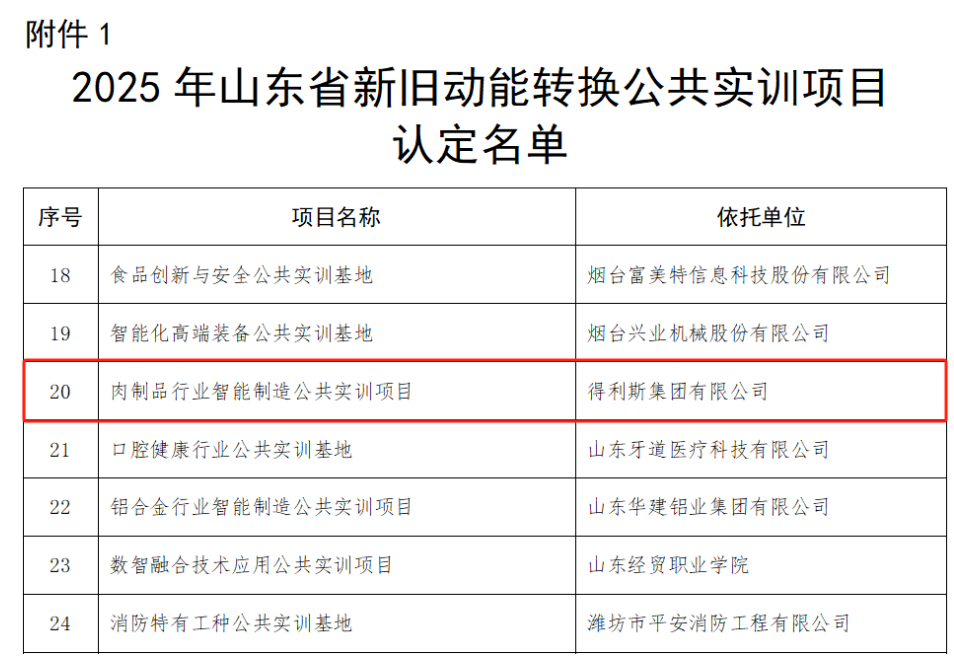
得利斯集团有限公司肉制品行业智能制造公共实训项目被认定为2025年山东省新旧动能转换公共实训项目
Zhong Guo Zhi Liang Xin Wen Wang· 2025-08-04 13:59
Group 1 - Shandong Delisi Group's meat processing industry intelligent manufacturing public training project has been selected for the 2025 Shandong Province new and old kinetic energy conversion public training project list [1][2] - The Shandong Province new and old kinetic energy conversion public training project aims to promote deep integration of industry and education, optimize the training of skilled talent in manufacturing, and support enterprise transformation and innovation [2] - The establishment of public training bases in Shandong Province is seen as a key strategy for enhancing industry upgrades and improving the adaptability of vocational training to regional economic development [3] Group 2 - Delisi focuses on high-quality development in the food industry, driven by market demand and research innovation, with an emphasis on pig breeding, product research and development, and intelligent manufacturing [3] - The company is actively promoting deep integration of "industry, academia, research, and application" through building a talent matching platform, creating a comprehensive innovation system covering technology breakthroughs, achievement transformation, and talent cultivation [3] - Delisi plans to continue leveraging the Shandong Province new and old kinetic energy conversion public training base to cultivate composite skilled talents that adapt to industry changes while attracting high-level research teams [3]

广东21地市经济“半年报”出炉 大部分地市主要经济指标增速加快
Nan Fang Ri Bao Wang Luo Ban· 2025-08-04 08:07
Core Insights - The economic performance of Guangdong's cities in the first half of the year shows a stable contribution from major cities like Shenzhen and Guangzhou, while smaller cities in the eastern, western, and northern regions demonstrate impressive growth rates [1][2][4] Economic Performance Overview - Shenzhen and Guangzhou both surpassed 1.5 trillion yuan in GDP, with Shenzhen leading at 1.83 trillion yuan and a growth rate of 5.1%, contributing significantly to the province's overall GDP growth [2][5] - The combined GDP of the four major cities (Shenzhen, Guangzhou, Foshan, and Dongguan) exceeded 4.5 trillion yuan, accounting for over 60% of Guangdong's total GDP of 68.73 trillion yuan [2][5] Growth Rate Highlights - Meizhou, Shanwei, and Zhaoqing recorded the highest growth rates, with Meizhou achieving a 5.7% increase, while seven out of ten cities with growth rates above or equal to the provincial level are located in the eastern, western, and northern regions [1][2] - Zhaoqing emerged as a "dark horse" with the highest export growth rate of 16.7%, driven by the development of the new energy storage industry [3] Industrial Performance - Guangzhou's industrial added value increased by 0.7%, marking the first positive growth since last year, with significant contributions from the automotive and emerging industries [4][5] - The automotive parts manufacturing sector in Guangzhou saw a remarkable growth of 48.4%, while the integrated circuit industry expanded by 30% [4][5] Trade and Export Dynamics - Despite challenges from external factors like the "tariff war," Guangdong's cities have shown resilience in foreign trade, with Shenzhen leading in export scale and Guangzhou achieving a 15.5% year-on-year growth in imports and exports [2][3] - The overall export of lithium-ion batteries from Zhaoqing surged by 68.7%, reflecting the city's focus on new energy technologies [3] Future Outlook and Strategic Initiatives - Cities like Shantou are focusing on upgrading traditional industries, with investments in the toy industry growing by 10.1% [7] - Various cities are implementing strategies to stimulate economic growth, such as Guangzhou's push for stability in key industries and investment in new sectors like artificial intelligence and low-altitude economy [8]
政治局会议点评:以更明确更长远政策路径导向新旧动能转换
Orient Securities· 2025-08-03 03:17
Economic Growth and Policy Direction - China's GDP growth rate reached 5.3% in the first half of the year, leading to a more cautious market outlook regarding the July Politburo meeting[5] - The meeting signifies a shift towards more refined and long-term economic and industrial policies, emphasizing the transition from old to new growth drivers[5] Policy Implications - Traditional policy measures still have room for adjustment, allowing for potential monetary easing if unexpected risks arise in the second half of the year[5] - The meeting highlighted the importance of regulating chaotic competition among enterprises, moving beyond just price wars to encourage quality and service[5] Consumer and Investment Focus - Emphasis on "people's comprehensive development" and "common prosperity" suggests future policies will focus on enhancing consumer experience and service consumption[5] - The introduction of childcare subsidies and support measures indicates a shift towards investing in human capital, which may lead to further fiscal expansion[5] Strategic Outlook - The upcoming five-year plan is expected to enhance market expectations for the transition of growth drivers, especially in light of changing international dynamics[5] - Key areas for growth include self-sufficiency, resource security, and technological innovation, all linked to the new growth driver transition[5] Risks and Challenges - Risks associated with overextending export growth could impact macroeconomic policy space in the coming months[5] - Potential liquidity risks from the U.S. may also pose challenges for the domestic market[5]
青岛银行2025年上半年净利润同比增长16.05% 股权结构调整或成发展新契机
Jing Ji Guan Cha Wang· 2025-08-01 08:43
尤为重要的是,青岛银行近年来持续保持较高分红水平,形成了稳定的投资者回报机制。今年6月18 日,该行发布公告称,2024年度A股利润分配方案为"每10股派1.60元",现金分红总额约9.31亿元(含 税),现金分红比例维持在33%以上。这一数据不仅连续四年保持稳定,更显著高于上市城商行28%的 平均分红水平,体现了该行对股东回报的高度重视。 青岛银行(002948)(002948.SZ;03866.HK)于7月31日发布2025年半年度业绩快报。数据显示,该 行上半年实现归属于母公司股东的净利润30.65亿元,同比增长16.05%;营业收入达76.62亿元,同比增 长7.50%;资产总额突破7430亿元,较上年末增长7.69%。截至上半年末,青岛银行在盈利能力、资产 规模和资产质量等方面均实现稳步提升,加权平均净资产收益率(年化)达15.75%,同比提高0.41个百 分点。 值得关注的是,青岛银行的股权结构或将迎来重要变化。6月11日,该行公告显示,青岛国信发展(集 团)有限责任公司计划通过子公司增持股份至不超过19.99%,若获批将跃居第一大股东。此次股权结 构调整可能重塑青岛银行的公司治理格局,地方国资话 ...
专家解读《中国汽车产业竞争力评价研究(2025)》:全球格局下的中国机遇与突破路径
Zhong Guo Jin Rong Xin Xi Wang· 2025-07-31 10:23
Core Viewpoint - The report titled "China Automotive Industry Competitiveness Evaluation Research (2025)" highlights the competitive landscape of the global automotive industry, emphasizing China's opportunities and pathways for breakthroughs in the context of global dynamics [1]. Group 1: Research Framework - The study establishes a "1+1+N" evaluation framework focusing on comprehensive automotive industry competitiveness and specialized competitiveness in intelligent connected new energy vehicles, with additional evaluations for key segments of the industry chain [2]. - The framework integrates classic theories such as Porter's Diamond Model and PEST analysis, aligning with the automotive industry's transformation towards electrification, connectivity, and intelligence [2]. Group 2: Global Competitiveness Ranking - Based on 2023 data, the global automotive industry competitiveness ranking is as follows: EU, Japan, USA, China, and South Korea, reflecting a clear tiered structure [4]. - The EU leads due to its balanced advantages, including strong technological innovation and a mature automotive culture, while Japan follows with deep technological expertise and global market presence [4]. - The USA and China are in the second tier, with the USA excelling in innovation and China in scale and transformation speed, having established a complete industrial system [4]. Group 3: China's Performance in Key Segments - China ranks first globally in the intelligent connected new energy vehicle sector, driven by a robust policy framework, collaborative innovation, and a massive market demand [6]. - In specific segments, China leads in power batteries and hydrogen fuel cell vehicles, showcasing advanced technology and a complete supply chain [7]. - The intelligent cockpit sector is also competitive, sharing the top tier with the USA, thanks to high market penetration and integration of AI technologies [8]. Group 4: Future Trends and Strategic Directions - The next decade is critical for the global automotive industry, with three major transformations anticipated: a shift in competitive discourse towards new energy vehicles, regionalization of supply chains, and a reconfiguration of productivity driven by data and technology [9]. - China's automotive industry is positioned to transition from the second tier to the first tier, with a focus on enhancing technological innovation, upgrading industry structure, and expanding domestic market presence [9].

济南济北经济开发区工业产值过亿元企业达到38家
Qi Lu Wan Bao Wang· 2025-07-31 08:03
Core Viewpoint - The Jinan government is actively promoting the "Industrial Strong City Development Strategy" with a focus on high-quality industrial economic development in the Jiyang District, leveraging opportunities from cross-strait industrial cooperation and local economic policies [1][2]. Group 1: Industrial Development Initiatives - The Jinan Economic Development Zone has introduced innovative practices to enhance industrial cooperation, resulting in the introduction of 152 projects with Taiwanese investment, including 110 industrial projects, totaling over $2.7 billion in investment [1]. - The development zone has implemented a "project-first" approach, establishing a mechanism for key project management, which has led to the completion of 154 new projects in 2023, with 33 projects already operational [2]. Group 2: Industry Transformation and Upgrading - The Jinan Economic Development Zone is accelerating its industrial transformation by focusing on key sectors such as food and bio-manufacturing, modern pharmaceuticals, and equipment manufacturing, with the food and beverage industry surpassing 10 billion yuan in output [3]. - The region has seen significant growth in industrial output, with 38 companies achieving over 100 million yuan in industrial output, and the establishment of 160 national high-tech enterprises [3].