
AI芯片

Search documents
沐曦股份下周五启动申购
Sou Hu Cai Jing· 2025-11-27 23:16
Core Viewpoint - The domestic GPU chip manufacturer Muxi Co., Ltd. is accelerating its IPO process, with the official subscription date set for December 5, 2023, aiming to raise 3.904 billion yuan for three major GPU projects [1] Group 1: IPO Details - Muxi Co., Ltd. plans to issue 40.1 million shares, with an initial strategic placement of 8.02 million shares, and the online subscription code is 787802 [1] - The company submitted its IPO application on June 30 and received approval from the China Securities Regulatory Commission on November 12, completing the process in just 116 days [1] Group 2: Company Background - Established in September 2020, Muxi is recognized as a leader in high-performance general-purpose GPUs in China, achieving technological breakthroughs in the AI chip sector, which has been dominated by international firms [1] - The performance of Muxi's products matches that of mainstream high-end processors internationally, placing the company in a leading position domestically [1] Group 3: Financial Performance - The main product, the Xiyun C500 series, is the primary source of revenue for the company, generating revenues of 15.4681 million yuan, 72.2 million yuan, and 31.4 million yuan from 2023 to the first quarter of 2025, accounting for 30.09%, 97.28%, and 97.87% of the main business income during the same periods [2]
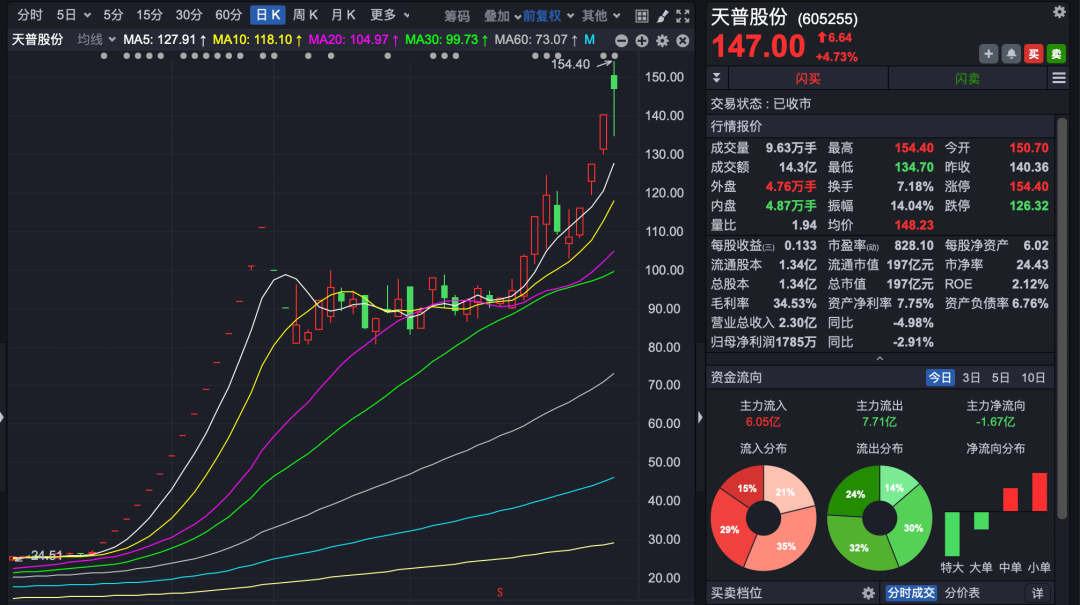
大牛股,4天再涨35%,停牌核查
Zheng Quan Shi Bao· 2025-11-27 14:27
Core Points - Tianpu Co., Ltd. (605255) is undergoing its fourth suspension for stock price fluctuations, with a cumulative increase of over 450% since late August, including a 35% rise in the last four trading days [2][3] Group 1: Stock Price Movement - The stock price of Tianpu Co., Ltd. has increased over 450% from August 22 to November 27, with a notable 35% rise from November 24 to 27 [2][3] - The company has experienced multiple trading halts due to significant price volatility, with a history of 15 consecutive trading days of price increases from August 22 to September 23 [3] Group 2: Acquisition and Control Changes - The price fluctuations are linked to the acquisition and capital increase plans by Zhonghao Xinying, which will result in a new actual controller for Tianpu Co., Ltd. [5] - Tianpu Co., Ltd. has clarified that Zhonghao Xinying's existing capital path is unrelated to the acquisition and that there are no plans for asset injection or major business changes in the next 12 months [5] Group 3: Financial Metrics and Risks - The current price-to-earnings ratio of Tianpu Co., Ltd. is 605.87, significantly higher than the industry average of 29.71 [6] - The controlling shareholders and acquirers hold 75% of the company's total shares, indicating a small free float and potential irrational speculation risks [6] - Recent trading data shows a dispersed trading volume, with nearly 1.2 billion yuan traded over two days, but the top five buying positions accounted for only 57.18 million yuan [6] Group 4: Tender Offer Details - Zhonghao Xinying's tender offer is ongoing and will not be affected by the stock suspension, with the offer period running from November 20 to December 19 [6][7] - The tender offer price is significantly lower than the recent closing price of 147.00 yuan per share, leading to a potential loss of 123.02 yuan per share for investors who accept the offer [6][7]


TPU挑战GPU,但美银建议:英伟达、博通、AMD都买
硬AI· 2025-11-27 14:20
Core Viewpoint - Bank of America predicts that the AI data center market will grow fivefold to over $1.2 trillion by 2030, maintaining a buy rating on Nvidia, Broadcom, and AMD despite potential market share declines for Nvidia [2][4][11]. Market Growth and Dynamics - The total addressable market (TAM) for AI data centers is expected to increase from $242 billion in 2025 to over $1.2 trillion by 2030, indicating a significant market expansion [11]. - Even if Nvidia's market share normalizes from 85% to 75%, its absolute revenue is projected to experience explosive growth [4][11][12]. Competitive Landscape - Custom chips, such as Google's TPU, are seen as a challenge to GPUs, particularly for companies with large internal workloads like Google and Meta [3][4]. - However, GPUs remain irreplaceable in public cloud and enterprise markets due to their flexibility and broader ecosystem [13]. Investment Recommendations - Bank of America maintains a buy rating for Nvidia, Broadcom, and AMD, suggesting that current valuations do not fully reflect their long-term profitability [5][15]. - Nvidia is expected to achieve over 40% sales and earnings growth, with a target price of $275, while its earnings per share could exceed $10 by 2027 and $20 by 2030 [16][17]. - Broadcom is viewed as a major beneficiary of the custom chip trend, with a target price of $400, anticipating over 100% year-over-year growth in AI business revenue by 2026 [18][19]. - AMD is also recommended for holding, with a target price of $300, reflecting its growth potential across various sectors despite facing cyclical slowdowns in embedded markets [21][23].

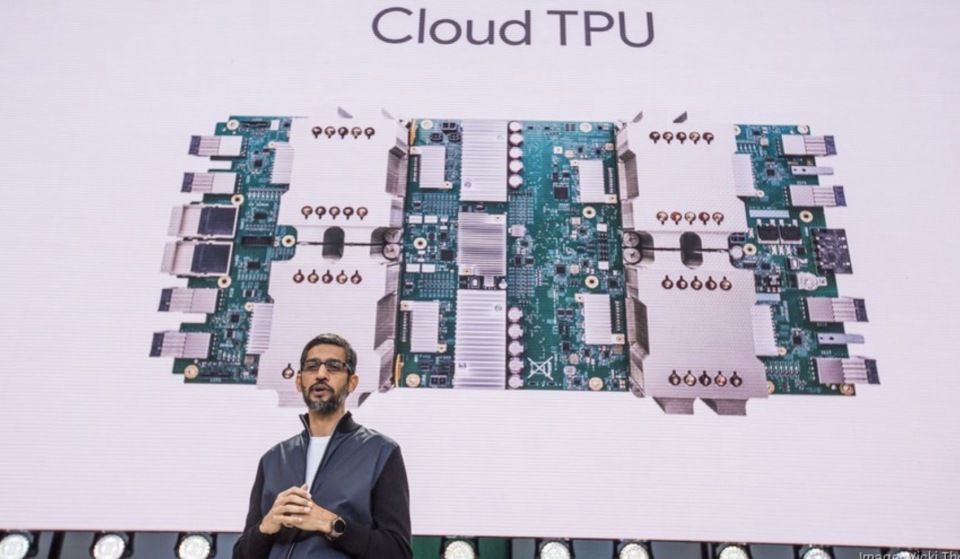
谷歌 Ironwood TPU 突袭,英伟达 GPU 迎来挑战者?
Tai Mei Ti A P P· 2025-11-27 07:35
Core Viewpoint - Nvidia issued an urgent statement in response to market discussions regarding AI hardware development, particularly in light of Google's launch of the seventh-generation Ironwood TPU and Meta's consideration of TPU solutions [1][2]. Group 1: Nvidia's Market Position - Nvidia's stock experienced volatility, with a peak decline of 7% and a closing drop of 2.59% following the statement [2]. - The statement has garnered over 1.5 million views and more than 750 comments, indicating significant interest within the AI community [2]. - Observers note that as major clients begin to develop their own chips, the competitive landscape for AI chips is changing [2]. Group 2: Google's AI Infrastructure Strategy - Google is redefining AI infrastructure with a comprehensive solution that integrates custom hardware, cloud services, and specialized chips [3][5]. - The Ironwood TPU is Google's most powerful and energy-efficient accelerator to date, achieving a performance increase of approximately 10 times compared to the previous TPUv5p and over 4 times compared to TPUv6e [3]. - The Ironwood TPU features high bandwidth, large memory capacity, and advanced cooling systems, making it suitable for complex, high-concurrency, low-latency model deployments [3]. Group 3: Implications for the AI Chip Market - Google's introduction of Ironwood signals a significant challenge to Nvidia's GPU dominance, raising questions about the future of Nvidia's market position [8]. - Nvidia emphasizes its unique value proposition as the only platform capable of running all AI models anywhere, highlighting its established ecosystem [8][9]. - Nvidia's advantages include generality and compatibility, a mature ecosystem, and flexibility that allows it to adapt to rapid AI technology iterations [9][12]. Group 4: Future Market Dynamics - Meta is reportedly negotiating with Google to procure TPU chips for deployment in its data centers starting in 2027, reflecting a strategic shift among major tech companies towards diversified AI infrastructure [14]. - If Google continues to leverage its TPU and integrated infrastructure, the AI industry may undergo a profound transformation affecting hardware market dynamics and investment valuation logic [15][16]. - The AI hardware market is expected to transition from a GPU-dominated landscape to a more diversified ecosystem featuring GPUs, TPUs, custom ASICs, and cloud services [17]. Group 5: Investment and Valuation Changes - The focus of hardware competition is shifting from selling chips to providing comprehensive services and infrastructure [18]. - Future valuation metrics will prioritize companies that can offer economical, scalable, and integrated infrastructure solutions [18]. - The lowering of infrastructure barriers is likely to stimulate innovation among AI startups and service-oriented companies, driving the next wave of AI commercialization [19].



A股异动丨“谷歌链”继续活跃,赛微电子20CM涨停创历史新高
Ge Long Hui A P P· 2025-11-27 03:05
Core Viewpoint - The A-share market is witnessing significant activity in Google-related industry chain stocks, driven by Google's challenge to Nvidia's dominance in the AI chip market through its TPU chip offerings [1] Group 1: Stock Performance - Saiwei Electronics reached a historical high with a 20% limit up [1] - Xidi Micro increased by over 13% [1] - Zhihui Power and Taicheng Light both rose by over 9% [1] - Yintang Zhikong and Guangku Technology saw increases of over 7% [1] - Tengjing Technology grew by over 5% [1] - Dekeli experienced a rise of over 4% [1] Group 2: Market Developments - Google is leveraging its advancements in AI models to challenge Nvidia's chip market leadership [1] - The company has begun promoting its TPU chip deployment in its own data centers to major clients like Meta, aiming to expand beyond its Google Cloud rental business [1]



“谷歌链”继续活跃,赛微电子20CM涨停创历史新高
Ge Long Hui· 2025-11-27 02:55
Group 1 - The core viewpoint of the news is that Google is challenging NVIDIA's dominance in the chip market by promoting its TPU chips to major clients like Meta, leveraging its advancements in AI models [1] - In the A-share market, stocks related to the Google supply chain are experiencing significant activity, with Saiwei Electronics hitting a historical high with a 20% increase, and other companies like Xidi Micro, Zhihui Power, and Taicheng Light also seeing substantial gains [1] - Google aims to expand its TPU chip deployment from its cloud rental business to a broader market, indicating a strategic shift in its approach to AI hardware [1]



一文读懂谷歌TPU:Meta投怀送抱、英伟达暴跌,都跟这颗“自救芯片”有关
3 6 Ke· 2025-11-27 02:39
Core Insights - Alphabet's CEO Sundar Pichai faces declining stock prices, prompting Nvidia to assert its industry leadership, emphasizing the superiority of GPUs over Google's TPU technology [2] - Berkshire Hathaway's investment in Alphabet marks a significant shift, coinciding with Meta's consideration of deploying Google's TPU in its data centers by 2027 [2] - Google continues to collaborate with Nvidia, highlighting its commitment to supporting both TPU and Nvidia's GPU technologies [2] TPU Development History - The TPU project was initiated in 2015 to address the unsustainable power consumption of Google's data centers due to the increasing application of deep learning [3] - TPU v1 was launched in 2016, proving the feasibility of ASIC solutions for Google's core services [4] - Subsequent versions (v2, v3) were commercialized, with TPU v4 introducing a supernode architecture that significantly enhanced performance [5][6] Transition to Commercialization - TPU v5p marked a turning point, entering Google's revenue-generating products and doubling performance compared to v4 [6][7] - The upcoming TPU v6 focuses on inference, aiming to become the most cost-effective commercial engine in the inference era, with a 67% efficiency improvement over its predecessor [7][8] Competitive Landscape - Google, Nvidia, and Amazon are at a crossroads in the AI chip market, each pursuing different strategies: Nvidia focuses on GPU versatility, Google on specialized TPU efficiency, and Amazon on cost reduction through proprietary chips [19][20][22] - Google's TPU strategy emphasizes vertical integration and system-level optimization, contrasting with Nvidia's general-purpose GPU approach [21][22] Cost Advantages - Google's vertical integration allows it to avoid the "CUDA tax," significantly reducing operational costs compared to competitors reliant on Nvidia GPUs [26][27] - The TPU service enables Google to offer lower-priced inference capabilities, attracting businesses to its cloud platform [27][28] Strategic Importance of TPU - TPU has evolved from an experimental project to a critical component of Google's AI infrastructure, contributing to a significant increase in cloud revenue, which reached $44 billion annually [30][31] - Google's comprehensive AI solutions, including model training and monitoring, position it favorably against AWS and Azure, enhancing its competitive edge in the AI market [32]
海光信息大涨8%,寒武纪拉升,半导体设备ETF(561980)盘中拉涨超3%
2 1 Shi Ji Jing Ji Bao Dao· 2025-11-27 02:39
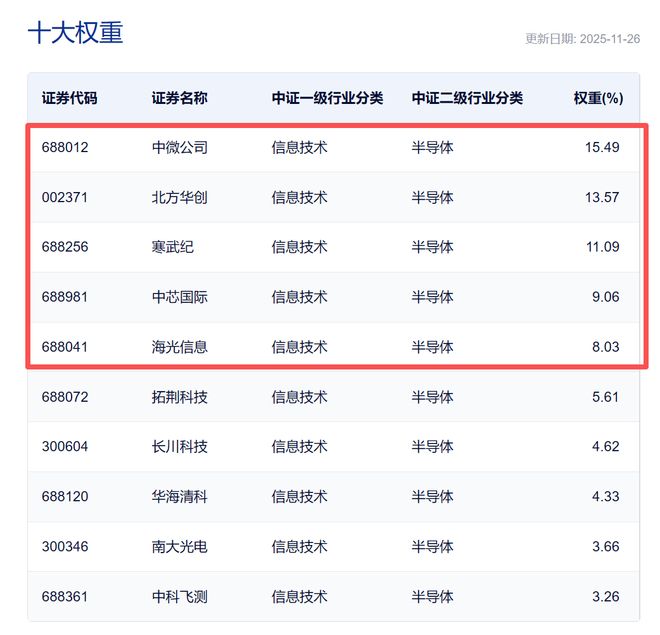
Group 1 - The semiconductor equipment ETF (561980) opened high on November 27, with a mid-day increase of over 3%, and several component stocks such as Haiguang Information rising over 8% [1] - The domestic GPU "unicorn" Muxi Co., Ltd. is set to launch its IPO on December 5, aiming to raise 3.904 billion yuan for the development and industrialization of new high-performance general-purpose GPUs [1] - The IPO process for Muxi took 117 days from acceptance to approval, only 29 days longer than that of Moer Thread, which opened for subscription on November 24, attracting 4.8266 million retail investors [1] Group 2 - Guotai Junan pointed out that the listing of Muxi on the Sci-Tech Innovation Board marks a significant step for domestic high-end chips in terms of capital and marketization [1] - The current iteration of advanced process technology in China is expected to lead to a gradual shift of AI chips towards domestic wafer foundries, with full domestic production in packaging and testing [1] - Core assets like SMIC, which are positioned in advanced processes, are anticipated to benefit from the vast domestic market opportunities in the AI era [1] Group 3 - The semiconductor equipment ETF (561980) tracks the CSI Semiconductor Index, with the top five holdings being Zhongwei Company (15.49%), Northern Huachuang (13.57%), Cambricon (11.09%), SMIC (9.06%), and Haiguang Information (8.03%), indicating a concentration of over 57% in these leading firms [2] - The index's component stocks are primarily leaders in semiconductor equipment, materials, and integrated circuit design, with over 90% of the index representing critical segments of domestic innovation [3]





大摩:谷歌每对外销售约50万颗TPU,将推升2027年谷歌云营收增加约130亿美元,每股盈利增长约3%
Ge Long Hui· 2025-11-27 02:33
Group 1 - The core viewpoint is that Google's external sales of approximately 500,000 TPUs could lead to an increase of about $13 billion in Google Cloud revenue by 2027, representing an 11% growth rate, and an increase of approximately $0.37 in earnings per share, equating to a 3% growth rate [1] - If Google Cloud's business growth continues to accelerate and the company's semiconductor market expansion is successful, it will help maintain a high valuation for its stock [1] Group 2 - In terms of industry scale, with Nvidia expected to ship around 8 million GPUs by 2027, Google's external sales of TPUs in the range of 500,000 to 1 million units remains reasonable [3] - There is uncertainty regarding Google's overall strategy for promoting TPU external sales, with investor focus on its business model, pricing strategy, and the types of workloads that TPUs can handle [3] - This year, Google has spent approximately $20 billion on Nvidia for large language model-related computing, while spending on TPUs has been only around $1 billion, indicating a potential adjustment in capital allocation next year, although overall AI chip demand is unlikely to result in a "winner-takes-all" scenario [3]


大摩:谷歌每对外销售约50万颗TPU,将推升2027年每股盈利约3%
Ge Long Hui· 2025-11-27 02:15
Core Insights - Morgan Stanley analysts estimate that Google's external sales of approximately 500,000 TPUs could increase Google Cloud revenue by about $13 billion, representing an approximate growth rate of 11% by 2027, with an increase in earnings per share of about $0.37, or roughly 3% [1] Group 1 - The potential for Google Cloud's revenue growth is linked to the successful expansion of its semiconductor market presence [1] - Analysts suggest that if Google Cloud's business growth accelerates, it will help maintain a high valuation for the company's stock [1] - The estimated external sales range for Google TPUs is considered reasonable, especially in the context of Nvidia's expected GPU shipments of around 8 million units by 2027 [1] Group 2 - There is uncertainty regarding Google's overall strategy for promoting TPU external sales, with key investor concerns focusing on its business model, pricing strategy, and the types of workloads that TPUs can support [1] - This year, Google has spent approximately $20 billion on Nvidia for large language model-related computing, while expenditures on TPUs have been around $1 billion, indicating a potential adjustment in capital allocation next year [1] - The overall demand for AI chips is unlikely to result in a "winner-takes-all" scenario, suggesting a competitive landscape [1]