
卫星互联网

Search documents
盛洋科技:子公司FTA与全球头部卫星运营商的南美项目目前正按合同实施推进
Mei Ri Jing Ji Xin Wen· 2026-01-05 10:41
Core Viewpoint - The company is progressing with its South American project through its subsidiary FTA, focusing on software licensing, custom development, and small-scale product delivery, while planning to expand its market presence and explore collaborations with local operators [1] Group 1: Project Implementation - FTA is currently implementing its South American project as per contract, with initial activities centered on software licensing, custom development, and small-scale product delivery verification [1] - The company aims to leverage its partner's channel resources and adapt to the South American market demands to gradually expand the coverage of its terminal products [1] - The impact of recent international situations on FTA's South American project has been limited, and the project is advancing steadily according to contractual agreements [1] Group 2: Technology and R&D - FTA's DVB-NIP technology offers a dual interaction capability for content distribution between satellite and IP networks, utilizing its self-developed Q-Stream platform [1] - The technology supports satellite internet signal transmission needs and provides various OTT functions, including linear broadcasting, VoD, targeted advertising, and family-wide streaming [1] - The company plans to continue investing in R&D to keep pace with industry technology standards and strengthen its leading position in the satellite internet niche [1]

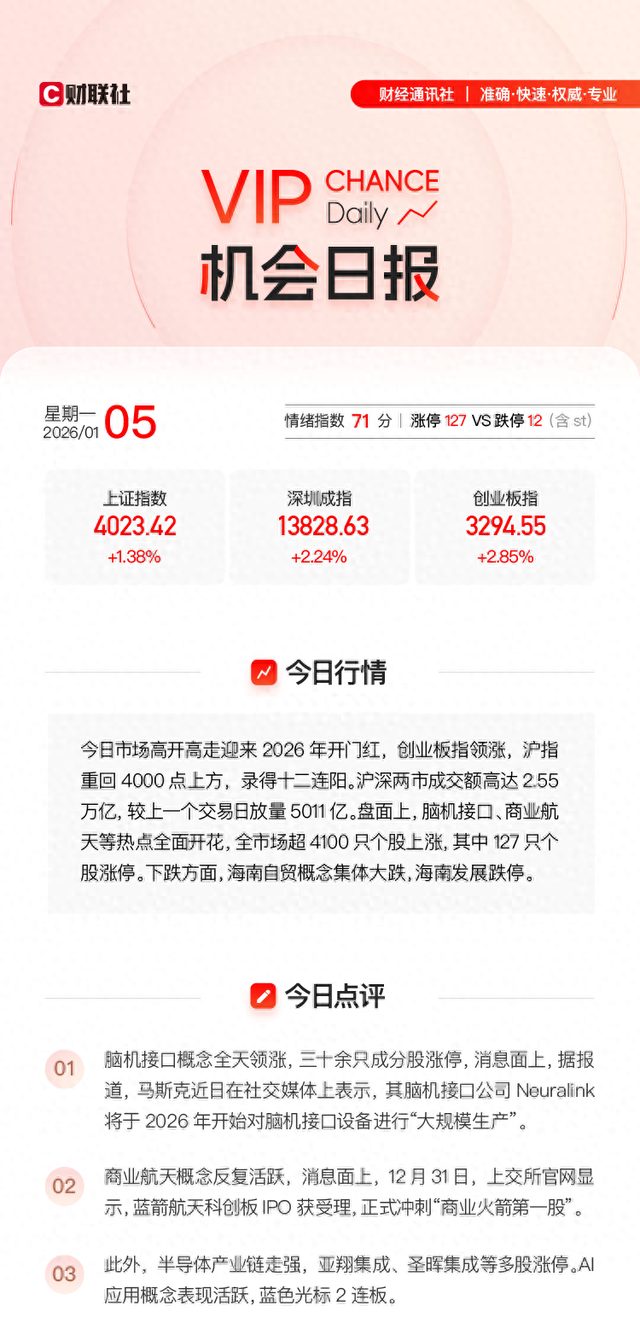
VIP机会日报指数迎2026年开门红 脑机接口概念大涨 栏目前瞻解读 提及2家公司双双20cm涨停
Xin Lang Cai Jing· 2026-01-05 10:11
Group 1: Brain-Computer Interface - Neuralink, founded by Elon Musk, plans to start large-scale production of brain-computer interface devices in 2026 [5] - The brain-computer interface industry is expected to accelerate commercialization, with companies like Xiangyu Medical and Mylande experiencing significant stock price increases [9][10] - Analysts predict that the market size of the brain-computer interface industry will exceed $10 billion by 2030 [10] Group 2: Commercial Aerospace - Blue Arrow Aerospace has received approval for its IPO on the Sci-Tech Innovation Board, aiming to become the first publicly listed commercial rocket company in China [14] Group 3: Robotics - Morgan Stanley forecasts that China will ship 14,000 humanoid robots this year, with annual growth expected to double in the coming years, potentially exceeding 1 million units by 2034 [25] - The first full-body force-controlled humanoid robot, Q1, is set to be released, indicating a rapid acceleration in product iteration and market application [25] Group 4: AI Applications - Meta has announced the acquisition of AI agent company Manus to enhance its AI innovation efforts, with the integration of Manus into Meta's core consumer products [27] - The demand for AI applications is rapidly expanding, as indicated by the significant increase in token consumption, reflecting a shift from concept validation to revenue generation [30] - Tax Friend Co., mentioned in relation to AI applications, saw its stock price rise significantly following the announcement of expected AI application growth in early 2026 [30][31]


频繁发射火箭的 SpaceX 今年上市,为什么星链服务是其价值关键? | 声动早咖啡
声动活泼· 2026-01-05 09:01
Core Viewpoint - SpaceX, founded by Elon Musk in 2002, aims to revolutionize space travel and establish human life on Mars, with a significant focus on both rocket manufacturing and satellite internet services through its Starlink project [3][4]. Group 1: SpaceX and Starlink Development - SpaceX has significantly reduced rocket launch costs through reusable technology and in-house component manufacturing, which has positioned it as a leader in the commercial launch market [4][6]. - The Starlink satellite division was established in 2015, with the goal of providing satellite-based internet services to generate long-term revenue for Mars colonization efforts [4][5]. - Starlink satellites operate at a lower altitude (approximately 1200 km) compared to traditional satellites, improving data transmission speed and reducing latency [5][7]. Group 2: Market Position and Financial Performance - In 2022, Starlink generated approximately $12.8 billion in revenue, accounting for about 70% of SpaceX's total revenue, indicating strong market demand for its services [7][8]. - SpaceX's valuation is heavily influenced by expectations of future Starlink revenues, with 70% of its current valuation attributed to this segment [7]. Group 3: Customer Base and Service Expansion - Starlink's customer base includes a significant number of affluent residential users in the U.S., with 57% of users willing to pay a premium for satellite internet services [8]. - The company is expanding its services to maritime and aviation sectors, partnering with major airlines to provide faster and more stable internet services on flights [8][9]. Group 4: Regulatory and Technological Developments - SpaceX has partnered with T-Mobile to offer mobile internet services via Starlink, although regulatory approval for this service is expected in 2024 [9][10]. - The acquisition of EchoStar's wireless spectrum licenses for $17 billion is a strategic move to enhance mobile communication capabilities, allowing for improved data transmission rates [10]. Group 5: Future Innovations and AI Integration - SpaceX is exploring the development of space-based data centers, leveraging advancements in satellite technology to process and store data in orbit, which could address energy and cooling challenges faced by terrestrial data centers [12].
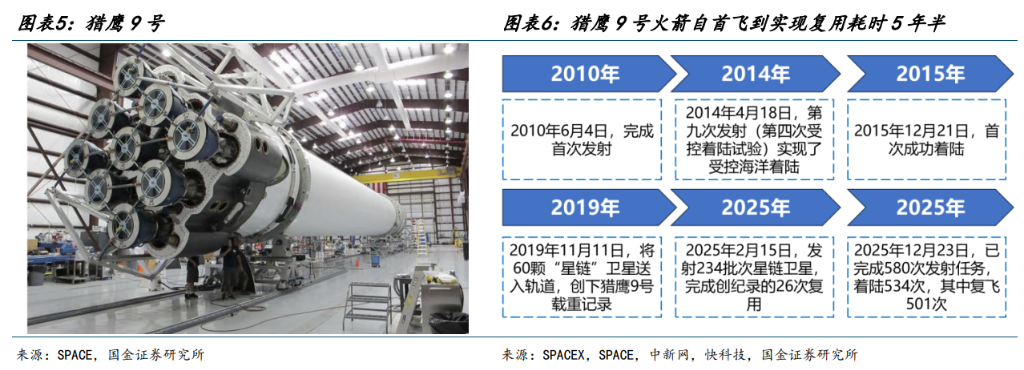
国金证券:可回收火箭从0到1迈入黄金发展期 动力系统等组成环节有望受益
智通财经网· 2026-01-05 08:45
Core Insights - The report by Guojin Securities emphasizes that reusability is a key method to reduce launch vehicle costs and is crucial for overcoming bottlenecks in commercial space development [2][4] - The commercial rocket industry is entering a rapid iterative development phase, transitioning from 0 to 1, driven by the frequent launches of reusable rockets [1][4] Group 1: Reusable Rockets Development - Domestic reusable rockets are entering a phase of intensive launches, marking a new stage in low-cost exploration of commercial space [2] - The "Zhuque-3" rocket, developed by Blue Arrow Aerospace, successfully completed its maiden flight, while the Long March 12甲 rocket also attempted recovery during its first flight [2] - Current average launch costs for expendable rockets range from 110 million to 180 million yuan, while some reusable rockets are priced around 67 million USD; with full recovery, costs could drop to 2 to 5 million USD [2] Group 2: Global Competition and Cost Advantages - The Falcon 9 rocket, the world's first orbital-class reusable rocket, has completed 580 launches with a recovery success rate of 534 landings and 501 reuses [3] - Following the normalization of reusability, SpaceX's launch frequency increased significantly from 13 launches in 2019 to 138 in 2024 [3] - The launch cost for Falcon 9 is approximately 18,000 yuan/kg, and if fully reusable, it could drop to 5,000 yuan/kg, significantly lower than current operational rockets [3] Group 3: Demand from Satellite Internet Construction - The construction of satellite internet in China is accelerating, with plans to launch 44,816 satellites, leading to a projected demand for 150 commercial rocket launches per year [4] - Policy support for the commercial rocket industry is evident, with the Shanghai Stock Exchange issuing guidelines for the listing of commercial rocket companies on the Sci-Tech Innovation Board [4] - The commercial rocket industry is transitioning into a new phase of engineering and industrialization, poised for a golden development period alongside the satellite industry [4][6]

从0到1迈入黄金发展期:中国商业火箭产业链全景拆解
Hua Er Jie Jian Wen· 2026-01-05 08:34
Core Insights - China's commercial space industry is at a critical turning point similar to SpaceX in 2015, with the recent test flights of Zhuque-3 and Long March 12A marking the transition of reusable rocket technology from experimental to engineering implementation [1][2] - The opening of the fifth set of standards for the Sci-Tech Innovation Board has cleared obstacles for IPOs of rocket companies, indicating a significant market opportunity driven by the rigid demand for satellite internet and the cost revolution brought by reusable technology [1][10][13] Market Opportunity - The satellite internet construction is expected to create a trillion-dollar market, driven by the rapid deployment of satellite constellations such as GW and G60, which plan to deploy up to 44,816 satellites [1][7][9] - The annual replacement demand for nearly 9,000 satellites will create a substantial capacity gap, further fueling the demand for commercial launches [1][7] Technological Development - Reusable rocket technology is identified as the key to breaking the cost bottleneck in space transportation, with China currently in a phase similar to SpaceX's early technical ramp-up [2][18] - The recent test flights of Zhuque-3 and Long March 12A, despite not achieving complete recovery, signify the start of a concentrated exploration period for reusable rockets in China [2] Cost Advantages - The cost advantages of high-frequency reuse are significant, as demonstrated by SpaceX's Falcon 9, which has achieved a marginal reuse cost of $15 million per launch, compared to the average cost of $110 million to $180 million for expendable rockets [5] - If China's commercial rockets can achieve similar breakthroughs, launch costs could be drastically reduced, supporting the large-scale deployment of satellite internet [5] Investment Focus - Analysts suggest that investment should focus on the most valuable segments of the supply chain, particularly engine manufacturing and rocket structure, which will benefit first from high consumption before reusable technology matures [1][18] - The core components of a typical liquid rocket, such as engines and structures, account for a significant portion of hardware costs, with the first-stage engine and structure comprising 77.8% of the total [14][18] Policy and Capital Market - The improvement of policy frameworks and the opening of capital market exit channels are accelerating the transition of commercial space from a storytelling phase to a performance-driven phase [10][17] - The new IPO guidelines for the Sci-Tech Innovation Board directly pave the way for leading commercial rocket companies like Blue Arrow Aerospace and Interstellar Glory [10][13]
雷电微力(301050.SZ):产品可适配低轨卫星星上载荷、地面终端等领域
Ge Long Hui· 2026-01-05 07:33
格隆汇1月5日丨雷电微力(301050.SZ)在投资者互动平台表示,低轨卫星作为卫星互联网与商业航天发 展的核心载体,市场需求持续释放,公司产品可适配低轨卫星星上载荷、地面终端等领域,能满足卫星 通信、遥感、导航等多场景的需求。因产品在卫星通信上的设计方案不同,因此价值也不统一。 ...
卫星板块强势依旧,卫星ETF(563230)盘中涨幅达4.2%
Mei Ri Jing Ji Xin Wen· 2026-01-05 05:52
Group 1 - The satellite industry is experiencing a strong start to the year, with significant gains in sectors such as Beidou navigation, space stations, aircraft carriers, and commercial aerospace, as evidenced by the satellite ETF (563230) rising by 4.2% [1] - The military industry ETF (512710) increased by 3.06%, while the aviation ETF (159392) saw a rise of 2.32%, indicating robust investor interest in these sectors [1] - Key stocks within the satellite ETF, including Haige Communication, China Satcom, and Beidou Star, reached their daily limit up [1] Group 2 - The implementation of the "Satellite Navigation Positioning Benchmark Station Management Measures" on January 1, 2026, will consolidate the national benchmark stations into a single network of 6,951, strengthening the commercial foundation for Beidou's time-space services [1] - Following the failure of Venezuela's satellite navigation system, Elon Musk announced that SpaceX's "Starlink" will provide free services, highlighting the strategic value of satellite internet and the necessity for domestic development of autonomous low-orbit constellations [1] - The satellite ETF (563230) closely tracks the satellite industry index, which encompasses sectors such as integrated circuit design, communication systems and terminal equipment, aerospace, general software development, and electronic components and automation machinery, indicating high investment efficiency and purity within the sector [1]
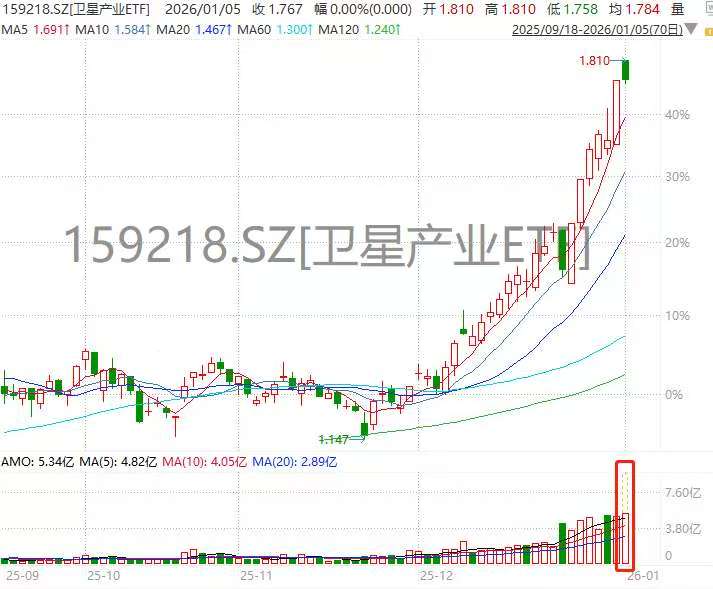
2.5亿资金盘中集中下注!卫星产业ETF(159218)盘中净流入、成交额双双创历史新高
Jin Rong Jie· 2026-01-05 03:37
1月5日,卫星板块持续活跃。数据显示,截至10时59分,表征板块的卫星产业ETF(159218)跌0.34%, 此前一度涨2.43%。交投持续升温,成交额超5.3亿,盘中净流入超2.5亿,双双创历史新高。 分析指出,卫星板块受到多重因素催化。国内层面迎来标志性事件,商业航天领军企业蓝箭航天的科创 板IPO申请正式获受理,拟募集资金高达75亿元,将重点用于可重复使用火箭的研发与产能建设,标志 着产业从技术验证迈向大规模商业化与资本化的关键一步。与此同时,宏观政策对2026年多型新火箭首 飞及回收目标的展望,为行业明确了发展路径。国际层面,近期地缘事件凸显了自主可控的卫星互联网 在全球通信中的战略价值。在政策、资本、技术及战略需求共振下,卫星产业的高景气度持续获得验 证,覆盖全产业链的卫星产业ETF(159218)已成为资金高效布局这一长期赛道的重要工具。 风险提示:基金有风险,投资需谨慎。 资讯所属栏目还有更多独家策划、专家专栏,免费查阅>> ...
盛洋科技跌2.06%,成交额2.87亿元,主力资金净流出3021.65万元
Xin Lang Zheng Quan· 2026-01-05 03:07
Core Viewpoint - The stock of Shengyang Technology has experienced a decline of 2.06% as of January 5, with a market capitalization of 5.926 billion yuan, reflecting mixed trading activity and a notable increase in revenue and profit year-on-year [1][2]. Group 1: Stock Performance - As of January 5, Shengyang Technology's stock price is 14.28 yuan per share, with a trading volume of 287 million yuan and a turnover rate of 4.76% [1]. - Year-to-date, the stock has decreased by 2.06%, with a slight decline of 0.35% over the last five trading days, but has increased by 20.30% over the last 20 days and 26.60% over the last 60 days [1]. Group 2: Financial Performance - For the period from January to September 2025, Shengyang Technology reported a revenue of 644 million yuan, representing a year-on-year growth of 13.39%, and a net profit attributable to shareholders of 7.1347 million yuan, up by 6.16% [2]. - Cumulatively, the company has distributed 55.9729 million yuan in dividends since its A-share listing, with 4.8876 million yuan distributed over the last three years [3]. Group 3: Shareholder Information - As of September 30, 2025, the number of shareholders for Shengyang Technology has increased to 24,300, marking an 8.30% rise, while the average circulating shares per person have decreased by 7.66% to 17,090 shares [2]. - Notably, the fund "Huaxia Industry Prosperity Mixed A" has exited the list of the top ten circulating shareholders [3]. Group 4: Business Overview - Shengyang Technology, established on June 10, 2003, and listed on April 23, 2015, is located in Shaoxing City, Zhejiang Province, and specializes in the research, manufacturing, and sales of various RF cables and related products [1]. - The company's main business revenue composition includes RF cable products (35.83%), display devices (34.92%), high-frequency heads and related accessories (14.39%), others (9.55%), and 5G communication base station services (5.31%) [1].
工信部:面向车联网、低空经济等提升互联网赋能水平
Cai Jing Wang· 2026-01-05 02:33
Core Insights - The Ministry of Industry and Information Technology has released guidelines to accelerate the innovation and development of national new-type internet exchange centers [1] Group 1: Industry Development - The guidelines aim to address data exchange needs for low-latency applications in scenarios such as vehicle networking and low-altitude economy [1] - The initiative seeks to enhance the service level of industry empowerment [1] Group 2: Business Support - The exchange centers are encouraged to support enterprises in cloud migration, multi-cloud interconnection, G virtual private networks, industrial internet, and satellite internet [1] - Innovative business offerings are to be provided by the exchange centers to meet the demands of various application scenarios [1]