大模型

Search documents
神秘AI模型在海外爆火,知情人士:系智谱即将发布的GLM-5;福特汽车全球销量首次落后于比亚迪;传百度临近春节秘密启动“O计划”丨邦早报
创业邦· 2026-02-11 00:07
Group 1 - BYD has filed a lawsuit against the U.S. government to reclaim tariffs imposed on imported materials, claiming significant costs for its operations in the U.S. [2] - Over 1,000 companies, including major players like Costco and Toyota, have initiated similar lawsuits against the U.S. government regarding tariffs [2]. - NIO's CEO Li Bin emphasized the importance of optimizing the CBU mechanism to maximize efficiency and minimize costs in the company's operations [6]. Group 2 - Ford's global sales fell by approximately 2% to around 4.4 million units, while BYD's sales reached 4.6 million units, marking a significant shift in the automotive market [6]. - BYD aims to increase its export volume to 1.3 million units in 2025, following a successful year of expansion in Europe, South America, and Asia [6]. - NIO plans to implement a "store partner" program to enhance operational efficiency and market responsiveness, allowing store managers greater decision-making power [6]. Group 3 - The European Union has approved Google's acquisition of cybersecurity startup Wiz for $32 billion, marking Google's largest acquisition to date [9]. - Apollo Global Management is nearing a $3.4 billion loan agreement to finance the purchase of NVIDIA chips for Elon Musk's xAI [10]. - Alibaba's DAMO Academy has released an open-source foundational model for embodied intelligence, RynnBrain, enhancing its AI capabilities [10]. Group 4 - The Shanghai government has opened over 5,200 kilometers of autonomous driving test roads, with plans to expand the testing area further [17]. - Toyota and Nissan reported sales increases in China for January, while Honda's sales continued to decline due to delays in new electric vehicle launches [17]. - The launch of the Robotaxi ride-hailing service by Alipay indicates a growing trend towards automated transportation solutions in urban areas [15].





李书福加持、资本热捧,“中国版马斯克”横空出世?
3 6 Ke· 2026-02-10 23:31
Core Insights - The article discusses the emergence of a new player in the AI industry, particularly focusing on the leadership of Yin Qi at Jieli Technology and the launch of the new model Step 3.5 Flash by Jiyue Xingchen, which aims to integrate AI into the physical world [2][9][35] Group 1: Industry Trends - The domestic large model sector is experiencing intense competition, with major players releasing new model versions and engaging in aggressive talent acquisition, including a combined investment of 4.5 billion yuan for recruitment during the Spring Festival [2] - The current landscape indicates a shift towards physical AI, as companies like OpenAI and Google are investing in robotics and integrating AI into hardware, marking a transition from virtual to physical applications of AI [4][28] Group 2: Company Developments - Jiyue Xingchen, under Yin Qi's leadership, is the only company in China focusing on both large models and terminal applications, aiming to bring AI into the physical world [2][9] - The company has secured 5 billion yuan in B+ round financing, setting a record for the largest single financing in the Chinese large model sector in the past year [9][25] Group 3: Leadership and Vision - Yin Qi, a veteran in the AI field, has shifted his focus from his previous company, Megvii, to the automotive sector, believing that AI combined with vehicles represents a significant opportunity for growth [9][12][28] - His strategy emphasizes the importance of profitability and creating a closed-loop system for AI applications, which he believes is essential for long-term success [14][25] Group 4: Technological Innovations - Jiyue Xingchen's new model, Step 3.5 Flash, is designed for intelligent agents, offering low latency and high-speed capabilities, which are crucial for applications in autonomous driving and smart cabins [26][29] - The company has achieved deep compatibility with several domestic AI chip manufacturers, ensuring a closed-loop for domestic computing power [27] Group 5: Market Positioning - The collaboration between Jiyue Xingchen and Jieli Technology aims to create a comprehensive intelligent driving system, which has already been implemented in over 300,000 vehicles [29] - Yin Qi's approach focuses on partnering with leading automotive companies to establish a strong market presence and build a data-driven feedback loop for continuous improvement [32]
中国软件国际(00354.HK):2月10日南向资金增持91.6万股
Sou Hu Cai Jing· 2026-02-10 19:27
Group 1 - The core viewpoint of the article highlights that southbound funds have increased their holdings in China Software International (00354.HK) by 916,000 shares on February 10, with a total net increase of 33.596 million shares over the last five trading days [1] - Over the past 20 trading days, southbound funds have increased their holdings on 14 days, resulting in a cumulative net increase of 61.662 million shares [1] - As of now, southbound funds hold 899.7 million shares of China Software International, accounting for 32.82% of the company's total issued ordinary shares [1] Group 2 - China Software International Limited is an investment holding company that provides global technology software and information technology services [1] - The company operates through two main segments: technology professional services and internet information technology services [1] - The primary business of the company includes the development of generative artificial intelligence (AIGC), sales of large model software and hardware, and digital transformation consulting services for enterprise resource planning (ERP) models [1] - Key products include the "Question Series" solutions, large model application integrated machines, and the Lingxi AI application platform [1] - The company provides services primarily to sectors such as water conservancy, transportation, government platforms, military, energy, education, and finance, operating in both domestic and overseas markets [1]


国产大模型告别百模大战,头部领先优势明显,摩根大通:首次覆盖智谱与MiniMax
Zhi Tong Cai Jing· 2026-02-10 14:04
Core Insights - The competitive landscape of China's AI market has shifted from over 200 developers to less than 10, creating a dual-track competition between tech giants and independent pioneers [1] - JPMorgan has initiated coverage on two key players, Zhipu and MiniMax, both of which are positioned to capitalize on the next wave of global AI value creation [1] Industry Changes - The transformation in the AI industry is characterized by a shift from parameter scale to model performance, commercialization efficiency, and global adaptability as key survival factors [1] - The current competition is marked by tech giants like Tencent and Alibaba leveraging scale and data advantages, while independent firms like Zhipu and MiniMax focus on technological agility and innovation [1] Zhipu: Industry Benchmark Driven by Technology - Founded in 2019, Zhipu has established a technological barrier centered around its GLM series models, focusing on an enterprise-level MaaS (Model as a Service) model [3] - By the first half of 2025, 85% of Zhipu's revenue is expected to come from localized deployments, with a gross margin of 59.1% [3] - Zhipu's financial forecast indicates a compound annual growth rate (CAGR) of 127% from 2026 to 2030, with profitability expected by 2029 and a target price of HKD 400, representing a potential upside of 44% [3] MiniMax: Builder of a Global Multimodal AI Ecosystem - Established in late 2021, MiniMax has a "born global" strategy, creating a comprehensive multimodal model covering text, voice, video, and music [4] - By the first three quarters of 2025, overseas revenue is projected to account for 73.1% of MiniMax's total, with significant contributions from the U.S. and Singapore [4] - MiniMax's financial outlook suggests a CAGR of 138% from 2026 to 2030, with profitability anticipated by 2029 and a target price of HKD 700, indicating a potential upside of 36% [5] Competitive Dimensions: Technology, Commercialization, and Cost Structure - Zhipu focuses on text models with iterative upgrades, while MiniMax has a comprehensive multimodal approach [6] - Zhipu's revenue structure is heavily weighted towards domestic markets (88%), whereas MiniMax has a balanced international presence [6] - Both companies rely on leased computing power, with a significant shift in cost structure expected post-2025, as training costs decrease and inference costs increase [6] API Business as a Core Growth Engine - The profitability of the API business is influenced by unit inference pricing, efficiency, GPU utilization, and regional structure, with MiniMax achieving a higher gross margin of 69.4% in its API business compared to Zhipu [7] - The rise of Zhipu and MiniMax signifies a transformative moment in the Chinese AI market, showcasing the innovative capabilities of Chinese enterprises on a global scale [7]
普联软件:公司研发的智能体开发平台,支持知识问答、数据问答、文档解析等通用智能能力
Zheng Quan Ri Bao Zhi Sheng· 2026-02-10 12:13
Core Insights - The company, Puli Software, has developed an intelligent agent development platform that supports various general intelligent capabilities such as knowledge Q&A, data Q&A, and document parsing [1] - The platform also facilitates enterprise-level applications including intelligent financial sharing, intelligent treasury management, intelligent equipment operation and maintenance, and intelligent investment asset management [1] - The platform is compatible with several large models including DeepSeek, GLM, Tongyi Qianwen, Xinghuo, Wuyawen, Jiutian, Doubao, and Wenxin Yiyan [1] Summary by Categories - **Product Development** - Puli Software's intelligent agent development platform supports multiple intelligent capabilities [1] - The platform enables the development of various enterprise-level applications [1] - **Applications** - Applications include intelligent financial sharing, intelligent treasury management, intelligent equipment operation and maintenance, and intelligent investment asset management [1] - **Integration with Large Models** - The platform supports integration with major large models such as DeepSeek, GLM, and others [1]
从能力领先到入口级产品:阿里押注模型、生态与AI 基础设施
GUOTAI HAITONG SECURITIES· 2026-02-10 11:56
Investment Rating - The report rates the investment in the industry as "Buy" [5] Core Insights - Alibaba's top-level strategy is shifting from "model competition" to "system integration," leveraging the "Tongyi Qianwen" and cloud platforms to create a closed-loop capability for the next generation of platform dominance [2][5] - The focus of Alibaba's AI strategy post-2025 will be on integrating "model + ecosystem + AI infrastructure" to enhance user experience and operational efficiency across various high-frequency scenarios [5] - Significant capital expenditure is directed towards cloud and AI infrastructure to support model and platform expansion, including data center upgrades and self-developed AI chips [5] Summary by Sections 1. Pre-2022: Foundation of "Cloud + Data Intelligence" - The strategic focus was on practical AI applications that enhance productivity in real-world scenarios, particularly in e-commerce, logistics, and fintech [8][9] - AI capabilities were productized and standardized through platforms like PAI and City Brain, transforming internal efficiencies into external commercial advantages [15][17] 2. 2023-2024: Entering the Era of Large Models - 2023 marks a pivotal point for Alibaba, with a restructured organization and strategy emphasizing AI as a core driver for business transformation [37][39] - The launch of the "Tongyi Qianwen" model aims to standardize AI capabilities across all business units, facilitating a unified approach to AI application [42][43] - A series of vertical applications based on the Tongyi Qianwen model were rapidly developed to create a comprehensive product matrix, enhancing user engagement and operational efficiency [44][46] 3. 2025 and Beyond: Transition to Entry-Level Products - The overall strategy will pivot towards using "model + ecosystem" to compete for the next generation of platforms, with a clear division of responsibilities between AI2C and AI2B [5][39] - Capital expenditures will support the expansion of AI infrastructure, focusing on integrated hardware and software solutions [5][64] - The competitive landscape is shifting towards AI computing and platform capabilities, with Alibaba Cloud maintaining a leading market share in IaaS and PaaS [67]

昆仑万维:具体业绩数据将在公司2025年度报告中详细披露
Zheng Quan Ri Bao· 2026-02-10 11:37
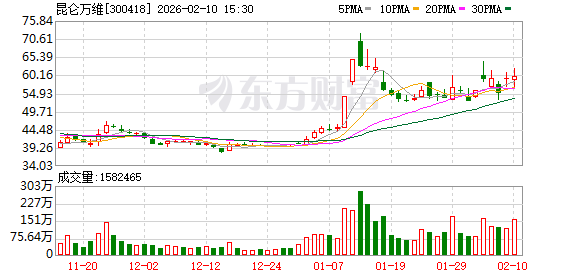
(文章来源:证券日报) 证券日报网讯 2月10日,昆仑万维在互动平台回答投资者提问时表示,2025年,公司持续以"算力-大模 型-应用"全链条布局为根基,在市场推广和研发方面持续加大投入,对当期业绩造成一定影响。具体业 绩数据将在公司2025年度报告中详细披露,可关注后续公告。 ...

字节,又发了新一代图像模型
财联社· 2026-02-10 11:10
Core Viewpoint - The article discusses the launch of ByteDance's new image generation model, Seedream 5.0, which enhances video editing capabilities and offers significant improvements in intelligent understanding and editing precision compared to its predecessor, Seedream 4.5 [2][3]. Group 1: Product Features - Seedream 5.0 is positioned as a more affordable alternative to Nano Banana Pro, allowing users to utilize it for free up to 20 times daily [3]. - The model supports real-time online image searching, enabling quick generation of promotional images for trending events and products, with features like "feature transfer" and "example editing" for precise adjustments [8]. - The resolution capabilities of Seedream 5.0 include support for 2K images, with enhancement options up to 4K, and it boasts faster generation speeds [3]. Group 2: Application Scenarios - The applications of Seedream 5.0 span various sectors, including advertising, e-commerce, film production, digital entertainment, and education [5]. - The model allows users to choose different versions based on their needs, such as using Seedream 5.0 for knowledge reasoning and intelligent editing, while Seedream 4.5 is preferred for high-quality visuals [3]. Group 3: Industry Trends - The article highlights the rapid growth of AI technologies, with OpenClaw becoming one of the fastest-growing open-source projects, indicating a shift towards execution-oriented AI agents [15]. - Major companies like ByteDance, Alibaba, Kuaishou, and Baidu are launching new AI applications, suggesting an acceleration in industry penetration [16]. - The advancements in AI multi-modal applications, particularly in video generation, are expected to lower production costs and technical barriers, enhancing overall efficiency [16].

VIP机会日报传媒影视板块今日爆发 栏目持续追踪梳理 提及多家公司涨停
Xin Lang Cai Jing· 2026-02-10 09:49
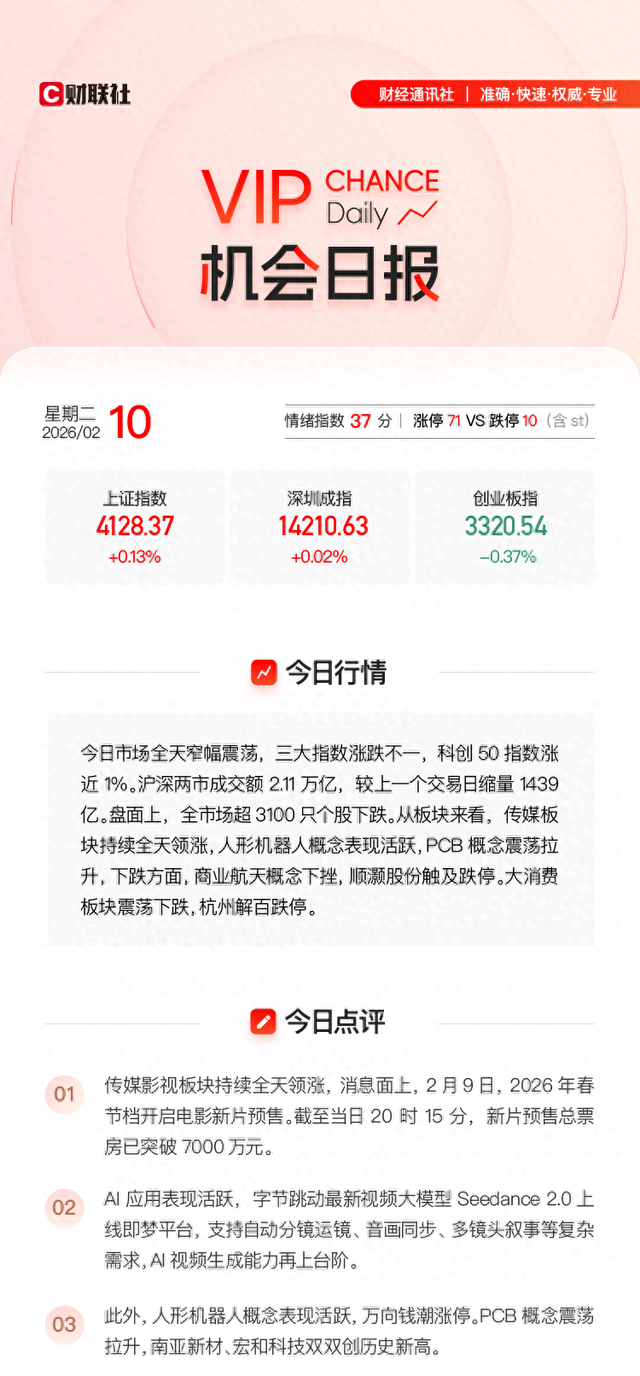
Group 1: Film and Media Industry - The 2026 Spring Festival film season has begun, with new film pre-sales exceeding 70 million yuan as of February 9 [5] - Tencent has launched the "Fire Dragon Comic Drama" platform to explore the AI animation short drama market, highlighting the low cost and short production cycle advantages of AI comic dramas [6][9] - Huayi Brothers and other companies have seen stock price increases due to the growing interest in AI comic dramas [9][12] Group 2: AI Applications - ByteDance's Seedance 2.0 video model is undergoing internal testing, indicating a deep integration of large models with various scenarios by 2026, which may benefit companies like Bona Film Group [11][12] - Companies like Chinese Online are integrating AI technology into content creation and distribution, leading to significant stock price increases [17][18] - The rapid development of AI is driving demand for computing power, benefiting companies involved in AI data center construction, such as Dongyangguang, which saw a stock price increase of 16.75% [24][25] Group 3: Company Performance - Hai Kan Co. has actively engaged in the micro-short drama sector, with its AI comic drama business entering the commercialization stage, resulting in a stock price increase of 38.36% [13][14] - Huace Film & TV has also experienced a stock price increase of 17.8% as it capitalizes on the growing demand for multi-modal models in creative industries [15][16] - Jie Cheng Co. has seen a stock price increase of 20% due to its strong position in the film copyright operation and strategic partnerships with major tech companies [19][20]


港股收评:三大指数收涨,传媒板块集体走强
2 1 Shi Ji Jing Ji Bao Dao· 2026-02-10 09:32
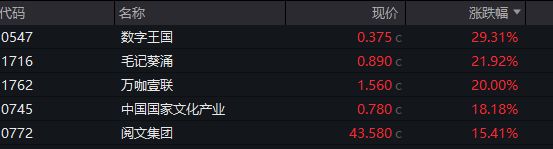
Market Performance - The Hang Seng Index closed up 0.58%, the Hang Seng Tech Index rose 0.62%, and the Hang Seng China Enterprises Index increased by 0.81% [1] - The optical communication sector led the gains, with Longi Fiber Optics rising by 8.8%, Dongfang Electric up over 7%, and Weichai Power increasing by 3.69% [1] Sector Highlights - The cultural media sector saw significant gains, with Digital Kingdom surging over 29%, Reading Group rising over 15%, and DaMai Entertainment and China Ruyi both increasing by over 5% [1] - Biopharmaceutical stocks strengthened, with WuXi AppTec rising over 4%, Rongchang Bio up 3.64%, and Kailai Ying increasing by 3.5% [2] Individual Stock Movements - Notable individual stock movements included Digital Kingdom with a rise of 29.31%, Mao Yi Chuang up 21.92%, and Wan Ka Yi Lian increasing by 20% [2] - The education sector experienced declines, with Dongfang Zhenxuan down over 9% and New Oriental-S falling over 4% [4] New Listings - Le Xin Outdoor debuted with a remarkable increase of 102.29%, closing at 24.78 HKD, and at one point, it surged over 130% during trading [4] AI and Technology Developments - The stock of Zhipu AI, referred to as the "first global large model stock," saw a peak increase of over 24%, with a two-day cumulative rise exceeding 56% [5] - The release of the AI video generation model Seedance 2.0 by ByteDance is expected to significantly reduce production costs and enhance efficiency in the AI drama and short drama sectors, potentially accelerating industry growth [7]