积极财政政策

Search documents
前三季度我国财政运行总体平稳 重点领域支出保障有力
Yang Shi Xin Wen· 2025-10-17 10:01
前三季度地方政府专项债券、超长期特别国债、中央金融机构注资特别国债等资金共支出4.21万亿元 (含以往年度结转债券支出),增强经济发展动能,推动经济持续回升向好。 为进一步发挥积极财政政策效能,保障重点领域重大项目资金需求,财政部将继续提前下达2026年新增 地方政府债务限额,支持重点项目2026年一季度建设资金需求,支持各地按规定化解存量隐性债务和解 决政府拖欠企业账款,巩固拓展经济回升向好势头。结合当前财政经济运行情况,中央财政从地方政府 债务结存限额中安排5000亿元下达地方,有力支持地方完成今年经济社会发展目标任务。 (文章来源:央视新闻) 财政部今天发布的数据显示,前三季度,全国财政收入16.39万亿元,同比增长0.5%,其中,第三季度 同比增长2.5%,增幅明显提高,反映出当前经济运行总体平稳、稳中有升的态势。 前三季度,全国财政支出20.81万亿元,同比增长3.1%。 财政支出靠前发力,重点领域支出保障有力,民生、科技等国家重大战略领域得到较好保障。社会保障 和就业、教育、卫生健康、科学技术、节能环保、文化旅游体育与传媒等6项支出增幅均为近三年同期 最高水平。 ...
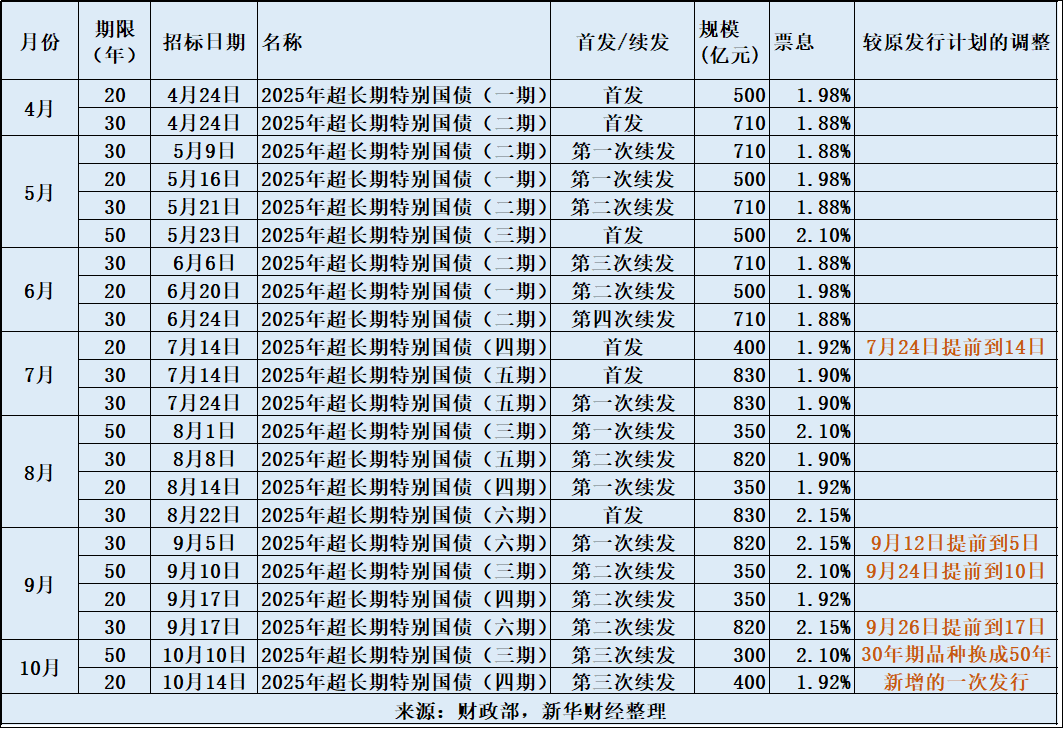
【财经分析】“量增时早、精准发力” 1.3万亿元超长期特别国债发行收官
Xin Hua Cai Jing· 2025-10-16 02:05
Core Viewpoint - The issuance of super long-term special government bonds in 2023 has reached a record scale of 1.3 trillion yuan, marking a significant increase and an earlier issuance schedule compared to previous years, which injects strong momentum into high-quality economic development [1][2]. Group 1: Issuance Characteristics - The total issuance of super long-term special government bonds for 2023 is 1.3 trillion yuan, a 30% increase from 1 trillion yuan in 2022 [1][2]. - The first issuance occurred nearly a month earlier than in 2022, reflecting a proactive fiscal policy approach [1][2]. - The bonds include 20-year, 30-year, and 50-year maturities, with 300 billion yuan, 850 billion yuan, and 150 billion yuan issued respectively [4]. Group 2: Fund Allocation and Impact - Of the total issuance, 800 billion yuan is allocated to support "two heavy" projects, and 500 billion yuan is directed towards "two new" policies [4]. - The funds have already supported approximately 8,400 projects, leading to total investments exceeding 1 trillion yuan [5]. - The consumer sector has seen significant activity, with 3.3 billion people applying for subsidies, resulting in sales exceeding 2 trillion yuan [5]. Group 3: Efficiency and Recommendations - The efficient transmission of funds is crucial for guiding market investments towards key areas and optimizing industrial structure [5]. - Suggestions for improving fund usage efficiency include stricter project selection, faster fund disbursement, and enhanced oversight mechanisms [6]. - Experts emphasize the need for a dynamic monitoring and evaluation system to optimize investment directions based on performance [6].

多省加力推进重大项目建设 基建助力四季度稳增长
Zhong Guo Jing Ying Bao· 2025-10-14 04:43
Group 1 - The core viewpoint of the articles emphasizes the acceleration of major project construction in various provinces as a key strategy to achieve economic growth targets for the year [1][2] - Jiangsu Province held a meeting on October 11 to coordinate major project construction and strengthen planning for next year's projects [1] - Hubei Province convened a meeting on October 9 to promote major project construction for the fourth quarter of 2025, reflecting a strong focus on large-scale projects [1] - Anhui Province launched 587 major projects with a total investment of 332.38 billion yuan on September 30, indicating a robust project initiation trend [1] Group 2 - The issuance of special bonds has accelerated significantly this year, with a total of approximately 366.13 billion yuan issued as of September 28, surpassing the 3.6 trillion yuan mark [1][2] - New policy financial tools are being introduced to support project construction, with a total scale of 500 billion yuan designated for project capital [2] - Economic forecasts for the fourth quarter remain optimistic, with expectations of a GDP growth rate of around 4.5% for the quarter and approximately 5% for the entire year [2]
执政联盟破裂,“高市丸”未起航先搁浅
Qi Lu Wan Bao· 2025-10-12 22:03
Core Points - The election of Sanae Takaichi as the new president of the Liberal Democratic Party (LDP) on October 4 marks a significant political shift, potentially leading her to become Japan's first female Prime Minister, although the recent decision by Komeito to exit the ruling coalition introduces uncertainty into the prime ministerial selection process [2][3] Group 1: Political Dynamics - Takaichi's new leadership team predominantly consists of members from the Aso faction, reflecting a strong patronage influence from Taro Aso, who is seen as a key supporter in her election [3][4] - The appointment of several controversial figures associated with "black money" scandals raises concerns about the integrity of the new administration, as Takaichi has indicated that these individuals will not face repercussions despite public dissatisfaction [5][6] Group 2: Coalition Concerns - Komeito's leadership has expressed three major concerns regarding Takaichi's administration, particularly focusing on the "black money" issue, historical recognition, and strict foreigner policies, which could jeopardize the coalition's stability [6][7] - The potential for diplomatic tensions with neighboring countries due to Takaichi's right-wing stance and past actions, such as visiting the Yasukuni Shrine, poses risks for Japan's foreign relations [7] Group 3: Economic Challenges - Takaichi's economic policies echo those of former Prime Minister Abe, advocating for aggressive fiscal measures, which may lead to further financial strain and investor concerns about Japan's fiscal health [8][9] - The uncertainty surrounding the implementation of the Japan-U.S. trade agreement and Takaichi's willingness to renegotiate terms if they do not align with Japan's interests adds another layer of complexity to her economic agenda [8][9]

积极财政政策靠前发力 今年地方债发行已逾8.5万亿元
Shang Hai Zheng Quan Bao· 2025-10-10 18:20
Group 1 - The issuance of local government bonds has exceeded 8.5 trillion yuan this year, with new special bonds amounting to 36,795 billion yuan and new general bonds at 6,444 billion yuan, significantly surpassing last year's quota of 800 billion yuan for special bonds [1] - The progress of local bond issuance is stable and shows a trend of rapid advancement, particularly with the completion of local debt replacement bonds, which plays a crucial role in supporting economic growth [1][2] - Approximately 28% of the new special bonds issued for project construction are allocated to municipal and industrial park infrastructure, while 18% is directed towards transportation infrastructure [1] Group 2 - The issuance of "special" new special bonds has reached about 1.2 trillion yuan this year, exceeding the previously arranged quota of 800 billion yuan, likely due to an expansion of their intended uses [2] - As of the end of September, 1.98 trillion yuan of refinancing special bonds have been issued for replacing hidden debts, with an expected issuance of about 1.2 trillion yuan in local government bonds in the fourth quarter [2] - Experts suggest clarifying the scale of local hidden debts and increasing local government debt limits to alleviate repayment pressures and optimize debt structures [3] Group 3 - The Ministry of Finance plans to implement a series of measures to address hidden debt, including the early allocation of part of the 2026 new local government debt limit [3][4] - There is a possibility that the early issuance of the 2026 new limit could occur in the fourth quarter, which would help local governments free up more funds for development and construction [4]
“黑天鹅”突袭!刚刚,大跳水!
券商中国· 2025-10-10 14:32
Core Viewpoint - The recent decision by Japan's Komeito party to exit the ruling coalition with the Liberal Democratic Party (LDP) introduces significant uncertainty into Japan's political and legislative agenda, despite the likelihood of Sanae Takaichi becoming the next Prime Minister [1][6]. Political Developments - Komeito has confirmed its withdrawal from the ruling coalition but will continue to cooperate with the LDP on certain issues [3][4]. - The breakdown of negotiations between Komeito and the LDP was primarily due to disagreements over the regulation of political donations from corporations and groups [4]. - Komeito's leader, Tetsuo Saito, indicated that without a joint governance agreement, Komeito would not support Takaichi in the upcoming Prime Minister election [4][6]. Market Reactions - Following the announcement, the USD/JPY exchange rate fell sharply, dropping nearly 0.5%, while the Nikkei 225 futures experienced a significant decline, falling over 1200 points and ultimately closing down 2.42% [1][4]. - The broader Japanese stock market also saw declines, with the TOPIX index dropping by 1.85% and the Nikkei 225 index down by 1.01% [4]. Implications for Governance - The dissolution of the coalition is expected to weaken Takaichi's legitimacy and authority as Prime Minister, despite the LDP remaining the largest party in both houses of the Diet [6][7]. - The LDP and Komeito coalition, which has been a cornerstone of political stability for nearly 25 years, is now considered defunct, marking the end of a long period of stability [6][7]. - The LDP currently holds 196 seats in the House of Representatives and 100 seats in the House of Councillors, while Komeito holds 24 and 21 seats, respectively [7]. Future Legislative Challenges - The loss of Komeito's support will complicate Takaichi's ability to push through budget proposals and legislation in the Diet, leading to potential legislative gridlock [7]. - Analysts suggest that the weakened position of the LDP could result in increased chaos within the Diet, as the party struggles to maintain control over its political agenda [7]. Economic Policy Outlook - Takaichi's economic policies are expected to lean towards maintaining loose monetary policy and advocating for active fiscal measures, which may exert downward pressure on the yen [8]. - The anticipated fiscal expansion under Takaichi's leadership could support economic growth but may also exacerbate Japan's current inflation challenges [8].

被讽“第二次麻生政权”,高市难逃“短命首相”魔咒?
Qi Lu Wan Bao Wang· 2025-10-10 07:34
Core Points - The election of Sanna Takichi as the new president of the Liberal Democratic Party (LDP) marks a significant moment as she is likely to become Japan's first female Prime Minister, but she inherits a challenging political landscape [1] - Takichi's cabinet appointments predominantly feature members from the Aso faction, indicating a strong influence from former Prime Minister Taro Aso, raising questions about her ability to lead independently [2][3] - The inclusion of politicians with past "black money" scandals in her administration has sparked public concern and criticism, undermining her promises of political reform [4][5] Political Dynamics - The new leadership structure heavily reflects the Aso faction's dominance, with key positions filled by Aso's supporters, which has led to public skepticism about Takichi's autonomy [2][3] - The appointment of individuals linked to past scandals, such as Koichi Hagiuda, has raised alarms about the LDP's commitment to addressing corruption issues [4] - Public sentiment is further complicated by the potential for Takichi's hardline stance on historical issues to strain Japan's diplomatic relations with neighboring countries [6] Economic Challenges - Takichi's economic strategy aims to revive the economy through aggressive fiscal policies, including tax cuts and government spending, which may exacerbate Japan's fiscal situation [7] - The depreciation of the yen against the dollar has raised concerns among investors, reflecting fears of financial instability under her leadership [7] - The execution of the Japan-U.S. trade agreement remains uncertain, with Takichi open to renegotiation if it does not serve Japan's interests, indicating potential volatility in trade relations [7][8] Public Sentiment and Future Outlook - There is significant public dissatisfaction with the government's handling of economic issues, including rising prices and demographic challenges, which Takichi must address to maintain support [7][8] - The effectiveness of her administration in responding to these pressing concerns will be crucial for her political longevity and the stability of her government [8]
南财快评|高市早苗会给日本经济带来什么
2 1 Shi Ji Jing Ji Bao Dao· 2025-10-09 09:29
Core Viewpoint - The election of Sanna Takai as the first female president of the Liberal Democratic Party (LDP) in Japan marks a significant political shift, but she faces substantial economic and geopolitical challenges ahead [1][4]. Economic Challenges - Japan is grappling with high inflation, stagnant wages, weak growth, and a government debt ratio to GDP of 240% [3]. - Takai's proposed policies include active fiscal measures, such as reducing gasoline taxes and supporting wage increases for employees in struggling companies [1][3]. - The current economic environment differs from when Abenomics was introduced, as Japan now faces over 2% inflation and declining purchasing power [2][3]. Fiscal and Monetary Policy - Takai advocates for a combination of active fiscal policy and loose monetary policy, similar to Abenomics, but acknowledges the limitations of direct subsidies due to fiscal discipline [2][3]. - She has suggested tax relief for companies that increase wages, particularly for small and medium-sized enterprises, but there are concerns about the effectiveness of such measures [3]. - The concept of "net debt balance" is introduced to assess fiscal health, which stands at 136% as of 2023, but this may not reflect the underlying fiscal challenges [3]. Geopolitical Considerations - Takai's leadership is expected to emphasize Japan's national interests and strengthen cooperation with the U.S. and South Korea in critical supply chains [4]. - Concerns exist regarding her right-wing stance and its potential impact on international relations, although historical precedents suggest that political leaders often moderate their positions once in power [4]. Public Perception and Image - The election of a female president is seen as a move to refresh the LDP's image and attract new supporters, with Takai's appearance symbolizing a change in the party's landscape [5]. - The immediate focus for the public will be on how effectively she addresses Japan's economic challenges [5].
高市早苗会给日本经济带来什么
2 1 Shi Ji Jing Ji Bao Dao· 2025-10-09 09:16
Core Viewpoint - The election of Takashi Sanae as the first female president of the Liberal Democratic Party (LDP) in Japan brings attention to her potential as the first female Prime Minister, but she faces significant economic challenges, including high inflation, stagnant wages, and weak growth [2][4]. Economic Challenges - Japan is currently grappling with high inflation rates exceeding 2%, stagnant wage growth, and a government debt-to-GDP ratio of 240% [3][4]. - The previous economic policies under Abenomics, which aimed to stimulate growth through inflation, may not be applicable in the current economic environment [3][4]. Policy Proposals - Takashi Sanae has proposed active fiscal policies, including reducing gasoline taxes and supporting wage increases for employees in struggling companies through tax incentives [2][4]. - She advocates for a "salary promotion tax system" to encourage companies to raise wages by offering corporate tax reductions [4]. Government Debt and Fiscal Policy - The proposal to issue deficit bonds raises concerns about increasing the national debt, which is already substantial [4]. - The concept of measuring fiscal health through "net debt balance" has been introduced, which may present a more favorable view of Japan's financial situation, but does not address the underlying fiscal challenges [4]. Geopolitical Stance - Takashi Sanae's leadership is expected to emphasize Japan's national interests and strengthen cooperation with the US and South Korea, reflecting traditional geopolitical values [5][6]. - Concerns exist regarding her right-wing stance and its potential implications for international relations, although historical examples suggest that leaders may moderate their positions once in power [5][6]. Public Perception and Image - The election of a female leader is seen as a move to refresh the image of the LDP and attract new supporters, with Takashi Sanae's public persona contributing to this narrative [6].
64岁安倍铁粉上台!日股创新高,日元却暴跌,日本经济要崩盘?
Sou Hu Cai Jing· 2025-10-08 09:42
Core Viewpoint - The Japanese stock market surged following the election of Kishi Mako as the president of the Liberal Democratic Party, driven by expectations of continued fiscal spending and monetary easing under her leadership [1][3][19] Market Reaction - The Nikkei 225 index rose by 4.8% and the Topix index increased by 3.1%, both reaching historical highs [1] - The market's enthusiasm is attributed to the belief that Kishi will maintain expansive fiscal policies, as investors seek returns in the stock market due to limited alternatives [3][19] Currency and Bond Market Impact - The Japanese yen depreciated by 1.5% against the US dollar, nearing the critical psychological level of 150, and hit a historical low against the euro [5] - Predictions from major institutions suggest the yen could further weaken to the 150-160 range [5] - The yield on 30-year Japanese government bonds rose to 3.29%, a record high, while the 40-year bond yield increased by 14 basis points to 3.52% [5] Economic Concerns - The depreciation of the yen poses a dual challenge for Japan, as it increases import costs for a resource-poor nation, leading to higher living expenses for citizens [7][8] - Kishi's economic policies lack clarity, particularly regarding funding for subsidies to combat rising prices [13] Political Landscape - Kishi's election reflects a preference for stability over change, but her political foundation is precarious due to the tarnished reputation of the Abe faction [15][19] - The upcoming challenges include managing inflation while attempting to stimulate the economy, creating a potential policy dilemma [17][19] Market Sustainability - Analysts express skepticism about the sustainability of the stock market rally, suggesting it may be a short-term emotional response rather than a reflection of long-term economic improvement [17] - The core contradiction Kishi faces is the need for fiscal stimulus amidst rising inflation, which could lead to a cycle of economic stagnation [17][19]