劳动力市场

Search documents
美联储理事沃勒:美联储不应等到劳动力市场恶化才采取行动。
news flash· 2025-08-01 12:04
Core Viewpoint - Federal Reserve Governor Waller emphasizes that the Federal Reserve should not wait for a deterioration in the labor market before taking action [1] Summary by Relevant Categories Federal Reserve Actions - Waller advocates for proactive measures by the Federal Reserve to address economic conditions rather than reactive responses to labor market changes [1] Labor Market Insights - The statement suggests that monitoring labor market indicators is crucial for timely interventions by the Federal Reserve [1]
美国就业“塌方式”降温?特朗普移民政策副作用炸裂!
Jin Shi Shu Ju· 2025-08-01 11:13
Group 1 - The Trump administration's immigration policies are increasingly straining an already weakening labor market, with July non-farm payrolls expected to show only 110,000 new jobs, down from 147,000 in June and below the average of 130,000 for the year [2] - The demand for labor is decreasing due to uncertainty from Trump's tariff policies, particularly affecting industries reliant on foreign labor such as agriculture, construction, and food manufacturing [2][3] - The U.S. labor force decreased by 130,000 in June, with a total decline of 364,000 since the beginning of the year, and the labor force participation rate fell to 62.3%, the lowest since December 2022 [2] Group 2 - The number of immigrants detained by ICE has increased from an average of 15,000 per month in 2024 to nearly 40,000 by June this year, while deportations have risen from an annualized rate of 400,000 to about 600,000 [2] - The total number of foreign workers in the U.S. has decreased by over 1 million in the past four months, with a record 5.4 million people exiting the labor market in May alone [3][4] - The share of foreign workers in the U.S. labor force fell to 19.1% in June from 19.8% in March, indicating a significant impact on industries struggling to replace lost labor [5] Group 3 - The labor shortage related to immigration could reduce the potential annual economic growth rate in the U.S. from 2% to 1% [6] - The job market is experiencing a split, with labor shortages in construction, hospitality, and agriculture, while white-collar job recruitment is slowing due to economic uncertainty [6] - The stable unemployment rate, which slightly decreased from 4.2% to 4.1%, may lead the Federal Reserve to refrain from interest rate cuts despite a significant slowdown in job growth [6]
前美联储理事:劳动力市场若没有恶化 美联储9月可能不降息
Sou Hu Cai Jing· 2025-08-01 04:01
前美联储理事Larry Meyer在本周的美联储的议息会议结束后写道,鲍威尔讲话的含义是,如果事情继 续像现在这样发展(其中包括重要的一点,即劳动力市场没有恶化),FOMC很有可能在9月份继续按兵不 动。与此同时,鲍威尔听起来并不排斥降息,只要未来数据和前景的演变表明有充分的理由去降息, FOMC就会采取降息行动。 来源:金融界AI电报 ...
前美联储理事:劳动力市场若没有恶化,美联储9月可能不降息
news flash· 2025-08-01 03:54
金十数据8月1日讯,前美联储理事Larry Meyer在本周的美联储的议息会议结束后写道,鲍威尔讲话的 含义是,如果事情继续像现在这样发展(其中包括重要的一点,即劳动力市场没有恶化),FOMC很有 可能在9月份继续按兵不动。与此同时,鲍威尔听起来并不排斥降息,只要未来数据和前景的演变表明 有充分的理由去降息,FOMC就会采取降息行动。 前美联储理事:劳动力市场若没有恶化,美联储9月可能不降息 ...
7月美联储议息会议点评:9月降息悬而未决
China Post Securities· 2025-08-01 02:50
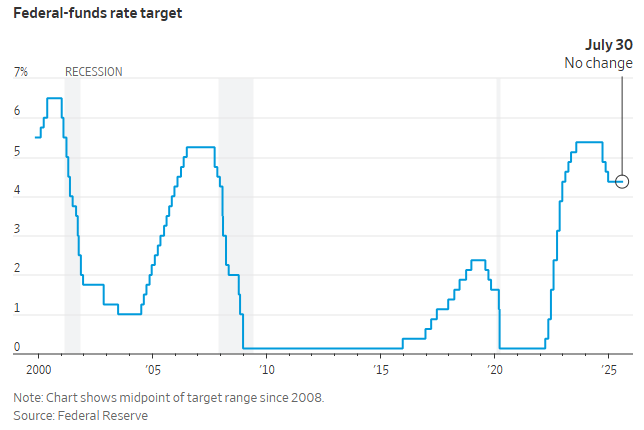
证券研究报告:宏观报告 发布时间:2025-08-01 研究所 分析师:李起 SAC 登记编号:S1340524110001 Email:liqi2@cnpsec.com 研究助理:高晓洁 SAC 登记编号:S1340124020001 Email:gaoxiaojie@cnpsec.com 近期研究报告 《海外宏观周报:美股业绩表现亮眼》 - 2025.07.29 宏观观点 9 月降息悬而未决——7 月美联储议息会议点评 ⚫ 核心观点: 在最新的 FOMC 会议上,美联储决定继续维持联邦基金利率目标 区间在 4.25%-4.50%不变,符合市场预期。鲍威尔主席在发布会上的 表态整体偏鹰,他强调当前风险更偏向于通胀,而失业率维持低位反 映劳动力市场状况依然稳健。有两位理事鲍曼和沃勒对此次决议投下 反对票,二人皆主张应当降息 25 个基点,这是三十多年来首次有两 位理事反对,或显示出联储内部在政治压力下出现分歧。 鲍威尔明确表示,尚未就 9 月是否降息作出任何决定,但在此之 前将收到两轮就业与通胀数据,届时委员会将根据最新数据作出判 断。发布会后市场对 9 月降息的预期有所降温,根据 CME Fed Watch ...
宏观经济点评报告:鹰派卫道士鲍威尔
SINOLINK SECURITIES· 2025-08-01 01:25
Economic Performance - The U.S. GDP growth rate for Q2 was reported at 3.0%, following a contraction of 0.5% in the previous quarter, exceeding the expected 2.6%[7] - However, the overall economic growth rate is projected to decline to 1.2% in the first half of 2025, significantly lower than the second half of 2024[7] - The domestic private final purchases (PDFP) growth has weakened, with Q1 revised down to 1.9% and Q2 at only 1.2%, indicating a decline in internal economic momentum[13] Federal Reserve Policy - Jerome Powell is characterized as a hawkish figure, prioritizing inflation risks over full employment, advocating for tighter monetary policy to suppress inflation[3] - The recent FOMC meeting saw two dissenting votes, marking a notable increase in opposition during Powell's tenure, reflecting the end of a "great moderation" era[5] - The removal of the phrase "uncertainty further reduced" from the Fed's statements suggests ongoing concerns about policy uncertainty, particularly related to Trump's administration[6] Risks and Challenges - Increased uncertainty in the Middle East could significantly raise oil prices, leading to higher inflation in the U.S. and complicating the Fed's rate-cutting decisions[4] - Trump's domestic policies may face greater resistance, potentially leading to increased fiscal stimulus and unexpected easing from the Fed[4] - Heightened volatility in U.S. financial markets could accelerate capital outflows and a decline in the dollar, risking a deeper recession[4]
中国固定收益研究:鲍威尔鹰派表态,避免给出9月降息指引
Bank of China Securities· 2025-07-31 10:50
Report Industry Investment Rating - Not provided in the given content Core Viewpoints - The Fed's July FOMC meeting maintained the federal funds rate as expected, with two dissenters advocating a 25 - basis - point cut. Powell's hawkish stance reduced market expectations for a September rate cut, and after the meeting, yields on 2 - year, 5 - year, and 10 - year US bonds rose. The probabilities of rate cuts in September, October, and December dropped to 43%, 64%, and 87% respectively [3]. - The Fed will continue to be data - dependent, and its policy is in a "moderately restrictive" range. It will only shift to a more neutral stance when the risks to inflation and employment are "fully balanced," implying a greater focus on inflation currently. The Fed will make decisions based on future data and has left room to delay rate cuts [7]. Summary by Related Catalogs Fed Meeting Outcomes - The Fed's July FOMC meeting kept the federal funds rate unchanged at 4 - 1/4 to 4 - 1/2 percent. Governors Bowman and Waller voted against, preferring a 25 - basis - point rate cut, which was in line with their previous statements [3][8]. - After the meeting, yields on 2 - year, 5 - year, and 10 - year US bonds rose by 6, 5, and 2 basis points respectively. The probabilities of rate cuts in September, October, and December according to CME FedWatch dropped to 43%, 64%, and 87% respectively [3]. Powell's Press Conference Key Information Tariff Impact on Inflation - Powell emphasized that the transmission of tariffs to inflation is in the early stage, with monthly tariff revenue reaching $30 billion, and only a small part borne by exporters. Upstream companies and retailers plan to pass on costs to consumers [5]. - He believed that there is still a long way to assess the full impact of tariffs, suggesting that there may not be a clear judgment even in September [5]. - He stated that the Fed "looking through" temporary inflation only means not raising rates, not a reason for rate cuts, and the Fed will ensure the "one - time" nature of the impact [5]. Labor Market - The labor market is robust but has downward risks. Although new job growth has slowed significantly, the unemployment rate is low, and indicators such as the quit rate and the ratio of job openings to the unemployed are relatively stable. However, the low unemployment rate is due to both a slowdown in labor demand and a reduction in labor supply caused by immigration policies [5]. Economic Growth - Powell downplayed the recognition of "moderate" economic growth slowdown in the meeting statement, saying that the weakening of GDP and final private consumption was in line with expectations. He reiterated that policy focuses on the dual goals of "inflation and employment," suggesting that as long as the job market is stable, the growth slowdown is not enough to trigger a policy shift [6]. Uncertainty - Powell thought the level of uncertainty was the same as in June. Although the current estimate of tariff levels has converged, future uncertainty is still high, and the meeting statement removed the expression of "reduced uncertainty" [6]. Inflation - Powell expected that excluding tariffs, current inflation remains above the 2% target. The composition of inflation pressure has changed, with sticky service inflation easing and tariff increases pushing up prices of some goods [6]. Fed Independence - Powell firmly stated that the Fed will not consider government fiscal needs to maintain its independence, warning that if the Fed loses independence, the government could manipulate rate cuts to influence elections [7]. Future Policy Outlook - The Fed will continue to be data - dependent, and its current policy is in a "moderately restrictive" range. It will only shift to a more neutral stance when the risks to inflation and employment are "fully balanced," implying a greater focus on inflation currently [7]. - There will be two rounds of employment and inflation data before September, and the Fed will make decisions based on future data, leaving room to delay rate cuts [7]. Suggestions - Powell's statements seem to be somewhat inconsistent with the economic assessment in the FOMC statement. It is recommended to follow the statements of other voting members to determine if this reflects the overall tendency of the committee [7]. - Powell's avoidance of giving a September rate - cut guidance may trigger stronger pressure from the Trump administration [7].
机构:美联储9月份降息的门槛已经提高
news flash· 2025-07-31 07:51
金十数据7月31日讯,Van Lanschot Kempen投资策略师Joost Van Leenders在一份报告中表示,美联储周 三决定维持利率不变后,9月份降息的门槛已经提高,尽管有两名反对者投票赞成降息25个基点。这位 资深投资策略师说,美联储将获得两轮通胀和就业数据,但这些数据的变化不大可能大到需要降息的程 度。他说,要降息,通胀应该向美联储2%的目标缓和,但鉴于我们预计的进口关税传导效应,这种情 况实现的可能性极低。另一种情况是,劳动力市场需要大幅走弱。 机构:美联储9月份降息的门槛已经提高 ...
时间是个“照妖镜”,鲍威尔押注:美国经济将在2个月内显露真面目
Feng Huang Wang· 2025-07-31 04:02
Group 1 - The Federal Reserve, under Chairman Powell, is facing uncertainty regarding the economic outlook, with two distinct scenarios being considered: one indicating potential economic weakness hidden beneath stable data, and the other suggesting resilience driven by AI investments and household wealth growth [1][4][6] - The current low unemployment rate of 4.1% may create a false sense of security about the job market, as there are signs of a weakening labor market, including a high number of workers not seeing wage growth and a decline in consumer spending on non-essential items [2][3][4] - Consumer spending is shifting, with reductions in travel and dining expenses, while essential costs like housing continue to rise, indicating a potential strain on the economy [3][4] Group 2 - There is a contrasting view that the warning signals regarding the economy may be overstated, with key factors such as AI investment and wealth accumulation potentially offsetting negative trends [4][5] - Economic challenges have persisted, including rapid interest rate hikes and regional banking crises, but some analysts believe that unless unforeseen shocks occur, a comprehensive recession is unlikely [5][6] - The Federal Reserve is maintaining a cautious approach, keeping options open for future rate decisions while monitoring the impact of tariffs and other economic factors [6][8]