
战略性新兴产业

Search documents
国内第二家股份制银行AIC获批,全国总部将落户广州天河
Nan Fang Du Shi Bao· 2025-11-23 13:26
Group 1 - CITIC Bank's wholly-owned subsidiary, CITIC AIC, has received approval from the National Financial Supervision Administration to commence operations, becoming the second joint-stock bank AIC approved in China after Industrial Bank's AIC [2] - CITIC AIC is headquartered in Guangzhou, Guangdong Province, with a registered capital of RMB 10 billion [2] - The establishment of CITIC AIC is part of a broader initiative to support qualified commercial banks in setting up financial asset investment companies, enhancing the investment capabilities in strategic emerging industries [2][3] Group 2 - CITIC AIC will focus on market-oriented debt-to-equity swaps and equity investment in strategic emerging industries and "specialized, refined, distinctive, and innovative" sectors, aiming to support tech enterprises and the private economy [3] - The financial sector is a key pillar of the Tianhe District's economy, with a projected value added of RMB 156.08 billion in 2024, accounting for approximately 51.2% of the city's total [3] - The approval of CITIC AIC marks a significant breakthrough for Tianhe District in attracting licensed financial institutions and reflects CITIC's recognition of the innovation and industrial foundation in the Guangdong-Hong Kong-Macao Greater Bay Area [3]



刚宣布,又一家AIC来了
Zhong Guo Ji Jin Bao· 2025-11-23 12:40
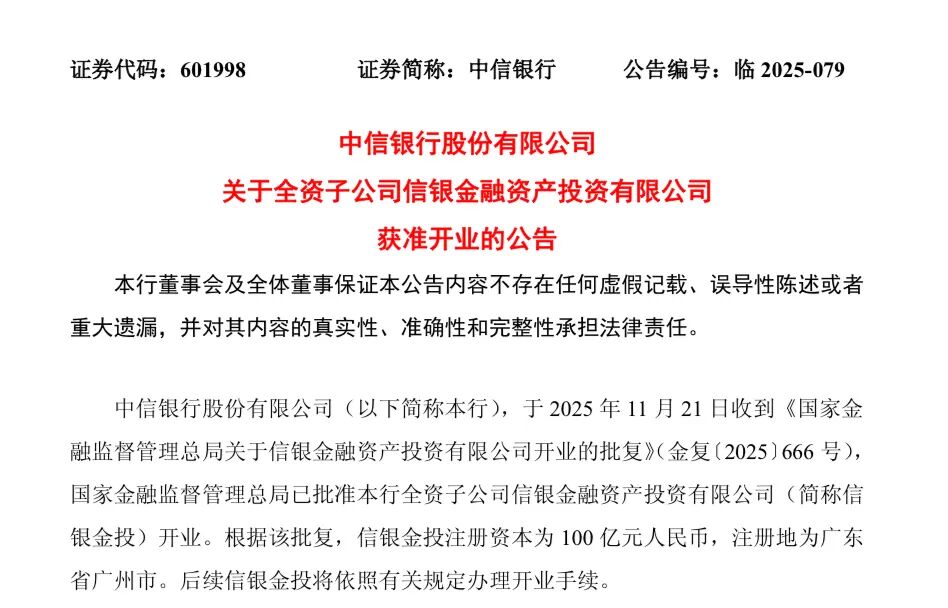
Core Points - CITIC Bank's wholly-owned subsidiary, Xinyin Financial Investment Co., has been approved to commence operations with a registered capital of 10 billion RMB [1][4] - The establishment of Xinyin Financial Investment is part of CITIC Bank's strategy to support the development of "technology finance" and strategic emerging industries [3][5] - The approval process for Xinyin Financial Investment took only six months, indicating a smooth establishment process [3] Company Overview - Xinyin Financial Investment will focus on market-oriented debt-to-equity swaps and equity investment in strategic emerging industries and "specialized, refined, unique, and innovative" sectors [5][6] - The company aims to support technology enterprises and the private economy, helping to reduce leverage and promote sustainable development [3][5] - CITIC Bank has a strong advantage in corporate finance, with a well-established credit and risk management capability, which is expected to enhance its contributions to high-quality economic development [6] Industry Context - The approval of Xinyin Financial Investment aligns with the recent expansion of financial asset investment companies (AIC) in China, which aims to bolster support for technology innovation and private enterprises [7][10] - Other banks, including Industrial Bank, China Merchants Bank, and Postal Savings Bank, have also received approvals to establish AICs, indicating a growing trend in the industry [7][8][9] - The establishment of AICs is expected to open new growth opportunities through equity investment, while also presenting challenges in liquidity management and risk control [10]
刚宣布,又一家AIC来了
中国基金报· 2025-11-23 12:35
Core Viewpoint - Citic Bank's wholly-owned subsidiary, Xinyin Financial Asset Investment Co., Ltd. (Xinyin Jintou), has been approved to commence operations with a registered capital of 10 billion RMB, marking a significant step in the bank's strategy to support "technology finance" and strategic emerging industries [1][4][7]. Group 1: Establishment and Approval Process - The establishment process for Xinyin Jintou was efficient, taking only six months from application to approval [4]. - Citic Bank announced the investment in May, emphasizing its commitment to supporting national initiatives in technology finance [4][5]. - The approval from the National Financial Regulatory Administration was granted in June, allowing Citic Bank to proceed with the establishment of Xinyin Jintou [6]. Group 2: Business Focus and Strategic Goals - Xinyin Jintou will focus on market-oriented debt-to-equity swaps and equity investment in strategic emerging industries and "specialized, refined, unique, and innovative" sectors [9]. - The company aims to support technology enterprises and the private economy, helping to reduce leverage and promote sustainable development [6][9]. - Xinyin Jintou will leverage Citic Bank's financial capabilities to provide comprehensive financial services, including equity and debt financing, to strategic and technology enterprises [9]. Group 3: Industry Context and Expansion of AIC Licenses - The approval of Xinyin Jintou is part of a broader trend where the National Financial Regulatory Administration has accelerated the expansion of Financial Asset Investment Company (AIC) licenses, allowing more banks to establish AICs [11]. - Other banks, including Industrial Bank, Citic Bank, and China Merchants Bank, have also received approvals for AICs, indicating a growing interest in equity investment to support technology innovation and private enterprises [11][12]. - The establishment of Xinyin Jintou is expected to enhance Citic Bank's corporate finance capabilities and contribute to the high-quality development of the real economy [9][13].
新央企,开始组建!
中国能源报· 2025-11-23 07:13
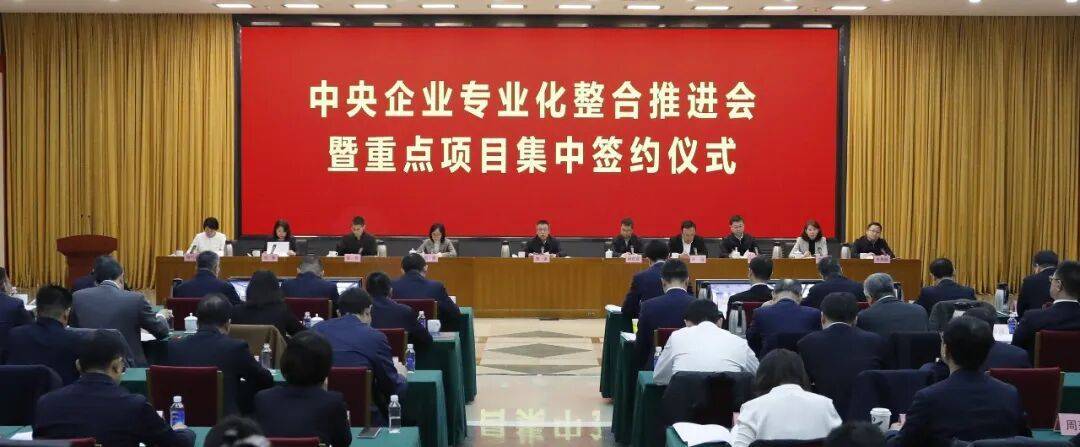
Core Viewpoint - The State-owned Assets Supervision and Administration Commission (SASAC) of the State Council has organized a signing ceremony for eight specialized integration projects, aiming to promote professional integration among central enterprises, private enterprises, and local governments across various key sectors [1][3]. Group 1: Project Overview - The signed projects involve 17 entities, including central enterprises, private enterprises, and local governments, covering key areas such as new materials, artificial intelligence, cruise industry, and inspection and testing [3]. - The focus of these specialized integration projects is on accelerating breakthroughs in core technologies, strengthening strategic emerging industries, optimizing traditional industries, and promoting high-quality development of key industrial chains [5]. Group 2: Economic Impact - The cruise industry has a significant driving effect, with a ratio of economic benefit generated from the industry ranging from 10 to 14 times for every 1 yuan of revenue produced [7]. - The China Tourism Group is leading the establishment of a central enterprise cruise operation platform, which will result in the largest fleet in Asia following the integration [8]. Group 3: Strategic Direction - SASAC emphasizes the importance of focusing on core business operations, enhancing resource allocation efficiency, and promoting professional integration while avoiding disorderly expansion and low-level repeated construction [10]. - The integration efforts are aimed at consolidating similar businesses, improving overall efficiency, and ensuring alignment with future industry and technology development trends [10].

农银投资、浦东创投共同发起设立企航私募投资基金,出资额33.34亿元
Sou Hu Cai Jing· 2025-11-23 03:42
Group 1 - The establishment of the Shanghai Puchuang Qihang Private Investment Fund, with a total investment of 3.334 billion RMB, reflects the collaboration between financial capital and local industrial capital to promote technological innovation and the development of advanced manufacturing and strategic emerging industries [2][3] - The fund's operational scope includes private equity investment, investment management, and asset management, with key partners being Agricultural Bank of China Capital Management Co., Ltd. and Shanghai Pudong Private Fund Management Co., Ltd. [2] - The partnership between Agricultural Bank of China Investment and Pudong Innovation Investment Group aims to create a "finance + industry" dual-drive model, enhancing the support for quality enterprises and key project investments [2][3] Group 2 - The Qihang Fund is expected to focus on advanced manufacturing, green energy, digital economy, and technological innovation, providing capital and resource support for upstream and downstream enterprises in related industries [3] - Private equity funds are becoming important financial tools for driving industrial upgrades and the transformation of technological achievements, effectively combining policy funds with social capital [3] - The establishment of the fund is anticipated to enhance Shanghai's financial support for technological innovation and industrial upgrading, contributing to the development of a new capital platform that serves national strategies and regional economic growth [3]

首批科创创业人工智能ETF 等16只硬科技基金获批 即将启动募集
Sou Hu Cai Jing· 2025-11-23 03:10
Core Viewpoint - The approval of 16 new hard technology investment products signals increased funding and support for the hard technology sector, indicating a positive regulatory stance towards strategic emerging industries [1] Group 1: Product Approval - 16 hard technology products have been rapidly approved, including ETFs focused on artificial intelligence and semiconductor sectors [1] - The approved products consist of 7 AI ETFs, 3 semiconductor ETFs, 4 semiconductor design theme ETFs, and 2 actively managed technology equity funds [1] - The approval process was notably swift, with some products receiving approval on the same day they were submitted for review [1] Group 2: Market Impact - The new products are expected to attract significant new capital focused on technology investments, enhancing the overall market for hard technology [1] - Industry insiders view the rapid approval as a strong signal of regulatory support for strategic emerging industries [1]

共同描绘中国式现代化万千气象下的老区图景
Ren Min Ri Bao· 2025-11-22 22:19
Core Viewpoint - The news highlights the efforts of Bazhong City in Sichuan Province to implement systematic reforms in mainstream media, emphasizing the importance of media integration in the digital age and the city's commitment to strengthening its ideological front and promoting its unique cultural and industrial characteristics [1][2]. Group 1: Media and Cultural Development - Bazhong City is actively implementing important reforms in mainstream media to adapt to the trends of the digital age, aiming to consolidate its ideological position and enhance the overall narrative [1]. - The city has a rich historical background, being a significant site for the Red Army during the revolutionary period, which continues to influence its cultural identity [1]. Group 2: Educational and Scientific Advancements - Bazhong has a strong emphasis on education and has produced numerous talents, including notable figures like Wu Weiren, the chief designer of the lunar exploration program [2]. - The city has established a national-level science popularization and innovation application industrial base, featuring advanced facilities such as the largest 16K immersive ultra-high-definition dome cinema in the country [2]. Group 3: Energy Resources and Industrial Strategy - Bazhong is rich in energy resources, with oil and gas mineral rights covering 82.5% of the city's area, and shale gas reserves amounting to 1.4 trillion cubic meters, alongside approximately 2.5 billion tons of shale oil resources [2]. - The city is focusing on developing characteristic advantageous industries and strategic emerging industries, implementing a development strategy centered on "ecological industrialization" and "advanced manufacturing" to build a modern industrial system unique to Bazhong [2].
去年保险业提供科技保险保障约9万亿元 支持科技自立自强存量资金增长107%
Ren Min Ri Bao· 2025-11-22 21:53
报告显示,保险业扩大健康保险覆盖面,将更多医疗新技术、新药品、新器械的应用纳入保障范围。去 年,长期健康险新增保单4489.35万件,新增保险金额150.30万亿元,赔付支出1187.77亿元、同比增长 3.07%,年末有效保险金额330.55万亿元。 (文章来源:人民日报) 中国保险行业协会近日发布的《中国保险业社会责任报告(2024)》显示,保险业聚焦国家重大战略和 重点领域,为科技创新和现代化产业体系等领域提供一揽子风险管理和保险服务。2024年,科技活动主 体签单42.44亿件,赔款支出177.28亿元;保险业提供科技保险保障约9万亿元。险资运用方面,保险业 为战略性新兴产业投资6800亿元,同比增长17%;支持科技自立自强存量资金8800亿元,同比增长 107%。 ...
官宣,新央企组建!中国旅游集团牵头
Sou Hu Cai Jing· 2025-11-22 09:21
Group 1 - The State-owned Assets Supervision and Administration Commission (SASAC) organized a meeting to promote the professional integration of central enterprises, resulting in the signing of key projects in various sectors including new materials, artificial intelligence, cruise operations, inspection and testing, and air logistics [1][3] - Central enterprises are focusing on professional integration to align with national strategies, drive technological innovation, and promote high-quality development, optimizing resource allocation and enhancing core competitiveness [3][7] - The China Tourism Group is leading the establishment of a central enterprise cruise operation platform, which will have the largest fleet in Asia following this integration [3] Group 2 - The cruise industry has a significant economic impact, with a multiplier effect of 1:10 to 1:14, meaning that for every 1 yuan of revenue generated by the cruise industry, it can drive 10 to 14 yuan in related industries [5] - SASAC emphasizes that professional integration must align with future industry and technology trends, focusing on high-end development and eliminating low-level redundant construction to improve overall efficiency [7] - The China Tourism Group, a key state-owned enterprise, has total assets exceeding 200 billion yuan by the end of 2024, making it a leading player in the tourism sector with a comprehensive industry chain and high brand value [7]
新央企组建!
Zheng Quan Shi Bao· 2025-11-22 08:38
Group 1 - The State-owned Assets Supervision and Administration Commission (SASAC) organized a meeting to promote the professional integration of central enterprises, resulting in the signing of 8 groups of projects involving 17 units in key areas such as new materials, artificial intelligence, cruise operations, inspection and testing, and aviation logistics [1][2] - The signed projects aim to accelerate breakthroughs in core technologies, strengthen strategic emerging industries, and optimize traditional industries for high-quality development [1][2] - China Tourism Group is leading the establishment of a central enterprise cruise operation platform, which will have the largest fleet in Asia post-integration, with a significant economic impact ratio of 1:10 to 1:14 for the cruise industry [1] Group 2 - SASAC emphasized that professional integration must align with future industry and technology trends, focusing on long-term goals and avoiding short-term scale pursuits [2] - The integration strategy includes deepening core business operations, enhancing resource allocation efficiency, and focusing on emerging sectors to strengthen the scale and capabilities of strategic emerging industries [2] Group 3 - China Tourism Group is a key state-owned enterprise directly managed by the central government, with a history dating back to 1923, and operates a diverse range of businesses including travel agencies, scenic spots, hotels, and cruise operations [3] - The group has a workforce of over 42,000 and total assets exceeding 200 billion, serving over 80 million tourists annually [3]