
减污降碳

Search documents
环保产业协会郭承站:共享减污降碳技术成果,推动全球节能减排
2 1 Shi Ji Jing Ji Bao Dao· 2025-09-11 03:26
Core Viewpoint - The future cooperation path for the environmental protection industry is emphasized as "going out and bringing in," focusing on technology, equipment materials, and talent [1] Group 1: International Cooperation - The Chinese environmental protection industry has developed the capability to "go out" with advanced technologies and materials, particularly in the context of the "dual carbon" strategy [1] - The industry aims to strengthen international cooperation to share advanced technologies and materials for pollution reduction and carbon neutrality globally [1] Group 2: Technological Advancements - China leads in nuclear power technology globally and has advanced photovoltaic and wind power technologies that are both cost-effective and energy-saving [1] - The country possesses a strong reserve of technology and talent, providing a competitive advantage for international collaboration [1] Group 3: Global Consensus - The reduction of pollution and carbon emissions, as well as addressing climate change, is recognized as a global consensus rather than the responsibility of a single country or region [1] - There is a call for coordinated sharing of global technologies to accelerate innovation in energy-saving and emission reduction [1]
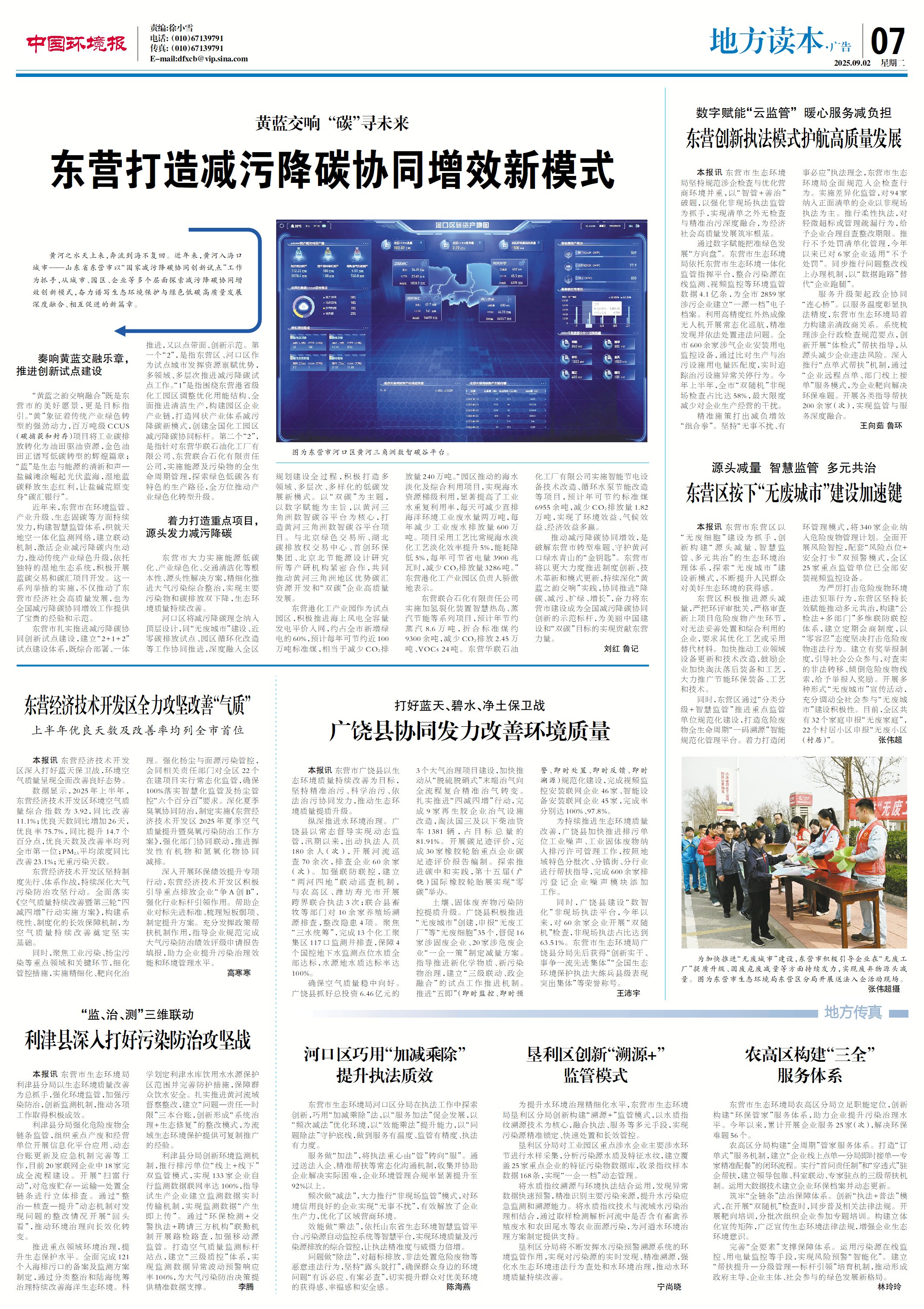
东营打造减污降碳协同增效新模式
Zhong Guo Huan Jing Bao· 2025-09-02 00:56
Core Viewpoint - Dongying City is leveraging the "National Pollution Reduction and Carbon Reduction Collaborative Innovation Pilot" to explore synergistic innovation models for pollution reduction and carbon reduction across various levels, aiming for high-quality development that integrates ecological protection and low-carbon growth [2][12]. Group 1: Innovation Pilot Construction - The "Yellow-Blue Harmony" symbolizes Dongying's vision for traditional industry transformation, with a focus on a million-ton CCUS (Carbon Capture, Utilization, and Storage) project that converts industrial carbon emissions into oilfield resources [3][13]. - Dongying has established a "2+1+2" pilot construction system, which includes two pilot cities (Dongying District and River Mouth District), one provincial chemical park, and two major petrochemical companies, promoting multi-level pollution reduction and carbon reduction efforts [14][15]. Group 2: Key Projects and Initiatives - Dongying is implementing fundamental solutions for energy decarbonization, industrial greening, and clean transportation, aiming for a dual reduction in major pollutants and carbon emissions [15]. - The Dongying Port Chemical Industry Park is a pilot area that is advancing offshore wind power projects, expected to save nearly 1 million tons of standard coal annually, equivalent to a reduction of 2.4 million tons of CO2 emissions [16]. - Dongying Huayuan Petrochemical and Dongying United Petrochemical are implementing energy and pollutant lifecycle management, with projects expected to save significant amounts of steam and reduce CO2 emissions [16][17]. Group 3: Collaborative Development - Dongying is collaborating with various research institutions to develop carbon sink resources and promote high-quality development of "dual carbon" enterprises [15][16]. - The city aims to deepen the "Yellow-Blue Harmony" practice, promoting a synergistic approach to carbon reduction, pollution reduction, and green growth, positioning itself as a national model for collaborative innovation in pollution and carbon reduction [17].

服贸会发布第二批129场活动信息
Bei Jing Wan Bao· 2025-08-22 08:04
Group 1 - The 2025 China International Service Trade Fair will be held from September 10 to 14 at Shougang Park, featuring 129 forums and promotional activities [1] - Key forums include topics on service trade development, digital trade trends, world tourism cooperation, and e-commerce [1] - 58 promotional activities will facilitate international service trade cooperation, including events like "Beijing Day" and cross-border service promotion [1] Group 2 - Anhui Province will set up a 252 square meter comprehensive exhibition hall to showcase its service trade development and competitive advantages [2] - The province will also host a promotional event to highlight its business environment and service industry expansion initiatives [2]

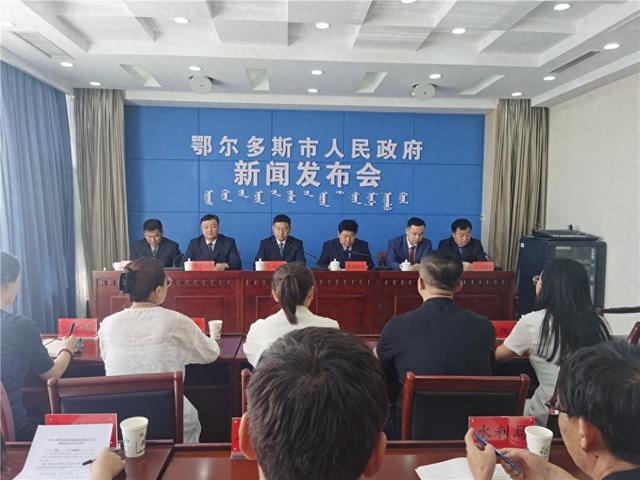
鄂尔多斯市减污降碳协同创新试点工作取得阶段性成果
Nei Meng Gu Ri Bao· 2025-08-19 14:40
Core Viewpoint - Ordos City has successfully implemented a pilot project for coordinated pollution reduction and carbon reduction, showcasing significant achievements in environmental governance and economic growth [3][9]. Group 1: Pilot Project Achievements - Ordos City, along with the Ordos High-tech Industrial Development Zone and the Sulige Economic Development Zone, was selected as one of the first national pilot projects for coordinated pollution and carbon reduction, being the only city in Inner Mongolia to achieve this [3]. - A total investment of 1000.99 billion yuan has been completed across 84 key pilot projects, with air quality remaining above 90% since the start of the 14th Five-Year Plan [3]. - The city's GDP reached 636.3 billion yuan, marking the third instance of crossing the trillion-yuan threshold during the 14th Five-Year Plan, with a 25.8% reduction in energy consumption per unit of GDP and a 13.6% decrease in carbon emission intensity [3]. Group 2: Innovative Approaches - The "photovoltaic desertification control" model has been introduced, integrating renewable energy development with ecological restoration, resulting in nearly 10 million kilowatts of photovoltaic projects and the reclamation of over 300,000 acres of desertified land [4]. - The city is advancing hydrogen energy applications in modern coal chemical processes, with 13 approved wind and solar hydrogen projects totaling 939.2 million kilowatts, aiming to reduce coal consumption by approximately 253 million tons annually [5]. Group 3: Green Logistics and Environmental Governance - A multi-modal transport system is being developed to promote green logistics, with significant investments in rail infrastructure and the use of hydrogen-powered heavy trucks, resulting in a reduction of carbon emissions by approximately 78,000 tons [6]. - The city has implemented comprehensive air quality improvement plans, including the closure of small coal-fired boilers and the establishment of a solid waste utilization database, leading to a decrease in industrial solid waste generation intensity from 5.88 tons per 10,000 yuan in 2020 to 4.05 tons in 2023 [7]. Group 4: Technological Innovation and Community Engagement - Ordos City is fostering innovation through the establishment of research institutions and the implementation of technology-driven projects, contributing to advancements in green technologies [8]. - The city has launched a carbon benefit mechanism to encourage community participation in carbon reduction efforts, including the development of a personal carbon account system [8]. Group 5: Future Directions - Ordos City aims to build a "beautiful Ordos" by focusing on industrial transformation, energy structure adjustment, and environmental governance, striving to create a comprehensive system for coordinated pollution and carbon reduction innovation [9].

闻不见气味 看得见降碳 ——台州湾经开区医化园区解锁产业“绿”码
Zhong Guo Hua Gong Bao· 2025-08-18 13:33
Group 1: Core Insights - The Taizhou Bay Economic and Technological Development Zone's pharmaceutical park is a national pilot for pollution reduction and carbon emission control, implementing 20 green low-carbon technology transformation projects and achieving a carbon reduction of approximately 12,500 tons [1] - The park has established a complete industrial chain from intermediates to active pharmaceutical ingredients (APIs) and formulations, aiming to become a globally influential pharmaceutical innovation hub [2] - The transition from "pharmaceutical chemistry" to "pharmaceutical health" is a key path for industrial upgrading, with a focus on traditional pharmaceutical industries transforming into new materials and high-end formulations [2] Group 2: Technological Innovations - Huahai Pharmaceutical's Sichuan branch has achieved a 40% reduction in carbon emissions per unit output from 0.91 tons per 10,000 yuan in 2020 to 0.54 tons per 10,000 yuan in 2024, alongside significant waste reduction and economic benefits [3] - The company has implemented advanced solvent recovery technologies to improve energy efficiency and reduce steam and electricity consumption by 30% and 17% respectively [3] - A unique evaluation index for pollution reduction and carbon emission control in the pharmaceutical industry has been established, reflecting the levels of "pollution reduction," "carbon reduction," and "efficiency increase" [3] Group 3: Digital Empowerment - The Taizhou Bay Economic and Technological Development Zone has invested 100 million yuan in a "smart park" regulatory platform, integrating AI and big data for environmental management [4] - The park has developed a comprehensive ecological monitoring network that covers environmental quality, pollution sources, and ecological conditions [5] - The park has been recognized as a national pilot for innovative collaborative pollution reduction and carbon emission control, and has achieved the status of a "zero direct discharge" industrial park in Zhejiang Province [5]
国七标准渐进,尾气后处理环节或将迎来新一轮迭代周期
Hua Yuan Zheng Quan· 2025-08-14 02:28
Investment Rating - The investment rating for the automotive industry is "Positive" (maintained) [1] Core Insights - The automotive industry faces significant challenges regarding vehicle emissions, with motor vehicle exhaust being a major contributor to air pollution. Currently, motor vehicle NOx emissions account for over 34% of the national total, with heavy-duty trucks contributing 80% of this figure. In major cities like Beijing, Shenzhen, and Chengdu, vehicle emissions contribute over 40% to PM2.5 pollution [4][8] - The transition to the National VII emission standards is expected to create a market space exceeding 200 billion yuan from 2027 to 2030, driven by the need for new components and system upgrades to meet stricter emission requirements [4][3] Summary by Sections 1. Mobile Source Air Pollution - Motor vehicle exhaust is a leading source of air pollution, with heavy-duty trucks being the primary contributors to NOx emissions [4][8] - In 2023, the total emissions from mobile sources reached 1,924.6 million tons, with motor vehicles accounting for over 70% of this total [12][19] 2. Historical Standards Review and Outlook - The National VI emission standards are significantly stricter than previous standards, reflecting a trend towards tighter regulations and alignment with international standards [47][48] - The National VII standards are being developed with a focus on reducing emissions and improving vehicle durability, with a phased implementation strategy [48][51] 3. National VII Gradual Implementation - The National VII standards are expected to introduce new components focused on cold start emissions reduction, NOx reduction, and monitoring system upgrades, creating substantial market opportunities [4][3] - The projected incremental market space for automotive after-treatment systems from 2027 to 2030 is estimated at 2,442.2 million yuan, 4,813.0 million yuan, 6,357.0 million yuan, and 7,331.0 million yuan respectively [4][3] 4. Related Companies - Companies with strong technical capabilities and broad product layouts in the after-treatment sector are recommended for investment, including Yunyi Electric, Aikelan, Zhongzi Technology, and Weifu High-Tech [4][3]


北京前7个月优良天数168天,同比增加18天
Bei Jing Ri Bao Ke Hu Duan· 2025-08-13 07:07
深入开展夏季挥发性有机物(VOCs)专项治理,原辅材料低VOCs产品替代、治理设施提升、关键环节 治理、重点行业整治等16项重点措施扎实推进。发布鼓励夜间错峰加油、装卸油倡议,减少白天高温时 段VOCs挥发。推动公路和城市道路建设、养护项目推广应用温拌沥青,昌平、房山、怀柔等区多措并 举扩大温拌沥青使用面积,减少VOCs排放。 推进非道路移动机械清洁化,截至7月底,全市非道路移动机械新能源化率升至39.5%。持续宣传解读 《关于划定禁止使用高排放非道路移动机械区域的通告》,推动老旧机械淘汰;在西城区和大兴区工地 开展电动挖掘机试点应用。发布《沥青混合料搅拌站绿色生产技术要求和评价方法》,明确2025年10月 1日起作业用机械应符合国三及以上排放标准,推荐使用新能源机械。 综合运用清洁生产审核、"一厂一策"治理、绿色绩效评级等措施,深化重点行业企业创绿提质,1-7月 全市新增绿色企业669家,绿色企业比率升至28.5%,其中经开区、通州区创建10家绿色绩效"深绿"企 业,树立减污降碳绿色标杆。全市528家锅炉使用单位完成环保绩效评级,提前完成年度任务,进一步 推动氮氧化物减排,其中东城、海淀、丰台、石景山、通州 ...
在台州看见新时代美丽山海
Zhong Guo Huan Jing Bao· 2025-08-13 01:43
Core Viewpoint - Taizhou City is advancing ecological civilization construction through continuous environmental improvement and high-quality green development, exemplified by its successful initiatives in air and water quality management, biodiversity conservation, and sustainable tourism [1][3][4][10]. Environmental Improvement - Taizhou's urban air quality index for 2024 is reported at 2.84, ranking third in the province, with an AQI good rate of 94.0% and an average PM2.5 concentration of 24.1 micrograms per cubic meter [3]. - The city has achieved a water quality excellent rate of 93.8% for national and provincial control sections, exceeding the annual target by 3.2 percentage points, marking a historical best [4]. Biodiversity and Conservation - Since 2019, Taizhou has recorded 53 species of nationally protected wild plants and 108 species of nationally protected wild animals, including 19 first-class protected species [6]. - The discovery of the globally vulnerable species, the Brown-necked Duck, in Yuhuan Xuanmen Bay National Wetland Park, indicates significant ecological improvements [3]. Innovative Environmental Management - Taizhou has implemented a "Marine Cloud Warehouse" model for pollution management, integrating smart technology and blockchain for real-time monitoring of waste collection and disposal [10]. - The city has also introduced a digital carbon accounting system and established a carbon credit revenue distribution plan to support ecological protection [10][11]. Sustainable Tourism Development - The transformation of villages like Tahu Village and Linkeng Village into eco-tourism destinations showcases the economic benefits of environmental initiatives, with significant recognition for their sustainable practices [16][17]. - Taizhou's efforts in promoting rural tourism have led to the establishment of 25 model villages and 21 provincial urban-rural style sample areas, contributing to the overall goal of common prosperity [17].

点绿成“金”
Jin Rong Shi Bao· 2025-08-08 07:55
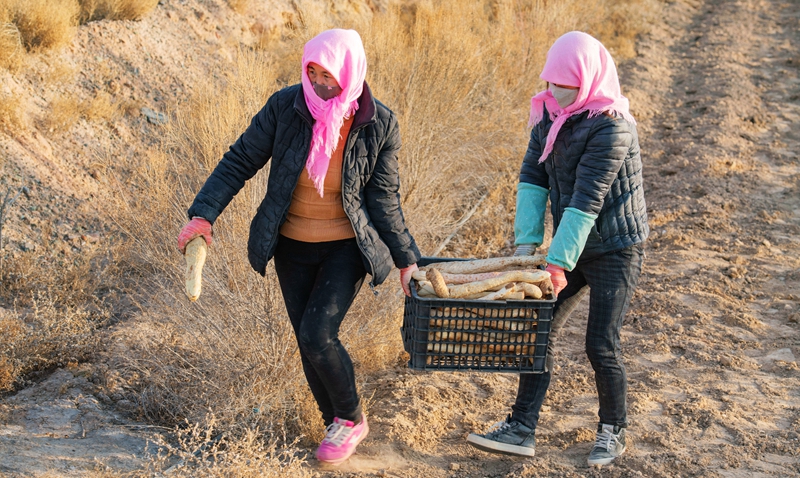
每年四五月份,寄生于梭梭根部的肉苁蓉到了采收季。肉苁蓉可加工后食用或制成药材,是当地村民的收入 来源之一。图为村民正在采收肉苁蓉。 聚焦协同创新 贷动"减碳增绿" 中国人民银行白银市分行联合白银市高新区建立了绿色金融支持减污降碳协同创新项目库,共梳理了18个减 污降碳项目。以此为基础,该行组织召开了全市绿色金融支持减污降碳协同创新试点推进会,积极向金融机构推 介减污降碳项目,引导甘肃银行白银分行向宏源开发有限公司投放贷款5.86亿元,用于水质净化及污水处理。农 业银行白银分行完成118万千瓦抽水蓄能电站项目的全额授信审批,投放贷款2743.45万元。中国银行白银分行支 持白银公司"光伏+废石场"项目建设,共计投放3.6亿元中长期固定资产贷款,利率3.2%,期限20年。农发行白银 市分行探索"争取竞争性利率安排""争取集团整体优惠"等措施,成功投放贷款6022万元,支持上沙沃驼水4.5万千 瓦牧光互补光伏发电项目建设。 截至目前,白银市金融机构为白银发展投新能源有限公司、中电建新能源公司等多家新能源企业批复项目贷 款36.79亿元。中国人民银行白银市分行累计发放碳减排支持工具贷款3笔1.91亿元,引导金融机构有 ...
“吃”的是垃圾,产出的是绿电 | 技术创新看长沙
Chang Sha Wan Bao· 2025-08-07 23:32
Core Viewpoint - The article highlights the innovative waste management and energy generation technologies developed by Yongqing Environmental Protection, showcasing its capabilities in transforming waste into clean energy and addressing environmental pollution [1][2][3]. Group 1: Waste Management and Energy Generation - Yongqing Environmental Protection operates a waste-to-energy plant that processes approximately 1,500 tons of urban waste daily, generating over 600,000 kWh of electricity [2]. - The company has developed a unique incineration technology that achieves a thermal reduction rate of 1.26%, significantly better than the national standard of 5% [2][3]. - In 2024, the company plans to process nearly 1 million tons of municipal waste, resulting in an electricity generation of over 300 million kWh and a carbon reduction of 300,000 tons [3]. Group 2: Research and Development Achievements - The Yongqing Environmental Protection R&D center has over 200 experts from various countries and has secured more than 300 patents in areas such as flue gas treatment, soil remediation, and solid waste resource utilization [4]. - The center has been recognized for its contributions, including a second-class national science and technology progress award and an environmental protection science and technology award [4]. - The center is involved in significant national projects, including three key R&D plans for site pollution remediation, providing essential scientific support for major initiatives like the South-to-North Water Diversion Project [4]. Group 3: Future Focus and Strategic Goals - The company aims to continue its focus on smart waste collection and transportation, high-value resource recovery, ultra-pure water technology for electronics, advanced clean energy technologies, and soil pollution prevention and remediation [5]. - Yongqing Environmental Protection seeks to establish technological advantages and gain a voice in the fields of solid waste treatment and clean energy in Hunan province [5].
