医药创新

Search documents
泰恩康郑汉杰:深化创新药研发布局 打造业绩增长新引擎
Zhong Guo Zheng Quan Bao· 2025-12-04 00:29
Core Insights - 泰恩康 has been awarded the "ESG New Rising Bull Award Top 20" at the 2025 Sustainable Development Forum, indicating its commitment to sustainable practices in the pharmaceutical industry [1] - The company is focused on deepening its innovation strategy during the "14th Five-Year Plan" period, particularly in drug research and commercialization [1][4] R&D Progress - 泰恩康's subsidiary, 江苏博创园生物医药科技有限公司, received a notice from the National Medical Products Administration for a Phase II clinical trial application for CKBA cream in treating non-segmental vitiligo in children aged 2-12 [2] - The company successfully completed a Phase II clinical trial for CKBA in adults and plans to submit a Phase III application soon [2] - CKBA is a novel immune modulator derived from traditional Chinese medicine, showing potential for treating various immune-related diseases, including Alzheimer's [3][4] Clinical Development - 泰恩康 has initiated preclinical research for CKBA in treating Alzheimer's disease, with plans to submit an IND application by the second half of 2026 [4] - The company emphasizes the importance of innovation in drug development, aiming to provide solutions for Alzheimer's patients globally [4][6] Strategic Focus - 泰恩康 has transitioned to a research-driven model, increasing R&D investment from 6.9% to 21.96% of revenue between 2022 and 2024 [4] - The company employs a "pyramid" R&D strategy, focusing on generic drugs at the base, modified chemical drugs and biologics in the middle, and innovative drugs at the top [5][6] Product Structure - 泰恩康 has established three main product segments: sexual health, gastrointestinal, and ophthalmology, with notable products like "爱廷玖" and "和胃整肠丸" [6][7] - The company is expecting several core drugs to be approved soon, which will enhance its product structure and drive revenue growth [7]
泰恩康郑汉杰: 深化创新药研发布局 打造业绩增长新引擎
Zhong Guo Zheng Quan Bao· 2025-12-03 22:10
Core Insights - The company, Taiankang, received the "ESG New Star Golden Bull Award Top 20" at the 2025 Golden Bull Enterprise Sustainable Development Forum, indicating its commitment to sustainable practices in the pharmaceutical industry [1] - During the 14th Five-Year Plan period, the company aims to deepen its focus on the pharmaceutical sector and implement an innovation-driven development strategy, enhancing its research and commercialization of innovative drugs [1][4] R&D Progress - Taiankang's subsidiary, Jiangsu Bochuangyuan Biopharmaceutical Technology Co., Ltd., received a notice from the National Medical Products Administration (NMPA) for the acceptance of its Phase II clinical trial application for CKBA cream in treating non-segmental vitiligo in children aged 2-12 [2] - The company successfully completed the Phase II clinical trial for CKBA in adult vitiligo patients and plans to submit a Phase III trial application soon [2] - CKBA is a novel immune modulator derived from traditional Chinese medicine, showing potential for treating other immune-related diseases, including Alzheimer's disease [3][4] Clinical Research and Development - The company has initiated preclinical research for CKBA in treating Alzheimer's disease, with plans to submit an Investigational New Drug (IND) application by the second half of 2026 [4] - CKBA has been recognized for its unique mechanism and potential in addressing Alzheimer's disease, which is increasingly prevalent due to aging populations [3][4] Innovation Strategy - Taiankang has established a comprehensive R&D system, focusing on various therapeutic areas, including dermatology, ophthalmology, and gastrointestinal health [5] - The company employs a "pyramid" R&D strategy, emphasizing innovative drug research at the top, supported by improved chemical drugs and biopharmaceuticals [6] - The company has transitioned from a sales-driven model to a research-driven approach, with R&D investment rising from 6.9% to 21.96% of revenue from 2022 to 2024 [4] Product Structure and Market Position - Taiankang has developed three main product segments: sexual health, gastrointestinal, and ophthalmic medications, with notable products like "Aiting Jiu" and "He Wei Zheng Chang Wan" [6][7] - The company is preparing to launch several core drugs, including domestic first generics, which are expected to enhance its product portfolio and drive revenue growth [7]
一款创新药诞生在杭州并获批上市
Hang Zhou Ri Bao· 2025-12-02 02:47
Core Insights - The approval of the IL-23p19 monoclonal antibody, Xinmeiyue (Pikangqibai Injection), marks a significant milestone in the treatment of autoimmune diseases in China, specifically for moderate to severe plaque psoriasis in adults, providing a new treatment option for over 7 million patients [1][2] - Hangzhou is emerging as a new hub for pharmaceutical innovation, with all four class 1 innovative drugs approved in the province by the third quarter of 2025 originating from the city, which accounts for 75% of the province's total class 1 innovative drug applications [1] - The Hangzhou Municipal Market Supervision Administration has implemented various measures to accelerate the transformation of innovative results, including a "green channel" for innovative drugs, significantly reducing the time for production licensing and inspections [1][2] Group 1 - The IL-23p19 monoclonal antibody is the first domestically developed drug of its kind approved in China, filling a gap in the drug development landscape [1] - The city of Hangzhou has become a focal point for pharmaceutical innovation, with a notable concentration of new drug approvals [1] - The local government has introduced practical measures to support the pharmaceutical industry, including expedited licensing processes and tailored solutions for individual company challenges [1][2] Group 2 - The market supervision department has actively addressed common industry challenges, resulting in a 37.5% decrease in consultation requests related to production issues [2] - The collaboration between the market supervision department and companies has been highlighted as crucial in navigating key regulatory milestones from research to market approval [2] - In 2025, it is expected that approximately 320 million yuan will be allocated to assist companies in applying for provincial and municipal industrial special funds, further driving pharmaceutical innovation [2]
【华创医药】医药行业2026年度投资策略:需求是力量之源,创新是破局之光
华创医药组公众平台· 2025-11-28 07:00
Group 1: Overall Industry Perspective - The pharmaceutical industry is expected to rebound due to continuous demand and innovation, which are essential for long-term growth and explosive revenue increases [2][12][19] - The industry has experienced a four-year bear market from 2021 to 2024, primarily due to high expectations from previous bull markets and the impact of the pandemic [13][17] - The demand for pharmaceuticals is accelerating, driven by aging populations and unmet medical needs, which positions the industry for recovery [19][27] Group 2: Innovative Drugs - China has become a significant player in global innovative drug development, with a high-quality increase in the number of therapies under research [2][21] - The total overseas licensing amount for domestic new drugs surpassed $10 billion for the first time in 2021, indicating a growing trend in overseas licensing [2][21] - The commercial realization of innovative drugs is entering a harvest phase, with expectations for accelerated revenue growth in the future [2][21] Group 3: CXO and CDMO - Starting in the second half of 2024, global pharmaceutical R&D demand is expected to gradually recover, particularly in the peptide, small nucleic acid, and ADC sectors [3][46] - The CDMO sector is transitioning from cost competition to technology premium, highlighting the increasing value of leading CRO companies [3][46] Group 4: Raw Materials and APIs - The raw materials sector is primarily focused on non-U.S. exports, with strong demand continuing, especially from Europe and India [3][62] - Many companies are expanding into domestic formulation integration businesses, which are expected to benefit from easing procurement pressures [3][62] Group 5: Medical Devices - The high-value consumables sector is expected to return to rapid growth as procurement pressures ease, driven by innovation [3][61] - The medical device sector is at a turning point, with technology upgrades and international expansion expected to drive performance and valuation recovery [3][61] Group 6: Traditional Chinese Medicine (TCM) - The TCM sector is anticipated to recover significantly by 2026, supported by improved market conditions and favorable policies [4][63] - Key factors for recovery include optimized shareholding structures, reduced channel inventory, and a favorable policy environment [4][63] Group 7: Medical Services - The medical services sector is expected to benefit from positive macro policies, which may alleviate concerns regarding private hospital receivables and payment cycles [4][63] Group 8: Blood Products - Despite short-term performance pressures, the blood products sector is expected to achieve supply-demand balance, with a focus on high-value new products driving growth [5][64] Group 9: Life Sciences Services - The life sciences services sector is experiencing a demand recovery, with domestic substitution and overseas expansion contributing to revenue growth [5][64]

华创证券:医药行业持续加码创新 看好中药2026年修复行情
智通财经网· 2025-11-27 05:51
Core Insights - The pharmaceutical industry is expected to reach new highs globally due to persistent human demand and unmet needs, alongside increased R&D investments by pharmaceutical companies [1] - Continuous innovation and successful outcomes are essential for pharmaceutical companies to achieve explosive revenue and stock price growth [1] Group 1: Innovative Drugs - China has seen a high-quality growth in the number of innovative therapies in development, significantly outpacing the global average, establishing itself as a key player in global innovative drug R&D [2] - Since 2021, the total overseas licensing amount for domestic new drugs has exceeded $10 billion, with ongoing growth in overseas licensing driving China's share in the global market [2] - The industry is entering an "innovation-driven" revenue era, fostering a positive dynamic between traditional pharmaceutical companies and emerging players [2] Group 2: Pharmaceutical Industry - The industry is experiencing accelerated growth as companies reap the benefits of years of R&D, with many transitioning to innovation-driven growth phases [2] - The current period is seen as just the beginning of a harvest phase, with future performance expected to further accelerate [2] Group 3: CXO Sector - Starting in the second half of 2024, global pharmaceutical R&D demand is anticipated to recover, with leading CXO companies seeing a gradual increase in orders and revenue [2] - There is strong demand for new molecular types such as peptides, small nucleic acids, and ADCs, which is driving high prosperity in the CDMO segment [2] - As drug development becomes more challenging, the value of leading CRO companies is expected to become more pronounced [2] Group 4: API Sector - API companies primarily focus on non-U.S. exports (Europe/India), with strong current demand [3] - Leading companies are achieving positive results in expanding into CDMO businesses, leveraging their robust EHS and GMP systems [3] - Many companies are also integrating local market formulation businesses, poised to benefit from easing centralized procurement pressures [3] Group 5: Medical Devices - The high-value consumables sector is expected to return to a high growth trajectory as procurement pressures ease, with innovation driving ongoing development and value reassessment [3] - The medical equipment bidding process is recovering, indicating a turning point for the sector, with optimism for domestic equipment technology upgrades and international expansion [3] - The IVD industry is under pressure, but policy disruptions are gradually clearing, allowing leading domestic companies to increase market share [3] Group 6: Traditional Chinese Medicine - The traditional Chinese medicine sector is expected to recover significantly, driven by improved chip structure, favorable policies, and inventory reduction [3] - The anticipated recovery sequence for sub-sectors includes hospital-based Chinese medicine, four categories of drugs, OTC common drugs, and high-value consumer Chinese medicine [3] Group 7: Medical Services - Positive macro policies are expected to restore consumer confidence, alleviating concerns about private hospitals' bad debts and payment cycles [4] Group 8: Pharmaceutical Retail - The pharmaceutical retail sector has faced ongoing pressure since Q3 2024 due to declining demand for four categories of drugs, consumer downgrading, and intensified competition [4] - Drugstores are responding by closing locations and enhancing efficiency, with expectations for recovery as high baseline effects are gradually digested [4] Group 9: Blood Products - Despite short-term performance pressures, the essential nature of blood products suggests a return to supply-demand balance [4] - The variety of products is increasing rapidly, with high-value new products expected to drive industry growth [4] Group 10: Life Sciences Services - The sector is seeing a recovery in demand, supported by deepening domestic substitution and ongoing international expansion, with quarterly revenue expected to turn positive from Q4 2024 [4] - The net profit margin for the sector has been improving, indicating sustained profitability growth [4]
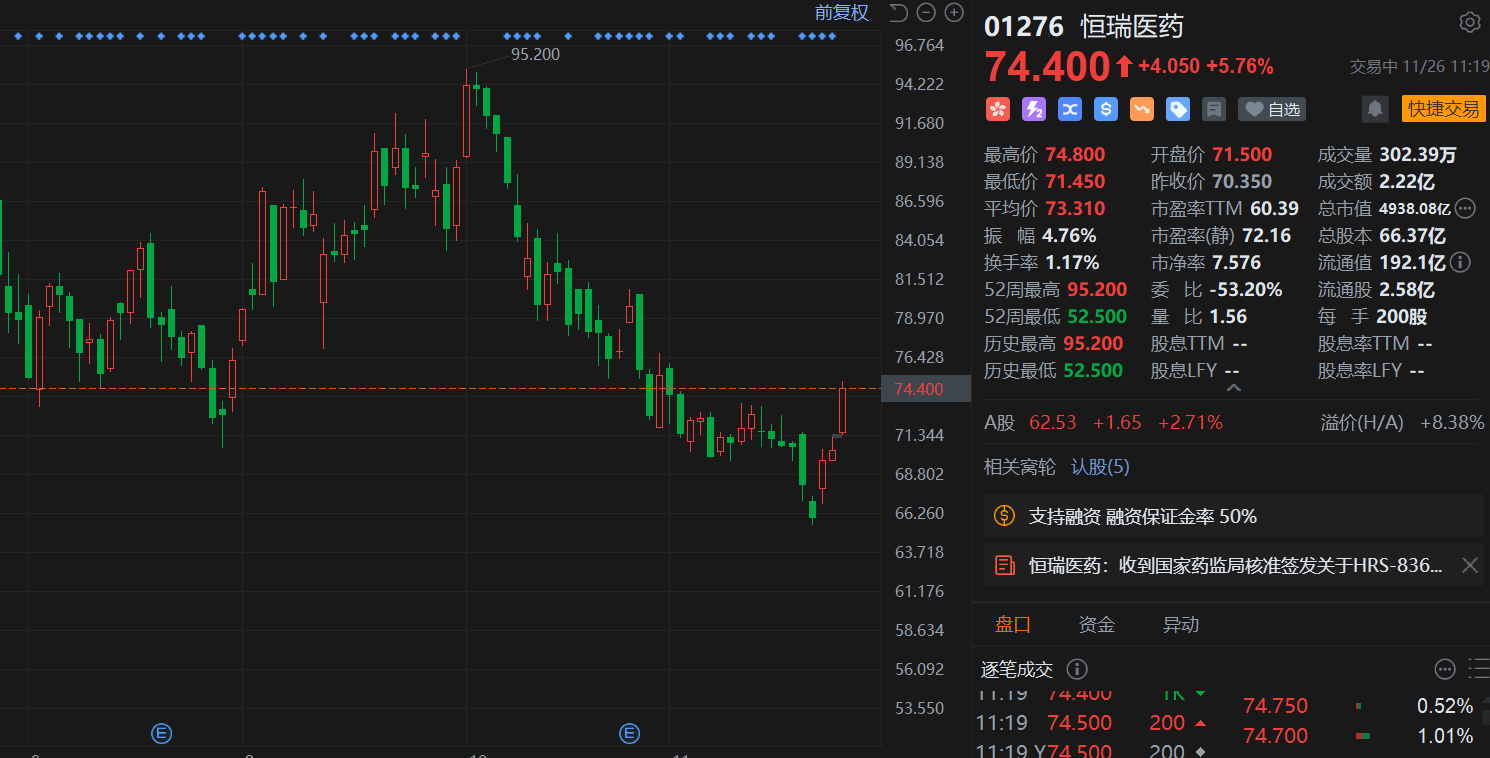
港股异动丨利好叠加,恒瑞医药继续涨超6%,3日累计反弹逾13%
Ge Long Hui· 2025-11-26 03:29
Core Viewpoint - 恒瑞医药 continues its rebound, rising over 6% and accumulating a total increase of over 13% in three days, currently priced at 74.4 HKD with a total market capitalization of 494.1 billion HKD [1] Group 1: Clinical Trials and Drug Development - 恒瑞医药 announced the approval from the National Medical Products Administration for two drug clinical trial notifications, including HRS-8364 tablets for late-stage solid tumors, with no similar drugs approved in the domestic and international markets [1] - The cumulative R&D investment for the HRS-8364 project is approximately 21.65 million CNY [1] - The injectable drug 瑞康曲妥珠单抗 will also commence clinical trials for HER2-positive solid tumor patients [1] Group 2: Industry Recognition and Events - 恒瑞医药 has over 10 research projects selected for presentation at the upcoming ESMO Asia conference, scheduled from December 5 to 7 in Singapore, highlighting the company's research capabilities in oncology [1] - This participation reflects the influence of Chinese pharmaceutical innovation on the global academic stage [1]

支持创新药和医疗器械发展,激发研发活力呵护百姓健康
Bei Jing Ri Bao Ke Hu Duan· 2025-11-23 08:42
Core Insights - China has transitioned from being a low-cost supplier of raw materials in the global pharmaceutical industry to becoming a significant source of drug innovation [1][2] - The "14th Five-Year Plan" emphasizes support for the development of innovative drugs and medical devices, indicating a robust growth trajectory for China's pharmaceutical industry [1] - Recent reforms in drug review and approval processes have accelerated the innovation and market entry of new drugs, with average review times significantly reduced [1][2] Group 1: Drug Innovation and Approval - The National Medical Products Administration (NMPA) has established expedited pathways for innovative drugs, including breakthrough therapy designations and priority reviews, resulting in an average review time of 225 working days for innovative drug applications in 2024 [1] - The average review time for priority-reviewed innovative drugs is only 162 working days, showcasing a marked improvement in approval speed [1] - The NMPA's support for clinical value-oriented drug innovation is evident through the establishment of various fast-track approval channels [1] Group 2: Medical Device Innovation - In November, the NMPA approved three innovative medical devices, reflecting a commitment to enhancing the regulatory framework for high-end medical devices [2] - The NMPA's 2025 announcement outlines ten measures to support the innovation of high-end medical devices, including optimizing special approval processes and improving standard systems [2] - China's drug review technical requirements are now fully aligned with international standards, allowing for synchronized drug submissions both domestically and internationally [2] Group 3: Market Dynamics and International Collaboration - The Chinese pharmaceutical market has grown to become the second largest in the world, attracting increased investment and interest from foreign pharmaceutical companies [3] - Despite the growth, there is a noted lack of original innovative drugs with new targets and mechanisms, indicating a need for enhanced foundational research and core technology development [3] - The NMPA emphasizes the importance of a collaborative approach among various sectors to boost original innovation capabilities in the biopharmaceutical industry [3]
2025第四届中欧生命科学与医药创新交流活动在北京举办
Huan Qiu Wang Zi Xun· 2025-11-19 11:32
Core Insights - The "China-Europe Innovation Community Theme Day Series Activities and the 2025 Fourth China-Europe Life Sciences and Pharmaceutical Innovation Exchange Event" was held in Beijing, establishing a high-level dialogue and cooperation platform in the life sciences and healthcare sector, which promotes the cross-border flow and optimization of innovative elements [1][3] - The event signifies a solid step forward in the construction of the China-Europe Innovation Community in the critical area of life and health, aiming to jointly address global public health challenges and enhance human health and well-being [1][3] Group 1 - Life health and pharmaceutical innovation are key areas of technological cooperation between China and Europe, serving as important pathways for addressing global challenges [3] - High-level visits and industry dialogues between China and Europe are expanding joint research and production cooperation in cutting-edge fields such as innovative drugs and cell therapies, while promoting regulatory standard collaboration [3] - The establishment of a stable and complementary industrial chain is crucial for addressing global health challenges and enhancing human well-being [3] Group 2 - Open cooperation is recognized as a fundamental principle in science and technology, with a consensus that progress is achieved through openness and collaboration [3] - Future efforts will focus on deepening cooperation in life sciences, targeting core technological challenges in areas such as gene therapy, precision medicine, rare disease mechanisms, and synthetic biology [3] - Strengthening cooperation ties and nurturing talent exchange is essential, with increased support for scientific talent development and encouraging the younger generation to engage in frontier exploration [3] Group 3 - The event attracted top experts, scholars, industry leaders, and corporate representatives from various countries, including China, Germany, Italy, Greece, France, Switzerland, the Netherlands, the United States, and Singapore [3] - Discussions included topics such as "Intelligent Connected Creation," "Digital Medical Technology Innovation Wave," "Patient Demand-Driven Innovation," and "Linking China-Europe Innovation to Support Scientific Research Transformation," sharing the latest research advancements and clinical practices [3] - The aim is to share breakthrough achievements in life health and pharmaceutical innovation between China and Europe and collaboratively outline a new blueprint for future cooperation [3]

创新价值凸显,中国力量加速渗透,生物医药ETF(512290)连续4日迎净流入
Mei Ri Jing Ji Xin Wen· 2025-11-19 07:33
Core Insights - The Chinese pharmaceutical industry is entering a critical phase characterized by "innovation realization and global layout" [1] - The core support for this transition includes population and domestic demand base, as well as comprehensive manufacturing capabilities across the entire industry chain [1] - Companies are actively exploring diversified overseas expansion paths in response to global competition and deepening policies [1] Industry Strategy - The industry needs to "focus on domestic markets, lead with innovation, and expand internationally" [1] - There is an emphasis on strengthening supply chain security and compliance capabilities domestically [1] - Internationally, the focus is on deepening diversified overseas layouts [1] Future Outlook - By 2026, the industry aims to capitalize on opportunities arising from innovation commercialization, global breakthroughs, policy optimization, and industry mergers and acquisitions [1] Investment Vehicle - The Biopharmaceutical ETF (512290) tracks the CS Biopharmaceutical Index (930726), which selects listed companies involved in biotechnology, pharmaceuticals, medical devices, and services from the Shanghai and Shenzhen markets [1] - This index reflects the overall performance of listed companies related to the biopharmaceutical sector [1]
第七届粤港澳大湾区生物医药创新大会在穗举行
Zhong Guo Zheng Quan Bao· 2025-11-17 00:52
Core Insights - The seventh Guangdong-Hong Kong-Macao Greater Bay Area Biopharmaceutical Innovation Conference was held in Guangzhou, focusing on the development paths of innovative drugs and the role of AI in drug research and development [1][2] - Industry experts emphasized the need for Chinese pharmaceutical companies to shift from "follower" to "leader" by addressing unmet medical needs and leveraging innovative technologies [1][2] Group 1: Conference Highlights - The conference theme was "Bay Area Innovation, Navigating New Journeys," discussing key topics such as dual circulation development, accelerated technology transfer, and compliance in global expansion [1] - Notable speakers included industry leaders and experts, highlighting the importance of innovation and internationalization as core drivers for Chinese pharmaceutical companies [2] Group 2: Regulatory and Industry Perspectives - The Director of the Guangdong Provincial Drug Administration stressed the importance of drug quality and safety, urging companies to strengthen regulatory compliance and communication with authorities to avoid approval delays [1] - The conference aimed to inject new vitality into the biopharmaceutical industry in the Greater Bay Area and across China, promoting high-quality development and attracting talent and projects [1]