信迪利单抗

Search documents
信达生物:25年业绩回顾:创新产品稳健放量;利润端实现扭亏;研发管线布局全面-20260401
海通国际· 2026-04-01 00:40
Investment Rating - The report maintains an "Outperform" rating for Innovent Biologics [2] Core Insights - Innovent Biologics achieved total revenue of RMB 13.0 billion in FY25, representing a year-on-year growth of 38%, with product sales revenue reaching RMB 11.9 billion, up 45% [3][15] - The company turned a net profit attributable to shareholders of RMB 810 million in FY25, compared to a loss of approximately RMB 100 million in the previous year [3][15] - The gross margin improved to 86.5%, an increase of 2.6 percentage points year-on-year [3][15] - The company expects to recognize out-licensing revenue progressively starting in 2026, with significant upfront payments from collaborations with Roche and Takeda [5][17] - The core asset IBI363 (PD-1/IL-2) is advancing smoothly, with three assets entering global Phase III clinical trials, estimated to have a combined addressable market exceeding USD 60 billion [19][21] Financial Summary - Revenue projections for FY26 and FY27 have been raised to RMB 17.8 billion and RMB 20.5 billion, respectively, along with net profit forecasts of RMB 2.3 billion and RMB 3.5 billion [10][21] - The company’s selling expenses increased by 31% year-on-year to RMB 5.7 billion, while R&D expenses decreased by 2% to RMB 2.6 billion [3][15] - The report indicates a strong organic sales growth driven by the oncology franchise and the expansion of the product portfolio, with multiple products included in the National Reimbursement Drug List (NRDL) expected to drive further growth in 2026 [4][16]
信达生物(01801):25年业绩回顾:创新产品稳健放量,利润端实现扭亏,研发管线布局全面
Haitong Securities International· 2026-03-31 14:32
Investment Rating - The report maintains an "Outperform" rating for Innovent Biologics [2] Core Insights - Innovent Biologics achieved total revenue of RMB 13.0 billion in FY25, representing a year-on-year growth of 38%, with product sales revenue reaching RMB 11.9 billion, up 45% [3][15] - The company turned a net profit attributable to shareholders of RMB 810 million in FY25, compared to a loss of approximately RMB 100 million in the previous year [3][15] - The gross margin improved to 86.5%, an increase of 2.6 percentage points year-on-year [3][15] - The report highlights strong organic sales growth driven by the oncology franchise and the expansion of the product portfolio, with multiple products included in the National Reimbursement Drug List (NRDL) expected to further boost sales in 2026 [4][16] - Out-licensing revenue of RMB 957 million was recognized in FY25, with significant upfront payments from collaborations with Roche and Takeda expected to be progressively recognized in the financial statements from 2026 onward [5][17] - The core asset IBI363 (PD-1/IL-2) is advancing smoothly, with three assets entering global Phase III clinical trials, estimated to have a combined addressable market exceeding USD 60 billion [7][19] - The early-stage pipeline shows strong global competitiveness, with 11 new molecules advanced into clinical development, expected to yield early data in 2026-2027 [9][20] - The target price is adjusted to HKD 107.40 based on a DCF model, reflecting an increase in revenue and net profit forecasts for 2026 and 2027 [10][21]
每日投资策略-20260330
Zhao Yin Guo Ji· 2026-03-30 03:04
Industry Insights - The electrolytic aluminum industry faces heightened supply risks following the attack on EGA's Al Taweelah smelter in Abu Dhabi, which has suffered significant damage due to missile and drone strikes [2][6][7] - EGA's production capacity accounts for approximately 2% of global electrolytic aluminum supply by 2025, indicating a substantial impact on the market [7] - The attack is viewed as a planned action, suggesting that more smelting facilities in the Middle East could be at risk, further increasing supply-side concerns [7] Company Analysis - BYD's 4Q25 earnings fell short of expectations, with net profit down 18% compared to forecasts, attributed to a decrease in gross margin and lower financial income [8][9] - The company is expected to benefit from increased exports and energy storage solutions, projecting a sales volume of 5 million units in 2026, with 1.5 million units coming from exports [8][9] - BYD's revenue is anticipated to grow by 9% and 8% in 2026 and 2027, respectively, maintaining a gross margin of 17.8% [9] Company Analysis (Continued) - Great Wall Motors reported a 16% year-on-year revenue increase in 4Q25, reaching a record high, with core net profit aligning with expectations despite a slight decline in gross margin [10][11] - The new platform is expected to enhance pricing competitiveness, with an upward revision of sales expectations for the WEY brand to 200,000 units in 2026 [10][11] - The company anticipates a 19% increase in net profit for 2026, reaching 11.8 billion yuan, supported by export growth and product structure optimization [11] Company Analysis (Continued) - GAC Group's 4Q25 performance met profit warnings, with revenue up 22% year-on-year, although net losses were reported due to increased impairment losses [12][13] - The launch of the Qijun brand in collaboration with Huawei is expected to be a key catalyst for stock performance, alongside a target to double export volumes to 250,000 units by 2026 [12][13] - The company is projected to narrow net losses to 4.8 billion yuan in 2026, supported by cost reduction efforts [13] Company Analysis (Continued) - Innovent Biologics reported a strong 2025 performance with total revenue reaching 13 billion yuan, driven by new product launches [18][19] - The company is transitioning towards a fully integrated global biopharmaceutical company, with significant partnerships enhancing its development capabilities [19][20] - Key catalysts for 2026 include pivotal clinical data readouts for IBI363 and IBI343, which could significantly impact the company's valuation [20] Company Analysis (Continued) - Kangfang Biotech achieved a 52% increase in product sales in 2025, with expectations for further growth driven by new indications being added to the national insurance directory [22][23] - The company is focusing on global expansion for its key products, with pivotal trials underway for its lead assets [25][26] - Anticipated data readouts for IBI363 and IBI343 in 2026 are expected to be significant value drivers for the company [24][25] Company Analysis (Continued) - Xunfei Medical reported a 24.7% revenue increase in 2025, although growth was slower than expected in the G-end business [26][27] - The company is expanding its customer base significantly, with services now covering over 77,000 grassroots medical institutions [27][28] - The synergy between G-end and B-end businesses is expected to enhance long-term revenue growth resilience, with a shift towards more recurring revenue models [28][29] Company Analysis (Continued) - China Tower's FY25 revenue grew by 2.7% to 100.4 billion yuan, with net profit increasing by 8.4% [30][31] - The company experienced a decline in EBITDA due to increased bad debt provisions and reduced asset disposal gains [31] - A dividend payout of 0.458 yuan per share was announced, reflecting a payout ratio of 77% [31]



全员中文属名,中山大学最新Nature论文:开创癌症动态风险适应性治疗新模式
生物世界· 2026-03-14 04:11
Core Viewpoint - The article discusses a groundbreaking study on nasopharyngeal carcinoma (NPC) treatment, highlighting the transition from a "one-size-fits-all" approach to a dynamic, risk-adaptive therapy guided by circulating tumor DNA (ctDNA) monitoring, which significantly improves patient outcomes [4][21]. Group 1: Clinical Background - Nasopharyngeal carcinoma is a prevalent malignant tumor in China, particularly in Southern regions like Guangdong, with an incidence rate of 20-40 per 100,000 people per year [6]. - Traditional treatment methods have been static, applying the same regimen to all patients regardless of their individual risk profiles, which has led to over-treatment of low-risk patients and under-treatment of high-risk patients [7][10]. Group 2: Study Overview - The EP-STAR clinical trial demonstrated that ctDNA dynamic monitoring can guide risk-adaptive treatment strategies, improving survival outcomes for NPC patients [4][10]. - Patients were categorized into three risk groups based on ctDNA clearance after chemotherapy: low-risk, mid-risk, and high-risk, with tailored treatment plans for each group [10][21]. Group 3: Efficacy Results - The study reported a remarkable 3-year event-free survival rate of 89.1% for mid-risk and high-risk patients undergoing risk-adaptive therapy [12][13]. - Mid-risk patients achieved a 3-year event-free survival rate of 91.4%, while high-risk patients reached 86.5%, compared to 90.6% for low-risk patients receiving standard treatment [14]. Group 4: Biological Insights - The research team analyzed tumor samples to understand the biological basis of different risk subgroups, which provided insights into the mechanisms behind the clinical efficacy of risk-adaptive therapy [16][17]. Group 5: Safety and Economic Considerations - The risk-adaptive strategy showed good clinical tolerability with no treatment-related deaths, and while there was a slight increase in grade 3-4 adverse events, they remained manageable [18]. - Economic analysis indicated that the ctDNA-guided treatment strategy only increased costs by $2,404.1 while providing an additional 1.9 quality-adjusted life years, resulting in a cost-effectiveness ratio of $1,225.2 per quality-adjusted life year, well below the accepted threshold [18]. Group 6: Clinical Significance - This research not only offers a new treatment paradigm for NPC but also signifies a shift in cancer treatment philosophy, providing scientific evidence to optimize existing treatment guidelines [21]. - The study's findings suggest that approximately 30% of patients would require enhanced treatment under the adaptive strategy, compared to 75% under traditional guidelines [21].


中美合作紧密的这一领域,迎来第二春?
财富FORTUNE· 2026-02-12 13:04
Core Viewpoint - The recent transactions among Chinese innovative pharmaceutical companies have brought optimism to a sector that has experienced fluctuations, with over $30 billion in licensing deals achieved in just over 40 days since 2026 began, surpassing the previous quarterly highs for upfront payments [1][3]. Group 1: Strategic Collaborations - Innovent Biologics and Eli Lilly announced a new global strategic collaboration to advance innovative drugs in oncology and immunology, with Innovent receiving an upfront payment of $350 million and potential milestone payments totaling up to $8.5 billion [3]. - This collaboration marks a shift from previous partnerships, focusing on early-stage ideas rather than established molecules, indicating a willingness from multinational corporations (MNCs) to invest in the early R&D capabilities of Chinese firms [3][5]. - Innovent retains all rights in Greater China while Eli Lilly secures exclusive global development and commercialization rights outside this region, reflecting a new model where MNCs pay for early-stage R&D capabilities [3][6]. Group 2: Market Reactions and Trends - Following the announcement of the collaboration, Innovent's stock price rose approximately 12% over two trading days, contributing to a rare consecutive increase in the Hong Kong innovative drug index [4]. - The new collaboration model may enhance resilience against external risks, particularly in light of geopolitical factors that have previously impacted the sector, such as stricter scrutiny from U.S. regulatory bodies on Chinese drug approvals [5][6]. Group 3: Industry Dynamics - The urgency for MNCs to expand their product lines due to looming patent expirations has led to increased transactions between large pharmaceutical companies and Chinese biopharmaceutical firms, with 38% of projects involving upfront payments over $50 million sourced from China [7]. - The collaboration model between Innovent and Eli Lilly is not easily replicable and relies on long-term trust built over years of partnership, highlighting the importance of established relationships in the industry [7]. - Despite the financial benefits of the collaboration, there are concerns that Innovent's role may be perceived as less proactive, as it retains only domestic rights while ceding international opportunities to Eli Lilly [7][8]. Group 4: Future Outlook - With Innovent recently achieving its first formal profitability, the immediate financial returns from such collaborations may be more appealing, suggesting a potential shift in the dynamics of power and negotiation within the Chinese innovative drug sector [8]. - The Hong Kong innovative drug index has shown signs of recovery after significant declines in late 2025, indicating renewed investor interest in high-risk investment areas, particularly in innovative drug collaborations [8].

驱动基因阴性NSCLC专题:下一代治疗范式:双抗、IO+ADC
Southwest Securities· 2026-02-10 03:06
Investment Rating - The report does not explicitly state an investment rating for the industry Core Insights - The proportion of driver gene-negative non-small cell lung cancer (NSCLC) patients is approximately 31% in both China and the United States, indicating a significant market opportunity for treatments targeting this demographic [2][15] - The estimated market size for immune drugs used in first-line treatment of driver gene-negative NSCLC is projected to be around 7.5 billion CNY (approximately 1.1 billion USD) in China and 18 billion CNY (approximately 2.7 billion USD) in the United States by 2030 [2] - The current first-line treatment for advanced driver gene-negative NSCLC primarily relies on PD(L)-1 inhibitors combined with chemotherapy, but there are limitations in long-term efficacy and options for patients intolerant to chemotherapy [3] Summary by Sections Section 1: NSCLC Global Overview - Lung cancer is the leading cancer type globally, with new cases accounting for approximately 12% of all cancer cases in 2022, translating to about 2.5 million new lung cancer cases [10] - In China, lung cancer represents about 22% of new cancer cases, with approximately 1.06 million new cases in 2022 [10] Section 2: Market Potential for Driver Gene-Negative NSCLC - The report highlights the significant market potential for immune therapies in treating driver gene-negative NSCLC, with a focus on the limitations of current treatment options [2][3] Section 3: Next-Generation Immunotherapy Approaches - The report discusses the advancements in dual (multi) antibody therapies and immune-oncology (IO) combined with antibody-drug conjugates (ADC), emphasizing their potential to improve treatment outcomes for patients with driver gene-negative NSCLC [5][8] - The clinical data supporting these new therapies is expected to catalyze further investment and development in this area [5] Section 4: Treatment Guidelines Comparison - The report compares treatment guidelines for driver gene-negative NSCLC between the United States and China, noting differences in treatment stratification and recommended therapies [32][34] - The U.S. guidelines emphasize PD-L1 expression levels, while Chinese guidelines focus more on performance status (PS) [32][34] Section 5: Future Catalysts - Key upcoming clinical data releases and studies are highlighted as potential catalysts for investment opportunities in the sector, particularly regarding dual antibodies and ADC therapies [5][8]


信达生物依然没有选择自己出海
Xin Lang Cai Jing· 2026-02-09 13:08
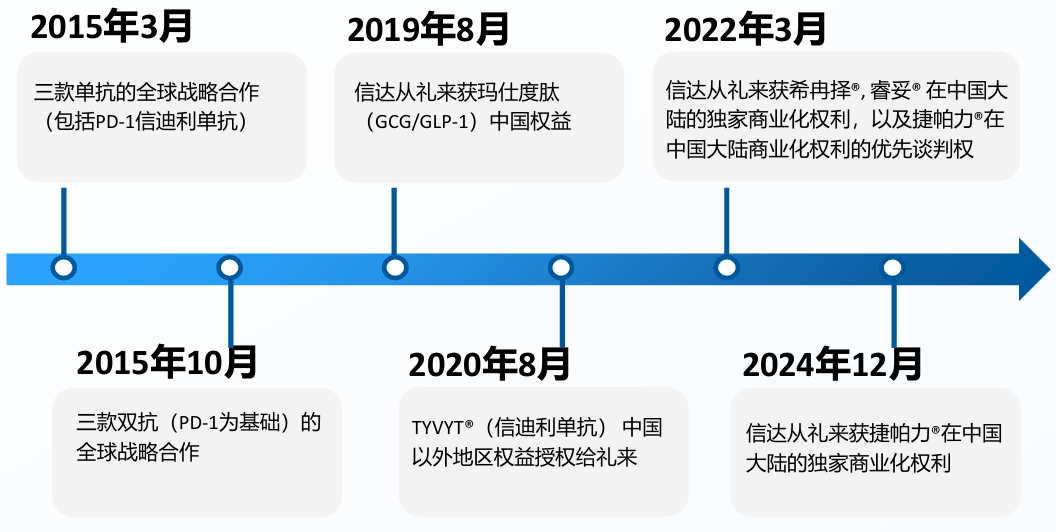
Core Viewpoint - The collaboration between Innovent Biologics and Eli Lilly marks the seventh partnership aimed at advancing innovative drugs in oncology and immunology, with Innovent leading the development and retaining rights in Greater China while Eli Lilly secures global rights outside this region [1][2]. Group 1: Financial Aspects - Innovent will receive an upfront payment of $350 million and potential milestone payments totaling up to $8.5 billion [1]. - Following the announcement, Innovent's stock price surged by 7.42%, closing at HKD 85.40 per share, with a market capitalization of HKD 148.2 billion [2]. Group 2: Strategic Importance - The collaboration is characterized as a pure incremental partnership, focusing on new targets and molecules outside Innovent's existing clinical pipeline [2]. - Innovent's management highlighted the recognition of its R&D capabilities globally and the long-standing relationship with Eli Lilly as key factors for this partnership [2]. Group 3: Historical Context - Previous collaborations between Innovent and Eli Lilly include the development of the PD-1 inhibitor, which became a cornerstone product for Innovent after its launch in 2018 [3]. - Innovent has also introduced the GLP-1 dual receptor agonist from Eli Lilly, which is set to launch in 2025, marking a significant addition to its product portfolio [3]. Group 4: Market Position and Future Plans - Innovent is seen as a leading player in the domestic innovative drug sector, having capitalized on significant targets like PD-1 and GLP-1, which are closely associated with Eli Lilly [2][3]. - The company aims to enter a new phase of dual-driven product lines and internationalization by 2025, with plans to establish a global R&D and commercialization platform [8][9]. - Innovent's goal includes having five pipelines enter global multi-center Phase III clinical trials by 2030, with a revenue target of CNY 20 billion by 2027 [9].

医药行业跟踪报告:信达生物与礼来合作再度升级,打造全球创新生态体系
Shanghai Aijian Securities· 2026-02-09 08:12
Investment Rating - The report assigns an "Outperform" rating for the pharmaceutical sector, indicating a positive outlook compared to the broader market [2][4]. Core Insights - The collaboration between Innovent Biologics and Eli Lilly has been upgraded, aiming to create a global innovative ecosystem for drug development in oncology and immunology. This partnership marks their seventh collaboration, enhancing their strategic relationship over more than a decade [2]. - The Chinese government has introduced a high-quality development plan for traditional Chinese medicine (TCM), focusing on improving raw material supply, innovation, and manufacturing capabilities. The plan aims to establish a collaborative development system by 2030, with significant investments in TCM innovation [2]. Summary by Sections Market Performance - The SW Pharmaceutical Biotechnology Index increased by 0.14% during the week of February 2 to February 8, outperforming the CSI 300 Index, which decreased by 1.33%. The Chinese medicine sector saw a notable rise of 2.56% due to new policies, while vaccines and other bioproducts experienced declines [2]. Strategic Collaborations - Innovent Biologics and Eli Lilly's new agreement includes a $350 million upfront payment and potential milestone payments of up to $8.5 billion, along with a tiered sales revenue sharing model for products outside Greater China. This partnership signifies a shift from traditional licensing to deeper integration of technology platforms and R&D systems [2]. Investment Opportunities - The report highlights continued optimism for Chinese innovative drugs entering international markets, particularly in areas such as antibody-drug conjugates (ADCs), dual antibodies, small nucleic acids, and weight-loss medications. Key companies to watch include Innovent Biologics, 3SBio, WuXi AppTec, and others [2].
中金:维持信达生物跑赢行业评级 目标价118.3港元
Zhi Tong Cai Jing· 2026-02-09 05:47
Core Viewpoint - CICC has raised the revenue forecast for Innovent Biologics (01801) for 2025 by 5.0% to 12.6 billion yuan, and the net profit forecast for 2026 by 274% to 6.68 billion yuan due to the impact of the Takeda collaboration, while introducing a net profit forecast of 4.14 billion yuan for 2027 [1] Group 1 - The company forecasts a product revenue of approximately 11.9 billion yuan for 2025, representing a year-on-year growth of about 45%, with Q4 product revenue expected to be around 3.3 billion yuan, showing over 60% growth year-on-year, aligning with CICC's expectations [2] - The company's product revenue has surpassed 10 billion yuan for the first time, driven by innovative products, with the oncology product portfolio expanding to 13 products by 2025 [3] - The company’s innovative product, Sintilimab, is expected to generate a revenue of 551 million USD in 2025, reflecting a year-on-year growth of about 5% [3] Group 2 - Seven products have been newly included in the national medical insurance catalog, which will be implemented starting in 2026, indicating clear performance drivers for 2026 [4] - The company expects the synergistic effects of its products to further manifest in 2026, with strong commercial momentum anticipated [4] - The company has reached a 10 billion USD collaboration with Takeda regarding IBI363 and is expected to see significant profit increases in 2026 due to upfront payments [5]
中国创新药龙头大涨近7%,拿下国际巨头88亿美元合作,首付3.5亿美元
21世纪经济报道· 2026-02-09 05:42
Core Viewpoint - The article discusses the strategic collaboration between Innovent Biologics and Eli Lilly to advance global research and development of innovative drugs in oncology and immunology, highlighting the financial terms and potential implications for both companies [1][3]. Summary by Sections Strategic Collaboration - Innovent Biologics announced a strategic partnership with Eli Lilly to develop innovative drugs in oncology and immunology, with Innovent leading the projects from drug discovery to clinical validation in China [1]. - The agreement includes an upfront payment of $350 million and potential milestone payments totaling up to $8.5 billion, along with a sales revenue sharing model for net sales outside Greater China [1]. Market Reaction - Following the announcement, Innovent's stock surged nearly 7%, reaching HKD 85 per share, with a market capitalization of HKD 147.6 billion [1]. Industry Context - Analysts note that multinational pharmaceutical companies are increasingly recognizing the value of Chinese innovative drug assets, shifting from high-risk acquisitions to collaborative models that leverage China's cost-effective and efficient R&D capabilities [3]. - However, some industry voices express concern that Innovent's role in drug development and commercialization in China may limit its long-term growth potential, as Eli Lilly retains global market rights [3]. Historical Collaboration - Innovent has a long-standing relationship with Eli Lilly, dating back to early investments and collaborations in drug development, including significant agreements in 2015 that set records for collaboration amounts between multinational and local companies [4][5]. - The partnership has led to successful product launches, including the PD-1 inhibitor, which became the first to be included in China's national medical insurance directory [4]. Financial Performance - Innovent's revenue has seen significant growth, with total revenue reaching CNY 3.844 billion in 2020, a 266.9% increase year-on-year, driven by product sales, particularly from its core product [5]. - The company aims to achieve CNY 11.9 billion in total product revenue by 2025, marking a 45% year-on-year increase, and has set a target of CNY 20 billion by 2027 [9]. Future Outlook - Innovent is focusing on expanding its product pipeline and has several products in critical phases of development, with plans to enhance its global presence through strategic collaborations [12]. - The company is also addressing potential challenges related to its pipeline and market positioning, aiming to balance revenue generation with R&D investments [14]. Industry Transformation - The article highlights a broader trend in the Chinese pharmaceutical industry, emphasizing the need for innovation to be recognized and valued globally, transitioning from efficiency-driven to quality and originality-driven innovation [15].