国产算力

Search documents
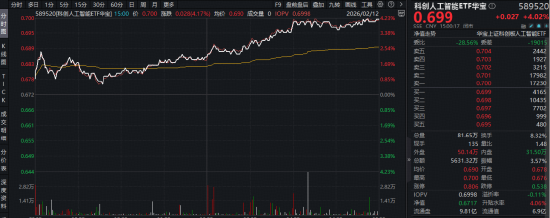
智谱GLM-5引爆行情!国产大模型再获突破!科创人工智能ETF(589520)猛拉4%,马斯克:模型发展速度太快!
Xin Lang Cai Jing· 2026-02-12 11:37
Group 1 - The core viewpoint of the article highlights the rapid development of domestic AI models, particularly the launch of Seedance 2.0 and GLM-5, indicating a competitive edge in the global AI landscape [1][3][10] - The performance of the Huabao AI ETF (589520) has been impressive, with a 4.02% increase, recovering above the 20-day moving average, reflecting strong investor interest in the domestic AI sector [1][7][8] - Key stocks within the ETF, such as Yuke (20% limit up), Jingchen (over 15% increase), and Xinyuan (over 12% increase), have shown significant gains, indicating a bullish trend in the AI and semiconductor sectors [8][10] Group 2 - The GLM-5 model, previously known as "PonyAlpha," has been recognized for its advanced capabilities, positioning China among the top tier in sparse architecture and AI model development [3][10] - The model has been optimized for compatibility with major domestic chip platforms, showcasing the capability of Chinese chip clusters to support large-scale generative models, which is a significant step towards a mature ecosystem [10] - According to CITIC Securities, the domestic computing power sector is expected to thrive, with potential for a long-term bullish market similar to the US stock market in 2023, driven by the urgency for domestic semiconductor and AI chip development [3][10]


多款国产芯片宣布Day0支持智谱GLM-5
Guan Cha Zhe Wang· 2026-02-12 01:59
Core Insights - Zhipu AI has launched and open-sourced GLM-5, with multiple domestic chips completing Day0 adaptation for optimized performance [1][2] - GLM-5 has achieved state-of-the-art (SOTA) performance in coding and agent capabilities, with significant improvements in parameter scale and pre-training data [2] Group 1: GLM-5 Launch and Adaptation - Zhipu AI's GLM-5 has been adapted for high throughput and low latency on domestic chip platforms including Huawei Ascend, Moore Threads, and others [2] - The collaboration with Haiguang Information has optimized the underlying operators and hardware acceleration for stable operation on Haiguang DCU [1] - Moore Threads has completed full-process adaptation and verification on its MTT S5000 GPU, achieving high-performance inference while reducing memory usage [1] Group 2: Technical Enhancements and Performance Metrics - GLM-5's parameter scale has expanded from 355 billion (with 32 billion activated) to 744 billion (with 40 billion activated), and pre-training data has increased from 23 terabytes to 28.5 terabytes [2] - The introduction of the "Slime" asynchronous reinforcement learning framework supports larger model scales and complex tasks, enhancing learning from long-term interactions [2] - The integration of DeepSeek Sparse Attention mechanism significantly reduces deployment costs while maintaining long text performance [2] Group 3: Support from Huawei - Huawei's Ascend NPU and MindSpore AI framework provide comprehensive support from data to training, contributing to the development of SOTA models based on self-innovated computing power [3]
神仙打架+1!讯飞星火X2硬核亮相,行业深度全面升级
量子位· 2026-02-11 14:57
Core Viewpoint - The article highlights the significant advancements of iFLYTEK's Starfire Model X2, showcasing a 50% improvement in reasoning performance compared to its predecessor, Starfire X1.5, achieved within just three months, and emphasizes its capabilities based on domestic computing power [2][10][50]. Group 1: Model Performance and Capabilities - Starfire X2 demonstrates outstanding general capabilities, ranking among the top in the industry, and competes closely with international models like GPT-5.2 and Gemini-3-Pro [2][12]. - The model excels particularly in mathematical calculations and logical reasoning, maintaining proficiency in over 130 languages [3][12]. - Starfire X2's reasoning training efficiency has improved by 50%, a notable achievement given the diminishing returns in performance enhancement for large models [8][9]. Group 2: Technical Innovations - The model incorporates several technical innovations, including weight quantization, low-precision KVCache, and a two-stage reasoning sampling method, which enhance training efficiency by 10% [24][27][30]. - A new adaptive calibration algorithm ensures that the model maintains logical consistency during training and inference, addressing common issues in large model architectures [24]. - The recursive high-difficulty data synthesis method allows for the creation of high-quality training data, improving the model's reasoning accuracy [25][26]. Group 3: Industry Applications and Market Position - Starfire X2 is positioned to drive significant advancements in various industries, with a focus on practical applications and user experience [31][54]. - In the healthcare sector, Starfire X2 outperforms competitors in key metrics, establishing a new benchmark for medical AI models [34][35]. - The model's deployment in education enhances personalized learning experiences, allowing for detailed feedback and analysis of student performance [37][41]. Group 4: Strategic Direction and Future Outlook - iFLYTEK's strategy emphasizes a combination of a general-purpose model and specialized industry models, aiming for rapid deployment and practical applications [54][55]. - The company has established itself as a leader in the domestic AI landscape, leveraging its unique approach to overcome challenges related to computing power and model performance [50][56]. - The advancements of Starfire X2 signal a shift towards the application of domestic AI models, marking the beginning of a new phase of growth and opportunity in the industry [56].

春节AI红包大战,算力届春晚才是真福利
Sou Hu Cai Jing· 2026-02-11 04:03
2月10日光合组织牵头的研讨会,集结百家生态伙伴,堪称算力版"春晚盛宴"。现场启动联合攻关专 项,给大模型产业发"算力红包":超3万卡国产AI算力池开放共享,400+大模型适配完成,中小企业用 算成本大降。还有AI布道师认证,给行业送技术干货。 比起手机里的小额红包,这场"春晚"才是真红利:国产算力+大模型的协同突破,让AI技术真正走进千 行百业。这个春节,个人抢红包,企业拿算力福利,国产AI生态双喜临门! 今年春节被大模型红包承包了:腾讯元宝10亿、百度文心一言5亿、阿里千问亿元冠名,而真正的产业 福利藏在郑州——国产算力界的"春晚"太硬核! ...

未知机构:国产算力之华正新材继续新高高端覆铜板筑基涨价潮核心受益者东北计算机-20260211
未知机构· 2026-02-11 02:15
Summary of Conference Call Records Company and Industry Involved - **Company**: 华正新材 (Huazheng New Materials) - **Industry**: CCL (Copper Clad Laminate) industry, specifically focusing on high-end CCL materials and their applications in the domestic computing power sector Core Points and Arguments 1. **Price Increase in CCL Industry**: The CCL industry has entered a price increase phase driven by both cost push and demand pull, following price hikes announced by major players like 建滔 (Kingboard) and Resonac [1] 2. **Domestic Computing Power Surge**: The accelerated release of domestic computing power chips, such as Huawei's昇腾910C, is pushing for faster localization of high-frequency and high-speed CCL materials [1] 3. **Low Inventory Levels**: The CCL industry has experienced a prolonged destocking phase, resulting in current low inventory levels, which enhances price elasticity [1] 4. **Improved Bargaining Power**: With rising copper prices and a shortage of glass fiber cloth supply, CCL manufacturers are regaining bargaining power [1] 5. **Profit Margin Expansion**: 华正新材, as a leading domestic CCL manufacturer, is expected to benefit from the current price increase cycle, leading to potential profit margin expansion and performance elasticity [1] 6. **Strong Ties with Huawei**: The company has established deep ties with Huawei, positioning itself as a core supplier of essential materials for the domestic computing power base [1] Additional Important Content 1. **High Standards for PCB Layers**: Huawei's昇腾 servers require an increase in PCB layers and have stringent requirements for signal transmission loss [2] 2. **Ultra Low Loss Material Certification**: 华正新材's Ultra Low Loss materials have passed multiple terminal certifications and are being sold in small batches, directly competing with high-end products from companies like 台光电 (Taiwan Union Technology) and 松下 (Panasonic) [2] 3. **Revenue Growth Projection**: The revenue from CCL is expected to grow by 14.26% year-on-year in 2024, indicating a significant structural upgrade with increasing market share in high-frequency and high-speed boards within the server sector [2] 4. **CBF Film Development**: The company’s CBF laminated insulation film is set to break Japan's ABF monopoly and has been validated by major domestic IC substrate manufacturers, with small batch deliveries already achieved [2] 5. **Valuation Potential**: Given the tight supply of advanced packaging capacity in CoWoS, the need for domestically controlled packaging materials is urgent, and this business segment has high valuation elasticity [2] 6. **Risk Factors**: Potential risks include severe fluctuations in raw material prices and delays in the validation process for domestic computing power PCBs [2]

未知机构:国联民生电子中芯国际25Q4悲观预期下的诸多亮点领导好今-20260211
未知机构· 2026-02-11 01:55
【国联民生电子】中芯国际25Q4:悲观预期下的诸多亮点 【国联民生电子】中芯国际25Q4:悲观预期下的诸多亮点 相较于此前市场的悲观预期,公司在收入等方面仍取得了超预期增长,同时后续仍迎来成熟制程涨价+先进制 程扩产多重催化,公司作为国产算力中军,较此前高点已回撤22%,当前港股PB仅3.46x,当下建议积极布局 领导好,今日中芯公告25Q4业绩,此前市场对于Q4预期较为悲观,我们在preview中前瞻提示有望优于指引,整体 来看在收入、稼动率等方面存在诸多亮点,梳理核心要点如下: 25Q4 ➠营收:24.89亿美元,yoy+12.8%,qoq+4.5%大超此前指引0-2% ➠归母净利润:1.73亿美元,yoy+60.7%,qoq-9.9% ➠毛利率:19.2%,环比-2.8pct,同比-3.4pct 虽有环比下滑、但符合指引 ➠产能利用率:95.7%,环比减少0.1pct,同比+10.2pct ➠资本开支:24.1亿美元 领导好,今日中芯公告25Q4业绩,此前市场对于Q4预期较为悲观,我们在preview中前瞻提示有望优于指引,整体 来看在收入、稼动率等方面存在诸多亮点,梳理核心要点如下: 26Q1 25Q ...

未知机构:芯原股份交流更新重视ASIC赛道扩容份额提升双击核心CSP及GPU客-20260211
未知机构· 2026-02-11 01:50
Company and Industry Summary Company: 芯原股份 (Chip Origin) Key Points 1. **Core Customer Engagements** - Confirmed collaboration with Tencent on accelerator cards and DPU, with project involvement exceeding that of ByteDance, reaching a turnkey level [1] - Confirmed significant deployment of PPU with Alibaba on Samsung, with project involvement slightly lower than ByteDance, projecting profits of $200-300 per unit [1] - Confirmed successful testing of MX return chips, with further mass production progress to be monitored within the year [1] - Confirmed an increase in wafer orders from ByteDance, contributing to overall demand, with further tracking of specific wafer return progress required [1] - Baidu's Kunlun chip project remains under observation for confirmation [1] - Other projects including ByteDance's VPU/DPU, Ideal's second-generation autonomous driving, and VIVO's ISP are all in mass production [1] 2. **Market Potential** - The market space for Chip Origin is substantial, with Alibaba estimated at 40-50 billion, ByteDance at 30-40 billion, and Tencent and Baidu's markets currently unknown, indicating a market exceeding 100 billion [2] - Even with a 15% net profit margin, this translates to a profit potential of 15 billion [2] 3. **Long-term Viability** - The role of ASICs is expected to persist alongside the growth of the domestic computing market, with initial project experience and core IP accumulation serving as a competitive moat [2] Additional Important Insights - The emphasis on the growth of domestic computing power driven by companies like ByteDance and Alibaba highlights the increasing importance of ASIC technology in the market [1] - The ongoing developments in various projects indicate a robust pipeline for Chip Origin, suggesting potential for sustained revenue growth [1] - The need for continuous monitoring of production progress and market dynamics is critical for assessing future performance and opportunities [1][2]

未知机构:国联民生电子国产算力更新260210领导好今日国产算力板-20260211
未知机构· 2026-02-11 01:45
【国联民生电子】国产算力更新-260210 领导好,今日国产算力板块有诸多重磅行业新闻及变化,给您更新如下: 1晶圆厂 ➠今日 公告Q4业绩,毛利率与少数股东权益不及预期,但相较于此前市场悲观预期,收入仍取得亮眼的环比增 长,我们认为公司当前已深度回调,考虑后续成熟制程涨价+先进制程扩产等多重催化,当下已是值得配置的国产 算力核心标的。 【国联民生电子】国产算力更新-260210 2国产ASIC ➠我们团队自 上市以来持续跟踪,每两周组织国产ASIC专家更新产业变化,目前字节一期流片顺利且预计上修整 个生命周期的出货,同时一季度新签订单将保持高增给全年业绩带来极高的确定性,仍然是我们推荐的兼具胜率 与赔率的核心标的。 2国产ASIC 3先进封装 ➠我们 ➠今日上交所公告,盛合晶微将于2月24日进行IPO审议,作为科创板稀缺高端封测标的,其上市有望带动先进封 装板块估值重构,高端算力封装将成为前道以外又一核心瓶颈环节,建议重点关注国产龙头长电、通富以及新兴 厂商甬矽、 (子公司星辰技术),同时先进封装的设备材料亦将充分受益此次大扩产。 领导好,今日国产算力板块有诸多重磅行业新闻及变化,给您更新如下: 1晶圆厂 ...
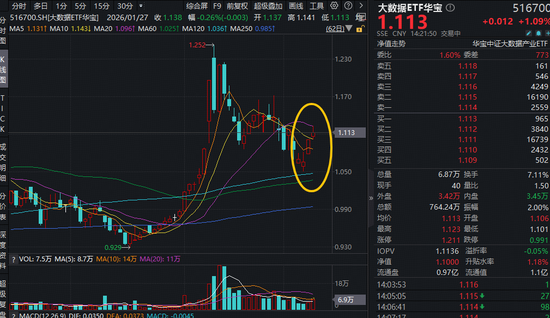
Seedance概念活跃,国投智能领涨超9%!大数据ETF(516700)盘中拉升1.8%,冲击4连阳!
Xin Lang Ji Jin· 2026-02-10 06:33
Group 1 - The core focus of the news is the significant rise of the Seedance concept, particularly in the domestic computing and AI application sectors, with the big data ETF Huabao (516700) experiencing a price increase of over 1.8% at one point and currently up by 1.09% [1] - The AI video generation model Seedance 2.0 from ByteDance has gained attention for its ability to generate high-quality videos from text and images, supporting video segments of 5 to 15 seconds with multi-angle shots and dialogue [1][3] - The domestic video generation field is becoming increasingly competitive, similar to the state of large language models in 2025, with companies focusing on differentiated development in specific application scenarios [3] Group 2 - The data center is identified as a core infrastructure for AI, with a high demand in the computing market driving steady growth in the IDC industry [3] - The Huabao big data ETF (516700) tracks the CSI big data industry index, with a significant weight of 40.91% in computing concepts and 37.43% in AI application concepts as of the end of 2025 [3][5] - Key stocks in the ETF include industry leaders such as Zhongke Shuguang, Keda Xunfei, and Inspur Information, with a focus on technology self-reliance and the acceleration of domestic substitution processes [5]

继续看好国产算力与AI应用 - 科技组首席联合电话会
2026-02-10 03:24
Summary of Conference Call Notes Industry and Company Overview - The discussion primarily revolves around the semiconductor industry, specifically focusing on storage solutions and domestic computing power in China. Key companies mentioned include: - Semiconductor companies: 中芯国际 (SMIC), 江丰电子 (Jiangfeng Electronics), 晶特电子 (Jingte Electronics), 拓荆 (Tuojing), 中微 (Zhongwei), 华创 (Huachuang), 芯源微 (Xinyuanwei), 华海 (Huahai), and others. - AI-related companies: 字节跳动 (ByteDance), 腾讯 (Tencent), 阿里巴巴 (Alibaba). Key Points and Arguments 1. **Storage Sector Outlook** - The storage sector is currently experiencing adjustments due to delays in the listing of two-inch wafers, but this is seen as a buying opportunity rather than a setback. The certainty of the listing remains intact despite the delays [1][2]. - The growth potential for the storage chain is not solely dependent on the listing but also on advancements in the advanced process technology, supported by high import numbers of lithography machines [2]. 2. **Capital Expenditure and Market Sentiment** - Companies in the semiconductor sector are showing optimistic capital expenditure and order situations, indicating a sector-wide opportunity. Key players are expected to benefit from this trend [3]. - Specific companies like 江丰法财 (Jiangfeng) and 鼎龙 (Dinglong) are highlighted for their positive developments in photolithography and polishing liquids, respectively [3]. 3. **Domestic Computing Power and AI Development** - The domestic computing power sector is driven by the growth of AI in China, with major CSP companies like 字节跳动 (ByteDance) leading investments. The focus is on how these companies can leverage AI to enhance user-generated content (UGC) [4][5]. - The introduction of AI models is expected to significantly reduce the difficulty of producing high-quality UGC, potentially transforming the content creation landscape [4]. 4. **Investment Opportunities in AI and Media** - The upcoming Chinese New Year is anticipated to boost AI-related applications and media content, with companies like 博纳影业 (Bona Film Group) and those involved in IP-related content being recommended for investment [10][11]. - The sentiment around AI applications remains optimistic, with expectations of continued growth in the industry despite recent market adjustments [9][10]. 5. **Market Adjustments and Future Projections** - The Hong Kong market, particularly the Hang Seng Technology Index, has seen a decline due to liquidity issues and shifts in sentiment regarding AI narratives in the US market [9][12]. - Despite recent downturns, the long-term outlook for the semiconductor and AI sectors remains positive, with expectations of strong capital expenditure growth from major tech firms [12][15]. 6. **Gaming Sector Insights** - The gaming sector has faced significant declines, with a noted 22.8% drop in A-share gaming stocks. However, companies like 完美世界 (Perfect World) are seen as having potential due to strong pre-launch metrics for new titles [19]. Other Important Insights - The discussion emphasizes the importance of advanced packaging in the semiconductor supply chain, highlighting companies that are well-positioned in this area [7]. - The impact of regulatory changes on the consumer internet sector is noted, particularly regarding algorithm governance, but the fundamental impact on the market is considered limited [14]. - The potential for AI applications in various sectors, including social media and content creation, is a recurring theme, with significant implications for user engagement and market dynamics [5][6]. This summary encapsulates the key insights and projections discussed during the conference call, providing a comprehensive overview of the current state and future outlook of the semiconductor and AI industries.