
增量资金入市

Search documents
“牛市旗手”终于启动,两股涨停,东财涨超3%,超百亿成交再登顶!券商ETF(512000)放量涨逾2%
Xin Lang Ji Jin· 2025-08-13 05:21
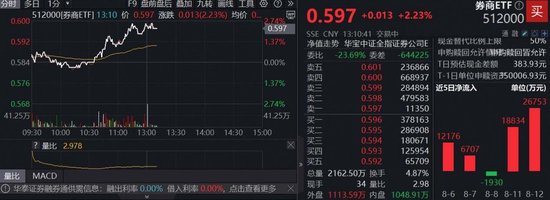
Group 1 - The Shanghai Composite Index has broken through the high point from October 8 of last year, significantly boosting market sentiment, with brokerage stocks leading the surge [1] - Major brokerages such as Guosheng Securities and Changcheng Securities have seen consecutive trading limits, while Dongfang Caifu, a leading brokerage, has increased by over 3% with a real-time transaction volume of 13.8 billion [1] - The top brokerage ETF (512000) reached a price increase of over 2.5%, indicating a strong trading atmosphere with a significant increase in transaction volume [1][3] Group 2 - Analysts suggest that policy guidance is leading to a sustained influx of medium to long-term funds into the market, with a potential recovery in the equity allocation of insurance funds, wealth management, and public offerings [3] - The continuous increase in margin trading balances reflects investors' growing willingness to take risks and the improving market conditions, indicating a positive outlook for trading activity [3] - The brokerage ETF (512000) has seen substantial inflows, with 2.68 billion yuan raised recently and a cumulative net inflow of 6.25 billion yuan over the past five days [3] Group 3 - The brokerage ETF (512000) has a fund size exceeding 25.9 billion yuan, with an average daily transaction volume of 8.25 billion yuan, making it one of the largest and most liquid ETFs in the A-share market [5] - The ETF passively tracks the CSI All Share Securities Company Index, encompassing 49 listed brokerage stocks, with nearly 60% of its holdings concentrated in the top ten brokerages [6]





A股三大重磅驱动,牛市旗手全线爆发
Zheng Quan Shi Bao· 2025-08-13 04:59
Core Viewpoint - The brokerage sector is experiencing significant gains, driven by increased client activity and favorable market conditions, indicating a potential new growth phase for the securities industry [1][3][4]. Group 1: Market Performance - The brokerage sector saw a surge in stock prices, with notable gains from companies like Guosheng Jinkong and Changcheng Securities, contributing to a positive market sentiment [1][3]. - The A-share market has been defined as a "bull market" by multiple brokerages, with expectations of increased capital inflow due to the anticipated interest rate cuts in the U.S. [6]. Group 2: Driving Factors - Three main drivers for the recent performance include an increase in T0 client numbers, steady growth in client margin scales, and a noticeable rise in leverage among existing clients, as evidenced by the financing balance exceeding 2.02 trillion yuan [1][3]. - Analysts suggest that policy guidance is encouraging long-term capital to enter the market, with structural adjustments indicating a turning point, which could enhance the growth potential for brokerage services [1][6]. Group 3: Future Outlook - The securities industry is expected to benefit from a new growth cycle, with increased demand for brokerage, margin financing, asset management, and investment banking services as new capital flows into the market [1][6]. - The improvement in asset quality and the reduction of valuation concerns are also contributing to a more favorable outlook for brokerages, with a focus on cost reduction and efficiency improvements [7].


沪指创近4年新高,年内涨幅超9%
Sou Hu Cai Jing· 2025-08-13 04:48
Group 1 - A-shares indices collectively rose, with the Shanghai Composite Index breaking its previous high of 3674.4 points set on October 8, 2024, marking the highest level since December 13, 2021, with a year-to-date increase of over 9% [2] - As of August 12, the margin trading balance in A-shares returned to 2 trillion yuan, with a reported balance of 20,345.33 billion yuan, an increase of 833.5 million yuan from the previous trading day [2] - The sectors leading the gains included shipbuilding, electronic chemicals, aerospace, communication equipment, and non-ferrous metals, while medical devices, port shipping, coal, and energy metals saw declines [2] Group 2 - Zhejiang Merchants Securities indicated that the "924" market trend began on August 11, establishing a long-term market bottom, with expectations for a strong market post-April 7, 2025, potentially leading to the fifth bull market in A-share history [3] - The three core supporting factors for the recent market rise—policy bottom-line thinking, emergence of new growth drivers, and influx of incremental funds—remain unchanged, suggesting potential catalysts for market confidence [3] - China Merchants Securities noted that the semi-annual reports are expected to confirm the improvement in overall free cash flow for listed companies, reinforcing the logic for re-evaluating A-shares [3]

资金,蜂拥而入!
天天基金网· 2025-08-08 05:05
Core Viewpoint - The article highlights a significant inflow of funds into equity ETFs and active equity funds, indicating a market rebound and renewed investor interest in equity investments [2][3][10]. Fund Inflows - On August 6, over 70 billion yuan flowed into equity ETFs, marking a reversal in the trend of fund outflows seen earlier in August [2][3]. - Notable net subscriptions were recorded for several ETFs, including 12.05 billion yuan for the Southern CSI 1000 ETF and over 5 billion yuan for both the E Fund CSI A500 ETF and Southern CSI 500 ETF [3]. - Hong Kong-themed ETFs also attracted substantial investments, with a net subscription of 21 billion yuan on the same day [3]. Fund Purchase Restrictions - Several high-performing active equity funds have implemented purchase restrictions to ensure stable operations and protect existing investors' interests. For instance, the China Europe Digital Economy Mixed Fund suspended large purchases exceeding 1 million yuan starting August 6 [4][5]. - This trend of limiting large subscriptions has been observed across nearly 30 funds since July, including the Yongying Ruixin Mixed Fund and the GF Growth Leading Mixed Fund [4]. New Fund Issuance - The new fund issuance market has shown significant recovery, with seven active equity funds exceeding 1 billion yuan in issuance since July. The Dachen Insight Advantage Mixed Fund alone raised 24.61 billion yuan [6]. - "Fixed income plus" products are also seeing proportional allocations due to high demand, as evidenced by the Southern Stable Growth Bond Fund, which had its fundraising cut short after reaching the 50 billion yuan cap [6]. Investment Trends - The "fixed income plus" strategy is gaining traction, as investors seek to enhance yield while maintaining a controlled risk profile amid declining 10-year treasury yields [8]. - The report from Huatai Securities indicates that equity funds are becoming a key channel for reallocating household savings, with a notable increase in the number of stock and mixed fund applications since mid-July [10]. Market Outlook - The overall sentiment among institutions remains optimistic, with active equity fund positions rising to relative highs. As of August 1, the average stock position for ordinary equity funds was approximately 90.34%, up 1.05 percentage points from July 25 [10]. - The expectation of continued policy support and the upcoming disclosure of semi-annual earnings from listed companies are anticipated to enhance investment opportunities, particularly in technology, high-end manufacturing, and high-dividend sectors [11].

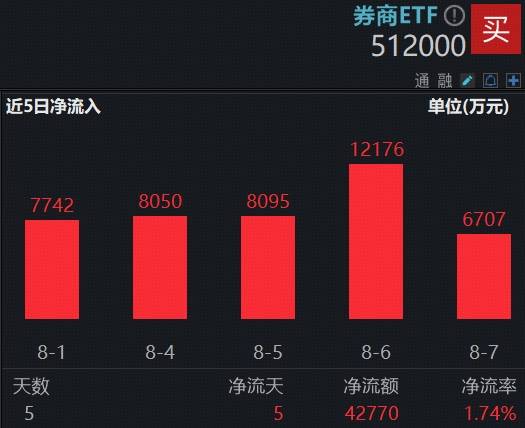
“牛市旗手”券商ETF(512000)连续5日吸金4.2亿元,机构:四重逻辑战略看多券商
Sou Hu Cai Jing· 2025-08-08 01:42
Core Viewpoint - The A-share market is experiencing a bullish trend, with significant inflows into the top broker ETF, indicating a positive outlook for the brokerage sector [1][3]. Group 1: Market Trends - The Shanghai Composite Index has seen four consecutive days of gains, reaching new highs, with the top broker ETF (512000) receiving a net inflow of 428 million yuan over the past five days [1]. - Recent market conditions have led to increased trading volumes and margin financing balances, contributing to a noticeable upward trend in brokerage stock prices [4]. Group 2: Brokerage Sector Outlook - Four key logical strategies support a bullish outlook for the brokerage sector: 1. Anticipated inflows of new capital are expected to benefit brokerage businesses across the board, as policies encourage long-term capital to enter the market [3]. 2. Adjustments in proprietary trading structures are likely to enhance performance elasticity, as the attractiveness of equity markets increases with lower long-term interest rates [3]. 3. Continuous improvement in asset quality is observed, with a reduction in impairment scales reflecting better asset management within brokerages [3]. 4. Revenue recovery and cost reduction strategies are expected to enhance profit elasticity, with the industry entering a phase of stable management costs and a decline in workforce numbers for the first time in a decade [4]. Group 3: Investment Opportunities - The brokerage ETF (512000) and its linked funds provide a diversified investment tool, covering 49 listed brokerage stocks, with nearly 60% of the portfolio concentrated in the top ten leading brokerages [5]. - The overall valuation of the brokerage sector remains at historically low levels, suggesting potential for recovery, while short-term market sentiment may drive beta performance [4][5].
广发证券:重视资金结构性力量 四重逻辑战略看多券商
智通财经网· 2025-08-07 07:06
资产质量持续改善,估值隐忧缓解 2023年以来多措并举推动地方债务风险缓释,据IMF披露的中国金融体系稳定评估(FSSA)报告,截至 2024年底,我国地方政府融资平台的债务余额约为15万亿元,同比下降25%;40%的地方融资平台已转型 为市场导向型企业或被出清。2024年以来房地产政策"组合拳"成效凸显,高质量发展趋势下市场信心稳 步增强,城投、地产风险缓释降低金融机构的"非标"风险。券商表内减值规模及占比下降客观反映券商 资产质量持续改善。43家上市券商减值合计于2020年越过历史高点后大幅下降。 智通财经APP获悉,广发证券发布研报称,7月中央政治局会议提出,增强国内资本市场的吸引力和包 容性,巩固资本市场回稳向好势头。从"稳股市"到"吸引力",是从"稳"到"进"的表达。"吸引力"体现于 境内外增量资金的持续入市,"包容性"体现于通过资本市场投融资改革更好服务新质生产力发展。 2025Q2证券板块公募基金持股比例从Q1的0.37%上升到0.64%,但仍处于历史低位。随着增量资金接力 入市,业绩和估值空间打开,该行战略看好证券板块的配置机会。 广发证券主要观点如下: 增量资金有望接力入市,券商业务有望全面 ...

罕见!主动外资杀回来了
Ge Long Hui· 2025-08-05 09:25
Market Overview - A-shares showed resilience by recovering above 3600 points after a pessimistic atmosphere over the weekend, despite a significant sell-off of 18 billion HKD by southbound funds [1] - The Hang Seng Index rose by 0.68% and the Hang Seng Tech Index increased by 0.73% following a strong buying spree of 23.426 billion HKD by southbound funds [1] Fund Flows - There has been a notable shift in fund attitudes, with insurance funds contributing 363.9 billion CNY to the market as of Q1 this year, marking a significant inflow [4] - Active foreign capital saw its first inflow into Hong Kong stocks and ADRs since October last year, amounting to approximately 429 million USD, while A-shares continued to experience outflows [5] - Margin trading balances reached 1.99 trillion CNY, nearing the 2 trillion CNY mark, with margin trading accounting for 10.07% of total A-share trading volume, a record high [6] Retail Investor Activity - Retail investors have been actively entering the market, with 1.96 million new accounts opened in July, a 71% year-on-year increase [8] - The total number of new A-share accounts reached 14.56 million in the first seven months of the year, reflecting a 36.88% year-on-year growth [9] Fund Performance - Mixed funds showed a dual increase in scale and share in June, with a net increase in scale exceeding 120 billion CNY, although the number of shares only increased by 9.7 billion [9] - The new issuance of mixed funds in June indicated a recovery, with 49 new products launched, raising a total of 25.9 billion CNY [9] Financial Products and Taxation - The issuance of the second batch of floating-rate products is scheduled, with notable funds set to launch [10] - Recent confirmation that profits from overseas stock trading will be subject to a 20% tax has led to increased interest in domestic cross-border ETFs, with net purchases of 27 billion CNY in the previous week [18][19]

A股融资余额创逾十年新高 上证指数创今年以来新高
Zhong Guo Zheng Quan Bao· 2025-07-30 21:50
Market Overview - On July 30, the A-share market experienced fluctuations, with the Shanghai Composite Index reaching a new high for the year, while the ChiNext Index fell over 1% [1][2] - The total market turnover was 1.87 trillion yuan, slightly increasing from the previous trading day [2] - Over 1,700 stocks rose, with more than 50 stocks hitting the daily limit [1][2] Sector Performance - The steel, oil and petrochemical, and media sectors led the market gains, with respective increases of 2.05%, 1.84%, and 0.99% [2][3] - Conversely, the power equipment, computer, and automotive sectors saw declines of 2.22%, 1.59%, and 1.27% [2] Financing Activity - As of July 29, the A-share financing balance reached 19,684.21 billion yuan, marking a new high in over ten years, with an increase of over 130 billion yuan in July [4][5] - The financing net buying was particularly strong from July 21 to July 29, with net purchases exceeding 790 billion yuan during this period [4] - Among 31 sectors, 30 saw an increase in financing balance, with the pharmaceutical, electronics, and non-ferrous metals sectors leading in net buying amounts [4] Stock-Specific Movements - Notable stocks in the steel sector included Baogang Co., which hit the daily limit, and other companies like Maanshan Iron & Steel and Angang Steel, which rose over 4% [3] - In the media sector, stocks like Happiness Blue Ocean and Jinyi Media also reached the daily limit, with Beijing Culture rising over 9% [3] - Conversely, stocks such as Bicon Technology and Haoyuan Pharmaceutical saw significant declines, with Bicon dropping over 11% [3] Analyst Insights - Analysts maintain an optimistic long-term outlook for the index, despite existing market divergences, suggesting that incremental capital inflow may continue to drive market growth [1][7] - The current market lacks specific hot themes or industries, leading to a divergence between institutional and speculative trading styles [7] - Recommendations for market allocation include increasing exposure to gold and non-ferrous metals, as well as focusing on sectors benefiting from summer trends like tourism and dining [7]
A股融资余额创逾十年新高上证指数创今年以来新高
Zhong Guo Zheng Quan Bao· 2025-07-30 21:09
Market Overview - The A-share market experienced fluctuations on July 30, with the Shanghai Composite Index reaching a new high for the year, while the ChiNext Index fell over 1% [1][2] - The total market turnover was 1.87 trillion yuan, an increase of 417 billion yuan compared to the previous trading day [2] - Over 1,700 stocks rose, with more than 50 hitting the daily limit, indicating a strong market rotation [1][2] Sector Performance - The steel, oil and petrochemical, and media sectors led the market gains, with respective increases of 2.05%, 1.84%, and 0.99% [2] - Notable stocks in the steel sector included Baogang Co., Yayi Steel, and Xining Special Steel, which hit the daily limit, while other stocks like Maanshan Steel and Anyang Steel rose over 4% [2] - The media sector saw significant gains with stocks like Happiness Blue Sea and Jin Yi Film hitting the daily limit, and Beijing Culture rising over 9% [2] Financing Activity - As of July 29, the A-share financing balance reached 19,684.21 billion yuan, marking a new high in over ten years, with an increase of over 130 billion yuan in July alone [3][4] - The financing net buying was particularly strong from July 21 to July 29, with net purchases exceeding 790 billion yuan during this period [3] - Among the 31 sectors, 30 saw an increase in financing balance, with the pharmaceutical, electronics, and non-ferrous metals sectors leading in net buying amounts [3] Individual Stock Movements - In July, financing clients increased their positions in 435 stocks by over 100 million yuan, with the top ten stocks seeing significant inflows [4] - Conversely, 81 stocks experienced a reduction in positions exceeding 100 million yuan, with notable reductions in stocks like Wuliangye and Industrial Fulian [4] Analyst Insights - Analysts maintain an optimistic long-term outlook for the market, despite existing divergences, suggesting that incremental capital inflows could drive further market growth [5][6] - The current market lacks specific hot themes or sectors, leading to a divide between institutional and speculative trading styles [6] - Recommendations include increasing allocations in gold and non-ferrous metals, while also focusing on sectors benefiting from summer trends such as tourism and dining [6]
2025年二季度非银板块基金持仓分析:非银获增配,重视配置力量带来的非银机会
GUOTAI HAITONG SECURITIES· 2025-07-23 07:47
Investment Rating - The report assigns an "Overweight" rating to the non-bank sector [1] Core Insights - In the second quarter, the non-bank sector saw an increase in allocation but remains under-allocated by 4.72 percentage points. The effect of medium to long-term institutional capital entering the market is becoming evident, with optimism surrounding profit improvement and low valuations in non-bank stocks [3][5] Summary by Sections Market Performance - The second quarter market rally led to an increase in institutional allocation to the brokerage sector, with the proportion of public fund holdings (excluding passive index funds) rising from 0.51% to 0.80%, still under-allocated by 3.02 percentage points. The Wind All A-Share Index increased by 3.86%, contributing to a 4.67% rise in the brokerage index. Notable individual stock movements include: - Dongfang Wealth's holding value proportion increased from 0.1093% to 0.1484% - China Galaxy's holding value proportion rose from 0.0285% to 0.0465% - CITIC Securities' holding value proportion decreased from 0.0889% to 0.1662% [5] Insurance Sector - The insurance sector's allocation increased from 0.84% to 1.40%, still under-allocated by 1.23%. The insurance index rose by 11.53% in the second quarter. Key stock movements include: - China Ping An's holding value proportion increased from 0.54% to 0.85% - China Life's holding value proportion rose from 0.016% to 0.019% - New China Life's holding value proportion increased from 0.05% to 0.13% [5] Multi-Financial and Fintech Sector - The allocation to the multi-financial and fintech sectors increased from 0.176% to 0.182%. Notable stock movements include: - Tonghuashun was reduced in allocation, with its holding value proportion decreasing from 0.092% to 0.063% - Zhinan Compass saw an increase in institutional holdings from 2.39 million shares to 4.36 million shares, an 82% increase - Jiangsu Jinzhong's institutional holdings decreased by 7.6% to 179 million shares [5] Investment Recommendations - The non-bank sector remains under-allocated, with a total under-allocation of 4.72 percentage points. The report recommends increasing positions in undervalued non-bank stocks, particularly those with a high discount rate relative to A-shares. Recommended stocks include: - China Life H, CICC H, New China Life, China Ping An, China Pacific Insurance - Leading consumer finance company Yixin Group - M&A targets Xiangcai Securities and Industrial Securities - Stablecoin-related stocks Zhong An Online and Lakala [5][7]