新能源汽车发展

Search documents
宁德时代辟谣;理想汽车电池公司成立;罗马仕电池供应商成被执行人;亿纬配套小鹏两款新车;新能源商用车渗透率突破30%
起点锂电· 2025-10-19 06:38
Group 1 - The CINE2025 Solid-State Battery Exhibition and Industry Annual Conference will be held from November 6-8, 2025, in Guangzhou, with over 200 exhibitors and 20,000 professional attendees expected [2] - The event will feature the first batch of exhibitors including major companies like CATL, BYD, and GAC [2] - The conference aims to promote advancements in solid-state battery technology and industry collaboration [2] Group 2 - CATL and Dongfeng Commercial Vehicle have established a new five-year strategic cooperation focusing on product development and industry standards [4] - CATL has denied rumors about mass production of solid-state batteries by 2027, stating that commercialization will take more time [5] - The company continues to invest in solid-state battery research to maintain its technological leadership [5] Group 3 - XPeng Motors has introduced two new models equipped with batteries from Yiwei Lithium Energy, showcasing advancements in battery technology [6] - Blue Lithium has invested $20 million in Greenme's Indonesian subsidiary, acquiring a 5.95% stake to address global trade issues [7] - Ideal Auto and Sunwoda have established a joint venture for battery manufacturing, with a registered capital of 300 million yuan [8] Group 4 - Envision Energy has signed a memorandum of understanding for a 1GWh energy storage project in Europe [9] - Anprius (Wuxi) has been listed as a defendant in a legal case involving over 2.99 million yuan due to regulatory violations [10] - SK On is expanding its battery production facility in Georgia, USA, to enhance its market position amid import restrictions [11] Group 5 - Sichuan Fulian New Materials has announced an environmental impact assessment for a 350,000-ton lithium battery material project [13] - Ningxia Lithium Battery has applied for bankruptcy restructuring due to ongoing financial losses [16] - Guizhou Phosphate Group has successfully launched a 50,000-ton lithium iron phosphate project [17] Group 6 - Zhongke Electric has completed a pilot production line for silicon-carbon anode materials, preparing for mass production [18] - Putailai has assessed the impact of new export controls on its artificial graphite anode business as minimal [19] - Haimuxing has completed the acquisition of German company Xteg, marking its entry into the European market [21] Group 7 - Haoneng Technology has secured an order for solid-state battery production equipment from Beijing Pure Lithium [22] - Shenzhen Renergy has signed a strategic cooperation agreement with Shanghai Electric Power Electronics to explore energy solutions [23] - Liyuanheng has delivered its first solid-state battery production line and is engaging with over 30 clients [24][25] Group 8 - Fujian Green Power Technology is planning a lithium battery recycling project with a capacity of 6,000 tons [27] - Jiangsu Aosem Technology has received approval for a project to recycle and utilize lithium batteries, with an investment of 500 million yuan [28] - A 1 billion yuan lithium battery recycling project has been initiated in Jingmen, Hubei, with an expected annual revenue of 1.5 billion yuan [29] Group 9 - JD.com, in collaboration with GAC and CATL, is set to launch a new vehicle by November 9 [32] - CATL's subsidiary has completed its first external financing round, raising nearly 2 billion yuan [34] - In September, the penetration rate of new energy commercial vehicles in China surpassed 30% [38]



经济日报:巩固新能源汽车发展好势头
Xin Lang Cai Jing· 2025-10-16 23:52
Core Insights - In the first nine months of this year, China's new energy vehicle (NEV) production and sales both exceeded 10 million units, with a year-on-year growth rate of over 30%, indicating robust vitality in the automotive industry [1] - The implementation of the vehicle trade-in policy continues to show positive effects, with local auto shows thriving and companies launching new products intensively, contributing to a favorable overall market trend [1] Industry Developments - Relevant departments are encouraged to continuously optimize the charging and battery swapping infrastructure network, promote local R&D subsidies, and further implement a green circulation system for used cars and battery recycling [1] - Companies are urged to accelerate key technology breakthroughs, focusing on battery efficiency and intelligent connectivity, and to develop high-quality vehicles that comply with new regulations [1] - Opportunities to expand the market can be leveraged through initiatives like promoting NEVs in rural areas and pilot projects for electrification of public sector vehicles [1] Consumer Guidance - Consumers are advised to pay attention to policies and market trends, making rational purchasing decisions based on actual needs to jointly promote the healthy development of the NEV market [1]
巩固新能源汽车发展好势头
Jing Ji Ri Bao· 2025-10-16 22:14
Core Insights - In the first nine months of this year, China's new energy vehicle (NEV) production and sales both exceeded 10 million units, with a year-on-year growth rate of over 30%, indicating robust vitality in the automotive industry [1] - The implementation of the vehicle trade-in policy continues to show positive effects, with local auto shows thriving and companies launching new products intensively, contributing to a favorable overall market trend [1] Industry Developments - There is a need for multi-party collaboration to consolidate and expand the current positive situation in the automotive market [1] - Relevant departments should continue to optimize the charging and battery swapping infrastructure network, encourage local governments to increase R&D subsidies, and further implement a green circulation system for used cars and battery recycling [1] Company Strategies - Companies are urged to accelerate key technology breakthroughs, focusing on battery efficiency and intelligent connectivity, and to develop high-quality vehicles that comply with new regulations [1] - Opportunities to expand the market can be leveraged through initiatives such as promoting NEVs in rural areas and pilot projects for electrification of public sector vehicles [1] Consumer Engagement - Consumers are encouraged to pay attention to policies and market trends, making rational purchasing decisions based on actual needs to jointly promote the healthy development of the NEV market [1]
崔东树:9月全国汽车市场总体走势较强 卡车和客车市场回暖明显
智通财经网· 2025-10-16 07:00
Core Insights - The automotive market in China is expected to maintain strong growth in 2025, driven by macroeconomic factors and government policies promoting consumption [1] - The differentiation between passenger and commercial vehicles is becoming more pronounced, with passenger vehicle sales projected to grow by 13% in 2025, while commercial vehicles benefit from the electrification trend [4][6] - The performance of major automotive groups is showing significant divergence, with some state-owned enterprises lagging behind, while private companies like BYD and Chery are performing well [8][11] Group 1: Market Trends - The overall automotive market in September showed strong performance, with total sales reaching 3.2 million units, a year-on-year increase of 14.1% [6] - The commercial vehicle market is experiencing a structural growth driven by electrification, particularly in logistics and pickup segments [1][4] - The passenger vehicle market is benefiting from trade-in policies, with strong sales growth expected as regions resume previously paused incentives [4][11] Group 2: Sales Performance - From January to September 2025, total automotive sales reached 24.21 million units, with a cumulative growth rate of 12% [6] - In September 2025, narrow passenger vehicle sales totaled 2.8 million units, reflecting a year-on-year growth of 12% [16] - The sales of new energy passenger vehicles in September reached 1.5 million units, a year-on-year increase of 22% [24] Group 3: Company Performance - BYD leads the market, followed by Geely and Chery, with significant growth in their sales figures [18] - Traditional fuel vehicle sales are under pressure, with a projected decline of 10% in 2024, while new energy vehicles continue to gain market share [29][31] - The commercial vehicle segment is seeing strong performance from leading manufacturers like FAW and Heavy Truck, with significant year-on-year increases in sales [40]




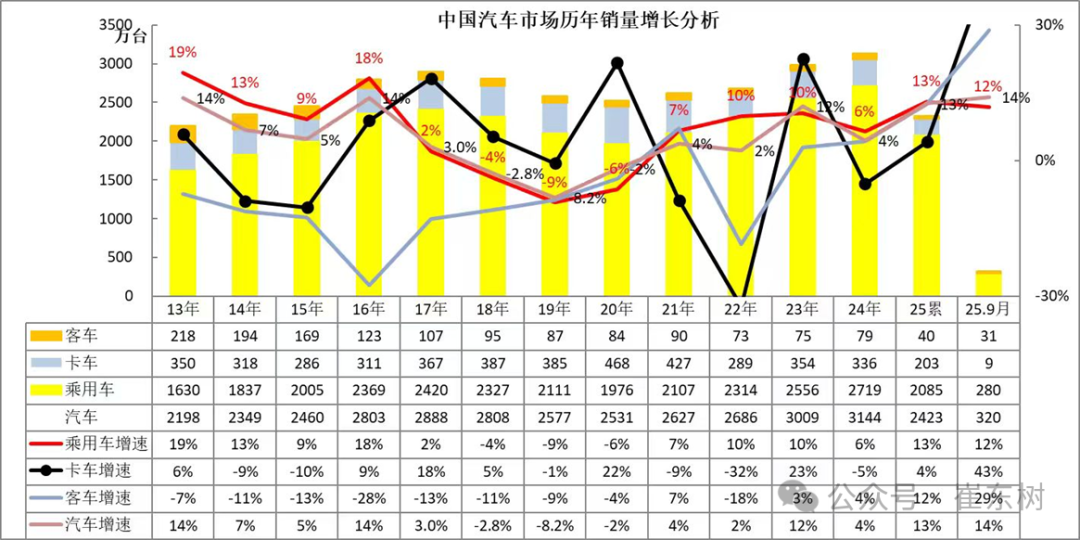
中国前三季度汽车产销量双超2400万辆
Yang Shi Xin Wen· 2025-10-15 00:19
记者今天(14日)从中国汽车工业协会获悉,今年前9个月,我国汽车工业多项经济指标实现两位数增 长。 最新数据显示,1—9月份,汽车产销量分别完成2433.3万辆和2436.3万辆,同比分别增长13.3%和 12.9%。其中,新能源汽车产销量均超过1100万辆,同比增长均超过30%,新能源汽车新车销量达到汽 车新车总销量的46.1%。 在出口方面,1—9月,汽车出口495万辆,同比增长14.8%。其中,新能源汽车出口表现抢眼,出口 175.8万辆,同比增长89.4%。 ...
史上首次!中汽协:9月汽车产销量均破300万辆
Nan Fang Du Shi Bao· 2025-10-14 17:14
Core Insights - China's automotive production and sales have surpassed 3 million units for the first time in September, marking a historical high for the same period [1] - The monthly growth rate for production and sales has remained above 10% for five consecutive months, indicating a strong recovery trend [1] - In the first nine months of 2023, total automotive production and sales reached approximately 24.4 million units, with year-on-year growth of 13.3% and 12.9% respectively [1] Group 1: Production and Sales Data - In September, automotive production reached 3.276 million units, while sales were 3.226 million units, reflecting year-on-year increases of 17.1% and 14.9% respectively [1] - For the first nine months, production totaled 24.433 million units and sales totaled 24.436 million units, with production and sales growth rates increasing by 0.6 and 0.3 percentage points compared to the previous period [1] Group 2: New Energy Vehicles (NEVs) - NEV production and sales exceeded 11 million units in the first nine months, with production at 11.243 million units and sales at 11.228 million units, showing year-on-year growth of 35.2% and 34.9% respectively [1] - NEVs accounted for 46.1% of total new car sales during this period [1] Group 3: Market Share and Brand Performance - Sales of Chinese brand passenger cars reached 14.651 million units in the first nine months, representing a year-on-year increase of 22.9% and a market share of 69%, up 5.1 percentage points from the previous year [2] - Traditional fuel passenger cars saw a decline in sales, particularly in the A-class segment, which dropped by 2.8% to 5.767 million units [2] Group 4: Export Performance - Total automotive exports reached 4.95 million units in the first nine months, with a year-on-year increase of 14.8% [2] - NEV exports surged by 89.4% to 1.758 million units, while traditional fuel vehicle exports fell by 5.6% to 3.192 million units [2] - Chery and BYD were notable exporters, with Chery exporting 936,000 units (up 12.9%) and BYD achieving a remarkable growth rate of 130% with 705,000 units exported [3]
车市热度持续走高,汽车产销月度增速连续5个月超10%
Bei Ke Cai Jing· 2025-10-14 12:53
Group 1 - The overall automotive market in China continues to show a positive trend, with production and sales growth rates exceeding 10% for five consecutive months [1] - In September, automotive production reached 3.276 million units, and sales were 3.226 million units, representing year-on-year increases of 17.1% and 14.9% respectively [1] - For the first nine months of the year, total automotive production was 24.433 million units, a 13.3% increase year-on-year, while sales reached 24.436 million units, up 12.9% [1] Group 2 - The market share of domestic brands in passenger vehicles is approximately 70%, with September sales exceeding 2 million units, marking a 2.5 percentage point increase year-on-year [3] - In the first nine months, passenger vehicle production and sales were 21.241 million and 21.246 million units, respectively, both showing year-on-year growth of around 13.9% and 13.7% [2] Group 3 - Traditional fuel passenger vehicles have seen a turnaround, with a 1.7% year-on-year increase in sales for the first nine months, following four consecutive months of growth [3] - The top fifteen automotive groups in terms of sales collectively sold 22.476 million units, reflecting a year-on-year growth of 12.9%, although their market share slightly decreased to 92.3% [4] Group 4 - The commercial vehicle market is also experiencing growth, with September production and sales increasing by nearly 30% year-on-year, and total sales for the first nine months reaching 3.117 million units, up 7.8% [4][5] - The sales of new energy commercial vehicles surged by 71.9% in September, with their market share in the commercial vehicle segment reaching 30% [5] Group 5 - New energy vehicles (NEVs) have achieved record production and sales, with 11.243 million units produced and 11.228 million units sold in the first nine months, marking year-on-year growth of 35.2% and 34.9% respectively [7] - In September, NEV sales reached 1.604 million units, a 24.6% increase year-on-year, with NEVs accounting for 49.7% of total new vehicle sales [7] Group 6 - The export of automobiles reached 4.95 million units in the first nine months, a 14.8% increase year-on-year, with NEV exports alone growing by 89.4% [9] - The forecast for 2025 suggests that total automotive exports could exceed 6.5 million units, with NEV sales expected to surpass 16 million units this year [10]
乘联分会:2025年1-8月中国占世界新能源车份额68%
Mei Ri Jing Ji Xin Wen· 2025-10-13 03:37
Core Insights - The global sales of broad new energy vehicles (NEVs) reached 28.2% of total automotive sales from January to August 2025, an increase of 1.9 percentage points compared to the entire year of 2024 [1] - Narrow NEVs accounted for 22.3% of total sales, with pure electric vehicles (EVs) making up 15% and plug-in hybrids at 7.3% [1] - Global sales of new energy passenger vehicles reached 13.33 million units, representing a year-on-year growth of 32% [1] - In August 2025, global new energy passenger vehicle sales were 1.829 million units, showing a year-on-year increase of 26% and a month-on-month increase of 4% [1] Market Penetration Trends - The penetration rate of new energy vehicles is rapidly increasing, reaching 13% in 2022, 16% in 2023, 19.9% in 2024, and projected to hit 24.4% by the third quarter of 2025 [1] - In August 2025, the penetration rates for new energy vehicles varied significantly by country: China at 48.2%, Germany at 26.4%, Norway at 80.2%, the UK at 31.9%, the US at 11.1%, and Japan at 1.8% [1] - The data indicates a notable imbalance in the development of new energy vehicles globally [1]
小鹏销量暴涨背后:拆解扶摇架构,看懂逆袭密码
Hu Xiu· 2025-10-13 03:30
9月销量破4万,8月销量3.7万台,7月交付3.6万台——从去年11月至今,整整10个月里,它的月销量始 终稳稳站在3万台以上。可要知道,在去年8月之前,小鹏连月销破万都堪称 "硬骨头",短短一年间, 这家公司为何能有如此天翻地覆的变化?一家成立仅11年的新能源车企,凭什么能被拥有百年造车积淀 的大众 "一眼相中",甚至还要不断深化合作关系? ...

中方回应美100%关税威胁;OpenAI下场做电商丨出海周报
2 1 Shi Ji Jing Ji Bao Dao· 2025-10-13 01:36
Trade Relations - The U.S. plans to impose a 100% tariff on Chinese exports related to rare earths and key software, prompting a response from China's Ministry of Commerce urging dialogue to resolve trade concerns [1] - China announced countermeasures against U.S. port fees on Chinese vessels, asserting that the U.S. actions violate WTO rules and the principle of mutual benefit [2] E-commerce Trends - Adobe forecasts that U.S. online holiday sales will reach $253.4 billion in 2025, a 5.3% increase year-over-year, with mobile contributing 56.1% of sales [3] - OpenAI has launched an instant checkout feature on ChatGPT, allowing users to search, select, and purchase products directly within the platform [5] Transportation and Logistics - Didi reported a 14% increase in daily ride-hailing demand during the recent holiday period, with overseas travel demand more than doubling compared to summer [4] - Deppon Express has established logistics routes to six Middle Eastern countries, offering tailored solutions for various product categories [8] Consumer Brands - Xiaomi opened two flagship stores in Europe and plans to expand to ten stores by the end of 2025, aiming to sell electric vehicles by 2027 [9] - Natural堂 completed a new financing round with a valuation exceeding 7 billion RMB, and plans to go public in Hong Kong [11] - BYD's 14 millionth new energy vehicle rolled off the production line in Brazil, with the Brazilian president becoming a car owner [12] Social Media and E-commerce Integration - TikTok is testing a new shopping feature in the UK called "Trendy Beat," focusing on popular products driven by platform content [7] - Indonesia has reinstated TikTok's local operating license after a previous suspension due to data reporting issues [6]