晶圆代工

Search documents
突传利好,尾盘直线拉升
Zheng Quan Shi Bao· 2025-08-15 00:18
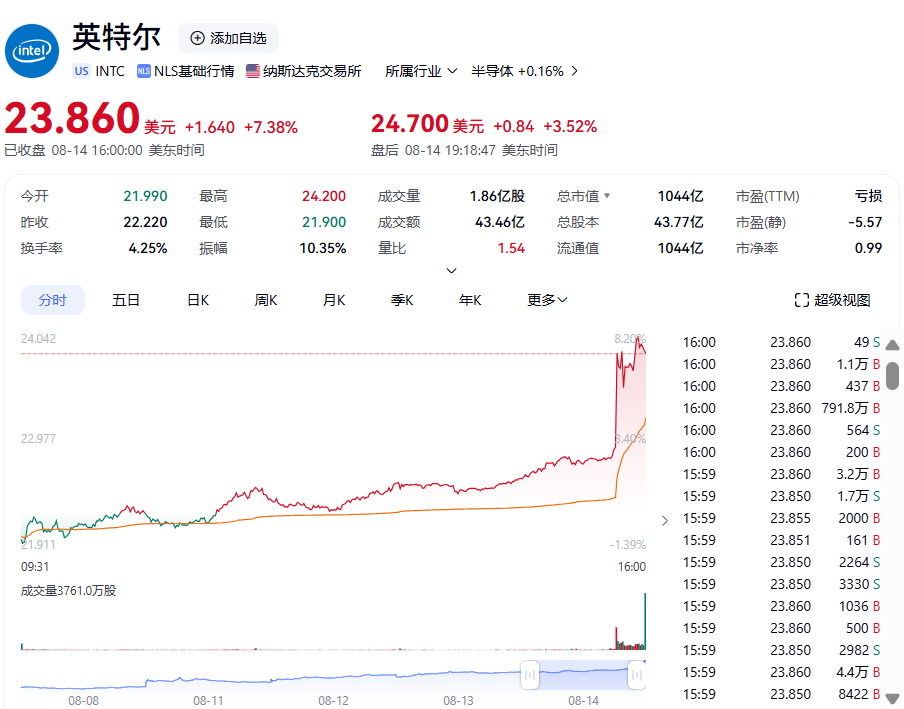
Group 1 - Intel's stock surged by 7.38% in after-hours trading, continuing to rise over 3% post-market [2] - The company is currently undergoing a strategic adjustment, with a reported revenue of $12.86 billion for Q2 2025, nearly flat year-over-year, but a net loss exceeding $2.9 billion, an increase of 81% year-over-year [6] - Intel plans to reduce its workforce by 15%, aiming to cut its total employee count from approximately 109,800 to 75,000 by the end of 2025 [6] Group 2 - The Trump administration is in discussions with Intel regarding a potential government investment to support the establishment of a factory in Ohio, as Intel is the only U.S. company with advanced chip manufacturing capabilities [5] - Despite the overall decline in Chinese concept stocks, companies like Xunlei and Weibo saw significant gains of 12.72% and 11.28% respectively, due to better-than-expected Q2 earnings [4]


突传利好,尾盘直线拉升!
Zheng Quan Shi Bao· 2025-08-15 00:14
Group 1: Intel's Market Performance - Intel's stock surged by 7.38% in after-hours trading, continuing to rise over 3% post-market [2] - The overall performance of major tech stocks showed mixed results, with Amazon up 2.86% and Netflix up 2.17%, while Apple and Tesla saw declines [2] Group 2: Intel's Strategic Developments - The Trump administration is in discussions about a potential government investment in Intel, which is the only U.S. company capable of manufacturing advanced chips domestically [6] - Intel's Q2 2025 revenue was reported at $12.86 billion, nearly flat year-over-year, but the company faced a net loss exceeding $2.9 billion, a significant increase of 81% year-over-year [7] - Intel is undergoing a major workforce reduction, planning to cut its employee count by 15%, from approximately 109,800 to 75,000 by the end of 2025 [7]
突传利好,尾盘直线拉升!
证券时报· 2025-08-15 00:09
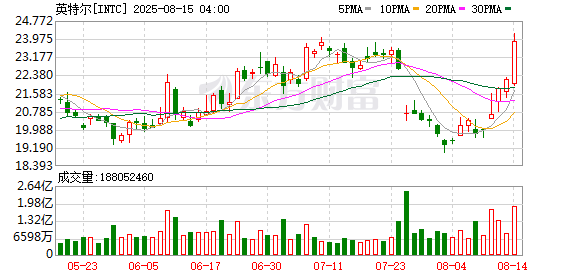
Core Viewpoint - Intel's stock experienced a significant surge, rising 7.38% during the trading session, attributed to potential government investment discussions and strategic adjustments within the company [2][6]. Group 1: Intel's Stock Performance - On August 14, Intel's stock price increased by 7.38%, continuing to rise over 3% in after-hours trading [2]. - The broader market showed mixed results, with the S&P 500 up 0.03%, while the Nasdaq and Dow Jones experienced slight declines [2]. Group 2: Government Involvement - The Trump administration is reportedly in talks with Intel regarding a potential government investment, which could support the establishment of a new factory in Ohio [6]. - This move is significant as Intel is the only U.S. company capable of manufacturing advanced chips domestically [6]. Group 3: Intel's Financial Situation - Intel's Q2 2025 revenue was reported at $12.86 billion, showing little year-over-year change, but the company faced a net loss exceeding $2.9 billion, a year-over-year increase of 81% [7]. - The company is undergoing a major workforce reduction, with plans to cut its employee count by 15%, reducing from approximately 109,800 to 75,000 by the end of 2025 [7]. - CEO Pat Gelsinger emphasized that these decisions are necessary to streamline operations and focus resources on future growth areas, particularly in AI and foundry services [7].

华虹半导体Q2财报发布,各类产品业务全面增长,营收5.661亿美元,同比增长18.3%
势银芯链· 2025-08-14 06:01
Core Viewpoint - Huahong Semiconductor reported strong financial performance for Q2 2025, with significant year-on-year and quarter-on-quarter growth in revenue, gross margin, and net profit, indicating effective cost management and operational efficiency improvements in a fluctuating global market [2][3][4]. Financial Performance - The company achieved sales revenue of $566.1 million in Q2 2025, representing an 18.3% increase year-on-year and a 4.6% increase quarter-on-quarter [2][3]. - Gross margin improved to 10.9%, up 0.4 percentage points year-on-year and 1.7 percentage points quarter-on-quarter [2][3]. - Net profit reached $8 million, a 19.2% increase year-on-year and a substantial 112.1% increase quarter-on-quarter [2][3]. Revenue Breakdown - Revenue from semiconductor wafer sales was the primary contributor, with 8-inch and 12-inch wafer sales generating $232.3 million and $333.8 million, respectively [4][6]. - By product category, wafer sales accounted for 95.6% of total revenue, while other products contributed 4.4% [5][6]. Regional Sales Analysis - Sales from China amounted to $469.7 million, representing 83.0% of total revenue and a 21.8% year-on-year increase [7]. - North American sales were $53 million, up 13.2% year-on-year, while sales from other Asian regions and Europe saw slight declines [7]. Capacity and Utilization - The company reported a capacity utilization rate of 108.3%, the highest in recent quarters, with total capacity equivalent to 447,000 8-inch wafers [8]. - The number of wafers shipped reached 1.305 million, reflecting an 18.0% year-on-year increase and a 6.0% quarter-on-quarter increase [8]. Product Technology and Market Segments - Revenue from embedded non-volatile memory reached $141.2 million, a 2.9% increase year-on-year, while power devices generated $166.7 million, up 9.4% [9][10]. - Consumer electronics remained the largest revenue source, contributing $357.4 million, or 63.1% of total revenue, with a year-on-year growth of 19.8% [11].
中芯国际(00981.HK):二季度收入超指引上限 产能利用率达92.5%
Ge Long Hui· 2025-08-12 10:51
机构:国信证券 研究员:胡剑/胡慧/叶子/张大为 2Q25 营收超指引上限,预计3Q25 营收环比增长。公司2Q25 实现销售收入22.09 亿美元(YoY +16.2%,QoQ -1.7%),高于指引(QoQ -4%至-6%)上限,晶圆收入占总收入的94.6%;毛利率为20.4% (YoY +6.4pct,QoQ -2.1pct),超指引(18%-20%)上限;归母净利润为1.32 亿美元(YoY -19.5%,QoQ -29.5%);折旧摊销金额为8.79 亿美元(YoY +10.2%,QoQ +1.5%)。公司预计3Q25 营收环比增长 5%-7%,毛利率为18%-20%。原先公司担心的关税政策是否硬着陆、市场刺激和急建库存是否透支了未 来的需求,以及大宗商品需求是否在新关税引起的价格上涨后衰退,这些目前并没有发生。 二季度产能利用率环比提高2.9pct,创3Q22 以来新高。公司2Q25 付运折合8 英寸晶圆239 万片(YoY +13.2%,QoQ +4.3%),产能利用率上升至92.5%(YoY+7.3pct,QoQ +2.9pct),创3Q22 以来新高。在晶 圆收入中12 英寸晶圆贡献76.1 ...

研报掘金丨国信证券:Q2收入超指引上限,维持中芯国际优于大市评级
Xin Lang Cai Jing· 2025-08-12 06:33
格隆汇8月12日|国信证券就中芯国际(0981.HK)发布研报称,公司二季度收入超指引上限,产能利用率 达92.5%,看好国内晶圆代工龙头中长期发展前景,预计公司2025-2027年归母净利润为5.76/7.92/9.26亿 美元,维持优于大市评级。 来源:格隆汇APP ...
中芯国际(688981):25Q2营收、毛利率环比优于指引,模拟芯片需求增长显著
Huajin Securities· 2025-08-10 14:53
Investment Rating - The investment rating for the company is "Buy" (maintained) [3] Core Views - The company reported a revenue of 2.209 billion USD in Q2 2025, which is a 1.7% decrease quarter-over-quarter, better than the guidance of a 4% to 6% decline. The average selling price decreased by 6.4%, while the number of wafers sold increased by 4.3% to 2.39 million [6] - The company is experiencing significant growth in demand for analog chips, particularly in the smartphone fast charging and power management sectors, as domestic companies accelerate the replacement of foreign market shares [6] - The company expects a revenue growth of 5% to 7% in Q3 2025, with an anticipated increase in both shipment volume and average selling price [6] - By 2030, mainland China is projected to become the largest foundry center globally, with the company positioned to benefit from this trend [6] Financial Data and Valuation - The company’s projected revenues for 2025, 2026, and 2027 are 671.64 billion, 771.20 billion, and 876.37 billion CNY, respectively, with year-over-year growth rates of 16.2%, 14.8%, and 13.6% [6][8] - The projected net profit for the same years is 49.71 billion, 60.82 billion, and 69.35 billion CNY, with year-over-year growth rates of 34.4%, 22.4%, and 14.0% [6][8] - The gross margin for Q2 2025 was 20.4%, with an expected range of 18% to 20% for Q3 2025 [6] - The company’s capacity utilization rate was 92.5% in Q2 2025, an increase of 2.9 percentage points from the previous quarter [6]
马斯克——左右半导体制造格局的平衡稳定器
是说芯语· 2025-08-09 00:31
Core Viewpoint - The article discusses the competitive landscape of the semiconductor manufacturing industry, highlighting the significant contract between Tesla and Samsung, which could reshape the dynamics of the foundry market and impact major players like Intel and TSMC [2][5][14]. Group 1: Semiconductor Manufacturing Landscape - The U.S. is currently the leading country in semiconductor manufacturing, with three companies capable of mass-producing 3nm chips, all located in the U.S. [2] - TSMC is projected to have a market value approaching $3 trillion, while Intel has laid off over 30% of its workforce in the past 18 months, and Samsung's chip manufacturing profits have plummeted by 94% year-over-year due to high inventory costs [2][4]. Group 2: Tesla and Samsung Partnership - Tesla has signed a $16.5 billion contract with Samsung, which is expected to ensure the Taylor factory's operational viability and production capacity for the next several years [5][8]. - The contract is seen as a strategic move for Tesla, allowing it to secure a reliable supply chain for critical AI chips, distancing itself from reliance on competitors like Nvidia and TSMC [8][10]. Group 3: Implications for Competitors - The partnership between Tesla and Samsung may significantly impact Intel, which has been focusing on its foundry business. Intel could face potential losses of up to $2 billion in orders due to Samsung's resurgence [14][15]. - Samsung's ability to secure large orders from Tesla and potentially Qualcomm could stabilize its foundry business and support ongoing technological development, especially in high-bandwidth memory (HBM) production [9][10][15]. Group 4: Challenges and Future Outlook - Samsung's semiconductor division has faced challenges, with a recent operating profit of only 400 billion KRW ($288 million), significantly below analyst expectations [10]. - The company is working to improve its HBM production capabilities, but delays in the rollout of its new DRAM technology could hinder its competitive position against rivals like SK Hynix and Micron [12][13].


华虹公司(688347):Q2毛利率超指引,Q3展望积极
Shenwan Hongyuan Securities· 2025-08-08 07:49
Investment Rating - The investment rating for the company is "Buy" (maintained) [2] Core Insights - The company reported Q2 revenue of $566.1 million, which is an 18.3% year-over-year increase and a 4.6% quarter-over-quarter increase, exceeding the expected range of $550-570 million. The gross margin was 10.9%, surpassing the expected 7%-9% [5][8] - The company has a positive outlook for Q3, with projected sales revenue between $620-640 million, indicating a quarter-over-quarter growth of 9.5% to 13.1% [8] - The company is accelerating its capacity expansion, with wafer deliveries reaching 1,305K in Q2, an 18% year-over-year increase and a 6% quarter-over-quarter increase [8] Financial Data and Earnings Forecast - The total revenue forecast for 2025 is $17.204 billion, with a year-over-year growth rate of 19.6% [7] - The net profit forecast for 2025 is $717 million, reflecting an 88.4% year-over-year increase [7] - The projected earnings per share for 2025 is $0.41, with a price-to-earnings ratio of 161 [7] Operational Highlights - The company maintained a high utilization rate of 108.3% in Q2, with a quarter-over-quarter increase of 5.6 percentage points [8] - The company is focusing on specialty process wafer foundry services, with significant growth in the analog and power management segments, which saw a year-over-year increase of 59.3% [8] - The company is expected to benefit from the integration of Shanghai Huahong and Huahong Semiconductor, which may enhance its operational capabilities [8]

突发!特朗普:英特尔CEO必须立即辞职,没有其他解决办法!公司股价大跳水
Mei Ri Jing Ji Xin Wen· 2025-08-07 13:13
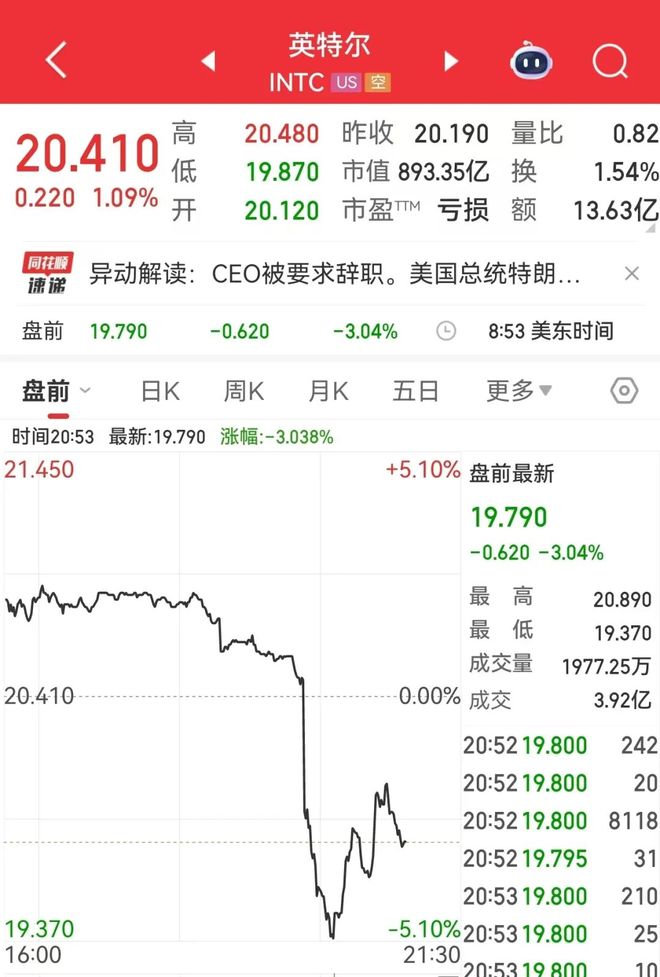
Core Viewpoint - The CEO of Intel is facing serious conflict of interest allegations, leading to calls for immediate resignation, which has negatively impacted the company's stock price [1][3]. Company Summary - Intel appointed Lip-Bu Tan as the new CEO effective March 18, 2023, after a brief tenure of less than six months for the previous CEO [4]. - The company is undergoing significant layoffs, planning to reduce its workforce from approximately 109,800 to 75,000 by the end of the year, marking a 15% reduction [4]. - As of the second quarter of 2023, Intel reported revenues of $12.9 billion, a slight increase from $12.8 billion year-over-year, but incurred a net loss of $2.9 billion, including restructuring costs and asset impairments [4]. - Intel's stock price has been in a downward trend, with a 60% decline in 2022, and it was removed from the Dow Jones Industrial Average in November 2022 [5]. - As of August 6, 2023, Intel's stock closed at $20.41 per share, with a market capitalization of $89.335 billion, significantly lower than Nvidia's market value [5].