稀土产业链

Search documents
呵呵,美国人抱怨:把稀土矿卖给中国后,无法再从中国买回来了
Sou Hu Cai Jing· 2025-10-24 13:04
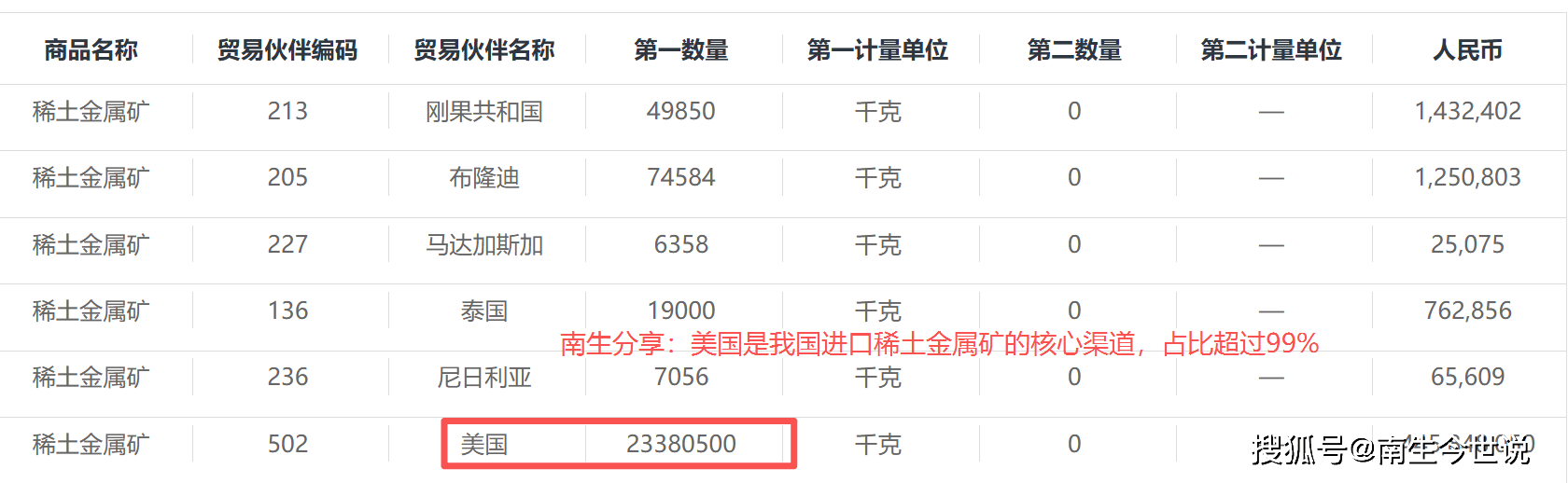
Core Insights - China's rare earth imports from the United States have reached 23,380,500 kilograms in the first three quarters of 2025, accounting for 99.33% of its total rare earth metal imports, highlighting a long-standing dependency on U.S. sources [1][2] - The average price of imported rare earth minerals from the U.S. is approximately 19.07 RMB per kilogram, raising concerns about the low pricing dynamics in the global rare earth market [2] - The U.S. possesses significant rare earth resources but struggles with processing capabilities, leading to a reliance on China for the refining and separation of rare earth elements [3][6] Trade Dynamics - In 2025, China imported a total of 23,380.5 tons of rare earth minerals, with a total transaction value of approximately 445.85 million RMB (around 44.6 million USD) [2] - The trade pattern indicates that the U.S. exports raw rare earth materials to China at low prices, which undermines its position in the global value chain [3][6] Strategic Shifts - China has transitioned from exporting raw materials to controlling the entire rare earth industry chain, achieving significant advancements in refining and separation technologies [7] - Currently, China handles about 90% of global rare earth refining and separation tasks, with a remarkable 98% capability in processing heavy rare earths [7] Future Competition - The competition in the global rare earth sector is expected to intensify, focusing on technological innovation and restructuring of supply chains [10] - The U.S. is attempting to develop alternative rare earth technologies and reduce dependency on China, but faces challenges in achieving breakthroughs in complex separation and purification processes [10] Industry Insights - China's strategic management of rare earth resources demonstrates the importance of mastering core technologies and maintaining a complete industrial chain to thrive in international competition [13] - The ongoing dynamics in the rare earth market reflect a significant shift in roles, with China moving from a low-cost exporter to a strategic player leveraging rare earths as a geopolitical tool [11][13]

美澳签订稀土协议,特朗普骄傲喊话:多到用不了
Sou Hu Cai Jing· 2025-10-24 11:56
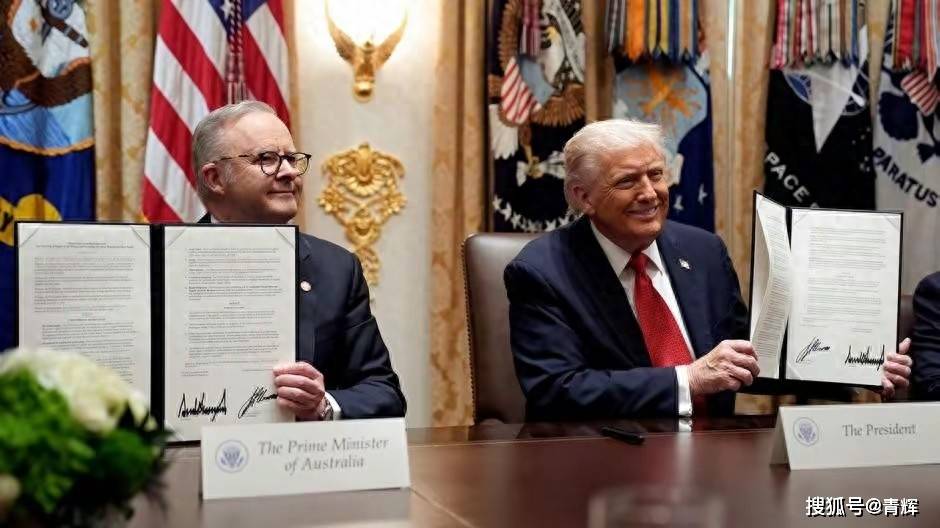
Core Points - The United States and Australia signed a significant agreement regarding rare earth elements valued at $8.5 billion, with over $3 billion to be invested in Australian rare earth mining projects in the next six months, expected to yield over 53 billion yuan in rare earth minerals [1] - The agreement includes plans for the U.S. to invest in rare earth processing facilities in Australia, aiming to produce 100 tons of gallium annually, which would alleviate supply issues for critical materials used in radar and electronic devices [3] - Following the agreement, Trump expressed confidence that the U.S. would soon have ample supplies of rare earths and other critical minerals, indicating a reduced reliance on China's rare earth supply chain [3][9] Investment and Industry Implications - Australia holds approximately 4% of global rare earth reserves, making it a significant player in the market, second only to China, Russia, and Vietnam [9] - The establishment of a complete rare earth supply chain in Australia is a complex process that involves not only mining but also separation and refining, which Australia currently lacks [11] - The U.S.-Australia collaboration aims to address the substantial gap in the U.S. rare earth industry, but the timeline for developing a fully operational supply chain is considered unrealistic within a year [11] Geopolitical Context - Trump's potential visit to China is contingent on an invitation, and there is skepticism regarding the likelihood of such a visit occurring, as there has been no formal invitation from China [13] - The recent U.S.-Australia rare earth agreement may serve dual purposes: demonstrating to China that the U.S. has alternative sources and signaling to the international community that the U.S. can reduce its dependence on China's rare earth supply [13]
美国警告断供就踢出SWIFT,中国稀土管制升级直击美国军工与芯片命门
Sou Hu Cai Jing· 2025-10-23 18:58
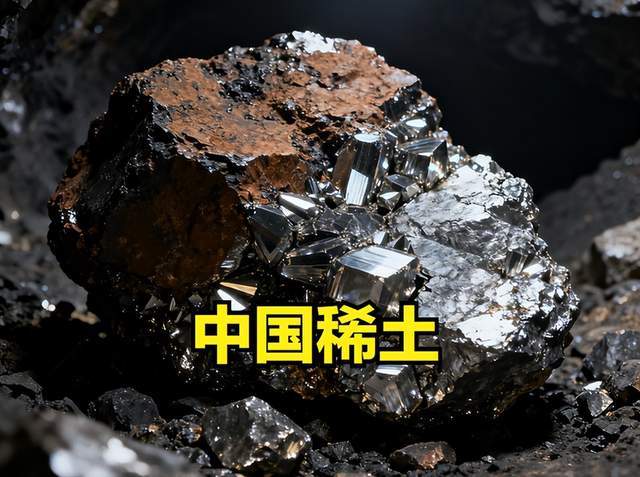
Core Viewpoint - The international competition over rare earth elements has intensified, particularly following China's announcement of export controls, which significantly impacts the U.S. high-tech sector [1][4]. Group 1: Background of U.S.-China Technology Competition - The U.S. has initiated comprehensive technology restrictions against China, including high-end chip bans and efforts to isolate Huawei, indicating a clear intent to block China's technological advancements [3]. - Initially, China adopted a restrained approach, hoping to gain leverage in future negotiations, but the increasing aggressiveness of U.S. strategies led to a shift in China's stance [3][6]. Group 2: China's Export Control Announcement - On October 9, 2025, China's Ministry of Commerce announced stricter controls on rare earth exports, including new regulations on five elements and stringent approvals for semiconductor-related exports, with military-related exports being largely denied [4]. - China dominates the global rare earth market, producing 65% of the world's supply and holding 49% of reserves, with a market share of 85% in refining and separation technologies [4]. Group 3: U.S. Response and Reactions - Following China's announcement, the U.S. experienced panic, with trade representatives attempting to reach out to China but receiving no response for three days, leading to a drastic change in U.S. tone from arrogance to humility [5]. - U.S. Treasury Secretary offered to extend tariff exemptions in exchange for easing export controls, but China remained resolute in its strategy [5]. Group 4: Implications for U.S. Military and Industry - The U.S. military heavily relies on rare earth elements, with 87% of core military equipment dependent on these resources, making any disruption in supply a significant risk for U.S. defense production [6]. - The U.S. threats to exclude Chinese companies from global markets and the SWIFT payment system are seen as largely bluster, given the critical dependence on rare earths for military capabilities [5][6]. Group 5: Global Supply Chain and Market Reactions - Countries like Australia and Canada are calling for the development of local supply chains, but experts believe it will take 5 to 10 years to close the gap with China due to high technical barriers [8]. - The rare earth price surged by 30% following the announcement, causing declines in U.S. chip stocks and raising concerns among defense contractors [11]. Group 6: Strategic Developments and Future Outlook - China is expanding its currency swap agreements and has seen a doubling in cross-border settlements in RMB, indicating a move towards financial independence from the U.S. [11]. - The historical context of China's previous export restrictions in 2010, which led to a tenfold price increase, suggests that current policies are more structured and less susceptible to WTO intervention [12]. - The ongoing rare earth competition is expected to accelerate the internationalization of the RMB and contribute to a multipolar global economic landscape [13].


每日投行/机构观点梳理(2025-10-23)
Jin Shi Shu Ju· 2025-10-23 10:43
Group 1: Gold and Silver Market Insights - Goldman Sachs maintains a target price of $4,900 per ounce for gold by the end of 2026, citing increasing interest in gold as a strategic diversification tool [1] - UBS expects silver prices to rebound to $55 per ounce by June 2026, indicating a positive outlook for silver investments [3] - Swiss Bank analysts suggest that the recent significant drop in gold prices is a short-term oversell, with strong fundamental supply-demand dynamics supporting future price increases [2] Group 2: Currency and Economic Policy Analysis - Analysts from Dutch Bank express concerns that the dollar's ability to sustain its recent gains may be limited, especially if the market does not find reasons to rule out potential Fed rate cuts [4] - German Bank analysts predict that the upcoming U.S. inflation data may not have a lasting impact on the dollar, as the Fed is likely to focus on employment conditions rather than inflation [5] - Goldman Sachs anticipates that the Bank of Japan may maintain its policy rate unchanged due to high uncertainty regarding economic prospects [6] Group 3: Economic Growth Projections - Barclays economists predict that the Bank of Japan may raise its economic growth forecast for FY2025 from 0.6% to 0.8%, based on reduced tariff uncertainties and strong GDP growth [7] - Goldman Sachs forecasts that the Bank of England will likely cut rates in February 2024, with the potential for earlier cuts due to lower-than-expected inflation data [8] - French Bank analysts suggest that the Bank of England may lower rates in December, putting further pressure on the pound [9] Group 4: Sector-Specific Insights - Citic Securities highlights the strategic value of the rare earth industry, driven by export control policies and increasing demand from various sectors [6] - Citic Securities also sees potential bottoming opportunities in the liquor industry, with expectations of a recovery in market demand by Q3 2025 [7] - Citic Securities projects a moderate appreciation of the RMB in 2026, supported by favorable external conditions and domestic economic stability [8]
美国稀土不用愁?行业专家:产业链几乎被中国垄断,谁都解决不了
Sou Hu Cai Jing· 2025-10-23 10:11
Core Viewpoint - China's recent restrictions on rare earth exports significantly impact the United States and Europe, which have long relied on China for these critical materials [1] Group 1: Supply Chain Dynamics - The United States has initiated a partnership with Australia to secure rare earth supplies, believing that this will alleviate concerns over dependence on China [1][3] - Australia ranks among the top countries in global rare earth reserves, leading the U.S. to feel optimistic about future supply [3] Group 2: Refining Challenges - Industry experts highlight that the real challenge lies not in the availability of rare earth reserves but in the refining capabilities, where China dominates with over 90% of global refining capacity for key rare earth elements [5] - Many countries, including the U.S. and Australia, can extract rare earths but lack the technology and infrastructure to refine them effectively [8] Group 3: Export and Import Dynamics - Historically, many countries have exported raw rare earth materials to China for refining, making China both a major exporter and importer of rare earths [7] - The U.S. and Australia can only provide unrefined rare earths, which does not solve the refining issue that both countries face [8] Group 4: Long-term Outlook - China's restrictions extend beyond raw ore to include equipment and technology related to refining and processing rare earths, complicating efforts by the U.S. to establish a self-sufficient supply chain [10] - Building a complete rare earth supply chain in the U.S. could take 5 to 10 years, and the country is unlikely to pursue this aggressively given the challenges involved [10]
特朗普笑了,“冤大头”终于出现,预言一年后,稀土会多到用不完
Sou Hu Cai Jing· 2025-10-23 04:06
Core Viewpoint - The recent $8.5 billion rare earth agreement between the US and Australia appears ambitious but overlooks a critical aspect: purification technology [1][3][4]. Group 1: Agreement Details - Australia will invest $3 billion to mine rare earths and plans to develop mineral resources worth $53 billion, with the US military establishing a gallium processing plant in Australia with an annual output of 100 tons [3]. - The agreement aims to target strategic sectors such as military and semiconductors, but the focus on mining neglects the essential purification technology [3][4]. Group 2: China's Dominance - China controls nearly 90% of global rare earth refining capacity, which is not merely a result of luck but a consequence of high technical barriers and extensive patent accumulation [4][6]. - The only company capable of large-scale production of rare earth extraction and separation centrifuges is based in China, highlighting the reliance of US companies on Chinese technology for deep processing [6][8]. Group 3: Challenges for the US and Australia - Establishing a factory capable of producing high-purity rare earth oxides will take at least three years and cost over 30% more than in China, with a total timeline of five to eight years from mining to finished products [6][8]. - The US military's inventory of samarium-cobalt magnets can only sustain production for six months, and new factories are still far from operational [8][10]. Group 4: Strategic Implications - Australia's agreement with the US may come at the cost of its economic ties with China, raising concerns about the viability of relying on US support for national security [12][14]. - The short-term impact of the US-Australia rare earth agreement is unlikely to disrupt China's position in the market, as China can adjust its strategic reserves in response to market fluctuations [14][16]. Group 5: Long-term Considerations - The rare earth competition is not about who has more mines but rather about who has a stronger industrial chain, which China has developed over three decades [18]. - The notion that the US and Australia can bypass technological barriers through financial investment is likely to lead to disappointment, as true technological accumulation requires time and effort [18].
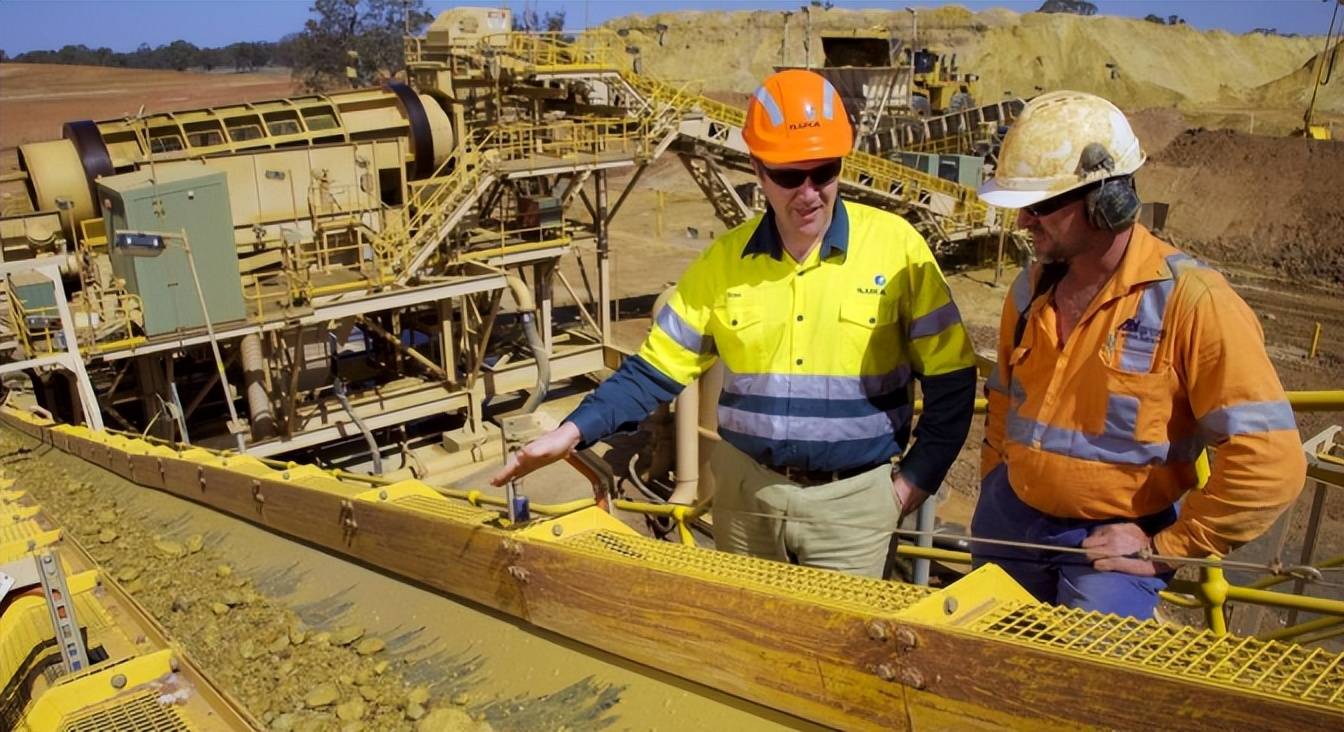
破解中方稀土管制?特朗普与澳签协议:一年后我们稀土多到用不完
Sou Hu Cai Jing· 2025-10-23 00:58
Core Viewpoint - The geopolitical struggle surrounding rare earth resources is intensifying, with the U.S. and Australia attempting to establish an alternative supply chain to reduce reliance on China, but significant challenges remain in achieving this goal [1][3][20]. Group 1: U.S.-Australia Cooperation - The U.S. has long been concerned about its dependence on China for rare earth materials, which are critical for high-end manufacturing sectors such as electric vehicles and military applications [3][5]. - A recent agreement between Trump and Australian Prime Minister Albanese aims to create a "substitute" rare earth supply chain, but the feasibility of this plan is questionable [3][5]. Group 2: Challenges in Rare Earth Processing - The extraction of rare earth minerals is only the first step; the subsequent processes of separation, purification, and processing are complex and currently dominated by China [5][9]. - Australia possesses abundant rare earth resources but lacks sufficient processing capabilities, often requiring its minerals to be sent to China for refinement [5][9]. Group 3: China's Competitive Advantage - China's true strength lies not in its rare earth reserves but in its complete industrial chain, which includes extraction, processing, and production of high-value products [9][20]. - The country has decades of accumulated experience in technology development and large-scale production, giving it a significant edge over other nations [9][20]. Group 4: The Concept of a "Rare Earth Alliance" - The U.S. is considering forming a "rare earth alliance" with countries like Japan, the EU, and Canada to share investment burdens and technological resources [11][13]. - However, these countries also rely on Chinese rare earth products, making a swift transition to localized production challenging [13][14]. Group 5: Long-Term Investment and Development - Rare earth projects require long lead times from investment to production, making it unlikely for the U.S. and Australia to see immediate results from their cooperation [16][18]. - The technical bottlenecks and lack of core processes mean that even if factories are built, they may struggle to produce high-quality products that meet market demands [11][18]. Group 6: Broader Implications of the Rare Earth Dispute - The ongoing rare earth competition reflects deeper international power dynamics, centering on control over supply chains and future technological competitiveness [20][22]. - While the U.S.-Australia agreement signals a shift, achieving true independence from China in the rare earth sector will require overcoming substantial technological and logistical hurdles [22].

中美稀土战第7天,澳方给美国送上外援:要多少稀土就卖多少
Sou Hu Cai Jing· 2025-10-22 18:20
Core Viewpoint - The ongoing "rare earth war" between China and the U.S. highlights the latter's deep reliance on Chinese rare earth elements, which are crucial for various technologies, including military and electric vehicles. The recent export control measures by China have intensified U.S. concerns about supply chain vulnerabilities [3][15]. Group 1: U.S. Concerns and Responses - The U.S. Treasury Secretary has expressed urgent concerns following China's new export regulations on rare earths, which target critical materials essential for U.S. industries [3]. - The U.S. is heavily dependent on China for rare earths, with significant implications for military and automotive sectors, as seen in the production of F-35 fighter jets and Tesla electric vehicles [3][15]. - Australia has stepped forward, claiming it can meet U.S. and global rare earth demands, indicating a willingness to support the U.S. in reducing its reliance on China [5][6]. Group 2: Australia's Position and Challenges - Australia's confidence stems from its substantial rare earth reserves and mining capabilities, with plans to collaborate with U.S. companies on rare earth processing facilities [7]. - However, experts warn that even with concerted efforts, it could take at least five years for the U.S. and its allies to catch up to China's established rare earth supply chain [7][9]. - China's technological superiority in rare earth processing, particularly in separation techniques, poses a significant challenge for U.S. and Australian efforts to establish a competitive supply chain [9][13]. Group 3: Global Reactions and Industry Implications - The fragmented responses from G7 allies reveal internal divisions, with countries like Germany cautious about potential economic repercussions from supply chain disruptions [11]. - Companies like Tesla are attempting to secure long-term agreements with Australian suppliers while facing rising processing costs due to the lack of domestic refining capabilities [13]. - China's comprehensive control over the rare earth supply chain, built over decades, underscores the importance of technological and industrial capabilities over mere resource availability in the global competition [15][17].
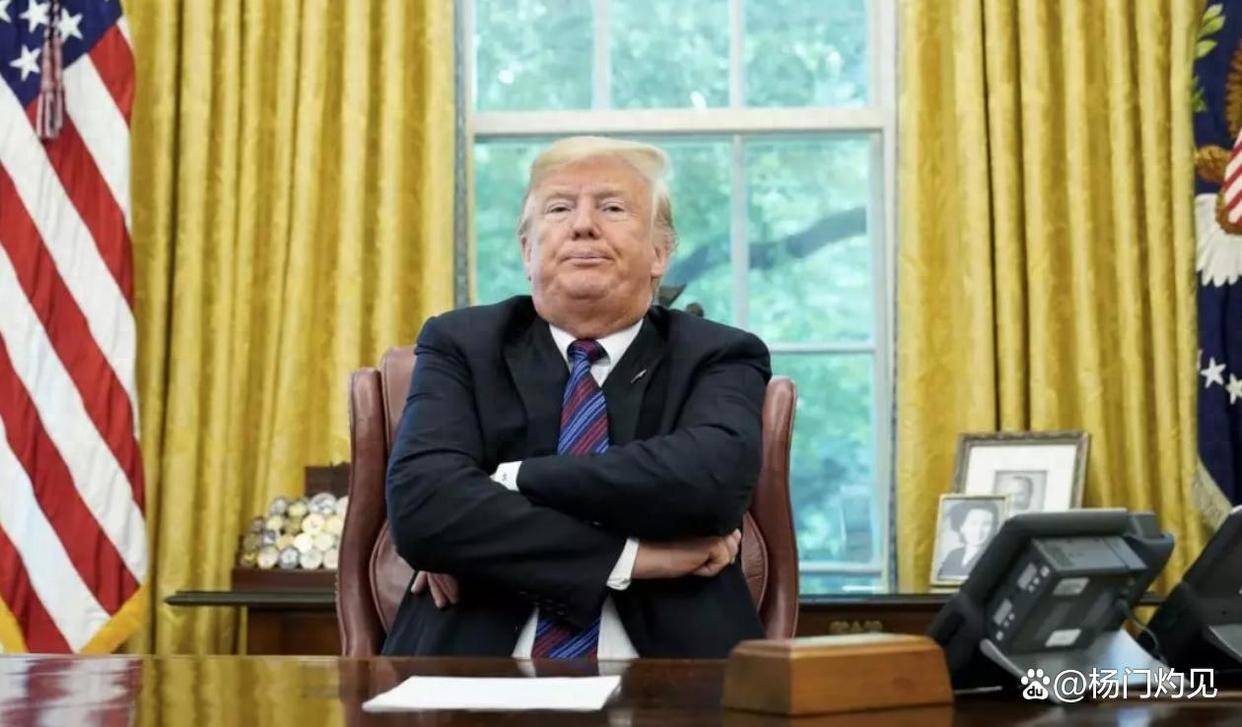
美澳签署稀土协议,一举打破中国垄断?特朗普直言:多到用不完
Sou Hu Cai Jing· 2025-10-22 08:17
Group 1 - The core viewpoint of the article is that the US and Australia have signed a critical rare earth agreement aimed at reducing China's dominance in the rare earth market, with Trump expressing confidence in an oversupply of rare earths in the US within a year [1][3][29] - The agreement involves a total investment of $3 billion from both countries over the next six months to develop Australia's rare earth mining projects, targeting a local rare earth resource valued at $53 billion [3] - The US military plans to build a gallium refining plant in Western Australia, which will produce 100 tons of gallium metal annually, a crucial material for radar, missiles, and satellites [5][29] Group 2 - Australia holds 3% to 4% of global rare earth reserves and half of the world's lithium exports, but faces challenges in processing these resources effectively [5][29] - Despite the optimistic statements, a significant portion of Australia's lithium is still exported to China for processing, highlighting the ongoing dependency on Chinese refining capabilities [7][29] - The process of turning rare earth ore into usable materials involves over 20 steps, with extraction and separation being the core technologies, where China has a substantial advantage due to decades of development [9][29] Group 3 - China's rare earth industry has a well-established supply chain, with significant cost advantages in processing compared to Australia, where environmental regulations and labor costs are much higher [11][29] - The US Geological Survey reports that China holds 44 million tons of rare earth reserves, accounting for 49% of global reserves, and dominates the processing capacity [15][29] - Previous attempts by the US to achieve rare earth independence, such as the "Rare Earth Independence Initiative" during the Obama administration, ended in failure due to high costs and technical challenges [16][29] Group 4 - The recent Chinese restrictions on rare earth exports are a response to US technology blockades, with significant impacts already observed in export volumes and prices [22][24] - Major companies, including Volkswagen, have expressed reluctance to join the US-led rare earth alliance, citing China's efficiency and cost-effectiveness in the supply chain [25][29] - The gallium production plan in Australia faces challenges, including the need for substantial investment in renewable energy to ensure stable power supply for the new plant [27][29] Group 5 - The essence of the rare earth competition is not about resource control but about mastering efficient and low-cost supply chain capabilities, with China having spent decades developing its industry [29] - The global trend towards restructuring supply chains indicates that future competition will focus on technological innovation and sustainable production methods, presenting both challenges and opportunities for China's rare earth industry [29]

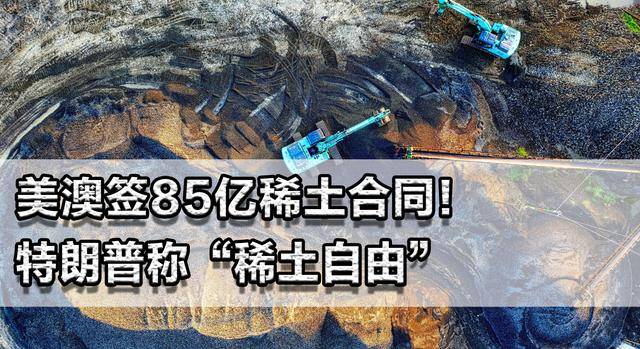
美澳签85亿稀土合同!特朗普称“稀土自由”,关键你没有提纯技术
Sou Hu Cai Jing· 2025-10-22 08:08
Core Viewpoint - The recent $8.5 billion rare earth cooperation agreement between the U.S. and Australia highlights the U.S.'s overconfidence in overcoming its reliance on China, despite lacking the necessary refining technology to utilize the raw materials effectively [1][3]. Group 1: U.S.-Australia Cooperation - The U.S. and Australia plan to invest $1 billion each to support critical mineral projects, but Australia's lithium exports still heavily depend on China, indicating a significant gap in processing capabilities [5]. - The agreement mentions "processing capacity," yet the planned gallium refining plant in Western Australia will only have an annual capacity of 100 tons, which is insufficient to meet demand [3]. Group 2: China's Dominance in Rare Earths - Over 90% of global rare earth refining capacity is concentrated in China, which leads in green smelting and high-purity refining technologies [3]. - The U.S. military's requirements for high-purity rare earths cannot be met domestically, as the highest purity achieved is only 99.1% to 99.9%, comparable to China's technology from the 1990s [3]. Group 3: Technological Barriers - The key issue in the rare earth competition is not merely access to raw materials but the ability to refine them effectively, which China currently dominates [7]. - The U.S. may acquire raw materials, but without Chinese technological support, establishing a competent refining system will be challenging [5][7]. - Previous setbacks, such as MP Materials facing business stagnation due to export restrictions to China, illustrate the difficulties within the U.S. supply chain [5].